
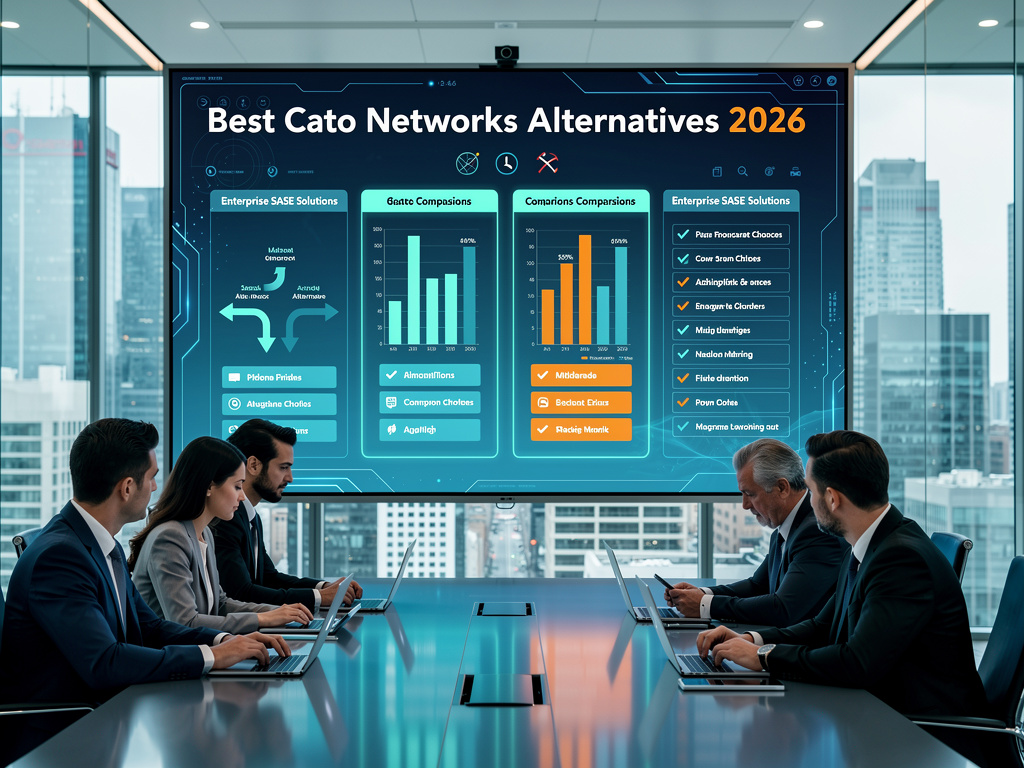
Best Cato Networks Alternatives: Top 10 Enterprise SASE and SD-WAN Solutions for 2026
Perimeter 81 Review
- Unified security console
- Zero Trust granular access
- Cloud native quick deployment
- Great for distributed teams
- Enterprise rollout can take weeks
- Policy setup needs planning

Cato Networks Review
- Single vendor SASE platform
- Global backbone performance
- Integrated security stack
- Fast deployment with sockets
- Best for multi site firms
- Subscription costs add up
- Needs PoP proximity
- Less on prem control

Zscaler Review
- Cloud native zero trust access
- Global scale low latency
- Replaces VPN complexity
- Strong compliance certifications
- Needs policy design expertise
- Subscription cost for small teams
- Training required for best results

Palo Alto Networks Review
- Leader in next gen firewalls
- Strong threat detection results
- Scales for enterprise needs
- Global support options
- Premium pricing
- Complex configuration setup
- Needs experienced security staff
- Migration requires careful planning

Netskope Review
- Strong cloud app visibility
- Unified SSE security stack
- Fast cloud native deployment
- Centralized easy management
- Enterprise grade pricing
- Network performance concerns
- Endpoint features need improvement

Cloudflare Review
- Generous free plan value
- Fast global Cdn network
- Strong Ddos protection
- Transparent pricing no bandwidth fees
- Limited free plan support
- Advanced setup can be complex
- False positive security blocks
- Potential vendor lock in

Fortinet Review
- Excellent price performance ratio
- Untegrated security fabric platform
- Handles heavy traffic well
- Scales for enterprises
- Support response can be slow
- Support expertise inconsistent
- Deployment can be complex

Juniper Review
- Unified centralized management
- Advanced threat prevention
- Scales for large enterprises
- Strong visibility and analytics
- Premium pricing
- Specialized training required
- Support quality can vary
- Ongoing licensing costs

Versa Networks Review
- Stable high availability connectivity
- Integrated zero trust security
- Advanced analytics and insights
- Multi tenancy for providers
- Subscription costs can scale
- Rollouts may take months
Cisco Review
- Comprehensive product portfolio
- Strong enterprise reliability
- Excellent work life balance
- Global partner ecosystem
- Premium pricing and licensing
- Support quality can vary
- Occasional hardware quality issues
- Documentation can be limited
Choosing the right SASE (Secure Access Service Edge) solution is crucial for modern enterprises seeking comprehensive network security and connectivity. While Cato Networks has established itself as a prominent player in the SD-WAN and SASE market, many organizations require alternatives that better align with their specific security requirements, budget constraints, or technical infrastructure. This comprehensive analysis explores the top 10 Cato Networks alternatives, examining their unique capabilities, deployment models, and enterprise suitability. From established security vendors like Palo Alto Networks and Fortinet to cloud-native solutions like Zscaler and emerging platforms like Perimeter81, each solution offers distinct advantages for different organizational needs and technical environments.
Understanding SASE Solutions and Why Organizations Seek Cato Networks Alternatives
The SASE market has evolved rapidly, with organizations demanding integrated security and networking capabilities that traditional solutions cannot provide. Cato Networks pioneered the cloud-native SASE approach, but enterprises often seek alternatives due to specific compliance requirements, existing infrastructure investments, or unique security policies.
SASE solutions combine multiple network and security functions into a unified platform. These include SD-WAN capabilities, secure web gateways, cloud access security brokers (CASB), firewall as a service (FWaaS), and zero trust network access (ZTNA). The convergence of these technologies creates comprehensive protection for distributed workforces and cloud-first architectures.
Organizations evaluate Cato Networks alternatives based on several critical factors:
- Performance optimization for specific geographic regions
- Integration capabilities with existing security infrastructure
- Compliance requirements for regulated industries
- Cost optimization for different deployment scales
- Specialized security features for unique threat landscapes
The decision to explore alternatives often stems from evolving business requirements rather than dissatisfaction with Cato Networks. Enterprise IT leaders must evaluate how each solution addresses their specific networking and security challenges while supporting long-term digital transformation initiatives.
Palo Alto Networks Prisma SASE: Comprehensive Security-First Approach
Palo Alto Networks delivers enterprise-grade SASE capabilities through Prisma SASE, combining Prisma Access with Prisma SD-WAN. This solution stands out for organizations prioritizing advanced threat prevention and comprehensive security analytics.
The platform integrates next-generation firewall capabilities, advanced threat prevention, URL filtering, and data loss prevention into a cloud-delivered service. Palo Alto Networks leverages its extensive threat intelligence network, processing over 150 billion security events daily to enhance protection accuracy.
Key Strengths and Capabilities
Prisma SASE excels in threat prevention accuracy, utilizing machine learning algorithms and behavioral analysis to identify sophisticated attacks. The platform’s App-ID technology provides granular application visibility and control, enabling organizations to implement precise security policies across distributed environments.
The solution offers autonomous digital experience management (ADEM), providing real-time visibility into application performance and user experience metrics. This capability helps IT teams proactively address performance issues before they impact business operations.
Global infrastructure spans over 100 locations worldwide, ensuring consistent performance for multinational organizations. The platform supports both inline and API-based deployment models, accommodating diverse architectural requirements.
Deployment Considerations and Limitations
Implementation complexity represents a significant consideration for organizations evaluating Prisma SASE. The platform’s extensive feature set requires careful planning and skilled security professionals for optimal configuration.
Licensing costs can be substantial for large deployments, particularly when organizations require advanced features like DNS security, IoT security, and SaaS security posture management. However, the total cost of ownership often justifies the investment through reduced security incidents and operational efficiency gains.
Integration with existing Palo Alto Networks security infrastructure provides significant advantages for organizations already invested in the vendor’s ecosystem. Third-party integrations require additional configuration but support most major security and IT management platforms.
Fortinet Secure SD-WAN: Integrated Security Fabric Approach
Fortinet’s Secure SD-WAN solution integrates seamlessly with the company’s Security Fabric architecture, providing unified visibility and control across distributed network infrastructure. This approach appeals to organizations seeking comprehensive security integration without platform fragmentation.
The solution combines FortiGate next-generation firewalls with cloud-delivered security services, creating a cohesive security posture from the network edge to cloud workloads. Fortinet’s approach emphasizes hardware-accelerated performance through custom ASIC processors.
Security Fabric Integration Benefits
The Security Fabric architecture enables coordinated threat response across multiple security components. When the SD-WAN solution detects a threat, it automatically shares intelligence with other Security Fabric components, triggering coordinated response actions.
FortiGate appliances provide hardware-accelerated encryption and inspection capabilities, maintaining high performance even under heavy security processing loads. This hardware advantage becomes particularly valuable for organizations with bandwidth-intensive applications.
Centralized management through FortiManager simplifies policy deployment and monitoring across distributed deployments. The platform supports fabric connectors that automatically discover and classify cloud resources, maintaining security policies as infrastructure scales.
Performance and Scalability Characteristics
Fortinet’s custom ASIC technology delivers industry-leading performance for security processing, with some FortiGate models achieving terabit-scale throughput. This performance advantage makes the solution attractive for high-bandwidth environments.
The platform supports hybrid deployment models, allowing organizations to leverage existing FortiGate investments while adding cloud-delivered security services. This flexibility reduces migration complexity and preserves infrastructure investments.
Global PoP (Point of Presence) infrastructure ensures consistent performance across geographic regions. Fortinet continuously expands its cloud infrastructure to support growing customer demand and emerging market requirements.
Zscaler Private Access: Cloud-Native Zero Trust Platform
Zscaler revolutionized enterprise security with its cloud-native zero trust platform, delivering security services from a global cloud infrastructure. The platform eliminates traditional network security appliances in favor of cloud-delivered protection.
The Zscaler approach fundamentally differs from traditional SASE solutions by treating every connection as untrusted and requiring verification before granting access. This zero trust methodology provides superior protection against lateral movement and insider threats.
Zero Trust Architecture Advantages
Zscaler’s zero trust exchange architecture inspects all traffic regardless of source, destination, or user credentials. This comprehensive inspection capability identifies threats that might bypass traditional perimeter security controls.
The platform provides application-specific access controls, granting users access to specific applications rather than entire network segments. This granular access model significantly reduces attack surface and limits potential breach impact.
Cloud-delivered security services eliminate the need for hardware appliance management, reducing operational complexity and infrastructure costs. Organizations can scale security capacity dynamically without hardware procurement delays.
Performance and Global Reach
Zscaler operates one of the largest security cloud platforms globally, with over 150 data centers providing low-latency access for users worldwide. The platform processes billions of transactions daily, continuously improving threat detection accuracy.
The solution’s cloud-native architecture automatically scales to accommodate traffic demands without manual intervention. This elastic scaling capability ensures consistent performance during traffic spikes or security events.
Integration with major cloud platforms including AWS, Microsoft Azure, and Google Cloud provides seamless protection for cloud-hosted workloads. API-based integrations enable automated security policy deployment and management.
Netskope Security Cloud: Data Protection and Cloud Security Focus
Netskope specializes in data protection and cloud security, providing comprehensive visibility and control over cloud application usage and data movement. The platform excels in environments with extensive SaaS application usage and strict data governance requirements.
The solution’s patent-pending technology provides real-time data and threat protection across web, cloud apps, and private apps through a unified cloud platform. Netskope’s approach emphasizes understanding data context and user behavior to implement intelligent security policies.
Advanced Data Loss Prevention
Netskope’s data loss prevention capabilities extend beyond traditional pattern matching to include machine learning-based content classification and user behavior analytics. The platform can identify sensitive data based on context rather than just predefined patterns.
The solution provides real-time coaching and policy enforcement, educating users about security risks while allowing legitimate business activities. This balanced approach reduces security friction while maintaining strong data protection.
Cloud application risk assessment capabilities evaluate over 40,000 cloud services, providing detailed risk scores and usage recommendations. This extensive database helps organizations make informed decisions about cloud service adoption.
Cloud Security Posture Management
The platform includes comprehensive CSPM capabilities that continuously assess cloud infrastructure configurations against security best practices and compliance frameworks. Automated remediation capabilities help organizations maintain secure cloud postures.
Integration with major identity providers and SIEM platforms enables centralized security management and incident response. The platform supports single sign-on and multi-factor authentication for seamless user experience.
API security features protect against shadow APIs and misconfigurations, providing visibility into API usage patterns and identifying potential security risks in application integrations.
Versa Networks: Comprehensive SD-WAN and Security Convergence
Versa Networks provides enterprise-grade SD-WAN and security convergence through its SASE platform, emphasizing carrier-grade reliability and extensive security feature integration. The solution appeals to service providers and large enterprises requiring robust performance guarantees.
The platform combines advanced routing capabilities with integrated security functions including next-generation firewall, intrusion prevention, URL filtering, and anti-malware protection. Versa’s approach emphasizes single-vendor simplicity without sacrificing functionality.
Carrier-Grade Architecture and Reliability
Versa’s carrier-grade architecture provides 99.99% uptime guarantees through redundant infrastructure and advanced failover mechanisms. The platform supports active-active deployments for maximum availability and performance.
The solution’s multi-tenancy capabilities enable service providers to offer managed SASE services to multiple customers through a single platform. This architecture provides cost efficiency and operational scalability for service provider environments.
Advanced analytics and machine learning capabilities provide predictive insights into network performance and security threats. The platform can automatically adjust routing and security policies based on real-time conditions.
Security Integration and Policy Management
Versa’s unified policy engine enables consistent security policy enforcement across all network locations and user connections. Policies automatically adapt based on user location, device type, and application requirements.
The platform includes advanced threat intelligence integration from multiple sources, providing real-time protection against emerging threats. Automated threat response capabilities can isolate compromised devices and block malicious traffic.
Compliance reporting features support major regulatory frameworks including GDPR, HIPAA, and PCI DSS. Automated compliance checking helps organizations maintain required security controls and documentation.
Cisco SD-WAN and SASE Solutions: Enterprise Infrastructure Integration
Cisco’s SD-WAN and SASE portfolio leverages the company’s extensive networking expertise and infrastructure investments to deliver comprehensive connectivity and security solutions. The platform integrates seamlessly with existing Cisco network infrastructure.
The solution combines Cisco SD-WAN technology with Umbrella security services and other security components to create a comprehensive SASE offering. Cisco’s approach emphasizes integration with existing enterprise infrastructure and familiar management tools.
Infrastructure Integration Advantages
Cisco’s extensive partner ecosystem enables organizations to leverage existing vendor relationships and technical expertise. Integration with Cisco switching, routing, and wireless infrastructure provides unified network management.
The platform supports flexible deployment models including on-premises appliances, cloud-delivered services, and hybrid configurations. This flexibility accommodates diverse organizational requirements and migration preferences.
DNA Center integration provides centralized network management and policy automation across the entire network infrastructure. Intent-based networking capabilities simplify complex policy deployments and network operations.
Security Services Integration
Cisco Umbrella integration delivers DNS-layer security and secure web gateway capabilities directly through the SD-WAN platform. This integration provides comprehensive internet security without additional infrastructure requirements.
The solution includes advanced malware protection through integration with Cisco Talos threat intelligence and AMP for Endpoints. Coordinated threat response capabilities enable rapid incident containment and remediation.
Zero trust security features provide microsegmentation capabilities and application-specific access controls. The platform can automatically adjust access privileges based on user behavior and threat conditions.
Cloudflare for Teams: Global Edge Network Security
Cloudflare for Teams leverages the company’s global edge network infrastructure to deliver security services from locations close to users worldwide. The platform provides comprehensive protection through a cloud-native architecture built on Cloudflare’s content delivery network.
The solution combines Cloudflare Access for zero trust access control with Gateway for secure web filtering and threat protection. This integrated approach provides comprehensive security coverage without traditional hardware requirements.
Global Edge Network Performance
Cloudflare’s global network spans over 275 cities worldwide, providing low-latency security services regardless of user location. The platform’s anycast architecture automatically routes traffic to the nearest data center for optimal performance.
The edge computing approach enables real-time threat analysis and blocking without backhauling traffic through centralized data centers. This architecture provides superior performance for geographically distributed organizations.
DDoS protection capabilities leverage Cloudflare’s extensive mitigation experience, protecting against attacks of virtually unlimited size. The platform automatically detects and mitigates threats without impacting legitimate traffic.
Zero Trust Access Implementation
Cloudflare Access provides comprehensive identity verification and application access control without requiring VPN connections. Users can securely access applications through identity-based authentication and authorization.
The platform supports multiple identity providers including Active Directory, Okta, and Google Workspace, enabling seamless integration with existing authentication systems. Single sign-on capabilities provide user convenience while maintaining security.
Browser isolation capabilities execute untrusted web content in remote browsers, preventing malware from reaching user devices. This approach provides superior protection against web-based threats and zero-day attacks.
Perimeter81 Network as a Service: Cloud Security for Modern Teams
Perimeter81 provides network as a service (NaaS) specifically designed for modern distributed teams and cloud-first organizations. The platform emphasizes ease of deployment and management while providing enterprise-grade security capabilities.
The solution combines software-defined perimeter technology with cloud-delivered security services to create secure network access for remote and hybrid workforces. Perimeter81’s approach prioritizes user experience and administrative simplicity.
Rapid Deployment and Management
Perimeter81’s cloud-native architecture enables rapid deployment without hardware requirements or complex network configurations. Organizations can implement secure network access within hours rather than weeks.
The platform provides intuitive management interfaces that don’t require specialized networking expertise. IT administrators can configure policies, manage users, and monitor security through web-based dashboards.
Automated provisioning capabilities integrate with major identity providers and HR systems, streamlining user onboarding and offboarding processes. This automation reduces administrative overhead and improves security consistency.
Zero Trust Network Access Features
The solution implements granular access controls based on user identity, device posture, and application requirements. Access policies automatically adjust based on risk factors and behavioral analytics.
Device trust capabilities assess endpoint security posture before granting network access, ensuring that only secure devices can connect to corporate resources. This approach prevents compromised devices from accessing sensitive data.
Network segmentation features create isolated access zones for different user groups and applications. This microsegmentation approach limits lateral movement and contains potential security incidents.
Juniper Networks Session Smart SD-WAN: AI-Driven Network Intelligence
Juniper Networks delivers AI-driven SD-WAN capabilities through its Session Smart platform, emphasizing intelligent routing and automated network optimization. The solution leverages artificial intelligence to continuously improve network performance and security.
The platform’s session-based architecture treats every application flow as an individual session with specific routing and security requirements. This approach enables granular traffic control and optimization for diverse application needs.
Artificial Intelligence Integration
Mist AI integration provides proactive network optimization and problem resolution through machine learning algorithms that analyze network behavior patterns. The AI system can predict and prevent performance issues before they impact users.
The platform includes natural language query capabilities that allow administrators to investigate network issues using conversational interfaces. This feature simplifies troubleshooting and reduces time to resolution.
Automated root cause analysis identifies network performance problems and recommends specific remediation actions. The AI system learns from past incidents to improve future problem detection and resolution.
Session-Based Routing Advantages
Session Smart routing eliminates traditional overlay tunnel requirements by implementing session-aware forwarding directly into the network fabric. This approach reduces complexity and improves performance.
The platform provides application-specific routing policies that automatically select optimal paths based on application requirements and network conditions. Real-time adaptation ensures consistent application performance.
Built-in security features include session-level encryption and authentication without requiring separate VPN tunnels. This integrated security approach simplifies deployment while maintaining strong protection.
Comparative Analysis: Performance, Security, and Management Features
Selecting the optimal Cato Networks alternative requires comprehensive evaluation of performance, security, and management capabilities across different organizational contexts. Each solution offers unique advantages that align with specific use cases and requirements.
Performance considerations include global infrastructure coverage, traffic optimization capabilities, and application-specific routing intelligence. Organizations must evaluate how each platform handles their specific traffic patterns and geographic requirements.
| Solution | Global PoPs | Zero Trust | AI/ML Features | Deployment Model | Key Strength |
|---|---|---|---|---|---|
| Palo Alto Networks | 100+ | Yes | Advanced | Cloud-first | Threat Prevention |
| Fortinet | 50+ | Yes | Moderate | Hybrid | Performance |
| Zscaler | 150+ | Native | Advanced | Cloud-native | Zero Trust |
| Netskope | 75+ | Yes | Advanced | Cloud-first | Data Protection |
| Versa Networks | 40+ | Yes | Moderate | Flexible | Reliability |
| Cisco | Global | Yes | Moderate | Hybrid | Integration |
| Cloudflare | 275+ | Native | Advanced | Edge-native | Performance |
| Perimeter81 | 45+ | Native | Basic | Cloud-native | Simplicity |
| Juniper | 35+ | Yes | Advanced | Flexible | AI Intelligence |
Security Architecture Comparison
Security architectures vary significantly among Cato Networks alternatives, with some platforms emphasizing traditional perimeter security while others implement native zero trust models. Understanding these architectural differences is crucial for security-conscious organizations.
Cloud-native platforms like Zscaler and Cloudflare implement zero trust principles from the ground up, treating every connection as potentially malicious. Traditional vendors have evolved their architectures to incorporate zero trust capabilities while maintaining compatibility with existing infrastructure.
Data protection capabilities differ substantially across platforms. Netskope specializes in cloud data security, while Palo Alto Networks emphasizes comprehensive threat prevention. Organizations must align security capabilities with their specific risk profiles and compliance requirements.
Management and Operational Considerations
Operational complexity varies significantly among SASE solutions. Cloud-native platforms typically offer simpler deployment and management experiences, while traditional vendors provide more granular control at the cost of increased complexity.
Integration requirements often determine platform selection. Organizations with existing Cisco infrastructure benefit from seamless integration, while companies seeking vendor diversification might prefer best-of-breed solutions.
Skills requirements differ across platforms. Some solutions require specialized networking expertise, while others prioritize ease of use for general IT administrators. Organizations must consider available skills and training requirements when selecting alternatives.
Cost Analysis and Total Ownership Considerations
Understanding the total cost of ownership for Cato Networks alternatives requires analysis beyond initial licensing costs. Hidden expenses including implementation, training, and ongoing management significantly impact long-term financial commitment.
Cloud-native solutions typically offer lower upfront costs and predictable operating expenses, while hybrid solutions may require hardware investments and maintenance overhead. Organizations must evaluate costs across their entire planning horizon.
Licensing Models and Pricing Structures
SASE vendors employ diverse licensing models that can significantly impact total costs. Per-user pricing works well for organizations with predictable user counts, while bandwidth-based pricing suits companies with variable user numbers but consistent traffic patterns.
Feature-based licensing tiers require careful evaluation to avoid unexpected costs as security requirements evolve. Organizations should understand upgrade paths and additional feature costs before making commitments.
Multi-year contracts often provide significant discounts but reduce flexibility for changing requirements. Companies must balance cost savings against the risk of technology evolution and changing business needs.
Hidden Costs and Implementation Expenses
Professional services costs for implementation and migration vary substantially among vendors. Complex solutions may require extensive consulting engagement, while simpler platforms enable self-deployment.
Training requirements impact both direct training costs and productivity during transition periods. Organizations should factor skill development time and potential productivity impacts into their cost calculations.
Integration costs with existing systems can be substantial. API availability and documentation quality significantly influence integration complexity and associated expenses.
Industry-Specific Requirements and Compliance Considerations
Different industries impose unique compliance and security requirements that influence SASE platform selection. Financial services, healthcare, and government organizations face specific regulatory frameworks that may favor certain solutions.
Data sovereignty requirements in various jurisdictions affect cloud service deployment and data processing locations. Organizations operating in regulated industries must ensure their chosen platform meets specific geographic and compliance constraints.
Financial Services and Banking Requirements
Financial institutions require extensive audit trails and compliance reporting capabilities to meet regulatory requirements. Solutions must support detailed logging and forensic analysis capabilities for incident investigation.
Data encryption standards in financial services often exceed general enterprise requirements. Platforms must support advanced encryption standards and key management practices specific to financial data protection.
Third-party risk assessment becomes critical when outsourcing security functions to cloud providers. Financial institutions must evaluate vendor security practices, compliance certifications, and risk management procedures.
Healthcare and Life Sciences Considerations
HIPAA compliance requires specific security controls and audit capabilities that not all SASE platforms support comprehensively. Healthcare organizations must verify PHI protection capabilities and compliance documentation.
Medical device connectivity introduces unique security challenges that traditional SASE solutions may not address. Specialized IoT security features become important for healthcare environments with connected medical equipment.
Business associate agreements with SASE vendors require careful legal review to ensure proper liability allocation and compliance responsibility distribution.
Future-Proofing and Technology Evolution Considerations
Technology evolution in the SASE market continues rapidly, making future-proofing considerations essential for long-term platform selection decisions. Organizations must evaluate vendor innovation capabilities and technology roadmaps.
Emerging technologies like 5G networks, edge computing, and quantum-resistant encryption will influence SASE platform requirements. Vendors with strong research and development investments are better positioned to adapt to technological changes.
Artificial Intelligence and Machine Learning Integration
AI-driven security and networking capabilities represent significant competitive advantages for SASE platforms. Organizations should evaluate current AI implementations and vendor roadmaps for advanced automation capabilities.
Machine learning applications in threat detection, traffic optimization, and user behavior analysis continue evolving rapidly. Platforms with strong data science capabilities and large datasets provide better foundation for AI advancement.
Automation capabilities reduce operational overhead and improve incident response times. Organizations should prioritize platforms with comprehensive automation frameworks and extensible integration capabilities.
Cloud Technology Advancement Impact
Serverless computing and containerization trends influence application architectures and security requirements. SASE platforms must evolve to protect modern application deployment models effectively.
Multi-cloud strategies require consistent security policy enforcement across diverse cloud environments. Platforms with strong cloud integration capabilities provide better support for complex multi-cloud deployments.
Edge computing growth creates new security perimeter challenges that traditional SASE approaches may not address completely. Organizations should evaluate vendor edge security strategies and implementation timelines.
Implementation Best Practices and Migration Strategies
Successfully implementing Cato Networks alternatives requires careful planning and phased migration approaches. Organizations must balance security requirements with operational continuity during transition periods.
Pilot deployments enable proof-of-concept validation and staff training before full-scale implementation. Starting with non-critical sites or user groups provides learning opportunities without business risk.
Migration Planning and Risk Mitigation
Comprehensive migration planning addresses technical dependencies, staff training, and rollback procedures. Organizations should identify critical applications and user groups that require special attention during migration.
Parallel operation capabilities allow gradual transition from existing solutions while maintaining service availability. This approach enables testing and validation without operational disruption.
Communication planning ensures stakeholder awareness and support throughout the migration process. Clear timelines, expected benefits, and potential impact areas help manage organizational change effectively.
Performance Monitoring and Optimization
Baseline performance measurement before migration enables objective comparison of new platform capabilities. Organizations should establish clear metrics for success evaluation and ongoing optimization.
Continuous monitoring during and after migration identifies performance issues and optimization opportunities. Real-time dashboards and alerting systems help maintain service quality throughout the transition.
User feedback collection provides valuable insights into practical platform performance and usability. Regular feedback sessions help identify training needs and configuration improvements.
In conclusion, selecting the right Cato Networks alternative requires careful evaluation of organizational requirements, technical capabilities, and long-term strategic goals. Each platform offers distinct advantages that align with different use cases, from Palo Alto Networks’ comprehensive threat prevention to Cloudflare’s global edge performance. Organizations must balance security features, performance requirements, cost considerations, and operational complexity to identify the optimal solution for their specific environment.
Frequently Asked Questions About Cato Networks Alternatives
- What are the main reasons organizations seek Cato Networks alternatives?
Organizations typically explore alternatives due to specific compliance requirements, cost optimization needs, performance requirements in certain geographic regions, integration demands with existing infrastructure, or specialized security features for their industry. Some companies also prefer vendor diversification strategies or have unique technical requirements that other platforms address more effectively. - Which Cato Networks alternative provides the best security features?
Palo Alto Networks Prisma SASE typically leads in comprehensive threat prevention capabilities, leveraging extensive threat intelligence and advanced machine learning. However, Zscaler excels in zero trust implementation, while Netskope specializes in data protection and cloud security. The “best” security depends on specific organizational threat models and compliance requirements. - How do cloud-native SASE solutions compare to hybrid deployment models?
Cloud-native solutions like Zscaler and Cloudflare offer simplified deployment, automatic scaling, and reduced infrastructure management overhead. Hybrid models from Fortinet and Cisco provide more control, better integration with existing infrastructure, and may offer superior performance for specific use cases. Organizations must balance simplicity against control and flexibility. - What factors should influence the choice between different Cato Networks alternatives?
Key factors include current infrastructure investments, required geographic coverage, specific security and compliance needs, available IT skills and resources, budget constraints, integration requirements with existing tools, and long-term technology strategy. Organizations should also consider vendor stability, support quality, and innovation roadmaps. - How do costs compare between different SASE platforms?
Costs vary significantly based on deployment size, required features, and contract terms. Cloud-native solutions often have predictable per-user pricing but may become expensive at scale. Traditional vendor solutions might require hardware investments but offer volume discounts. Organizations should evaluate total cost of ownership including implementation, training, and ongoing management expenses. - Which alternative works best for organizations with existing Cisco infrastructure?
Cisco’s own SD-WAN and SASE solutions provide seamless integration with existing infrastructure, unified management, and familiar operational procedures. However, organizations seeking best-of-breed approaches might consider solutions that offer strong Cisco integration APIs while providing specialized capabilities in security or performance optimization. - What are the key differences in deployment complexity between alternatives?
Perimeter81 and Cloudflare typically offer the simplest deployment experiences with minimal configuration requirements. Palo Alto Networks and Fortinet solutions may require more extensive planning and configuration but provide greater customization capabilities. Deployment complexity often correlates with feature richness and integration requirements. - How do these alternatives handle compliance requirements for regulated industries?
Most enterprise-grade alternatives support major compliance frameworks, but specific capabilities vary. Financial services organizations often prefer Palo Alto Networks or Cisco for comprehensive audit capabilities. Healthcare organizations should evaluate HIPAA-specific features and business associate agreement terms. Government agencies may require FedRAMP authorized solutions with specific security controls.




 Stack Insight is intended to support informed decision-making by providing independent information about business software and services. Some product details, including pricing, features, and promotional offers, may be supplied by vendors or partners and can change without notice.