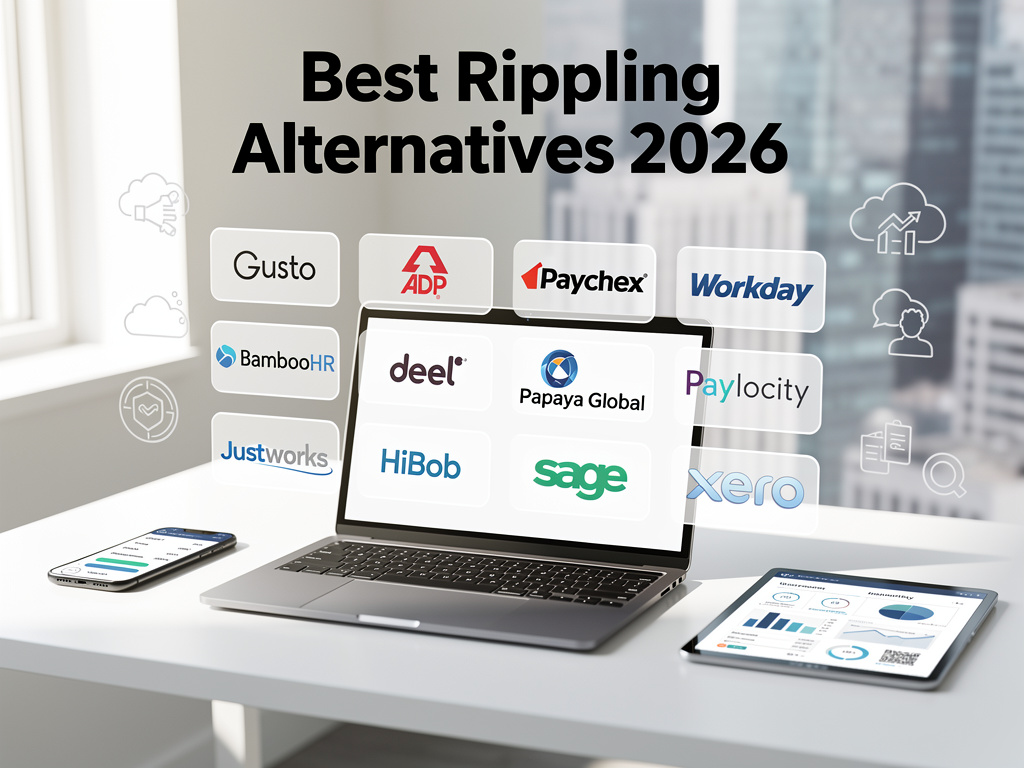
Best Rippling Alternatives for HR and Payroll Management in 2026

Hibob Review
- Intuitive user friendly interface
- Strong employee engagement tools
- Scales well for growing teams
- Dedicated customer success managers
- No native payroll processing
- Benefits need third party tools
- Advanced setup can be complex

Rippling Review
- All in one platform
- Powerful automation workflows
- Hundreds of integrations available
- Strong security compliance
- Complex setup for workflows
- Training across teams required
- Advanced modules raise costs

BambooHR Review
- Intuitive interface for SMBs
- Strong core HR modules
- Fast implementation timeline
- Excellent customer support
- Basic payroll and time tracking
- Benefits module still maturing
- Custom integrations can be tricky
- Limited industry specific features

Zoho People Review
- Centralized employee data
- Automated time and attendance
- Streamlined leave approvals
- Performance management tools
- Setup can take time
- May need Zoho ecosystem
Paylocity Review
- Unified HR and payroll suite
- Strong payroll accuracy
- Modern mobile self service
- Robust reporting and compliance
- Implementation can be complex
- Extra fees for add ons
- Support response times vary

Workday Review
- Cloud native architecture
- Integrated HR and finance
- Modern user experience
- Strong for compliance needs
- Implementation can be complex
- Limited customization flexibility
- Best for larger companies
SAP SuccessFactors Review
- Comprehensive talent management suite
- Strong global compliance coverage
- Scalable for large enterprises
- Advanced workforce analytics
- Complex implementation and rollout
- Steep user interface learning
- Long deployment timelines
- Change management heavy

ADP Workforce Now Review
- Best in class payroll accuracy
- Strong multi state compliance
- All in one HCM platform
- Extensive API integrations
- Complex for smaller teams
- Pricing adds up quickly
- Long implementation timeline
- Training required for users

UKG Ready Review
- All in one HR suite
- Cloud based scalable design
- Strong integrations and APISs
- Compliance tools and updates
- Limited international capabilities
- Moderate admin learning curve
- Complex reports need it help
- Support quality varies by tier

Namely Review
- Unified HR payroll benefits suite
- Modern intuitive interface
- Strong customization options
- Good implementation guidance
- Implementation can take weeks
- Integrations may add cost
- Support quality can vary
- Needs dedicated project resources
Finding the right HR platform can make or break your workforce management strategy. While Rippling offers comprehensive HR and IT management capabilities, it may not suit every organization’s unique needs. Many businesses seek alternatives that provide better pricing, specialized features, or improved user experiences. Whether you need enhanced global payroll processing, superior employee engagement tools, or more intuitive interfaces, numerous platforms compete effectively with Rippling. This comprehensive guide examines nine leading alternatives, analyzing their features, pricing models, and capabilities. We’ll help you identify the perfect solution for your organization’s specific requirements and budget constraints.
Understanding the Need for Rippling Competitors
Organizations today face complex workforce management challenges that require sophisticated solutions. Rippling has established itself as a comprehensive platform combining HR, payroll, and IT management features. However, many companies discover that specialized alternatives better serve their specific needs.
The demand for Rippling substitutes stems from several factors. Some organizations require more robust international capabilities than Rippling provides. Others need better integration with existing enterprise systems or prefer more intuitive user interfaces.
Cost considerations also drive the search for alternatives. Rippling’s pricing structure may not align with smaller organizations or those with limited HR budgets. Additionally, companies often prefer vendors that specialize in their industry vertical rather than broad-spectrum platforms.
Compliance requirements vary significantly across industries and regions. While Rippling offers comprehensive compliance tools, specialized providers often deliver deeper expertise in specific regulatory environments. This specialization proves crucial for organizations operating in highly regulated sectors.
User experience preferences further influence platform selection. Some teams prefer streamlined interfaces focused on core HR functions rather than comprehensive platforms with extensive feature sets. The choice between breadth and depth often determines which alternative best serves organizational needs.
Evaluation Criteria for HR Platform Selection
Selecting the optimal HR platform requires systematic evaluation across multiple dimensions. Our analysis framework examines key criteria that directly impact organizational success and user satisfaction.
Feature comprehensiveness serves as our primary evaluation metric. We assess core HR functionalities including employee onboarding, time tracking, performance management, and benefits administration. Advanced features like workflow automation and custom reporting receive additional consideration.
Pricing structure analysis examines both upfront costs and long-term value proposition. We evaluate per-employee pricing, implementation fees, and additional charges for premium features. Scalability pricing becomes crucial for growing organizations that need platforms accommodating workforce expansion.
Integration capabilities determine how well platforms connect with existing business systems. We examine API availability, pre-built connectors, and data synchronization reliability. Strong integration ecosystems reduce implementation complexity and ongoing maintenance overhead.
User experience evaluation focuses on interface design, navigation intuitiveness, and learning curve steepness. Platforms with superior user adoption rates typically demonstrate better long-term ROI through increased utilization and reduced support requirements.
Customer support quality encompasses response times, support channel availability, and resolution effectiveness. Organizations require reliable assistance during implementation phases and ongoing operations to maximize platform value.
HiBob: Modern HR for Dynamic Organizations
HiBob positions itself as a modern HR platform designed for mid-sized companies seeking employee-centric solutions. The platform emphasizes people analytics and employee engagement while maintaining comprehensive HR functionality.
Core features include robust onboarding workflows, performance management tools, and compensation planning modules. HiBob’s Bob interface provides intuitive navigation that reduces training requirements and accelerates user adoption across organizations.
The platform excels in employee engagement through pulse surveys, feedback collection, and recognition programs. Advanced analytics capabilities help HR teams identify trends, predict turnover, and make data-driven decisions about workforce strategies.
Pricing structure follows a per-employee monthly model starting around $8-12 per employee. Implementation costs vary based on organization size and customization requirements. Mid-market companies often find HiBob’s pricing competitive compared to enterprise-level alternatives.
Integration capabilities include connections with popular business tools like Slack, Microsoft 365, and various payroll providers. The API ecosystem supports custom integrations for organizations with specific connectivity requirements.
Customer support provides multiple channels including chat, email, and phone assistance. Response times typically meet industry standards, though some users report slower resolution for complex technical issues.
Strengths include excellent user experience design, strong analytics capabilities, and effective employee engagement tools. Limitations include less comprehensive payroll functionality compared to dedicated payroll providers and limited global compliance features for international operations.
BambooHR: Streamlined Solutions for Growing Companies
BambooHR targets small to medium-sized businesses with straightforward HR needs and limited IT resources. The platform emphasizes simplicity without sacrificing essential functionality.
Feature set covers fundamental HR operations including employee records management, time-off tracking, and basic reporting. Performance management tools enable goal setting, review cycles, and feedback collection through user-friendly interfaces.
The applicant tracking system integrates seamlessly with core HR functions, enabling smooth transitions from candidate management to employee onboarding. Electronic signature capabilities streamline document workflows and reduce administrative overhead.
Pricing starts at approximately $6-8 per employee monthly for core features. Additional modules like performance management and advanced reporting incur supplementary costs. Small businesses often find BambooHR’s transparent pricing structure attractive.
Mobile applications provide employees and managers with convenient access to essential functions. The mobile experience maintains full functionality while adapting to smaller screen formats effectively.
Customer support includes comprehensive knowledge bases, video tutorials, and direct assistance channels. Users frequently praise BambooHR’s responsive support team and helpful implementation guidance.
Integration ecosystem connects with popular accounting software, benefits providers, and productivity tools. Pre-built connectors simplify setup processes for common business applications.
Advantages include exceptional ease of use, reliable customer support, and cost-effective pricing for small businesses. Disadvantages encompass limited advanced features, basic reporting capabilities, and minimal global functionality for international operations.
Zoho People: Comprehensive Workforce Management
Zoho People forms part of the broader Zoho business suite, offering integrated HR management within a comprehensive business ecosystem. This positioning provides unique advantages for organizations already utilizing Zoho products.
Core functionality encompasses employee database management, attendance tracking, leave management, and performance evaluations. The platform includes project time tracking capabilities that benefit organizations managing billable hours or project-based work.
Workflow automation features enable custom approval processes, notification systems, and task assignments. These capabilities help organizations standardize HR operations while maintaining flexibility for unique business requirements.
Self-service portals empower employees to manage personal information, submit requests, and access company resources independently. This approach reduces administrative burden on HR teams while improving employee satisfaction.
Pricing structure offers multiple tiers starting from free plans for small teams up to enterprise packages around $3-5 per employee monthly. The cost-effective pricing makes Zoho People attractive for budget-conscious organizations.
Integration strengths lie primarily within the Zoho ecosystem, providing seamless connections with CRM, accounting, and project management tools. Third-party integrations exist but may require additional configuration effort.
Mobile applications deliver full platform functionality across iOS and Android devices. Offline capabilities ensure continued access during connectivity interruptions, particularly valuable for field-based teams.
Customer support varies by pricing tier, with higher-level plans receiving priority assistance and dedicated account management. Community forums and documentation provide additional self-help resources.
Benefits include exceptional value for money, strong Zoho ecosystem integration, and flexible customization options. Limitations encompass less sophisticated analytics compared to specialized HR platforms and potential complexity for organizations not using other Zoho products.
ADP Workforce Now: Enterprise-Grade HR Solutions
ADP Workforce Now targets mid-sized to large organizations requiring comprehensive HR and payroll integration. The platform leverages ADP’s decades of payroll expertise while expanding into full-spectrum HR management.
Feature depth includes sophisticated payroll processing, tax compliance management, benefits administration, and talent management tools. Advanced workforce analytics provide insights into labor costs, productivity trends, and compliance risks.
Global capabilities support multi-country operations with localized compliance requirements and currency handling. This international functionality makes ADP Workforce Now suitable for organizations with distributed workforces.
Compliance management represents a core strength, with automated updates for changing regulations and comprehensive audit trails. Organizations in heavily regulated industries particularly benefit from these capabilities.
Implementation support includes dedicated project managers, data migration assistance, and comprehensive training programs. Large-scale deployments receive additional resources to ensure successful adoption.
Pricing follows enterprise software models with customized quotes based on organization size and feature requirements. Costs typically range from $10-20 per employee monthly, with additional charges for premium modules.
Integration capabilities connect with major enterprise systems including ERP platforms, business intelligence tools, and third-party benefits providers. API access enables custom integrations for unique business requirements.
Mobile applications provide managers and employees with essential functionality while maintaining security standards required for payroll and personal data access.
Advantages include industry-leading payroll expertise, comprehensive compliance management, and robust global capabilities. Disadvantages encompass higher costs compared to simpler alternatives and potential complexity for smaller organizations with basic needs.
Workday: Cloud-Based Enterprise HR Platform
Workday serves large enterprises with complex HR requirements and extensive customization needs. The platform combines human capital management with financial management capabilities in a unified cloud solution.
Core modules include talent acquisition, workforce planning, compensation management, and learning systems. Advanced analytics and machine learning capabilities provide predictive insights for strategic workforce decisions.
Financial integration enables seamless connection between HR operations and enterprise financial systems. This integration proves valuable for organizations requiring tight cost control and detailed budget analysis.
Workflow configuration allows extensive customization to match unique organizational processes. However, this flexibility requires significant implementation effort and ongoing maintenance resources.
Security features meet enterprise requirements with role-based access controls, audit logging, and compliance certifications. Data encryption and privacy controls address regulations like GDPR and CCPA.
Mobile experience provides comprehensive functionality through native applications optimized for various device types. Offline capabilities ensure continued access during connectivity interruptions.
Pricing operates on enterprise license models with significant upfront costs and ongoing subscription fees. Total cost of ownership typically justifies investment for large organizations but may exceed budgets for smaller companies.
Implementation requires substantial resources including dedicated project teams, change management support, and extensive user training. Typical deployment timelines span 6-18 months depending on organization complexity.
Customer support includes dedicated success managers, comprehensive training resources, and priority technical assistance. User community forums provide additional peer support and best practice sharing.
Benefits include exceptional scalability, comprehensive feature sets, and strong enterprise integration capabilities. Limitations encompass high implementation costs, complex configuration requirements, and extended deployment timelines.
SAP SuccessFactors: Global Human Experience Management
SAP SuccessFactors focuses on large multinational organizations requiring global HR standardization across diverse geographic markets. The platform emphasizes employee experience management alongside traditional HR functions.
Module structure includes talent management, workforce analytics, employee experience tools, and succession planning capabilities. Machine learning features provide personalized recommendations for career development and skill building.
Global deployment capabilities support consistent HR processes across multiple countries while accommodating local compliance requirements. Localization features handle language variations, cultural differences, and regulatory compliance.
Analytics capabilities leverage SAP’s broader business intelligence ecosystem to provide comprehensive workforce insights. Predictive analytics help identify retention risks, performance trends, and succession planning opportunities.
Integration strengths lie within SAP’s enterprise ecosystem, providing seamless connections with ERP, finance, and business intelligence systems. Third-party integrations require additional configuration but comprehensive APIs support custom connections.
Mobile applications deliver full platform functionality with role-based access controls and security features meeting enterprise requirements. User experience design emphasizes efficiency for managers and employees.
Pricing follows enterprise software models with substantial licensing costs and implementation fees. Organizations typically require significant budgets and multi-year commitments to justify SuccessFactors investment.
Implementation complexity requires dedicated project teams, change management expertise, and extensive user training programs. Deployment timelines often span 12-24 months for full functionality.
Customer support includes dedicated account management, technical assistance, and access to SAP’s global partner network. Premium support tiers provide enhanced response times and specialized expertise.
Advantages include comprehensive global capabilities, strong SAP ecosystem integration, and advanced analytics features. Disadvantages encompass high costs, complex implementation requirements, and potential over-engineering for simpler HR needs.
UKG Ready: Small Business HR Simplicity
UKG Ready (formerly Kronos) targets small to medium-sized businesses seeking affordable HR solutions without enterprise complexity. The platform emphasizes ease of use while maintaining essential functionality.
Core features include payroll processing, time and attendance tracking, benefits administration, and basic talent management tools. Scheduling capabilities help businesses manage shift-based workforces effectively.
Compliance assistance provides automated updates for tax regulations and labor law changes. Small businesses particularly benefit from this support given limited internal compliance expertise.
Employee self-service capabilities reduce administrative overhead by enabling workers to manage personal information, view paystubs, and submit time-off requests independently.
Pricing structure offers transparent per-employee monthly costs starting around $8-12 per employee. Implementation fees remain reasonable compared to enterprise alternatives, making UKG Ready accessible for smaller organizations.
Time tracking integration connects seamlessly with payroll processing to eliminate manual data entry and reduce processing errors. This integration proves valuable for businesses with hourly workforces.
Mobile applications provide essential functionality for managers and employees while maintaining user-friendly interfaces. Offline capabilities ensure continued access during connectivity issues.
Customer support includes phone and email assistance with generally responsive service levels. Implementation support helps small businesses deploy systems successfully without extensive IT resources.
Integration options connect with popular business applications including accounting software and benefits providers. Pre-built connectors simplify setup processes for common business tools.
Benefits include affordable pricing, straightforward implementation, and reliable payroll processing. Limitations encompass basic reporting capabilities, limited customization options, and minimal global functionality.
Paylocity: Modern Payroll and HR Technology
Paylocity combines comprehensive payroll processing with modern HR technology designed for mid-market organizations. The platform emphasizes user experience while maintaining robust functionality.
Feature set includes advanced payroll capabilities, talent management tools, benefits administration, and workforce analytics. Learning management system integration supports employee development and compliance training requirements.
Employee engagement tools provide pulse surveys, feedback collection, and recognition programs. These capabilities help organizations improve retention rates and workplace satisfaction scores.
Video communication features enable personalized messaging and company-wide announcements. This functionality proves valuable for organizations prioritizing internal communication and culture building.
Pricing operates on per-employee monthly models with costs typically ranging from $15-25 per employee depending on selected modules. Implementation fees vary based on organization complexity and customization requirements.
Mobile experience delivers comprehensive functionality through well-designed applications supporting both iOS and Android platforms. User interface design emphasizes ease of use and visual appeal.
Integration capabilities connect with various business applications including accounting systems, benefits providers, and productivity tools. API access supports custom integrations for unique business requirements.
Customer support provides multiple assistance channels including phone, email, and chat options. Implementation support includes dedicated project managers and comprehensive training resources.
Compliance management features automate tax calculations, regulatory reporting, and audit trail maintenance. Multi-state capabilities support organizations with employees across different jurisdictions.
Advantages include excellent user experience design, comprehensive payroll functionality, and strong employee engagement tools. Disadvantages encompass higher pricing compared to basic alternatives and potential feature overlap for organizations with existing specialized tools.
Namely: HR Platform for Mid-Sized Companies
Namely designed its platform specifically for mid-sized organizations requiring more sophistication than small business tools but less complexity than enterprise systems. This focus creates a balanced approach to HR management.
Core functionality encompasses payroll processing, benefits administration, talent management, and compliance support. Social features encourage employee interaction and company culture development.
Performance management tools include goal setting, regular check-ins, and comprehensive review cycles. 360-degree feedback capabilities provide multiple perspectives on employee development and performance assessment.
Onboarding workflows guide new employees through paperwork, training requirements, and integration activities. Automated reminders and task assignments ensure consistent experiences across all new hires.
Reporting capabilities provide standard HR metrics alongside custom report building tools. Dashboard interfaces enable quick access to key performance indicators and trending data.
Pricing follows per-employee monthly models with costs typically ranging from $12-18 per employee. Additional modules and premium features incur supplementary charges based on usage requirements.
Integration options connect with various business applications including accounting software, benefits providers, and applicant tracking systems. API documentation supports custom integrations for unique connectivity needs.
Mobile applications deliver essential functionality while maintaining security standards required for HR data access. Push notifications keep users informed about important updates and required actions.
Customer support includes implementation assistance, ongoing technical support, and access to best practice resources. Response times generally meet industry standards for mid-market software providers.
Benefits include balanced feature sets appropriate for mid-sized companies, reasonable pricing structures, and comprehensive payroll integration. Limitations encompass limited global capabilities, basic analytics compared to specialized providers, and potential scalability constraints for rapidly growing organizations.
Comparative Analysis: Features and Capabilities
Understanding how these Rippling alternatives compare across key dimensions helps organizations make informed decisions. Our comprehensive analysis examines feature depth, pricing models, and implementation requirements.
| Platform | Target Market | Starting Price | Core Strengths | Key Limitations |
|---|---|---|---|---|
| HiBob | Mid-sized companies | $8-12/employee | Employee engagement, Analytics | Limited payroll, Global features |
| BambooHR | Small businesses | $6-8/employee | Ease of use, Customer support | Basic features, Limited reporting |
| Zoho People | Small to medium | $3-5/employee | Value pricing, Integration | Complex for non-Zoho users |
| ADP Workforce Now | Mid to large | $10-20/employee | Payroll expertise, Compliance | Higher costs, Complexity |
| Workday | Large enterprise | Enterprise pricing | Scalability, Integration | High costs, Long implementation |
| SAP SuccessFactors | Global enterprise | Enterprise pricing | Global capabilities, Analytics | Complexity, High costs |
| UKG Ready | Small business | $8-12/employee | Simplicity, Time tracking | Basic reporting, Limited features |
| Paylocity | Mid-market | $15-25/employee | User experience, Payroll | Higher pricing, Feature overlap |
| Namely | Mid-sized | $12-18/employee | Balanced features, Social tools | Limited global, Basic analytics |
Integration capabilities vary significantly across platforms. Enterprise solutions like Workday and SAP SuccessFactors offer comprehensive API ecosystems and pre-built connectors for major business systems.
Small business platforms prioritize ease of integration with common applications rather than extensive customization options. This approach reduces complexity while meeting typical connectivity requirements.
Mobile functionality has become essential for modern HR platforms. All alternatives provide mobile applications, but user experience quality and feature completeness vary considerably across vendors.
Compliance capabilities range from basic tax calculation support in smaller platforms to comprehensive global regulatory management in enterprise solutions. Organizations must match compliance requirements with platform capabilities.
Pricing Models and Total Cost Considerations
Understanding true costs requires analysis beyond published per-employee pricing. Implementation fees, training costs, and ongoing support charges significantly impact total cost of ownership.
Small business platforms typically offer transparent pricing with minimal hidden costs. Setup fees remain reasonable and implementation timelines stay manageable for organizations with limited IT resources.
Mid-market solutions balance feature richness with reasonable pricing structures. However, additional modules and premium features can increase costs substantially beyond base subscription fees.
Enterprise platforms require substantial upfront investments and ongoing commitment. Implementation costs often exceed annual subscription fees, particularly for complex deployments requiring extensive customization.
Training and adoption costs vary based on platform complexity and organizational change management requirements. Simpler platforms reduce these costs through intuitive interfaces and minimal learning curves.
Scalability pricing becomes crucial for growing organizations. Some vendors offer volume discounts while others maintain flat per-employee rates regardless of organization size.
Hidden costs include data migration fees, custom integration charges, and premium support services. Organizations should request comprehensive pricing breakdowns during evaluation processes.
Return on investment calculations must consider efficiency gains, reduced administrative overhead, and improved compliance outcomes. Quantifiable benefits help justify platform investments and guide selection decisions.
Implementation and Change Management Strategies
Successful platform deployment requires careful planning and comprehensive change management strategies. Implementation complexity varies dramatically across different alternatives.
Small business platforms emphasize quick deployment with minimal disruption. Standard configurations work for most organizations while basic customization options accommodate unique requirements.
Data migration represents a critical success factor regardless of platform choice. Clean, accurate data transfer ensures continuity while preventing operational disruptions during transition periods.
User training requirements correlate directly with platform complexity and interface design quality. Intuitive platforms reduce training overhead while complex systems require extensive education programs.
Pilot deployment strategies help organizations validate platform functionality before full-scale rollouts. Testing with limited user groups identifies potential issues and refinement opportunities.
Timeline expectations vary from weeks for simple platforms to months or years for enterprise solutions. Organizations must balance quick wins with comprehensive functionality requirements.
Change management communication helps users understand benefits and reduces resistance to new processes. Regular updates and feedback collection improve adoption rates.
Integration testing ensures seamless connectivity with existing business systems. Parallel running periods provide safety nets during initial deployment phases while validating data accuracy and process functionality.
Future Trends in HR Technology
The HR technology landscape continues evolving rapidly with artificial intelligence and machine learning capabilities becoming standard expectations rather than premium features.
Predictive analytics will enable more sophisticated workforce planning and retention strategies. Organizations increasingly expect platforms to provide insights rather than just data collection and storage capabilities.
Employee experience focus drives platform development priorities. User interface design, mobile optimization, and personalization features receive increased attention from vendors and buyers alike.
Global capabilities become essential as remote work normalizes and companies access talent across geographic boundaries. Compliance automation and multi-currency support grow in importance.
Integration ecosystems expand beyond traditional business applications to include wellness platforms, learning systems, and collaboration tools. Comprehensive connectivity becomes a competitive differentiator.
Security and privacy requirements intensify with expanding data protection regulations and increasing cyber threats. Platforms must demonstrate robust security frameworks and compliance certifications.
Automation capabilities will expand to cover more routine HR tasks including candidate screening, performance review scheduling, and compliance reporting. This evolution frees HR professionals for strategic activities.
Real-time analytics and dashboards provide immediate insights into workforce trends and operational metrics. Decision-making speed increases as data becomes more accessible and actionable.
Making the Right Choice for Your Organization
Selecting the optimal Rippling alternative requires systematic evaluation of organizational needs, resource constraints, and strategic objectives. No single platform serves all organizations equally well.
Small businesses benefit from platforms emphasizing simplicity, affordability, and quick implementation. BambooHR, UKG Ready, and Zoho People provide excellent value for organizations with straightforward HR requirements.
Mid-sized companies need balanced solutions offering sophisticated features without enterprise complexity. HiBob, Namely, and Paylocity deliver comprehensive functionality appropriate for growing organizations.
Large enterprises require scalable platforms with extensive customization capabilities and robust integration ecosystems. Workday, SAP SuccessFactors, and ADP Workforce Now support complex organizational structures.
Industry-specific requirements influence platform suitability. Heavily regulated sectors benefit from vendors with deep compliance expertise and automated regulatory update capabilities.
Geographic considerations become crucial for organizations with international operations. Global payroll capabilities, multi-currency support, and localized compliance features determine platform viability.
Budget constraints often limit available options but shouldn’t compromise essential functionality. Total cost of ownership analysis helps identify platforms delivering maximum value within financial parameters.
Future growth plans should influence current platform selection. Scalable solutions prevent costly migrations as organizations expand their workforce and operational complexity.
Conclusion
Choosing among Rippling alternatives depends heavily on organizational size, complexity, and specific requirements. Small businesses thrive with simplified solutions like BambooHR or UKG Ready, while enterprises need comprehensive platforms like Workday or SAP SuccessFactors. Mid-sized companies find balanced value in HiBob, Paylocity, or Namely. Success depends on matching platform capabilities with actual needs rather than pursuing feature-rich solutions exceeding requirements.
Frequently Asked Questions About Rippling Alternatives
- Which Rippling alternative offers the best value for small businesses?
BambooHR and Zoho People provide excellent value for small businesses with their affordable pricing starting at $3-8 per employee monthly and straightforward implementation processes. Both platforms offer essential HR functionality without enterprise complexity. - What are the main advantages of switching from Rippling to specialized HR platforms?
Specialized alternatives often provide deeper expertise in specific areas like payroll processing (ADP), employee engagement (HiBob), or global operations (Workday). Organizations may also benefit from better pricing structures, improved user experiences, or superior integration capabilities. - How long does implementation typically take for these Rippling competitors?
Implementation timelines vary significantly by platform complexity. Simple solutions like BambooHR or UKG Ready deploy within 2-8 weeks, while mid-market platforms require 2-4 months. Enterprise solutions like Workday or SAP SuccessFactors may take 6-24 months for full deployment. - Which platforms offer the strongest global payroll capabilities as Rippling substitutes?
ADP Workforce Now and SAP SuccessFactors provide the most comprehensive global payroll features among these alternatives. Both platforms handle multi-country compliance, currency conversion, and localized tax requirements effectively for international organizations. - Can these HR platform alternatives integrate with existing business systems?
Most alternatives offer integration capabilities, but depth varies considerably. Enterprise platforms like Workday and SAP SuccessFactors provide extensive API ecosystems, while smaller platforms focus on pre-built connectors for common business applications like accounting software and benefits providers. - What factors should determine my choice between these workforce management solutions?
Key decision factors include organization size, budget constraints, required features, global operations needs, integration requirements, and implementation timeline preferences. Match platform capabilities with actual business requirements rather than pursuing maximum feature sets. - How do mobile capabilities compare across these human resources software options?
All major alternatives provide mobile applications, but user experience quality varies. Paylocity and HiBob excel in mobile design, while enterprise platforms like Workday offer comprehensive functionality. Evaluate mobile features based on your workforce’s mobility requirements and device preferences. - Which Rippling alternatives provide the best customer support?
BambooHR receives consistently high ratings for customer support responsiveness and quality. ADP Workforce Now offers comprehensive support resources leveraging decades of payroll expertise. Enterprise platforms provide dedicated account management but may have longer response times for basic inquiries.
References:


 Stack Insight is intended to support informed decision-making by providing independent information about business software and services. Some product details, including pricing, features, and promotional offers, may be supplied by vendors or partners and can change without notice.