
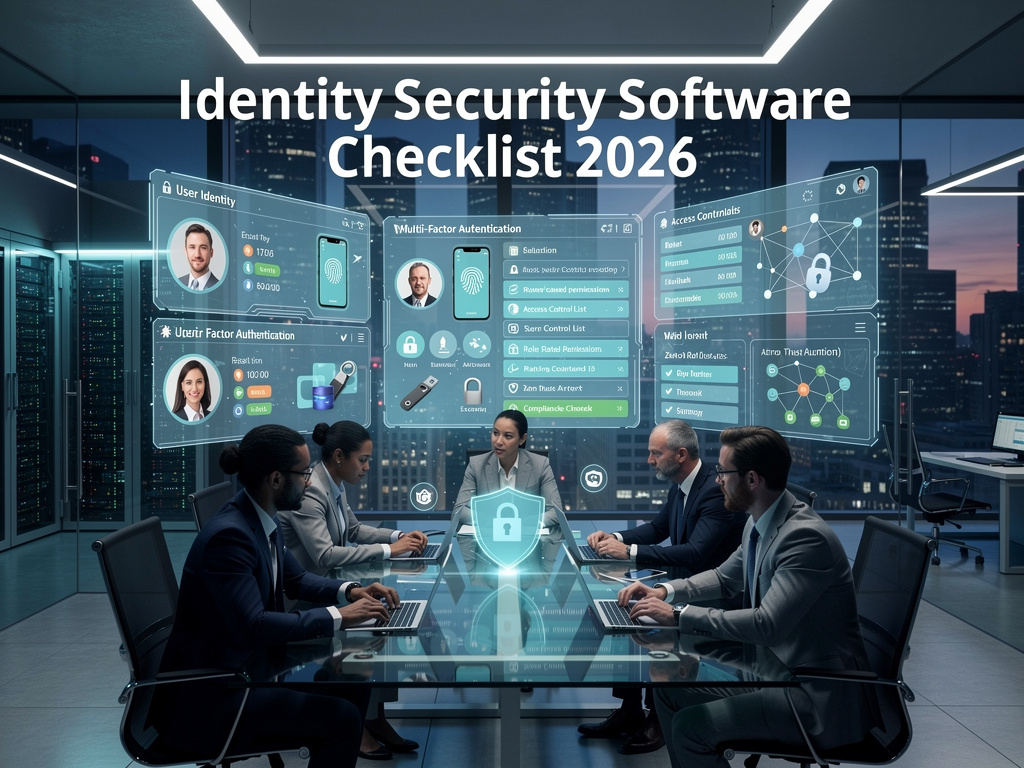
Identity Security Software Features Checklist: Essential Capabilities for Modern Cybersecurity
Identity Security has become the cornerstone of modern cybersecurity strategies. Organizations face unprecedented challenges in managing user identities, securing privileged access, and maintaining compliance across complex IT environments. This comprehensive guide examines essential features that every Identity Security software solution must possess to protect against evolving threats.
Modern Identity Security platforms go beyond traditional access management. They incorporate advanced analytics, behavioral monitoring, and dynamic authentication mechanisms. These capabilities ensure that only authorized users access sensitive resources while maintaining operational efficiency.
The following analysis explores critical features ranging from Multi-Factor Authentication to Zero Trust Architecture. Each capability addresses specific security challenges that organizations encounter in 2026’s threat landscape.
Universal Multi-Factor Authentication: The Foundation of Identity Security
Multi-Factor Authentication (MFA) represents the first line of defense in any robust Identity Security framework. Universal MFA extends beyond basic two-factor authentication to encompass all access points within an organization’s infrastructure.
Effective MFA solutions must support multiple authentication methods. These include biometric verification, hardware tokens, SMS codes, and push notifications. The system should seamlessly integrate with both corporate and personal devices.
Modern MFA platforms offer adaptive authentication capabilities. They analyze user behavior patterns and adjust authentication requirements based on risk levels. High-risk scenarios trigger additional verification steps automatically.
Key features to evaluate in MFA solutions include:
- Device compatibility across laptops, smartphones, and tablets
- Protocol support for SAML, OAuth, and OpenID Connect
- Offline authentication capabilities for remote users
- Emergency access procedures for authentication failures
Implementation considerations focus on user experience and security balance. The solution should minimize friction while maintaining strong security postures. Organizations must evaluate deployment complexity and ongoing maintenance requirements.
Privileged Access Management: Securing Critical System Access
Privileged Access Management (PAM) solutions discover, secure, and monitor accounts with elevated permissions. These systems address the significant security risks associated with administrative and service accounts.
Comprehensive PAM platforms provide automated discovery of privileged accounts across environments. They maintain centralized password vaults with encryption and access logging. Session recording capabilities capture all privileged user activities for audit purposes.
Critical PAM features include:
- Automatic password rotation for service accounts
- Just-in-time access provisioning and deprovisioning
- Privilege escalation controls with approval workflows
- Application-to-application password management
Modern PAM solutions integrate with cloud platforms and containerized environments. They support hybrid architectures where privileged accounts span on-premises and cloud resources. API-based integrations enable seamless workflow automation.
Evaluation criteria should emphasize scalability and performance. The solution must handle thousands of privileged accounts without impacting system responsiveness. Backup and recovery procedures ensure business continuity during system failures.
Least Privilege Access: Minimizing Attack Surfaces
Least privilege access principles ensure users receive minimum permissions necessary for job functions. This approach significantly reduces potential attack surfaces and limits breach impact.
Effective least privilege implementations require comprehensive permission analysis. The system must map user roles to specific resource requirements. Automated reviews identify and remediate excessive permissions across the environment.
Dynamic permission adjustment based on contextual factors enhances security. Time-based access controls automatically revoke permissions after specified periods. Location-based restrictions prevent access from unauthorized geographic regions.
Essential least privilege features encompass:
- Role-based access control with granular permission management
- Attribute-based access control for complex authorization scenarios
- Temporal access controls with automatic expiration
- Permission analytics for identifying access anomalies
Implementation requires careful planning and stakeholder coordination. Organizations must balance security requirements with operational efficiency. Regular access reviews ensure permissions remain aligned with business needs.
User Behavior Analytics: Detecting Anomalous Activities
User Behavior Analytics (UBA) leverages machine learning to establish baseline user behavior patterns. These systems detect deviations that may indicate compromised accounts or insider threats.
Advanced UBA platforms analyze multiple data sources simultaneously. They correlate login patterns, application usage, and data access behaviors. Machine learning algorithms continuously refine detection accuracy over time.
Behavioral analysis extends beyond individual users to encompass peer groups. The system identifies unusual activities by comparing behaviors within similar roles. Statistical models detect subtle anomalies that traditional security tools might miss.
Key UBA capabilities include:
- Baseline establishment for normal user behaviors
- Real-time anomaly detection with risk scoring
- Peer group analysis for contextual comparisons
- Automated response triggers for high-risk activities
Integration with Security Information and Event Management (SIEM) systems enhances threat detection. UBA alerts feed into incident response workflows for rapid remediation. False positive reduction improves security team efficiency.
Single Sign-On Integration: Streamlining User Experience
Single Sign-On (SSO) solutions eliminate password fatigue while improving security postures. Users authenticate once to access multiple applications throughout their work sessions.
Modern SSO platforms support diverse authentication protocols and application types. They integrate with cloud-based SaaS applications, on-premises systems, and mobile applications. Federation capabilities enable secure access across organizational boundaries.
Session management features provide granular control over user access. Administrators can configure session timeouts, concurrent session limits, and step-up authentication requirements. Global logout capabilities terminate all user sessions simultaneously.
Critical SSO features encompass:
- Protocol support for SAML, OAuth 2.0, and OpenID Connect
- Application catalog with pre-configured integrations
- Custom application integration capabilities
- Mobile device support for remote workforce
Deployment considerations focus on application compatibility and user adoption. The solution should minimize disruption to existing workflows. Comprehensive testing ensures seamless integration with critical business applications.
Identity Governance: Ensuring Compliance and Control
Identity Governance platforms provide comprehensive oversight of user identities and access rights. These systems ensure compliance with regulatory requirements while maintaining operational efficiency.
Automated provisioning and deprovisioning processes reduce manual errors and improve response times. The system integrates with Human Resources systems to manage identity lifecycles. Role mining capabilities identify optimal permission sets for specific job functions.
Certification campaigns enable regular access reviews by business owners. Automated workflows route certification requests to appropriate approvers. Exception handling processes address access requirements outside standard policies.
Essential governance features include:
- Automated lifecycle management for user identities
- Access certification campaigns with approval workflows
- Segregation of duties controls and monitoring
- Compliance reporting for regulatory requirements
Risk assessment capabilities identify high-risk access combinations. Policy engines enforce organizational security standards automatically. Audit trails provide comprehensive documentation for compliance purposes.
Zero Trust Architecture: Never Trust, Always Verify
Zero Trust Architecture challenges traditional perimeter-based security models. Every access request undergoes verification regardless of user location or network connection.
Identity verification forms the foundation of Zero Trust implementations. Continuous authentication ensures user identities remain valid throughout sessions. Device trust assessments evaluate endpoint security postures before granting access.
Micro-segmentation capabilities limit lateral movement within networks. Application-level controls prevent unauthorized resource access even after successful authentication. Policy engines make real-time access decisions based on multiple risk factors.
Zero Trust implementation requires:
- Continuous authentication and authorization
- Device compliance verification and enforcement
- Network micro-segmentation for lateral movement prevention
- Application-level access controls with fine-grained permissions
Migration to Zero Trust architecture demands careful planning and phased implementation. Organizations must assess existing infrastructure and identify integration requirements. Change management ensures user adoption and operational success.
Cloud Identity Integration: Supporting Hybrid Environments
Modern organizations operate in hybrid environments spanning on-premises and cloud infrastructures. Identity Security solutions must seamlessly integrate across these diverse platforms.
Cloud-native identity providers offer scalability and global availability. They support rapid deployment and automatic updates without infrastructure management overhead. API-first architectures enable flexible integration with existing systems.
Hybrid identity scenarios require synchronization between on-premises and cloud directories. The solution must maintain consistency while handling connectivity issues gracefully. Backup authentication methods ensure access during outages.
Cloud integration features encompass:
- Multi-cloud support for diverse platform environments
- Directory synchronization with conflict resolution
- Federated identity management across domains
- API connectivity for custom integrations
Performance considerations address latency and availability requirements. Geographic distribution of identity services improves user experience. Disaster recovery procedures ensure business continuity across regions.
Advanced Threat Protection: Defending Against Sophisticated Attacks
Identity Security platforms must defend against increasingly sophisticated threat actors. Advanced protection mechanisms detect and respond to credential theft, account takeover, and insider threats.
Threat intelligence integration provides context about emerging attack patterns. The system correlates internal events with external threat indicators. Machine learning models adapt to new attack techniques automatically.
Automated response capabilities mitigate threats in real-time. Risk-based authentication challenges suspicious activities without impacting legitimate users. Account lockout procedures prevent brute force attacks while maintaining availability.
Advanced protection features include:
- Credential stuffing detection and prevention
- Impossible travel detection based on geographic analysis
- Threat intelligence correlation for enhanced context
- Automated incident response with customizable workflows
Integration with Security Orchestration, Automation, and Response (SOAR) platforms enhances threat response. Playbooks automate common remediation tasks. Threat hunting capabilities enable proactive security investigations.
Compliance Reporting: Meeting Regulatory Requirements
Organizations must demonstrate compliance with various regulatory frameworks. Identity Security platforms provide comprehensive reporting capabilities for audit and compliance purposes.
Automated report generation reduces manual effort and ensures consistency. The system must support multiple compliance standards including SOX, GDPR, HIPAA, and PCI-DSS. Custom reporting capabilities address specific organizational requirements.
Audit trails capture detailed logs of all identity-related activities. These logs include authentication events, permission changes, and administrative actions. Tamper-proof storage ensures audit trail integrity over time.
Compliance reporting features encompass:
- Pre-built compliance templates for major regulations
- Custom report builder for specific requirements
- Automated scheduling and distribution
- Data retention policies with secure archival
Real-time compliance monitoring identifies violations as they occur. Alert mechanisms notify administrators of policy breaches immediately. Remediation workflows guide corrective actions to maintain compliance posture.
API Security and Management: Protecting Application Interfaces
Application Programming Interfaces (APIs) have become critical attack vectors requiring dedicated security controls. Identity Security platforms must extend protection to API endpoints and service communications.
API authentication mechanisms verify calling applications and services. OAuth 2.0 and JWT tokens provide secure authentication for API communications. Rate limiting prevents abuse and denial-of-service attacks.
API gateway integration enables centralized policy enforcement. The system applies authentication, authorization, and monitoring controls across all API endpoints. Throttling capabilities protect backend services from excessive requests.
API security capabilities include:
- OAuth 2.0 and OpenID Connect support for modern applications
- API key management with rotation and revocation
- Rate limiting and throttling for abuse prevention
- API analytics and monitoring for usage insights
Developer tools simplify API integration and testing. SDK libraries support multiple programming languages and frameworks. Comprehensive documentation accelerates development cycles and reduces implementation errors.
Mobile Device Management: Securing Remote Access
Mobile devices represent significant security challenges for modern organizations. Identity Security solutions must address authentication, authorization, and device management for smartphones and tablets.
Device enrollment processes establish trust relationships between mobile devices and corporate resources. Mobile Device Management (MDM) integration enforces security policies automatically. Application wrapping protects sensitive data within mobile applications.
Biometric authentication leverages device capabilities for enhanced security. Fingerprint, facial recognition, and voice authentication provide convenient yet secure access methods. Device attestation verifies hardware and software integrity before access.
Mobile security features encompass:
- Device registration and trust establishment
- Mobile application management with containerization
- Biometric authentication support for enhanced security
- Remote wipe capabilities for lost or stolen devices
Bring Your Own Device (BYOD) policies require careful balance between security and privacy. The solution should protect corporate data without compromising personal information. Separate work profiles maintain clear boundaries between personal and business use.
Identity Security Platform Comparison Framework
Organizations require systematic approaches to evaluate Identity Security solutions. The following framework provides comprehensive criteria for platform assessment and vendor selection.
| Feature Category | Essential Capabilities | Evaluation Criteria | Priority Level |
|---|---|---|---|
| Multi-Factor Authentication | Universal MFA, Adaptive Authentication, Multiple Methods | Device Support, Protocol Compatibility, User Experience | High |
| Privileged Access Management | Account Discovery, Password Vaulting, Session Recording | Scalability, Performance, Integration Capabilities | High |
| User Behavior Analytics | Anomaly Detection, Machine Learning, Risk Scoring | Accuracy, False Positive Rate, Response Time | Medium |
| Single Sign-On | Protocol Support, Application Integration, Session Management | Compatibility, Deployment Complexity, Reliability | High |
| Identity Governance | Lifecycle Management, Access Certification, Compliance | Automation Level, Workflow Flexibility, Reporting | Medium |
| Zero Trust Architecture | Continuous Verification, Micro-segmentation, Policy Engine | Implementation Complexity, Performance Impact, Scalability | Medium |
Vendor evaluation should include proof-of-concept testing in realistic environments. Technical teams must validate integration capabilities with existing infrastructure. Performance testing under realistic load conditions reveals scalability limitations.
Total Cost of Ownership (TCO) analysis encompasses licensing, implementation, and ongoing operational costs. Hidden costs include training, customization, and third-party integrations. Long-term vendor viability and product roadmap alignment ensure sustainable investments.
Implementation Best Practices and Considerations
Successful Identity Security implementations require careful planning and execution. Organizations must address technical, organizational, and cultural challenges throughout deployment phases.
Phased rollout approaches minimize disruption and enable iterative improvements. Pilot deployments with limited user groups validate configurations and identify issues. Gradual expansion allows teams to refine processes and address challenges proactively.
Change management initiatives ensure user adoption and minimize resistance. Training programs educate users about new authentication procedures and security benefits. Communication campaigns highlight security improvements and address user concerns.
Implementation best practices include:
- Comprehensive planning with stakeholder engagement
- Pilot testing with representative user groups
- Backup procedures for fallback scenarios
- Performance monitoring throughout deployment
Integration testing validates compatibility with existing applications and systems. Load testing ensures performance under production conditions. Security testing identifies configuration vulnerabilities before full deployment.
Ongoing optimization addresses performance issues and user feedback. Regular reviews assess security posture and compliance status. Continuous improvement processes adapt to changing business requirements and threat landscapes.
Conclusion
Identity Security software selection demands comprehensive evaluation of essential features and capabilities. Organizations must balance security requirements with operational efficiency and user experience. The features outlined in this checklist provide a foundation for robust Identity Security implementations. Successful deployments require careful planning, stakeholder engagement, and ongoing optimization to address evolving threats and business requirements in 2026.
References
For additional insights on identity security best practices, visit Okta’s Identity Security Checklist and Silverfort’s platform capabilities guide.
Frequently Asked Questions About Identity Security Software Features Checklist
- What are the most critical features to look for in Identity Security software?
Universal Multi-Factor Authentication, Privileged Access Management, and User Behavior Analytics represent the most critical capabilities. These features address primary attack vectors and provide comprehensive protection against credential-based threats.
- How does Identity Security software help with regulatory compliance?
Identity Security platforms provide automated compliance reporting, audit trails, and policy enforcement capabilities. They support major regulatory frameworks including SOX, GDPR, HIPAA, and PCI-DSS through pre-built templates and custom reporting functions.
- What implementation challenges should organizations expect with Identity Security solutions?
Common challenges include application integration complexity, user adoption resistance, and performance optimization requirements. Phased deployment approaches and comprehensive change management programs help address these challenges effectively.
- How do Identity Security features support remote workforce requirements?
Modern Identity Security platforms provide device-agnostic authentication, mobile device management integration, and cloud-based access controls. These capabilities ensure secure access from any location while maintaining user experience quality.
- What is the difference between Identity Security and traditional access management?
Identity Security encompasses advanced threat detection, behavioral analytics, and Zero Trust principles beyond traditional access management. It provides continuous monitoring and dynamic risk assessment rather than static permission controls.
- How should organizations prioritize Identity Security features during vendor selection?
Organizations should prioritize features based on their specific risk profile and compliance requirements. High-priority features typically include MFA, PAM, and SSO capabilities, while advanced features like UBA may have lower priority depending on organizational maturity.
- What role does artificial intelligence play in modern Identity Security software?
AI enhances Identity Security through machine learning-based anomaly detection, adaptive authentication, and automated threat response. These capabilities improve detection accuracy while reducing false positives and manual intervention requirements.
- How do Identity Security platforms integrate with existing IT infrastructure?
Modern platforms provide API-based integrations, standard protocol support (SAML, OAuth, OpenID Connect), and pre-built connectors for common applications. Cloud-native architectures enable flexible deployment options across hybrid environments.





 Stack Insight is intended to support informed decision-making by providing independent information about business software and services. Some product details, including pricing, features, and promotional offers, may be supplied by vendors or partners and can change without notice.