
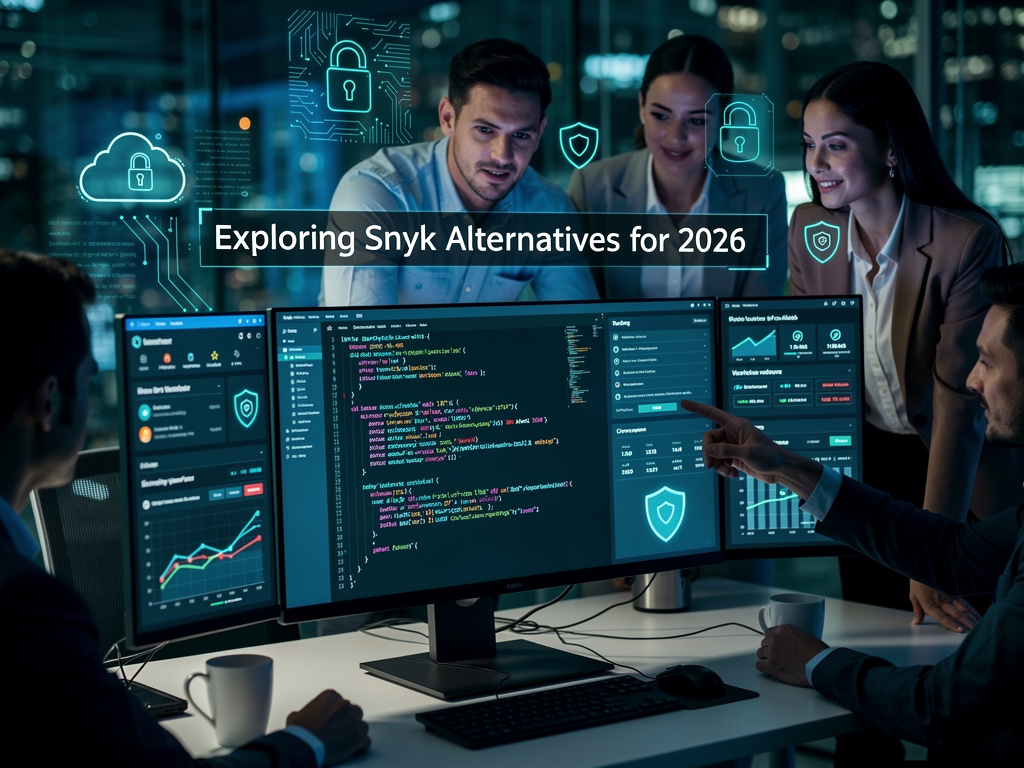
Best Snyk Alternatives for Code Security in 2026: Top 9 Developer Security Platforms

JFrog Xray Review
- Deep artifact scanning
- Real time blocking protection
- Strong policy and compliance
- Broad cicd integrations
- Policy setup learning curve
- Resource heavy on large repos
- Possible peak performance impact

Snyk Review
- Actionable fix recommendations
- Seamless IDE and Git integration
- Broad language and package support
- Automated pull requests for fixes
- Advanced setup takes longer
- Enterprise features may cost more
Black Duck Review
- Extensive vulnerability knowledge base
- Strong license compliance tracking
- Deep binary and container scanning
- Broad CI CD integrations
- Higher enterprise pricing
- Setup can take weeks
- May need security expertise
- Policy tuning takes time
Apiiro Review
- Unified security visibility
- Real time risk insights
- Strong DevOps integrations
- Fewer false positives
- Enterprise focused pricing
- Longer full rollout timeline
- May be heavy for small teams
SonarQube Review
- Strong code quality metrics
- Broad language support
- Great CI CD integrations
- Finds security issues early
- Initial setup can be complex
- Needs configuration expertise
- Can produce false positives
- Resource intensive for large projects

Mend Review
- Fast scanning performance
- Strong integrations with workflows
- Broad language and framework support
- Developer friendly experience
- Fewer advanced niche features
- Legacy tool integration challenges
- Policy setup takes time

Checkmarx Review
- Accurate vulnerability detection
- Supports many languages
- Strong CI CD integrations
- Detailed remediation guidance
- Complex initial configuration
- Steep learning curve
- Long scans on large codebases

Semgrep Review
- Very fast scan speeds
- Low false positives
- Custom rules and transparency
- Strong CI CD integration
- Limited third party integrations
- Weaker compliance reporting
- Per developer pricing costs

Veracode Review
- Supports 80 plus languages
- Scales for large portfolios
- Strong compliance reporting
- Reduces false positives
- Premium pricing tier
- May feel complex for small teams

Fossa Review
- Manual vulnerability verification
- Over 500 package managers
- Strong license compliance
- Enterprise scale deployments
- Pricing requires sales call
- May be overkill small teams
Finding the right application security platform is crucial for modern development teams. While Snyk has established itself as a popular choice for vulnerability management, many organizations seek alternatives that better align with their specific security needs and development workflows. The landscape of developer security tools has evolved significantly, offering diverse solutions for static analysis, software composition analysis, and runtime protection.
This comprehensive guide examines nine leading Snyk alternatives that deliver robust security capabilities. Each platform offers unique strengths in areas like container scanning, infrastructure-as-code protection, and vulnerability prioritization. Organizations today require more than basic vulnerability detection – they need platforms that integrate seamlessly into DevSecOps workflows while providing actionable insights.
From runtime-first security solutions to comprehensive application security posture management platforms, these alternatives address the growing complexity of modern software development. We’ll analyze each solution’s core features, pricing models, and ideal use cases to help you make an informed decision for your security strategy.
Understanding the Modern Application Security Landscape
The application security market has transformed dramatically as organizations adopt cloud-native architectures and DevSecOps practices. Traditional security approaches often create bottlenecks in fast-paced development environments. Modern teams require security solutions that shift left while maintaining comprehensive coverage across the entire software development lifecycle.
Key requirements for application security platforms include:
- Real-time vulnerability detection and remediation
- Integration with existing development tools and CI/CD pipelines
- Comprehensive coverage including SAST, SCA, and container security
- Accurate vulnerability prioritization to reduce alert fatigue
- Support for multiple programming languages and frameworks
Security teams must balance thoroughness with developer productivity. False positives waste valuable time and resources. The most effective platforms combine multiple security testing methodologies while providing contextual insights that help teams focus on genuine risks.
Cloud-native development introduces additional complexity with infrastructure-as-code, containerized applications, and microservices architectures. Security solutions must adapt to these modern patterns while maintaining ease of use and implementation.
Black Duck: Enterprise Software Composition Analysis
Black Duck by Synopsys stands as one of the most established software composition analysis platforms in the market. This enterprise-grade solution excels at identifying open-source components and their associated vulnerabilities across complex software portfolios.
Core capabilities include:
- Comprehensive open-source detection using multiple scanning techniques
- License compliance management and risk assessment
- Supply chain security monitoring and threat intelligence
- Integration with major development and security tools
- Detailed vulnerability reporting and remediation guidance
Black Duck’s strength lies in its extensive knowledge base of open-source components. The platform maintains one of the largest databases of open-source packages, licenses, and security vulnerabilities. This comprehensive coverage makes it particularly valuable for large enterprises with complex software portfolios.
The solution provides detailed software bill of materials (SBOM) generation, which has become increasingly important for supply chain security compliance. Organizations can track component usage across multiple projects and receive alerts when new vulnerabilities affect their software.
Pricing considerations: Black Duck typically follows an enterprise pricing model based on the number of applications or lines of code scanned. Costs can be significant for large deployments, making it more suitable for established enterprises rather than smaller development teams.
Integration capabilities are extensive, supporting major IDEs, CI/CD platforms, and security orchestration tools. The platform offers both on-premises and cloud deployment options, providing flexibility for organizations with specific infrastructure requirements.
Apiiro: Code-to-Cloud Security Platform
Apiiro represents a new generation of application security platforms that provide comprehensive code-to-cloud visibility. This innovative solution combines traditional security scanning with runtime insights and business context to prioritize the most critical risks.
The platform’s unique approach involves continuous monitoring of code changes, dependencies, and cloud configurations. Apiiro builds a comprehensive map of application architecture, data flows, and potential attack paths. This holistic view enables more accurate risk assessment than traditional point solutions.
Key differentiators include:
- Application risk scoring based on business impact
- Automated security testing integration across the development lifecycle
- Real-time visibility into code-to-cloud relationships
- Advanced threat modeling and attack path analysis
- Comprehensive policy enforcement and governance
Apiiro’s strength in risk prioritization addresses one of the biggest challenges in application security – alert fatigue. Rather than overwhelming teams with hundreds of vulnerabilities, the platform focuses attention on issues that pose genuine threats to business operations.
The solution integrates deeply with development workflows, providing security feedback directly within familiar tools. Developers receive contextual guidance about security issues without leaving their preferred development environment.
Implementation considerations: Apiiro requires more extensive setup compared to simpler scanning tools. Organizations must invest time in configuring business context and risk parameters. However, this initial investment typically pays dividends through more accurate vulnerability prioritization.
The platform supports multiple deployment models, including cloud-native and hybrid environments. Integration with major cloud providers enables comprehensive visibility into serverless functions, containers, and traditional applications.
Checkmarx: Comprehensive Application Security Testing
Checkmarx has evolved from a static analysis specialist into a comprehensive application security platform. The solution combines multiple testing methodologies to provide thorough coverage across different types of applications and development environments.
The platform’s static application security testing (SAST) engine remains highly regarded for its accuracy and language support. Checkmarx covers over 30 programming languages and frameworks, making it suitable for diverse development environments.
Core platform components:
- Advanced SAST with low false-positive rates
- Software composition analysis for open-source security
- Infrastructure-as-code scanning for cloud security
- API security testing and documentation analysis
- Container and serverless security assessment
Checkmarx’s approach to developer experience emphasizes integration and workflow optimization. The platform provides multiple interfaces, from IDE plugins to command-line tools, ensuring security testing fits naturally into existing development processes.
The solution’s reporting capabilities are particularly strong, offering detailed technical information for developers alongside executive dashboards for management visibility. Custom reporting templates help organizations align security metrics with business objectives.
Scalability and performance: Checkmarx handles large codebases efficiently, with distributed scanning capabilities that reduce analysis time. The platform supports both incremental and full scans, optimizing resource usage while maintaining comprehensive coverage.
Advanced features include custom rule creation, allowing security teams to enforce organization-specific coding standards and security requirements. This flexibility makes Checkmarx adaptable to unique business requirements and regulatory compliance needs.
Semgrep: Fast and Customizable Static Analysis
Semgrep has gained significant traction as a lightweight, fast, and highly customizable static analysis platform. Originally developed by r2c, Semgrep focuses on providing accurate security scanning without the complexity often associated with enterprise security tools.
The platform’s rule-based approach allows organizations to customize security checks for their specific requirements. Semgrep’s rule syntax is designed to be developer-friendly, enabling security and development teams to collaborate on creating custom security policies.
Key advantages include:
- Extremely fast scanning with minimal resource requirements
- Easy rule customization using pattern-based syntax
- Strong support for modern programming languages
- Open-source core with commercial enterprise features
- Excellent integration with CI/CD pipelines and development tools
Semgrep’s performance characteristics make it ideal for organizations with large codebases or frequent code changes. The tool can scan millions of lines of code in minutes, providing rapid feedback to development teams.
The platform includes Semgrep Supply Chain, which provides software composition analysis capabilities. This component identifies vulnerabilities in open-source dependencies while maintaining the same performance and accuracy standards as the core SAST engine.
Community and ecosystem: Semgrep benefits from an active open-source community that contributes rules and improvements. The public rule registry contains thousands of security patterns covering common vulnerabilities and coding best practices.
For enterprise deployments, Semgrep offers additional features including advanced reporting, team management, and priority support. The pricing model is transparent and scales based on the number of developers, making it accessible for teams of various sizes.
Veracode: Enterprise-Grade Security Platform
Veracode represents one of the most established names in application security, offering a comprehensive platform that serves large enterprises and government organizations worldwide. The solution provides multiple security testing methodologies within a unified platform architecture.
The platform’s strength lies in its maturity and breadth of capabilities. Veracode covers the entire application security lifecycle, from early development through production monitoring. This comprehensive approach reduces tool sprawl while providing consistent security coverage.
Platform capabilities include:
- Static analysis with extensive language and framework support
- Dynamic application security testing (DAST) for runtime vulnerabilities
- Software composition analysis with license compliance
- Manual penetration testing services
- Application security consulting and training
Veracode’s approach to vulnerability management emphasizes risk-based prioritization. The platform combines technical vulnerability data with business context to help organizations focus on the most critical security issues.
The solution’s reporting and compliance features are particularly strong, supporting various regulatory frameworks and industry standards. Organizations can generate detailed audit reports and track security improvements over time.
Integration and deployment: Veracode offers flexible deployment options, including cloud-based scanning and on-premises solutions. The platform integrates with major development tools, CI/CD systems, and security orchestration platforms.
Professional services complement the technology platform, providing security consulting, training, and managed services. This comprehensive approach helps organizations build internal security capabilities while leveraging external expertise.
SonarQube: Code Quality and Security Analysis
SonarQube has established itself as the leading platform for continuous code quality inspection, with robust security analysis capabilities that complement its primary focus on code maintainability and reliability. The solution provides comprehensive static analysis across multiple programming languages.
Unlike pure-play security tools, SonarQube integrates security analysis with broader code quality metrics. This approach helps organizations improve overall software quality while addressing security vulnerabilities as part of standard development practices.
Core features include:
- Multi-language static analysis with security rule sets
- Code coverage analysis and technical debt assessment
- Quality gates for automated pass/fail criteria
- Detailed code metrics and trend analysis
- Extensive IDE and CI/CD integrations
SonarQube’s strength in developer adoption comes from its focus on code quality rather than just security. Developers often embrace the tool for its maintainability insights, naturally incorporating security practices into their workflows.
The platform’s security rules cover common vulnerability patterns including OWASP Top 10 issues, injection flaws, and authentication problems. While not as comprehensive as dedicated security platforms, SonarQube provides solid baseline security coverage.
Deployment options: SonarQube offers both open-source and commercial editions. The Community Edition provides basic security analysis, while commercial versions include advanced security features, branch analysis, and enterprise integrations.
Quality gates enable organizations to enforce security and quality standards automatically. Teams can configure rules that prevent code deployment when security vulnerabilities or quality issues exceed acceptable thresholds.
Mend (formerly WhiteSource): Open Source Security and Compliance
Mend focuses specifically on open-source security and license compliance, providing comprehensive software composition analysis for organizations heavily reliant on third-party components. The platform excels at identifying vulnerabilities, license risks, and operational issues in open-source dependencies.
The solution’s approach emphasizes automation and integration throughout the software development lifecycle. Mend can scan repositories, container images, and production environments to provide complete visibility into open-source usage and associated risks.
Key capabilities include:
- Comprehensive open-source vulnerability detection
- License compliance analysis and policy enforcement
- Automated remediation suggestions and pull requests
- Supply chain security monitoring and alerts
- Container and serverless function scanning
Mend’s database includes information about millions of open-source components across hundreds of programming languages and package managers. The platform provides real-time alerts when new vulnerabilities affect components used in monitored applications.
The solution’s remediation capabilities set it apart from basic vulnerability scanners. Mend can automatically generate pull requests with suggested fixes, significantly reducing the manual effort required to address security issues.
Integration strengths: The platform integrates deeply with development workflows, including IDE plugins, CI/CD pipeline integration, and repository monitoring. Mend supports major cloud platforms and container orchestration systems.
Advanced features include policy customization, allowing organizations to define specific rules for open-source usage, licensing requirements, and security thresholds. This flexibility helps organizations balance security requirements with development velocity.
JFrog Xray: DevSecOps Security and Compliance
JFrog Xray operates as a universal software composition analysis tool designed to integrate seamlessly with JFrog’s Artifactory repository manager. This integration provides unique visibility into software components as they move through build and deployment pipelines.
The platform’s strength lies in its deep integration with software supply chain workflows. Xray can scan artifacts at multiple points in the development lifecycle, from initial build through production deployment, providing continuous security monitoring.
Platform highlights include:
- Universal artifact scanning across package types and languages
- Policy-based security and license compliance enforcement
- Impact analysis showing vulnerable component usage
- Integration with CI/CD pipelines and development tools
- Advanced reporting and vulnerability trend analysis
JFrog Xray’s approach to vulnerability management emphasizes contextual analysis. The platform shows exactly where vulnerable components are used across an organization’s software portfolio, enabling targeted remediation efforts.
The solution’s policy engine allows organizations to create sophisticated rules governing software component usage. Teams can automatically block artifacts with critical vulnerabilities or license violations, preventing security issues from reaching production environments.
Operational advantages: Integration with Artifactory provides unique insights into component distribution and usage patterns. Organizations can track how components spread across projects and receive impact assessments when vulnerabilities are discovered.
Advanced analytics capabilities help organizations understand vulnerability trends, remediation effectiveness, and overall security posture improvements. Custom dashboards provide visibility for different stakeholder groups, from developers to executive leadership.
FOSSA: Open Source Management and Compliance
FOSSA specializes in open-source management, providing comprehensive analysis of licensing, security, and code quality for third-party components. The platform addresses the growing complexity of open-source usage in modern software development.
The solution’s approach combines automated scanning with policy enforcement to help organizations manage open-source risks effectively. FOSSA provides detailed component analysis, including security vulnerabilities, license obligations, and code quality metrics.
Core functionality includes:
- Deep dependency analysis and software bill of materials generation
- License compliance automation and obligation tracking
- Security vulnerability monitoring and alerting
- Code quality assessment for open-source components
- Policy enforcement and approval workflows
FOSSA’s strength in license compliance makes it particularly valuable for organizations with complex intellectual property requirements. The platform tracks license obligations and helps teams ensure compliance with various open-source licenses.
The solution’s dependency analysis capabilities provide deep visibility into transitive dependencies, helping organizations understand the full scope of their open-source usage. This comprehensive view is essential for accurate risk assessment.
Workflow integration: FOSSA integrates with popular development tools and CI/CD systems, providing automated scanning and policy enforcement throughout the development lifecycle. The platform supports both cloud and on-premises deployments.
Advanced features include custom policy creation, automated approval workflows, and detailed audit trails. These capabilities help organizations streamline open-source governance while maintaining security and compliance requirements.
Comparative Analysis: Feature Matrix and Capabilities
| Platform | SAST | SCA | Container Security | IaC Scanning | License Compliance | DAST | Deployment Model |
|---|---|---|---|---|---|---|---|
| Black Duck | Limited | Excellent | Good | Limited | Excellent | No | Cloud/On-premises |
| Apiiro | Good | Good | Good | Excellent | Good | Limited | Cloud |
| Checkmarx | Excellent | Good | Good | Good | Good | Yes | Cloud/On-premises |
| Semgrep | Excellent | Good | Limited | Good | Limited | No | Cloud/Self-hosted |
| Veracode | Excellent | Good | Good | Limited | Good | Yes | Cloud/On-premises |
| SonarQube | Good | Limited | Limited | Limited | Limited | No | Cloud/Self-hosted |
| Mend | Limited | Excellent | Good | Good | Excellent | No | Cloud/On-premises |
| JFrog Xray | Limited | Excellent | Excellent | Good | Good | No | Cloud/Self-hosted |
| FOSSA | Limited | Good | Good | Limited | Excellent | No | Cloud/On-premises |
Integration and Developer Experience Considerations
Developer adoption remains critical for application security program success. The most effective platforms integrate seamlessly into existing development workflows without creating friction or significantly impacting development velocity.
Key integration factors include:
- IDE plugin availability and functionality
- CI/CD pipeline integration and automation capabilities
- API availability for custom integrations
- Command-line tool support for automation
- Webhook and notification system flexibility
Platforms like Semgrep and SonarQube excel in developer experience, providing lightweight integrations that deliver fast feedback without disrupting development workflows. Enterprise solutions like Veracode and Checkmarx offer comprehensive integration options but may require more setup and configuration.
Security teams must balance comprehensive coverage with practical usability. Overly complex tools often face adoption resistance, undermining security program effectiveness regardless of technical capabilities.
The trend toward “shift-left” security emphasizes early vulnerability detection within development environments. Platforms that provide real-time feedback within IDEs and pull request workflows typically achieve higher adoption rates and more effective vulnerability remediation.
Pricing Models and Total Cost of Ownership
Application security platform pricing varies significantly based on deployment model, feature set, and organizational size. Understanding total cost of ownership helps organizations make informed decisions beyond initial licensing costs.
Common pricing models include:
- Per-developer licensing for teams and smaller organizations
- Application-based pricing for enterprise deployments
- Usage-based pricing tied to scans or lines of code analyzed
- Flat-rate pricing for unlimited usage within defined parameters
- Open-source options with commercial support and features
Hidden costs often include implementation services, training, and ongoing support requirements. Enterprise platforms may require dedicated resources for deployment, configuration, and maintenance.
Organizations should consider scaling implications when evaluating pricing models. Per-developer pricing can become expensive for large development teams, while application-based pricing may be more predictable for enterprise environments.
Open-source solutions like SonarQube Community Edition provide baseline capabilities with minimal licensing costs. However, organizations often require commercial features for enterprise deployments, changing the cost calculation significantly.
Security Coverage and Vulnerability Detection Accuracy
Effective application security platforms must balance comprehensive coverage with accuracy to minimize false positives and false negatives. Different platforms excel in different areas of security testing and vulnerability detection.
Static application security testing (SAST) capabilities vary significantly between platforms. Checkmarx and Veracode offer comprehensive SAST with extensive language support and low false-positive rates. Semgrep provides fast, customizable static analysis with excellent performance characteristics.
Software composition analysis (SCA) quality depends on database comprehensiveness and update frequency. Black Duck, Mend, and JFrog Xray maintain extensive databases of open-source components and vulnerabilities, providing thorough coverage for dependency security.
Accuracy considerations include:
- False positive rates and their impact on developer productivity
- Coverage of language-specific and framework-specific vulnerabilities
- Database update frequency and vulnerability research quality
- Contextual analysis capabilities for risk prioritization
- Integration with threat intelligence and security research
Runtime context increasingly influences vulnerability prioritization. Platforms like Apiiro combine static analysis with runtime insights to focus attention on exploitable vulnerabilities rather than theoretical risks.
Making the Right Choice: Selection Criteria and Recommendations
Selecting the optimal Snyk alternative requires careful consideration of organizational requirements, technical constraints, and strategic objectives. No single platform excels in every area, making trade-off analysis essential.
For comprehensive enterprise security: Veracode and Checkmarx provide broad coverage with mature platforms and extensive integration options. These solutions suit large organizations requiring multiple security testing methodologies and detailed compliance reporting.
For fast, developer-friendly scanning: Semgrep offers excellent performance with customizable rules and minimal resource requirements. This platform works well for organizations prioritizing developer experience and rapid feedback loops.
For open-source focused security: Black Duck, Mend, and FOSSA specialize in software composition analysis and license compliance. Organizations with complex open-source usage benefit from these platforms’ comprehensive component databases and policy enforcement capabilities.
For cloud-native environments: Apiiro and JFrog Xray provide strong support for modern development practices including infrastructure-as-code, container security, and DevSecOps workflows.
For budget-conscious teams: SonarQube offers solid baseline security analysis combined with code quality metrics. The open-source edition provides basic capabilities, while commercial versions add enterprise features.
Organizations should evaluate platforms based on their specific technology stack, security requirements, and team structure. Pilot programs help assess real-world performance and developer adoption before making final decisions.
Conclusion
The application security landscape offers numerous viable alternatives to Snyk, each with distinct strengths and ideal use cases. Organizations must carefully evaluate their specific requirements including technology stack, team size, security objectives, and budget constraints. Whether prioritizing comprehensive enterprise coverage, developer-friendly workflows, or specialized capabilities like open-source management, the platforms analyzed provide robust security solutions. The key to success lies in selecting tools that align with organizational culture and development practices while delivering effective vulnerability detection and remediation capabilities.
Frequently Asked Questions About Snyk Alternatives
- What are the main factors to consider when choosing Snyk alternatives?
Key considerations include security coverage breadth, integration capabilities, developer experience, pricing model, and specific requirements like compliance or container security. Organizations should evaluate platforms based on their technology stack and development workflows. - Which Snyk alternatives offer the best value for small development teams?
Semgrep and SonarQube Community Edition provide excellent value for smaller teams. These platforms offer strong security capabilities with transparent pricing and minimal resource requirements, making them accessible for budget-conscious organizations. - How do enterprise Snyk alternatives compare in terms of compliance support?
Veracode and Checkmarx excel in compliance support with comprehensive reporting and audit capabilities. Black Duck and FOSSA provide strong license compliance features, while platforms like Apiiro offer policy enforcement and governance capabilities. - Which platforms provide the best open-source security coverage?
Black Duck, Mend, and JFrog Xray offer comprehensive software composition analysis with extensive open-source component databases. These platforms provide thorough vulnerability detection, license compliance, and supply chain security monitoring. - What are the key advantages of runtime-focused security alternatives?
Runtime-focused platforms like Apiiro provide better vulnerability prioritization by identifying actually exploitable issues rather than theoretical risks. This approach reduces alert fatigue and helps security teams focus on genuine threats to business operations. - How important is developer experience when selecting security tools?
Developer experience is crucial for security program success. Platforms with poor usability face adoption resistance, undermining security effectiveness. Tools like Semgrep and SonarQube succeed partly due to their developer-friendly interfaces and workflow integration. - Which Snyk alternatives work best for container and cloud-native security?
JFrog Xray, Apiiro, and Checkmarx provide strong container security capabilities. These platforms support modern development practices including Kubernetes security, infrastructure-as-code scanning, and serverless function analysis. - What should organizations expect regarding implementation timeframes?
Implementation timeframes vary significantly between platforms. Simple tools like Semgrep can be operational within days, while comprehensive enterprise platforms may require weeks or months for full deployment and configuration. Organizations should plan accordingly based on their chosen solution’s complexity.





 Stack Insight is intended to support informed decision-making by providing independent information about business software and services. Some product details, including pricing, features, and promotional offers, may be supplied by vendors or partners and can change without notice.