
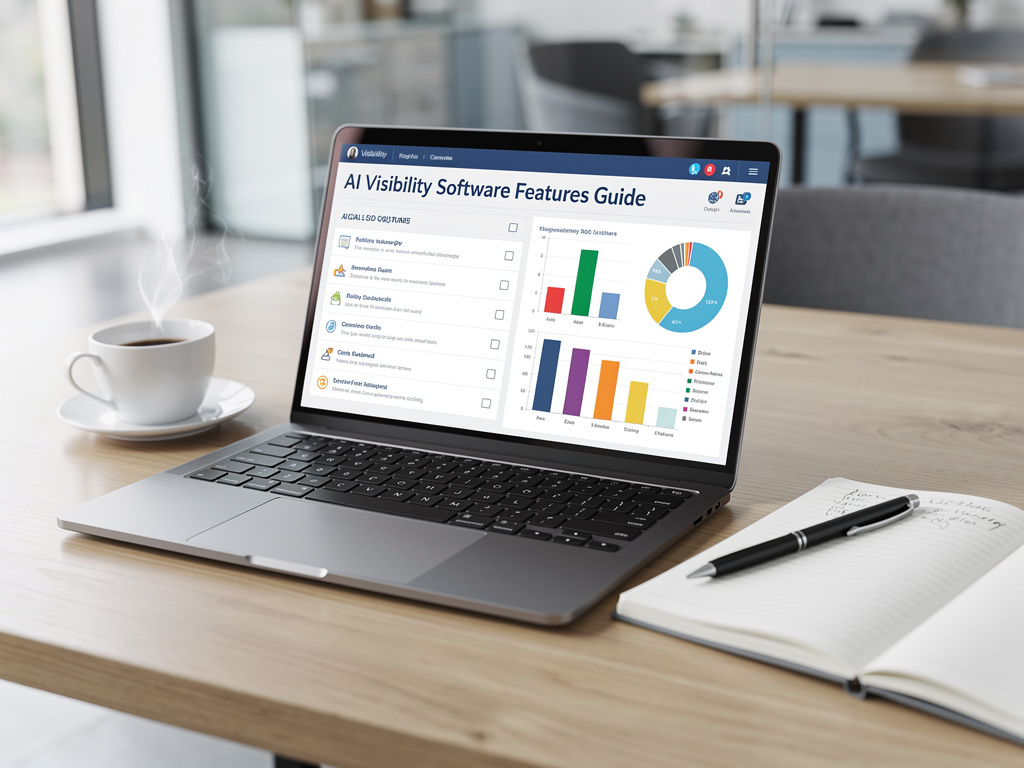
AI Visibility Software Features Checklist: The Complete Guide for 2026
AI search engines have changed everything. ChatGPT, Perplexity, Claude, and Google AI Overviews now answer millions of questions daily. Your brand needs to show up in these conversations. But how do you know if you’re actually appearing in AI-generated responses?
That’s where AI visibility software comes in. These tools track how often AI platforms mention your brand, which sources they cite, and how you stack up against competitors. Without this data, you’re flying blind in a market that’s shifting fast.
This guide breaks down the must-have features for any AI visibility tracking tool. We’ll compare the top platforms, explain what each feature does, and help you build a complete checklist for picking the right solution. Whether you’re running a marketing agency or managing an enterprise brand, you’ll find what you need here.
Why AI Visibility Tracking Matters in 2026
Traditional SEO tools can’t see what happens inside AI chat interfaces. They track Google rankings and keyword positions. But they miss the conversational layer completely. This creates a huge gap in your marketing data.
Think about how people search now. They don’t just type keywords into Google. They ask ChatGPT for recommendations. They use Perplexity to research products. They rely on Claude for comparisons. Your brand either shows up in these answers or it doesn’t.
Standard rank trackers ignore this entire channel. They can’t tell you if ChatGPT recommends your product when someone asks “what’s the best project management tool?” They can’t show you which competitors get mentioned instead.
AI visibility software fills this gap. It monitors conversational AI platforms and tracks:
- How often your brand appears in AI responses
- Which prompts trigger mentions of your company
- What sources AI models cite when discussing your industry
- How your visibility compares to direct competitors
- Changes in your AI presence over time
This data shapes your content strategy. It tells you where you’re winning and where you’re losing ground. Without it, you’re guessing about a channel that influences more buying decisions every day.
Core Features Every AI Visibility Tool Must Have
Not all AI visibility platforms offer the same capabilities. Some focus on basic monitoring. Others provide deep analytics and actionable recommendations. Before you commit to any tool, check for these fundamental features.
Real-Time AI Response Monitoring
The foundation of any visibility tracker is its monitoring capability. The tool needs to check AI platforms regularly and capture actual responses. Look for platforms that monitor:
- ChatGPT (including GPT-4 and newer models)
- Perplexity (both free and Pro versions)
- Claude (Anthropic’s AI assistant)
- Google AI Overviews (the AI summaries in search results)
- Bing Copilot (Microsoft’s AI integration)
- Meta AI (across Facebook and Instagram)
The best tools check these platforms multiple times per day. AI responses can change based on updates to the underlying models. Weekly monitoring isn’t enough anymore.
Citation Source Tracking
When AI platforms mention information, they often cite sources. Knowing which URLs get cited helps you understand where AI models pull their data. This feature shows you:
- Which of your pages AI models reference
- Competitor pages that get cited in your industry
- High-authority sources that appear frequently
- Gaps where your content should be cited but isn’t
Citation tracking guides your content strategy. If a competitor’s page gets cited for a topic you should own, you know exactly what to improve.
Competitor Benchmarking
Visibility means nothing in isolation. You need to know how you compare to competitors. Strong benchmarking features let you:
- Track multiple competitors simultaneously
- See share of voice across AI platforms
- Identify prompts where competitors outrank you
- Monitor changes in competitive positioning
This data drives prioritization. Focus your efforts where competitors are winning conversations you should own.
Prompt Query Management
AI visibility depends on asking the right questions. You need to monitor prompts that matter to your business. Good tools let you:
- Add custom prompt queries for your industry
- Group prompts by topic or product category
- Track branded and non-branded queries separately
- Discover new prompts based on AI suggestions
The prompt library you build determines what you can track. Start with queries your customers actually ask.
Advanced Features That Separate Good Tools from Great Ones
Basic monitoring gets you started. But advanced features deliver real competitive advantage. These capabilities turn raw data into actionable insights.
Actionable Optimization Recommendations
Seeing visibility gaps is one thing. Knowing how to fix them is another. The best platforms don’t just show problems. They suggest solutions. Look for:
- Content optimization tips based on what AI models prefer
- Specific page recommendations for improving citations
- Authority building suggestions to increase brand mentions
- Prompt-specific guidance for targeting key queries
Platforms like Athena include an “Action Center” that identifies visibility gaps and recommends fixes. Frase integrates optimization directly into its workflow. These features save hours of manual analysis.
Historical Trend Analysis
AI visibility changes over time. Model updates, new content, and competitor actions all affect your presence. Historical tracking shows:
- Visibility trends over weeks and months
- Impact of your optimization efforts
- Seasonal patterns in AI responses
- Correlation between content changes and visibility shifts
Without historical data, you can’t measure progress. Make sure your tool stores results for at least 12 months.
Sentiment Analysis
Getting mentioned isn’t always positive. AI platforms might describe your brand negatively or position you unfavorably against competitors. Sentiment analysis reveals:
- Whether mentions are positive, neutral, or negative
- How AI characterizes your brand versus competitors
- Changes in sentiment over time
- Specific content driving negative perceptions
This feature protects your brand reputation in AI channels.
Multi-Location and Multi-Language Support
AI responses vary by location and language. A query in English might produce different results than the same query in Spanish. Global brands need tools that track:
- Visibility across different countries
- Language-specific AI responses
- Regional competitor presence
- Localized content performance
Check coverage before committing. Not all tools support international tracking.
Integration and Workflow Features to Check
AI visibility data becomes more powerful when it connects to your existing tools. Integration capabilities determine how easily you can act on insights.
Content Management System Integration
Some platforms connect directly to your CMS. This lets you edit content based on AI visibility insights without switching tools. Frase, for example, integrates visibility tracking with content research and publishing.
Look for integrations with:
- WordPress and other popular CMS platforms
- Headless CMS systems
- Content collaboration tools
- Publishing workflows
SEO Tool Integration
AI visibility should complement your existing SEO strategy. The best tools connect with platforms like:
- Google Search Console
- Google Analytics
- Semrush
- Ahrefs
- Moz
This integration helps you see the full picture. Track traditional search and AI visibility in one view.
Reporting and Export Options
You’ll need to share AI visibility data with stakeholders. Reporting features should include:
- Automated reports delivered on schedule
- Custom dashboards for different audiences
- Export formats like PDF, CSV, and Excel
- White-label options for agencies
Agencies especially need white-label reports for client presentations.
API Access
Technical teams may want to build custom workflows around AI visibility data. API access enables:
- Custom integrations with internal tools
- Automated data pipelines
- Custom reporting dashboards
- Bulk operations and data extraction
Not every team needs API access, but it’s valuable for advanced use cases.
Your Complete AI Visibility Software Features Checklist
Use this checklist when evaluating any AI visibility platform. Check off each feature to ensure the tool meets your needs.
Monitoring Capabilities
- ☐ Tracks ChatGPT responses
- ☐ Monitors Perplexity mentions
- ☐ Covers Claude responses
- ☐ Includes Google AI Overviews
- ☐ Supports Bing Copilot
- ☐ Tracks Meta AI (if relevant)
- ☐ Updates data at least daily
- ☐ Stores historical response data
Analytics Features
- ☐ Provides citation source tracking
- ☐ Shows competitor benchmarking
- ☐ Calculates share of voice
- ☐ Includes sentiment analysis
- ☐ Offers trend analysis over time
- ☐ Displays visibility scores or metrics
Query and Prompt Management
- ☐ Allows custom prompt addition
- ☐ Supports prompt grouping and organization
- ☐ Separates branded and non-branded queries
- ☐ Suggests new prompts to track
- ☐ Handles sufficient query volume for your needs
Optimization Tools
- ☐ Provides actionable recommendations
- ☐ Identifies content gaps
- ☐ Suggests optimization priorities
- ☐ Connects insights to specific pages
- ☐ Includes content creation workflows
Integration and Reporting
- ☐ Integrates with SEO tools
- ☐ Connects to Google Analytics/Search Console
- ☐ Offers automated reporting
- ☐ Supports custom dashboards
- ☐ Provides API access
- ☐ Includes white-label options (for agencies)
Usability and Support
- ☐ Offers intuitive interface
- ☐ Provides onboarding support
- ☐ Includes documentation and resources
- ☐ Has responsive customer support
- ☐ Supports multi-user access
- ☐ Offers role-based permissions
Top AI Visibility Tools Compared: Detailed Reviews
Now let’s look at the leading platforms in the market. Each tool has different strengths. Your choice depends on your specific needs, budget, and existing tech stack.
Profound
Founded in 2024, Profound quickly became a leader in AI visibility tracking. The platform monitors all 10 major AI answer engines and provides detailed insights into your brand’s presence.
Key Features:
- Comprehensive coverage across all major AI platforms
- Automated content creation workflows
- Deep answer engine insights
- Agency-friendly white-label options
- Competitive benchmarking tools
Best For: Enterprises and agencies that need all-in-one tracking with content optimization. The platform excels at turning visibility data into actionable content strategies.
Pricing: Starting at $82.50/month when billed annually. Enterprise plans available for larger organizations.
Standout Capability: Profound combines visibility tracking with automated content workflows. You can identify gaps and create optimized content without switching platforms.
Frase
Frase takes a unique approach by integrating AI visibility tracking with content research and optimization. While other tools focus solely on monitoring, Frase helps you discover problems and fix them in one platform.
Key Features:
- Real-time AI response monitoring
- Content research and optimization tools
- Direct publishing capabilities
- Competitor analysis
- Custom prompt tracking
Best For: Content teams that want to combine visibility tracking with content creation. The integrated workflow speeds up optimization.
Pricing: Various tiers available based on usage and features needed.
Standout Capability: The ability to add target prompt queries and competitors, then track visibility across multiple AI platforms simultaneously. Frase positions AI tracking as part of a complete content workflow.
Otterly.AI
Otterly.AI stands out for its affordability and ease of use. The platform provides solid AI visibility tracking without the enterprise price tag.
Key Features:
- Multi-platform AI monitoring
- Competitor tracking
- Citation analysis
- Regular visibility updates
- Simple dashboard interface
Best For: Small businesses and startups that need AI visibility tracking on a budget. Also works well for agencies with cost-conscious clients.
Pricing: Free trial available. Paid plans start at $25/month when billed annually. This makes it one of the most accessible options.
Standout Capability: The price-to-value ratio is excellent. You get core visibility tracking features without paying enterprise prices.
Athena
Athena positions itself as a Generative Engine Optimization (GEO) platform. The tool combines prompt tracking with an Action Center that helps identify and fix visibility gaps.
Key Features:
- Prompt tracking across AI platforms
- Action Center with optimization recommendations
- GEO-focused approach
- Competitor benchmarking
- Visibility gap identification
Best For: Teams that want specific guidance on improving AI visibility, not just monitoring data.
Pricing: Contact for pricing details.
Standout Capability: The Action Center feature sets Athena apart. It doesn’t just show you visibility problems. It tells you exactly what to fix and why.
Semrush AI Visibility
Semrush, the established SEO platform, now includes AI visibility tracking. This makes it attractive for teams already using Semrush for traditional SEO.
Key Features:
- AI visibility tracking integrated with SEO tools
- Existing Semrush data and workflows
- Comprehensive keyword and competitor data
- One platform for SEO and AI visibility
- Strong reporting capabilities
Best For: Teams already using Semrush who want to add AI visibility without adopting a new platform.
Pricing: Starting at $99/month as part of Semrush subscription.
Standout Capability: The integration with Semrush’s existing SEO tools creates a unified view of traditional and AI search performance.
Ahrefs AI Tracking
Ahrefs, another SEO giant, offers AI visibility as an add-on feature. The platform focuses on benchmarking brand performance across AI platforms.
Key Features:
- AI visibility as add-on to core SEO tools
- Brand performance benchmarking
- Strong backlink and authority data
- Competitor comparison
- Integration with Ahrefs keyword data
Best For: Existing Ahrefs users who want to expand into AI visibility tracking.
Pricing: Add-on starting at $199/month on top of Ahrefs subscription.
Standout Capability: Ahrefs brings its expertise in backlink analysis to AI visibility. Understanding which pages have authority helps explain why AI models cite certain sources.
Similarweb
Similarweb offers side-by-side SEO and GEO tracking. The platform provides a comprehensive view of how traffic flows from both traditional and AI search.
Key Features:
- Combined SEO and AI visibility tracking
- Traffic analysis from AI sources
- Competitive intelligence
- Market analysis tools
- Enterprise-grade reporting
Best For: Enterprise teams that need comprehensive market intelligence alongside AI visibility tracking.
Pricing: Contact sales for custom pricing.
Standout Capability: The ability to see AI visibility alongside traditional traffic data provides valuable context for strategic decisions.
Peec AI
Peec AI focuses on smart suggestions for improving AI visibility. The platform analyzes your current presence and recommends specific improvements.
Key Features:
- AI-powered optimization suggestions
- Visibility monitoring
- Competitor tracking
- Content recommendations
- Performance tracking over time
Best For: Teams that want guidance on what to improve, not just data on current performance.
Pricing: Free trial available. Paid plans start at €89/month.
Standout Capability: The smart suggestion feature helps prioritize optimization efforts based on potential impact.
ZipTie
ZipTie specializes in deep analysis and comprehensive reporting. The platform provides detailed breakdowns of AI visibility metrics.
Key Features:
- Deep visibility analysis
- Comprehensive reporting tools
- Detailed metric breakdowns
- Competitor comparison
- Historical trend tracking
Best For: Analysts and strategists who need detailed data for decision-making.
Pricing: Starting at $58.65/month when billed annually.
Standout Capability: The depth of analysis and reporting options suit teams that need to present detailed findings to stakeholders.
Clearscope
Clearscope approaches AI visibility from a content creator’s perspective. The platform helps writers optimize content for both traditional and AI search.
Key Features:
- Content optimization for AI visibility
- Writing tools and suggestions
- Search intent analysis
- Competitive content analysis
- Integration with content workflows
Best For: Content creators and writers who need to optimize for AI visibility as part of their workflow.
Pricing: Starting at $129/month.
Standout Capability: The content-first approach helps writers create AI-friendly content from the start rather than optimizing after publication.
Comparison Table: AI Visibility Tool Features
| Tool | Best For | Starting Price | AI Platforms Covered | Key Strength |
|---|---|---|---|---|
| Profound | Enterprise & agencies | $82.50/month | 10+ platforms | All-in-one with content workflows |
| Frase | Content teams | Varies | Multiple platforms | Integrated content optimization |
| Otterly.AI | Budget-conscious teams | $25/month | Multiple platforms | Affordability |
| Athena | Action-oriented teams | Contact sales | Multiple platforms | Action Center recommendations |
| Semrush | Existing Semrush users | $99/month | Multiple platforms | SEO tool integration |
| Ahrefs | Existing Ahrefs users | $199/month add-on | Multiple platforms | Authority and backlink data |
| Similarweb | Enterprise teams | Contact sales | Multiple platforms | Combined SEO/GEO tracking |
| Peec AI | Optimization-focused teams | €89/month | Multiple platforms | Smart suggestions |
| ZipTie | Analysts and strategists | $58.65/month | Multiple platforms | Deep analysis and reporting |
| Clearscope | Content creators | $129/month | Multiple platforms | Content-first approach |
How to Choose the Right AI Visibility Tracker
With so many options available, choosing the right tool requires careful consideration. Here’s a framework for making your decision.
Consider Your Primary Use Case
Different tools excel at different things. Start by identifying your main goal:
- Monitoring only: If you just need to track visibility without optimization features, simpler tools like Otterly.AI work well.
- Content optimization: If you want to create better content based on AI visibility data, consider Frase or Clearscope.
- Competitive intelligence: If competitor benchmarking is your priority, look at Profound or Similarweb.
- Unified SEO platform: If you already use Semrush or Ahrefs, their AI visibility add-ons make sense.
Evaluate Your Budget
Pricing varies dramatically. Set realistic expectations based on your budget:
- Under $50/month: Otterly.AI offers the best value at this price point.
- $50-150/month: ZipTie, Peec AI, and Clearscope fit this range.
- $150+/month: Profound, Semrush, and enterprise tools provide more comprehensive features.
Remember that cheaper tools may limit query volumes or platform coverage. Calculate the cost per tracked query to compare accurately.
Check Platform Coverage
Not all tools monitor the same AI platforms. Consider which platforms matter most for your audience:
- ChatGPT: Essential for most businesses. Nearly all tools cover it.
- Perplexity: Growing rapidly. Most tools include it.
- Google AI Overviews: Affects traditional search traffic. Check if your tool covers it.
- Claude: Important for technical and professional audiences.
- Bing Copilot: Relevant if your audience uses Microsoft products.
Test Before Committing
Most tools offer free trials or demos. Use them to:
- Test the interface and usability
- Check data quality and accuracy
- Evaluate reporting features
- Assess customer support responsiveness
- Verify integration with your existing tools
A trial period reveals issues that marketing materials won’t mention.
Turning AI Visibility Data into Actionable Results
Tracking AI visibility is just the start. The real value comes from acting on the data. Here’s how to turn insights into improvements.
Identify High-Priority Prompts
Not all prompts matter equally. Focus on queries that:
- Have high search volume or business value
- Show competitor dominance you can challenge
- Align with your strongest content or products
- Represent buying intent rather than just research
Prioritize prompts where improvement will have the biggest impact.
Analyze Citation Patterns
Look at which sources AI models cite for topics you want to own. Ask:
- What makes cited pages different from yours?
- Do cited sources have more authority, detail, or freshness?
- Can you create better content than current citation sources?
- Are there content gaps you should fill?
This analysis guides content strategy and prioritization.
Build Authority Signals
AI models prefer authoritative sources. Improve your authority by:
- Creating original research and data
- Building high-quality backlinks
- Getting mentioned by industry publications
- Publishing expert content consistently
- Updating content to stay current
Authority building takes time but produces lasting results.
Optimize Content Structure
AI models extract information more easily from well-structured content. Improve your structure by:
- Using clear headings and subheadings
- Writing concise, direct answers to common questions
- Including lists and tables for easy extraction
- Adding relevant statistics and facts
- Updating publication dates regularly
Structured content makes it easier for AI to cite you accurately.
Common Mistakes to Avoid with AI Visibility Tools
Many teams make predictable errors when starting with AI visibility tracking. Avoid these pitfalls:
Tracking Too Few Prompts
Starting with just a handful of queries limits your insights. You need enough data to identify patterns and opportunities. Aim for at least 50-100 prompts initially, then expand based on findings.
Ignoring Non-Branded Queries
Branded queries (like “what is [your company]?”) matter, but non-branded queries often have more volume. Track category and problem-based queries like “best tool for X” or “how to solve Y.”
Checking Data Too Infrequently
AI responses change regularly. Monthly check-ins miss important shifts. Review your visibility data at least weekly, and set up alerts for significant changes.
Not Acting on Insights
The most common mistake is collecting data without taking action. Assign ownership for visibility improvements and track progress over time.
Focusing Only on Your Brand
Competitor data is just as valuable as your own. Understand where competitors succeed and why. Learn from their visibility wins.
The Future of AI Visibility Tracking
AI visibility tools are evolving rapidly. Watch for these developments in 2026 and beyond.
More AI Platforms to Monitor
New AI assistants launch regularly. Your visibility tool needs to keep pace with platforms like:
- Industry-specific AI assistants
- Voice AI platforms
- AI features in social media apps
- Enterprise AI tools
Choose tools that commit to expanding platform coverage.
Deeper Behavioral Integration
Future tools will connect AI visibility to business outcomes. Amplitude already tracks how AI-referred traffic converts and engages. Expect more platforms to link visibility to revenue impact.
Automated Optimization
Manual optimization is time-consuming. Future tools will increasingly automate the process of improving AI visibility. AI agents may handle content updates and authority building with minimal human input.
More Sophisticated Benchmarking
Current benchmarking is basic. Future tools will offer more nuanced competitive analysis, including:
- Market share by topic area
- Momentum indicators
- Prediction models for visibility changes
- Industry-specific benchmarks
Better benchmarking means better strategic decisions.
Setting Up Your AI Visibility Tracking Program
Ready to start tracking? Follow this step-by-step approach.
Week 1: Tool Selection and Setup
- Review your checklist requirements
- Test 2-3 tools with free trials
- Select and subscribe to your chosen platform
- Connect integrations with existing tools
Week 2: Prompt Library Building
- Research queries your customers ask
- Add branded and non-branded prompts
- Include competitor names in tracking
- Organize prompts by category
Week 3: Baseline Analysis
- Review initial visibility data
- Document current performance levels
- Identify biggest gaps and opportunities
- Set improvement targets
Week 4 and Beyond: Optimization and Monitoring
- Prioritize content improvements based on data
- Track changes in visibility over time
- Expand prompt library based on findings
- Report progress to stakeholders
Conclusion
AI visibility tracking isn’t optional anymore. As more people use ChatGPT, Perplexity, and other AI platforms to find products and answers, your brand needs to show up in those conversations. The right AI visibility software gives you the data to compete effectively.
Use the checklist in this guide to evaluate your options. Focus on the features that match your specific needs, budget, and existing tech stack. Then take action on the insights you gather. Visibility data only helps if you use it to improve.
FAQs About AI Visibility Software Features Checklist
| Who should use AI visibility tracking software? | Marketing teams, SEO professionals, brand managers, and agencies all benefit from AI visibility tools. Any organization that wants to understand and improve how they appear in AI-generated responses should consider these platforms. B2B companies and consumer brands alike need this data as AI search grows. |
| What’s the difference between traditional SEO tools and AI visibility software? | Traditional SEO tools track rankings in search engine results pages. AI visibility software monitors mentions and citations in conversational AI platforms like ChatGPT and Perplexity. These are different channels with different optimization requirements. Most brands need both types of tools. |
| How much does AI visibility tracking cost? | Prices range from $25/month for budget options like Otterly.AI to several hundred dollars monthly for enterprise platforms. Most mid-range tools cost $80-150/month. Choose based on the features you need and the query volume you’ll track. |
| Which AI platforms should I track? | At minimum, track ChatGPT and Perplexity as they have the highest user volumes. Google AI Overviews matters if organic search traffic is important to you. Claude and Bing Copilot are worth tracking for B2B and enterprise audiences. Start with the platforms your customers use most. |
| How often do AI visibility tools update their data? | Most tools update daily or multiple times per day. Some enterprise platforms offer near-real-time monitoring. Weekly or monthly updates aren’t sufficient because AI responses change frequently. Check update frequency before choosing a tool. |
| Can I track competitors with AI visibility software? | Yes, competitive tracking is a core feature of most AI visibility tools. You can monitor how often competitors get mentioned, which prompts trigger their appearance, and how your visibility compares. This data helps you identify opportunities and prioritize improvements. |
| What’s the most important feature in an AI visibility tool? | Real-time monitoring across multiple AI platforms is the foundation. Without accurate, current data, other features don’t matter. After monitoring, actionable recommendations and competitor benchmarking add the most value for most teams. |
| Do I need AI visibility tracking if I already use Semrush or Ahrefs? | Both Semrush and Ahrefs now offer AI visibility features as add-ons. If you’re happy with their coverage and capabilities, you may not need a separate tool. But dedicated AI visibility platforms often provide deeper analysis and more AI platform coverage. |
| How long does it take to see results from AI visibility optimization? | Initial improvements can appear within weeks as you optimize content structure and fill obvious gaps. Building authority and earning consistent citations takes 3-6 months of sustained effort. Track progress regularly to measure what’s working. |
| Should agencies use white-label AI visibility tools? | Yes, white-label options let agencies present AI visibility data under their own branding. This strengthens client relationships and positions the agency as an AI visibility expert. Look for tools like Profound that offer agency-specific plans with white-label reporting. |





 Stack Insight is intended to support informed decision-making by providing independent information about business software and services. Some product details, including pricing, features, and promotional offers, may be supplied by vendors or partners and can change without notice.