
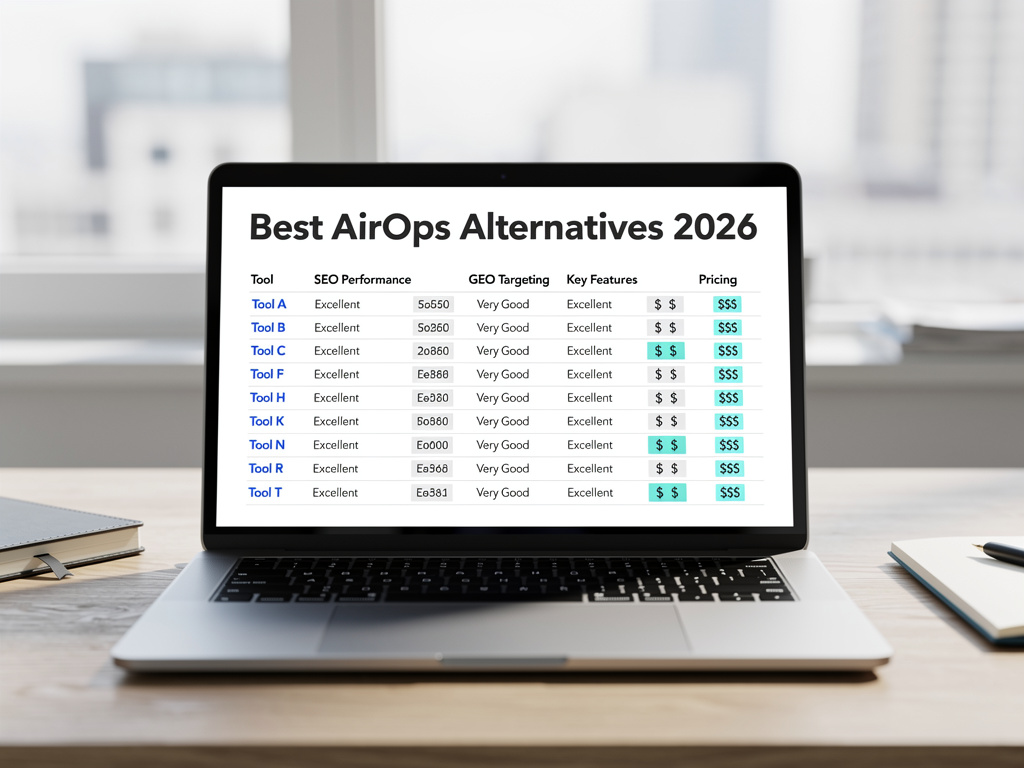
Best AirOps Alternatives: 20 Tools for AI Visibility, GEO, and SEO in 2026
If you’ve been using AirOps for your AI-powered content and SEO workflows, you’ve probably noticed some gaps. Maybe the pricing doesn’t fit your budget. Maybe you need features that AirOps just doesn’t offer. Or maybe you’re looking for something more specialized for your specific use case.
Good news: there are plenty of solid alternatives out there. Some focus on generative engine optimization (GEO). Others help you track how AI models perceive your brand. A few specialize in content creation. And some combine multiple capabilities into one platform.
This guide breaks down 20 AirOps competitors across different categories. We’ll look at what each tool does best, where it falls short, who should use it, and how much it costs. By the end, you’ll have a clear picture of which option makes sense for your specific needs.
What to Look for in AirOps Competitors
Before diving into specific tools, let’s establish what makes a good alternative to AirOps. Not every tool will check every box. That’s fine. What matters is finding one that solves your particular problem.
Core Features to Evaluate
When comparing AI workflow and SEO tools, pay attention to these areas:
- AI content capabilities: Can it generate, edit, and refine content at scale?
- SEO integration: Does it connect with search data and help you rank?
- GEO tracking: Can it monitor how AI chatbots mention your brand?
- Workflow automation: Does it let you build custom AI workflows without coding?
- Data connections: Can it pull from your existing tools and databases?
- Pricing flexibility: Is there a free tier? Does pricing scale reasonably?
Why People Switch from AirOps
AirOps works well for certain use cases. But users often look for alternatives because:
- They need better GEO monitoring features
- The pricing exceeds their budget for the features they actually use
- They want simpler interfaces for non-technical team members
- They need deeper integration with specific platforms
- They’re looking for more specialized tools instead of all-in-one solutions
Keep these factors in mind as we review each alternative below.
Whitebox: Enterprise AI Visibility and Brand Monitoring
Whitebox takes a different approach than most content tools. It focuses specifically on how AI systems perceive and represent your brand. This matters more than ever as people increasingly get information from ChatGPT, Perplexity, and similar AI assistants.
Key Features of Whitebox
The platform tracks brand mentions across major AI models. You can see exactly what these systems say when users ask about your company or products.
- AI brand monitoring: Track mentions across ChatGPT, Claude, Gemini, and others
- Sentiment analysis: Understand how AI models describe your brand
- Competitor comparison: See how you stack up against rivals in AI responses
- Alert system: Get notified when AI models start saying something new about you
- Historical tracking: Watch how AI perceptions change over time
Who Should Use Whitebox
Enterprise brands with reputation management concerns will get the most value here. If you’re worried about what ChatGPT tells millions of users about your company, Whitebox helps you monitor and respond.
It’s less useful for small businesses or those focused purely on content creation. The strength is monitoring, not generating.
Pricing and Value
Whitebox targets enterprise clients, so expect higher pricing than consumer tools. They typically offer custom quotes based on the number of brands and queries you need to track.
Pros: Deep AI monitoring capabilities, multi-model tracking, enterprise-grade reporting
Cons: Expensive for smaller teams, no content creation features, steep learning curve
Profound: AI-Powered Market Research Platform
Profound positions itself as an AI research assistant that goes beyond simple content generation. It’s built for teams that need to understand markets, competitors, and trends at a deeper level.
What Makes Profound Different
While many tools focus on creating content, Profound helps you figure out what content to create. It analyzes market data, identifies gaps, and suggests opportunities.
- Market analysis: Automated research on industries and competitors
- Trend identification: Spots emerging topics before they peak
- Research synthesis: Pulls together data from multiple sources
- Custom reports: Generates formatted research documents
- Data visualization: Creates charts and graphs from findings
Best Use Cases for Profound
Content strategists and market researchers get the most out of Profound. It’s particularly useful for:
- Quarterly market reports
- Competitive analysis presentations
- New market entry research
- Trend analysis for content planning
Limitations to Consider
Profound isn’t a direct AirOps replacement if you need workflow automation or content generation at scale. It’s a research tool first. Think of it as a complement to your content creation stack, not a replacement.
Pros: Strong research capabilities, good data synthesis, saves hours on manual research
Cons: Limited content creation, no SEO tools built in, requires additional tools for full workflow
Otterly AI: GEO Tracking and AI Search Visibility
Otterly AI focuses squarely on generative engine optimization. If you care about appearing in AI-generated answers, this tool was built for you.
Core Capabilities of Otterly AI
The platform monitors your visibility across AI search engines and chatbots. You can track how often you appear in AI responses and what context surrounds those mentions.
- AI search tracking: Monitor appearances in Perplexity, ChatGPT, and others
- Ranking analysis: See where you fall in AI-generated lists
- Citation tracking: Know when AI models cite your content as sources
- Competitor monitoring: Compare your AI visibility to competitors
- Recommendation tracking: See when AI recommends your products or services
Why GEO Matters in 2026
Traditional SEO still matters. But more people now ask AI assistants for recommendations instead of searching Google. If ChatGPT doesn’t mention your brand when someone asks about your category, you’re missing traffic.
Otterly AI helps you understand and improve this visibility. It shows you exactly what AI models say and helps you figure out how to influence those responses.
Pricing Structure
Otterly AI offers tiered pricing based on the number of queries and competitors you track. They have a free trial that lets you test core features before committing.
Pros: Purpose-built for GEO, covers major AI platforms, actionable insights
Cons: Narrow focus on monitoring, no content creation, newer platform with less track record
Peec AI: Video Content Analysis and Optimization
Peec AI takes a unique angle among AirOps substitutes. It focuses on video content, analyzing and improving your video marketing efforts with AI.
Video-Specific Features
Most content tools focus on text. Peec AI recognizes that video dominates online engagement and builds its features around that reality.
- Video analysis: AI reviews your videos for engagement factors
- Script suggestions: Recommendations for improving video scripts
- Thumbnail optimization: Analysis of what makes thumbnails click-worthy
- SEO for video: Title, description, and tag suggestions
- Performance prediction: Estimates how well videos might perform
Integration with Content Workflows
Peec AI works alongside other tools in your stack. You might use it specifically for video while using another tool for written content. This modular approach works well for teams with heavy video investment.
Who Benefits Most
YouTube creators, video marketers, and brands with significant video content investments will find the most value. If video is a small part of your strategy, Peec AI probably isn’t worth the investment.
Pros: Specialized video focus, unique in the market, actionable video improvements
Cons: Only useful for video content, doesn’t replace general content tools, limited to specific use cases
AthenaHQ: AI Knowledge Management for Teams
AthenaHQ approaches the problem from a knowledge management angle. It helps teams organize, share, and use information more effectively with AI assistance.
Knowledge Management Features
The platform acts as a smart repository for your team’s knowledge. AI helps surface relevant information and connect related ideas.
- Smart search: Find information using natural language queries
- Knowledge graphs: Visual connections between related content
- Auto-organization: AI categorizes and tags content automatically
- Team collaboration: Shared workspaces for research and content
- Integration hub: Connects with existing tools like Notion and Confluence
Content Creation Support
While not primarily a content creation tool, AthenaHQ helps teams create better content by making relevant information accessible. Writers can quickly find data, examples, and research to support their work.
Team Size and Use Cases
AthenaHQ works best for mid-sized to large teams with lots of institutional knowledge. Small teams or solo creators probably don’t need this level of organization.
Pros: Excellent knowledge organization, improves team efficiency, good integrations
Cons: Not a direct content creation tool, requires team adoption, takes time to set up properly
Goodie AI: Simplified Content Generation
Goodie AI strips away complexity to offer straightforward content generation. It’s one of the more accessible options for teams new to AI tools.
Simplicity as a Feature
Where AirOps and similar tools offer extensive customization, Goodie AI prioritizes ease of use. You can start creating content within minutes of signing up.
- Template library: Pre-built templates for common content types
- One-click generation: Simple prompts produce usable content
- Brand voice saving: Store your tone and style preferences
- Quick editing: In-app tools for refining generated content
- Export options: Easy output to various formats
Trade-offs to Consider
The simplicity comes with limitations. You won’t find advanced workflow automation or deep customization. Power users might feel constrained.
But for teams that just need to produce good content quickly without a steep learning curve, Goodie AI delivers.
Pricing Approach
Goodie AI typically offers a generous free tier, making it easy to test. Paid plans scale based on usage volume.
Pros: Very easy to use, fast setup, affordable entry point
Cons: Limited advanced features, may outgrow quickly, less customization
Bluefish AI: B2B Content Specialization
Bluefish AI targets B2B marketers specifically. The templates, tone suggestions, and content structures all cater to business-focused content.
B2B-Focused Features
Generic content tools often produce content that sounds too casual for B2B contexts. Bluefish AI understands the nuances of professional content.
- Industry templates: Pre-built formats for whitepapers, case studies, and reports
- Professional tone: Content that matches B2B expectations
- Data integration: Pull statistics and data into content easily
- Compliance awareness: Helps avoid problematic claims in regulated industries
- Sales enablement: Content designed to support sales processes
When Bluefish AI Makes Sense
B2B companies producing content for professional audiences will appreciate the specialization. If you’re tired of editing consumer-focused AI content to sound more professional, Bluefish AI saves that effort.
Limitations
The B2B focus means it’s not ideal for consumer brands or casual content. The professional tone can feel stiff for some applications.
Pros: Purpose-built for B2B, professional output, industry-specific templates
Cons: Not versatile, too formal for some uses, narrower audience
Scrunch: Influencer Marketing Meets AI
Scrunch combines influencer marketing tools with AI capabilities. It’s an interesting option for teams that blend content creation with influencer partnerships.
Influencer and Content Features
The platform helps you find, evaluate, and work with influencers while also supporting content creation efforts.
- Influencer discovery: AI-powered search for relevant creators
- Audience analysis: Deep data on influencer audiences
- Campaign management: Tools for organizing influencer partnerships
- Content collaboration: Shared spaces for working with creators
- Performance tracking: Monitor campaign results across channels
Unique Position in the Market
Few tools combine influencer marketing with broader content capabilities. If influencer partnerships are part of your strategy, Scrunch offers integration you won’t find elsewhere.
Who Should Consider Scrunch
Brands with active influencer programs get the most value. If you don’t work with influencers, other tools on this list will serve you better.
Pros: Unique influencer focus, good campaign tools, combined capabilities
Cons: Requires influencer focus to justify, content features less developed, niche application
Brandlight: Brand Management and AI Content
Brandlight focuses on maintaining brand consistency across AI-generated content. It’s built for teams worried about keeping their brand voice intact at scale.
Brand Consistency Features
The platform learns your brand guidelines and applies them automatically to generated content.
- Brand voice profiles: Detailed settings for tone, style, and terminology
- Asset management: Central storage for logos, images, and templates
- Consistency scoring: AI rates how well content matches brand guidelines
- Multi-team support: Different settings for different brands or departments
- Approval workflows: Built-in processes for content review
Enterprise Applications
Large organizations with strict brand standards benefit most. If multiple teams create content and brand consistency matters, Brandlight helps maintain that.
Smaller Team Considerations
For small teams or single-brand companies, Brandlight might be overkill. Simpler tools can handle basic brand voice settings without the complexity.
Pros: Strong brand controls, good for enterprise, multi-brand support
Cons: Complex for simple needs, higher learning curve, enterprise pricing
Writesonic: Full-Featured Content Platform
Writesonic is one of the more established AirOps alternatives. It offers a broad feature set covering content creation, SEO, and AI chat capabilities.
Comprehensive Feature Set
The platform tries to be an all-in-one solution for content needs. Most teams will find their core requirements covered.
- Article generation: Long-form content creation with SEO focus
- Chatsonic: AI chatbot with real-time information access
- Image generation: Built-in AI image creation
- SEO tools: Keyword research and optimization features
- Brand voice: Customizable tone and style settings
- API access: Integration with other tools and workflows
Writesonic vs. AirOps
Where AirOps focuses on workflow automation, Writesonic emphasizes content creation. If you need to produce lots of content quickly, Writesonic excels. For complex automated workflows, AirOps might still have an edge.
Pricing Flexibility
Writesonic offers a free tier and multiple paid options. This makes it accessible for testing before committing significant budget.
Pros: Broad feature set, established platform, affordable entry point, good SEO tools
Cons: Jack of all trades can mean master of none, interface can feel cluttered, some features less polished than specialized tools
Trakkr: Influencer Analytics and Tracking
Trakkr specializes in tracking and analyzing influencer marketing performance. It’s another niche option for specific use cases.
Analytics Focus
The platform goes deep on influencer analytics, offering data you won’t find in more general tools.
- Performance tracking: Monitor influencer content performance in real-time
- ROI calculation: Attribute results to specific influencer partnerships
- Audience insights: Detailed demographics and engagement data
- Competitive analysis: See what influencers your competitors use
- Trend identification: Spot rising creators before they peak
Integration with Content Strategy
Trakkr’s insights can inform broader content strategy. Understanding what works for influencers helps you create better owned content too.
Limited Content Creation
This is an analytics tool, not a content creation platform. You’ll need other tools for actually producing content.
Pros: Deep influencer analytics, unique insights, competitive intelligence
Cons: Narrow focus, requires influencer investment, no content creation
Qwairy: Research and Discovery Platform
Qwairy helps teams research topics and discover opportunities before creating content. It’s built for the planning phase of content work.
Research Capabilities
The platform aggregates information from multiple sources to give you a complete picture of any topic.
- Topic research: Comprehensive information gathering on any subject
- Question analysis: What questions people ask about topics
- Source discovery: Find authoritative sources for citations
- Gap identification: See what’s missing in existing content
- Outline generation: Create content structures based on research
Position in Workflow
Qwairy works best at the beginning of content creation. Use it to plan, then move to other tools for actual writing.
Complementary Tool
Think of Qwairy as a complement to content creation tools, not a replacement. It makes your other tools more effective by improving the planning phase.
Pros: Strong research features, improves content quality, good source finding
Cons: Doesn’t create content, requires additional tools, adds workflow step
Azoma: AI Content Operations
Azoma positions itself as a content operations platform, helping teams manage the full lifecycle of content creation.
Operations Focus
The platform addresses the organizational challenges of content at scale, not just the creation part.
- Workflow management: Coordinate content from idea to publication
- Team coordination: Assign tasks and track progress
- Content calendar: Plan and schedule content across channels
- Approval processes: Built-in review and approval workflows
- Performance tracking: Monitor published content results
Team Collaboration
Azoma shines for teams with multiple content creators and complex approval processes. Solo creators or small teams might not need this level of coordination.
AI Assistance
While Azoma includes AI features, they support operations rather than replace content creation tools. You’ll likely use Azoma alongside other generation tools.
Pros: Strong operations focus, good team features, comprehensive workflow management
Cons: Limited content generation, requires team to be effective, additional tool needed for creation
Gauge: Content Performance Analytics
Gauge focuses on understanding how your content performs. It’s an analytics-first platform that helps you make better content decisions.
Performance Metrics
The platform tracks content performance across multiple dimensions and surfaces actionable insights.
- Engagement tracking: See how users interact with content
- Conversion attribution: Connect content to business outcomes
- Competitor comparison: Benchmark against similar content
- Content scoring: AI-powered quality and performance predictions
- Recommendation engine: Suggestions for improving content
Data-Informed Content
Gauge helps you understand what works and what doesn’t. This information improves future content decisions, even if Gauge doesn’t create the content itself.
Integration Requirements
To work effectively, Gauge needs to connect with your website and content platforms. Setup takes some technical effort.
Pros: Deep analytics, actionable insights, performance focus
Cons: No content creation, requires setup time, needs data volume to be useful
LLM Pulse: AI Model Monitoring
LLM Pulse tracks how large language models represent topics and brands. It’s specialized for understanding AI-generated content about your space.
Model Monitoring Features
The platform watches what AI models say and alerts you to changes.
- Multi-model tracking: Monitor GPT-4, Claude, Gemini, and others
- Topic analysis: See how AI discusses your industry
- Change detection: Alerts when AI responses shift
- Accuracy tracking: Identify when AI says wrong things about you
- Competitive monitoring: Compare your AI presence to competitors
GEO Strategy Support
LLM Pulse directly supports generative engine optimization efforts. Understanding how AI models currently represent you is step one of improving that representation.
Specialized Use Case
This tool serves a specific need. If AI visibility doesn’t matter to your business yet, LLM Pulse probably isn’t a priority.
Pros: Unique AI monitoring, multi-model coverage, early warning system
Cons: Very specialized, no content features, newer category of tool
Semrush: The SEO Giant
Semrush is a well-established SEO platform that has added AI features over time. It’s one of the most comprehensive options for search-focused teams.
Core SEO Features
Semrush built its reputation on SEO tools, and those remain strong.
- Keyword research: Extensive database and analysis tools
- Site audits: Technical SEO identification and fixes
- Backlink analysis: Comprehensive link data and opportunities
- Rank tracking: Monitor search positions over time
- Competitor analysis: See what works for your competitors
AI and Content Features
Semrush has added AI writing assistance and content optimization tools. While not as sophisticated as specialized AI tools, they integrate well with the SEO features.
- SEO Writing Assistant: Real-time optimization suggestions
- Content templates: SEO-focused briefs for writers
- AI writing: Basic content generation capabilities
- Topic research: Content ideas based on search data
Semrush vs. AirOps
Semrush excels at SEO but lacks the workflow automation that makes AirOps powerful. If you need deep SEO data with some content help, Semrush works well. For complex AI workflows, you might need additional tools.
Pros: Best-in-class SEO tools, established platform, comprehensive data, reliable
Cons: AI features less advanced, expensive for full features, can be overwhelming
Searchable: AI Search Discovery
Searchable helps you understand and improve your visibility in AI-powered search experiences.
AI Search Focus
The platform tracks how AI search engines find and present your content.
- AI search tracking: Monitor appearances in AI-powered search
- Content optimization: Suggestions for improving AI discoverability
- Citation tracking: See when AI sources cite your content
- Query analysis: Understand what queries trigger your appearances
- Competitive intelligence: Compare AI search visibility to competitors
Growing Importance
As more search happens through AI interfaces, tools like Searchable become more valuable. This is an emerging category worth watching.
Current Limitations
The AI search tracking space is still developing. Tools are improving rapidly, but expect some rough edges.
Pros: Forward-looking focus, unique insights, growing category
Cons: Newer platform, evolving features, limited track record
Spotlight: Brand Mention Monitoring
Spotlight tracks brand mentions across the web and AI systems. It’s a monitoring tool for understanding how people and AI discuss your brand.
Monitoring Capabilities
The platform aggregates mentions from multiple sources into one dashboard.
- Web monitoring: Track mentions across websites and social media
- AI monitoring: See what AI systems say about your brand
- Sentiment analysis: Understand the tone of mentions
- Alert system: Get notified of important mentions quickly
- Trend analysis: Watch how perception changes over time
Reputation Management
Spotlight supports reputation management efforts by giving you visibility into what’s being said. You can respond to issues faster when you know about them.
Not a Content Tool
Spotlight monitors but doesn’t create. You’ll need other tools for content production.
Pros: Comprehensive monitoring, good alert system, multi-source tracking
Cons: No content creation, requires response strategy, monitoring only
Citation Junction: Source and Citation Management
Citation Junction helps content creators find, manage, and properly cite sources. It’s a specialized tool for improving content credibility.
Citation Features
The platform streamlines the research and citation process.
- Source discovery: Find authoritative sources for any topic
- Citation formatting: Automatic formatting in multiple styles
- Source verification: Check reliability of potential sources
- Reference management: Organize sources for future use
- Plagiarism prevention: Ensure proper attribution
Content Quality Improvement
Good citations improve content credibility and SEO. Citation Junction makes it easier to properly source your claims.
Niche Application
This tool serves a specific need. If your content doesn’t require citations, you won’t need Citation Junction.
Pros: Improves content credibility, saves research time, good source management
Cons: Very specialized, not needed for all content, requires additional creation tools
iGEO: Generative Engine Optimization Specialist
iGEO focuses specifically on optimizing content for AI-powered search and recommendation systems. It’s built entirely around the GEO concept.
GEO-Specific Features
The platform offers tools designed specifically for AI visibility.
- AI optimization: Suggestions for improving AI discoverability
- Format optimization: Structure content for AI consumption
- Entity optimization: Improve how AI understands your content’s subjects
- Testing tools: See how AI models interpret your content
- Tracking: Monitor AI visibility over time
Future-Focused Approach
iGEO bets that AI-powered search will become increasingly important. If that prediction holds, early adopters of GEO practices will have an advantage.
Complementary Tool
iGEO works alongside traditional SEO tools rather than replacing them. You still need content creation and traditional SEO capabilities.
Pros: Deep GEO focus, forward-looking, specialized expertise
Cons: Narrow focus, newer discipline, requires other tools for full workflow
Comparison Table: AirOps Alternatives at a Glance
| Tool | Primary Focus | Best For | Content Creation | SEO Features | GEO Features | Free Tier |
|---|---|---|---|---|---|---|
| Whitebox | AI Brand Monitoring | Enterprise Brands | No | No | Yes | No |
| Profound | Market Research | Strategists | Limited | No | No | Yes |
| Otterly AI | GEO Tracking | SEO Teams | No | Partial | Yes | Yes |
| Peec AI | Video Optimization | Video Marketers | No | Video SEO | No | Yes |
| AthenaHQ | Knowledge Management | Large Teams | Limited | No | No | Yes |
| Goodie AI | Simple Content Creation | Small Teams | Yes | Basic | No | Yes |
| Bluefish AI | B2B Content | B2B Marketers | Yes | Partial | No | Yes |
| Scrunch | Influencer Marketing | Brand Marketers | Limited | No | No | Yes |
| Brandlight | Brand Management | Enterprise | Yes | Partial | No | No |
| Writesonic | Full-Featured Platform | Content Teams | Yes | Yes | Partial | Yes |
| Trakkr | Influencer Analytics | Influencer Teams | No | No | No | Yes |
| Qwairy | Research Platform | Content Planners | Limited | Research | No | Yes |
| Azoma | Content Operations | Content Teams | Limited | No | No | Yes |
| Gauge | Performance Analytics | Data Teams | No | Analytics | No | Yes |
| LLM Pulse | AI Model Monitoring | Brand Teams | No | No | Yes | Yes |
| Semrush | SEO Platform | SEO Teams | Yes | Yes | Partial | Limited |
| Searchable | AI Search Discovery | SEO Teams | No | Partial | Yes | Yes |
| Spotlight | Brand Monitoring | PR Teams | No | No | Partial | Yes |
| Citation Junction | Source Management | Content Creators | No | Indirect | No | Yes |
| iGEO | GEO Optimization | SEO Teams | No | Partial | Yes | Yes |
How to Choose the Right AirOps Alternative
With 20 options to consider, picking the right tool can feel overwhelming. Here’s how to narrow down your choice.
Start with Your Primary Need
Ask yourself: what’s the main problem you’re trying to solve? Different needs point to different tools:
- Need to create content at scale? Look at Writesonic, Goodie AI, or Bluefish AI
- Need to improve AI visibility? Consider Otterly AI, iGEO, or LLM Pulse
- Need better SEO data? Semrush is the clear leader
- Need to manage content operations? Try Azoma or AthenaHQ
- Need to monitor brand perception? Look at Whitebox, Spotlight, or LLM Pulse
Consider Your Team Size
Some tools work better for solo creators. Others require team adoption to deliver value.
- Solo creators: Goodie AI, Writesonic, Qwairy
- Small teams: Writesonic, Bluefish AI, Citation Junction
- Large teams: AthenaHQ, Brandlight, Azoma, Semrush
- Enterprise: Whitebox, Brandlight, Semrush
Factor in Your Budget
Prices vary widely across these tools. Start with free tiers where available. Upgrade once you’ve confirmed value.
Most tools on this list offer free trials or free tiers. Take advantage of those before committing budget.
Think About Integration
No single tool does everything well. Plan for a stack of 2-3 tools that work together.
Common combinations:
- Writesonic (content) + Semrush (SEO) + Otterly AI (GEO)
- Bluefish AI (B2B content) + Qwairy (research) + Gauge (analytics)
- Goodie AI (content) + iGEO (optimization) + Spotlight (monitoring)
The Future of Content and AI Tools
The landscape for content and AI tools is changing fast. Here’s what to expect.
GEO Will Grow in Importance
More people are getting information from AI assistants instead of traditional search. Tools that help you appear in AI-generated answers will become more valuable.
Watch tools like Otterly AI, iGEO, and LLM Pulse. They’re positioned for where the market is heading.
Integration Will Become Smoother
Expect more tools to connect with each other. The best stack in 2026 might not require manual data transfer between platforms.
AI Quality Will Improve
Content generation keeps getting better. Tools that produce low-quality content today might improve dramatically. And tools that only add value through AI generation might lose their edge as free options improve.
Specialization Will Win
All-in-one platforms struggle to excel at everything. Specialized tools that do one thing really well often outperform general tools. Consider specialists for your most important needs.
Conclusion
Finding the right AirOps alternative depends entirely on your specific needs. If content creation is your priority, Writesonic or Goodie AI offer solid options. For GEO focus, Otterly AI and iGEO lead the pack. SEO teams should stick with Semrush for depth. And enterprises worried about AI brand perception should explore Whitebox or LLM Pulse. Test free tiers, combine complementary tools, and build a stack that matches your workflow.
Frequently Asked Questions About AirOps Alternatives
| What is the best free alternative to AirOps? | Writesonic offers the most complete free tier among AirOps competitors. It includes content generation, basic SEO features, and AI chat capabilities without upfront payment. Goodie AI also provides generous free access for simple content needs. |
| Which AirOps alternative is best for SEO? | Semrush remains the strongest option for SEO-focused teams. While it lacks some AI workflow features, its keyword research, site audits, and rank tracking capabilities are industry-leading. Combine it with a content tool like Writesonic for a complete solution. |
| What are the best tools for generative engine optimization (GEO)? | Otterly AI, iGEO, and LLM Pulse focus specifically on GEO. Otterly AI excels at tracking your visibility in AI-generated answers. iGEO helps optimize content for AI consumption. LLM Pulse monitors what AI models say about your brand across platforms. |
| Which tool should B2B companies choose instead of AirOps? | Bluefish AI specializes in B2B content with appropriate templates and tone. For enterprise needs with strict brand controls, Brandlight offers better governance features. Combine either with Semrush for SEO capabilities. |
| How do I know which AirOps alternative fits my team size? | Solo creators and small teams do well with simpler tools like Goodie AI or Writesonic. Mid-sized teams benefit from operational tools like Azoma. Large enterprises need platforms like AthenaHQ or Brandlight that support multi-team coordination and approval workflows. |
| Can I use multiple AirOps alternatives together? | Yes, and most teams should. No single tool excels at everything. A typical stack combines a content creation tool (like Writesonic), an SEO platform (like Semrush), and a GEO tracker (like Otterly AI). Choose based on your primary needs. |
| Are these AirOps competitors suitable for agencies? | Several tools work well for agencies. Writesonic and Semrush both offer agency-friendly features like client management and white-label options. Brandlight supports multiple brand profiles. Check each tool’s agency pricing and features before committing. |
| What’s the difference between GEO tools and traditional SEO tools? | Traditional SEO tools like Semrush focus on Google search rankings. GEO tools like Otterly AI and iGEO focus on visibility in AI-powered search and chatbots like ChatGPT and Perplexity. Both matter in 2026, but they require different approaches and tools. |
| Which AirOps alternative offers the best value for money? | Writesonic offers strong value with its broad feature set and affordable pricing tiers. For specific needs, specialized tools often provide better value than all-in-one platforms. Semrush costs more but delivers unmatched SEO data. Consider what features you’ll actually use. |
| How do I migrate from AirOps to an alternative? | Start by identifying which AirOps features you actually use. Export any workflows or templates you’ve created. Test alternatives during free trials before fully switching. Most teams can transition in 1-2 weeks without losing productivity. |





 Stack Insight is intended to support informed decision-making by providing independent information about business software and services. Some product details, including pricing, features, and promotional offers, may be supplied by vendors or partners and can change without notice.