
Pulley vs Qapita: A Complete Comparison for Startup Equity Management in 2026
Managing equity gets complicated fast. Once you’ve got co-founders, investors, employees with stock options, and multiple funding rounds, keeping track of who owns what becomes a real headache. That’s where cap table management software comes in.
Two platforms keep popping up in conversations: Pulley and Qapita. Both promise to simplify equity management, but they take different approaches. Pulley built its reputation serving Silicon Valley startups. Qapita started in Singapore and expanded across Asia-Pacific markets.
This comparison breaks down everything you need to know. We’ll look at features, pricing, user experience, integrations, and more. By the end, you’ll know which platform fits your company’s needs. We’ll also introduce Altshare as a strong alternative worth considering if neither Pulley nor Qapita checks all your boxes.
What Is Cap Table Management Software and Why Does It Matter?
Before we dig into the Pulley versus Qapita debate, let’s talk about why this software category exists in the first place.
The Problem with Spreadsheets
Most startups begin tracking equity in Excel or Google Sheets. It works fine when you’ve got two founders splitting things 50/50. But things get messy quickly.
- You raise a seed round and need to calculate dilution
- Early employees join and want stock options
- A SAFE note converts at your Series A
- Someone leaves and you need to handle their vesting
- Investors request cap table reports before your next round
Suddenly that simple spreadsheet has 47 tabs. Nobody’s quite sure which version is correct. And your lawyer charges $500 per hour to sort through the confusion during due diligence.
What Cap Table Software Actually Does
Good equity management platforms handle the heavy lifting:
- Accurate ownership tracking across all share classes
- Scenario modeling to see how future rounds affect ownership
- 409A valuations for tax-compliant stock option pricing
- Employee self-service portals so people can see their equity
- Document generation for stock grants and legal paperwork
- Investor reporting with clean, professional cap tables
The right platform saves time, prevents costly errors, and makes your company look professional to investors. The wrong one creates friction and eats into your runway with unexpected fees.
Pulley: Company Background and Core Philosophy

Pulley launched in San Francisco with a clear mission: make equity management accessible to early-stage startups. The company raised $40 million in Series B funding led by Founders Fund in 2022. That valuation landed somewhere between $150 million and $300 million.
Who Built Pulley and Why
The founders saw a gap in the market. Existing solutions like Carta worked well for later-stage companies. But seed-stage startups found them expensive and overly complex. Pulley positioned itself as the scrappier alternative.
The platform gained traction quickly in the Y Combinator community. Many accelerator companies chose Pulley over competitors because of its simpler interface and founder-friendly pricing.
Pulley’s Target Customer
Pulley built its product for:
- Pre-seed and seed-stage startups
- Founder-led companies in the US market
- Teams that want simplicity over extensive features
- Companies planning to scale but not there yet
The platform handles the basics extremely well. Cap table tracking, equity grants, basic scenario modeling. It’s designed to grow with startups through their early stages.
Pulley’s Unique Stakeholder Counting
Here’s something interesting about Pulley’s pricing model. Angel investors who write checks of $50,000 or less count as only half a stakeholder toward tier limits. This quirk matters if you’ve raised from lots of small angels.
Say you have 20 angel investors who each put in $25,000. On most platforms, that’s 20 stakeholders. On Pulley, that counts as 10. This can meaningfully affect which pricing tier you land in.
Qapita: Company Background and Market Position
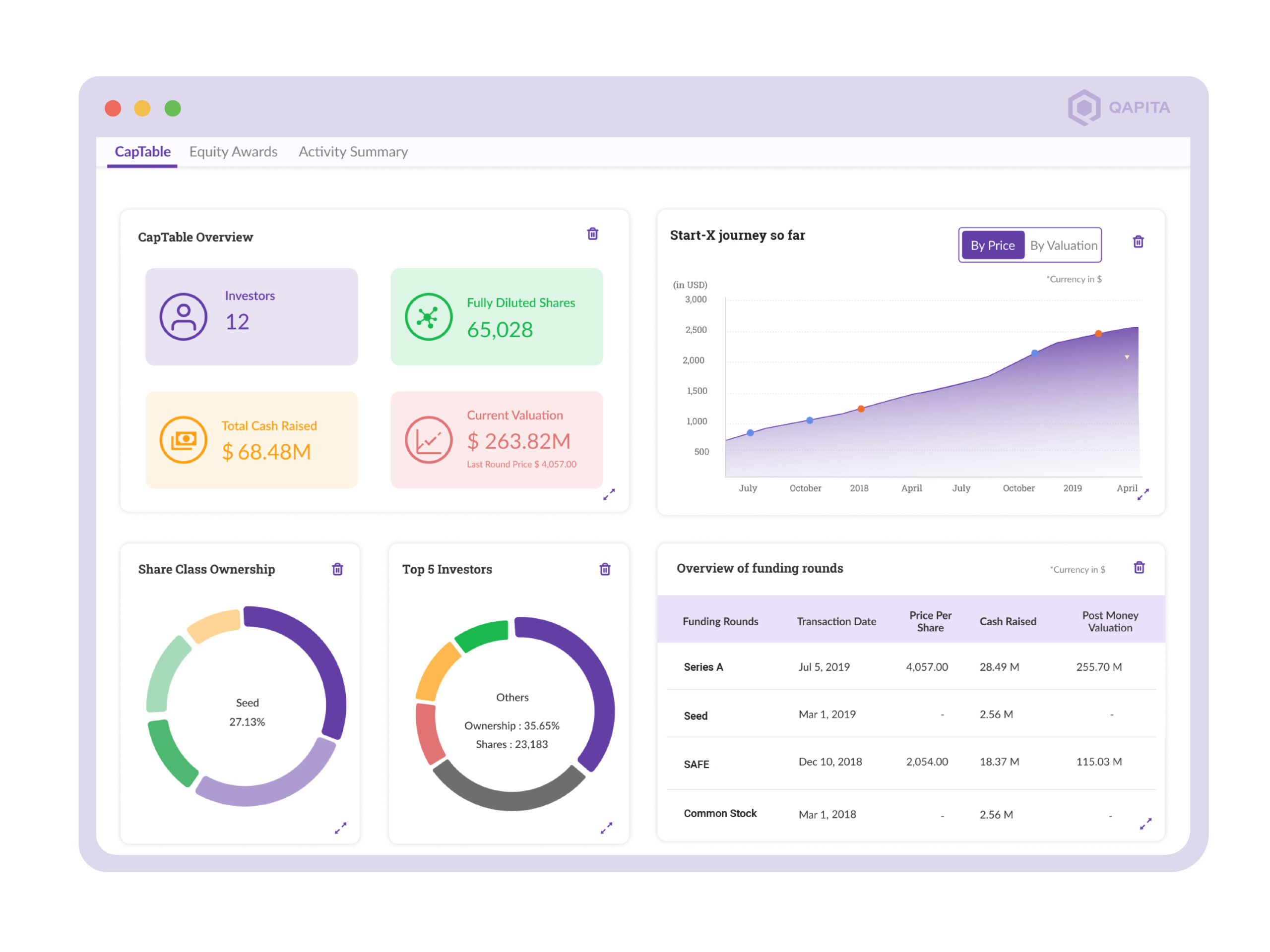
Qapita took a different path. Founded in 2019 and headquartered in Singapore, the company built its platform for the Asia-Pacific market first. It’s raised $65.5 million through its Series B round, with investors including Vulcan Capital and East Ventures.
The APAC-First Approach
Qapita’s founders recognized that Asian startups had different needs than Silicon Valley companies. Different regulatory environments. Different funding structures. Different expectations around employee equity.
The platform handles complexity that US-focused competitors often overlook:
- Multi-currency support for regional operations
- Compliance with various Asian regulatory frameworks
- ESOP structures common in Southeast Asian markets
- Fund administration services for VCs
Qapita’s Expanded Scope
Unlike Pulley’s tight focus on cap table management, Qapita offers a broader suite. The company provides equity management plus fund administration services. This makes it attractive to venture capital firms, not just startups.
Qapita competes in a different league in terms of total funding. At $65.5 million raised, it sits among the top three most-funded companies in the equity management space globally. That funding lets them build more features and expand to more markets.
Moving Beyond Asia
Qapita isn’t content staying regional. The company has expanded its customer base to include companies in the US, Europe, and Middle East. But its core strength remains serving businesses with Asian operations or investors.
Feature Comparison: Pulley vs Qapita Head to Head
Let’s break down how these platforms stack up across the features that matter most. This is where the Pulley compared to Qapita differences become clear.
Cap Table Management Core Features
| Feature | Pulley | Qapita |
|---|---|---|
| Basic cap table tracking | Yes | Yes |
| Multiple share classes | Yes | Yes |
| Convertible note tracking | Yes | Yes |
| SAFE note management | Yes | Yes |
| Warrant tracking | Yes | Yes |
| Historical cap table views | Yes | Yes |
| Multi-entity support | Limited | Yes |
| Multi-currency support | Limited | Strong |
Both platforms cover the basics well. The differences emerge in edge cases and international complexity. Qapita handles multi-currency and multi-entity setups more naturally. Pulley keeps things simpler for straightforward US-based structures.
Equity Plan Administration
Managing employee stock options is where many startups spend the most time in their cap table software. Here’s how the platforms compare:
Pulley’s approach:
- Clean interface for creating option grants
- Vesting schedule templates
- Exercise workflow handling
- Employee self-service portal
- Basic offer letter generation
Qapita’s approach:
- ESOP pool management with detailed tracking
- Multiple plan support for different employee groups
- Flexible vesting configurations
- Exercise and tax calculation tools
- Employee education resources
- Mobile app for employee access
Qapita goes deeper on equity plan features. This makes sense given Asian markets often have more complex ESOP structures. Pulley focuses on getting the common cases right without overwhelming users.
Scenario Modeling and Fundraising Tools
Planning your next funding round means running lots of “what if” scenarios. How much dilution at different valuations? What happens if you include a larger option pool refresh? Both platforms offer modeling tools.
Pulley’s modeling:
- Pro forma cap tables for planned rounds
- Basic dilution calculations
- Waterfall analysis
- SAFE conversion modeling
- Side-by-side scenario comparison
Qapita’s modeling:
- Advanced round modeling with multiple variables
- Liquidation preference waterfall analysis
- Exit scenario modeling
- Investor returns calculations
- Custom assumption inputs
Qapita’s modeling tools go deeper, especially for complex capital structures. If you have multiple classes of preferred stock with different preferences, Qapita handles that better. Pulley works great for simpler structures common at earlier stages.
409A Valuations: A Critical Comparison Point
Every US company issuing stock options needs a 409A valuation. This determines the strike price for options and keeps you compliant with IRS rules. Getting it wrong creates serious tax problems for employees.
How Pulley Handles 409A Valuations
Pulley’s Growth tier bundles 409A valuations into the subscription. This is a real money-saver for growing companies. Standalone 409A valuations from third parties often cost $3,000 to $10,000 each.
The bundled approach means:
- Predictable costs as you need annual updates
- Integrated process within the platform
- No separate vendor relationship to manage
- Faster turnaround since they already have your data
For early-stage startups watching every dollar, bundled 409A valuations provide real value. You know the cost upfront and don’t get surprised by big bills before each option grant.
How Qapita Handles 409A Valuations
Qapita’s Growth tier also adds a 409A valuation report. The company recognized that US companies need this capability even if they’re headquartered elsewhere or have Asian investors.
Qapita’s 409A process:
- Included in higher-tier plans
- Supports companies with complex international structures
- Handles multi-currency considerations
- Integrates with existing cap table data
Both platforms understand that 409A valuations shouldn’t be an afterthought. Including them in subscription tiers simplifies budgeting and reduces administrative burden.
Timing and Turnaround
When comparing Pulley against Qapita for 409A valuations, consider timing. Some platforms take 15 days or more to complete valuations. This matters when you’re trying to hire quickly and need accurate strike prices for offer letters.
Neither platform is notably faster than the other here. But both beat the traditional process of engaging an outside valuation firm, sending them documents, waiting for questions, and going through review cycles.
Pricing Breakdown: Pulley vs Qapita Cost Comparison
Pricing often makes or breaks the decision between cap table platforms. Let’s dig into what each option actually costs.
Pulley’s Pricing Structure
Pulley built its pricing around startup stages:
- Launch tier: Free for up to 25 stakeholders
- Growth tier: Paid plan with more features and stakeholders
- Scale tier: For larger companies with complex needs
The free tier attracted many early-stage companies. Starting with zero cost let founders delay the software expense until they had real revenue or funding. But that free tier has limits.
Remember Pulley’s half-stakeholder counting for small angels? That can keep you in a lower tier longer than expected. Run the numbers with your actual cap table before assuming you’ll hit tier limits quickly.
Qapita’s Pricing Structure
Qapita also offers tiered pricing:
- Free tier: Basic access to get started
- Surge tier: Mid-level with more capabilities
- Growth tier: Advanced features including 409A valuations
- Enterprise: Custom pricing for large organizations
Qapita charges $40 per stakeholder on Surge and $60 per stakeholder on Growth once you exceed included caps. These overage fees add up quickly if you have many small shareholders or option holders.
Price Comparison Table
| Consideration | Pulley | Qapita |
|---|---|---|
| Free tier available | Yes, up to 25 stakeholders | Yes, with limitations |
| Per-stakeholder overages | Yes, but with half-count for small angels | $40-$60 per stakeholder over limits |
| 409A valuation included | Yes, in Growth tier | Yes, in Growth tier |
| Annual vs monthly billing | Annual | Annual |
| Hidden fees | Watch stakeholder counts | Watch stakeholder counts |
The Real Cost Calculation
Don’t just compare headline prices. Model your actual situation:
- Count your current stakeholders (founders, investors, employees with equity)
- Project stakeholder growth over the next 12 to 24 months
- Identify which features you actually need
- Calculate total cost including overages
- Factor in 409A valuation costs if not included
A platform with a higher base price might cost less if it includes more stakeholders or bundled services. Don’t let low headline numbers distract from total cost of ownership.
User Experience and Interface Design
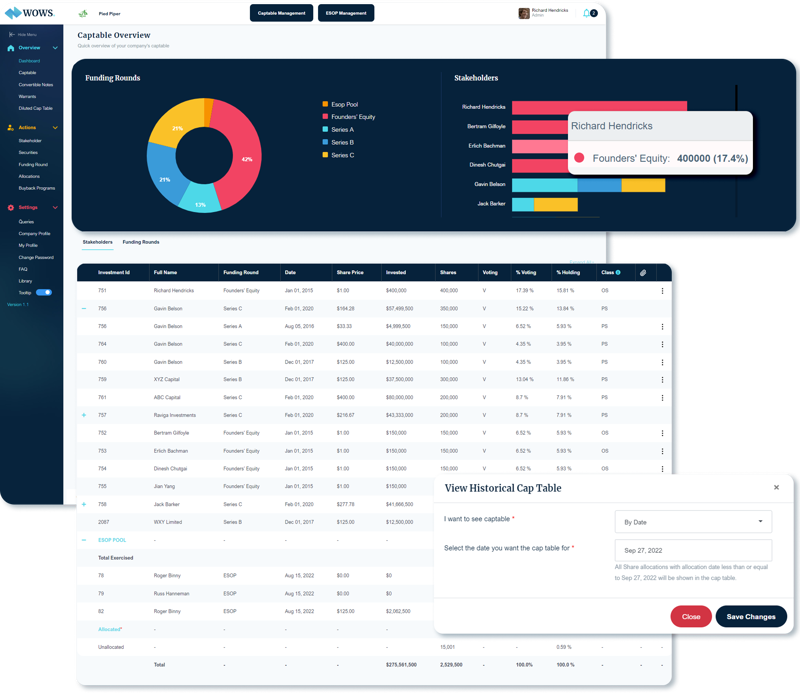
Software you hate using doesn’t help anyone. Let’s look at how Pulley and Qapita feel in daily use.
Pulley’s User Experience
Pulley earned its reputation on simplicity. The interface stays clean and uncluttered. New users can figure out basic tasks without reading documentation.
What users like about Pulley:
- Minimal learning curve
- Clear navigation structure
- Fast page load times
- Focused feature set without overwhelming options
- Good mobile responsiveness
Common complaints:
- Limited customization options
- Some advanced scenarios require workarounds
- Reporting can feel basic for complex needs
Pulley optimized for the 80% use case. If your needs fall within that range, you’ll love the simplicity. Edge cases can feel frustrating.
Qapita’s User Experience
Qapita packs more features into its interface. This creates tradeoffs. More power means more complexity.
What users like about Qapita:
- Comprehensive feature coverage
- Detailed reporting options
- Mobile app for employee access
- Strong documentation and help resources
- Handles complex international structures
Common complaints:
- Steeper learning curve initially
- Interface can feel busy
- Some features require training to use effectively
Qapita rewards users who invest time learning the platform. Power users appreciate the depth. Casual users might feel overwhelmed.
Employee Self-Service Portals
Both platforms let employees log in to view their equity. This matters more than you might think. When employees can check their vesting status and understand their ownership, they engage more with equity as compensation.
Pulley’s employee portal:
- Clean, simple interface
- Shows vesting schedule clearly
- Basic equity education content
- Exercise workflow when applicable
Qapita’s employee portal:
- More detailed equity breakdowns
- Mobile app access
- Richer educational resources
- Tax impact calculators
- Multiple language support
If you have employees across multiple countries, Qapita’s multi-language support matters. For US-only teams, Pulley’s simpler approach works well.
Integrations and Ecosystem
Cap table software doesn’t exist in isolation. It needs to work with your other tools. How do Pulley and Qapita connect with the broader startup tech stack?
Pulley’s Integration Ecosystem
Pulley focuses on integrations that matter most to early-stage US startups:
- HRIS systems: Connections to popular HR platforms
- Accounting software: For equity expense tracking
- Legal document tools: Streamlined paperwork generation
- Banking: For exercise payment processing
The integration list isn’t the longest in the market. But Pulley prioritized depth over breadth. The integrations that exist work reliably.
Qapita’s Integration Ecosystem
Qapita built more integrations to support its broader geographic reach:
- Regional HR systems: Popular across Asian markets
- Accounting platforms: Including those common outside the US
- Banking connections: Multi-currency capable
- Legal and compliance tools: For various jurisdictions
- Fund administration systems: For their VC clients
Companies with operations in multiple countries benefit from Qapita’s broader integration network. Single-country US startups might not need all that connectivity.
API Access
Some companies want to build custom integrations. API access enables that.
| API Feature | Pulley | Qapita |
|---|---|---|
| REST API available | Yes, on higher tiers | Yes, on higher tiers |
| API documentation quality | Good | Good |
| Webhook support | Limited | Yes |
| Rate limits | Standard | Standard |
Neither platform wins decisively on API capabilities. Both provide enough access for common integration needs.
Customer Support and Onboarding
When something goes wrong with your cap table, you need help fast. Equity errors can have legal and tax consequences. Support quality matters.
Pulley’s Support Model
Pulley structured support around self-service with escalation paths:
- Knowledge base: Extensive documentation and guides
- Email support: Available across all tiers
- Chat support: For quick questions during business hours
- Dedicated support: On higher-tier plans
- Migration assistance: Help moving from other platforms or spreadsheets
Users report generally positive experiences with Pulley support. Response times stay reasonable. Complex issues get escalated appropriately.
Qapita’s Support Model
Qapita offers tiered support that scales with plan level:
- Self-service resources: Documentation and video tutorials
- Email support: Standard across plans
- Priority support: For higher-tier customers
- Dedicated customer success: On enterprise plans
- Regional support teams: For different time zones
The regional support teams matter for companies outside US time zones. Getting help during your business hours instead of waiting overnight speeds up issue resolution.
Onboarding Experience
First impressions matter. Here’s how each platform handles new customers:
Pulley onboarding:
- Self-service setup for simple cap tables
- Migration tools to import from spreadsheets
- Guided setup flows for common scenarios
- Option for assisted onboarding on paid plans
Qapita onboarding:
- More hands-on approach by default
- Dedicated onboarding specialist for paid plans
- Data validation services
- Training sessions for team members
If your cap table is straightforward, Pulley’s self-service onboarding works great. Complex situations benefit from Qapita’s more guided approach.
Security and Compliance
Cap tables contain sensitive information. Ownership percentages, valuations, and personal financial data all live in these systems. Security can’t be an afterthought.
Pulley’s Security Measures
Pulley implements standard enterprise security practices:
- Encryption: Data encrypted at rest and in transit
- Access controls: Role-based permissions
- Audit logs: Track who did what and when
- SSO support: Single sign-on integration
- SOC 2 compliance: Independent security audit
For most startups, Pulley’s security posture meets requirements. Investors doing due diligence rarely raise concerns about the platform’s security practices.
Qapita’s Security Measures
Qapita emphasizes security given its enterprise and VC customer base:
- Encryption: Strong encryption standards throughout
- Multi-factor authentication: Required on sensitive operations
- Role-based access: Granular permission controls
- Audit trails: Detailed activity logging
- Regional data residency: Options for data location compliance
- Regular security audits: Third-party assessments
Companies with strict data residency requirements should note Qapita’s regional options. Some jurisdictions require data to stay within specific geographic boundaries.
Compliance Support
Beyond security, both platforms help with regulatory compliance:
| Compliance Area | Pulley | Qapita |
|---|---|---|
| 409A compliance (US) | Strong | Strong |
| SEC reporting support | Yes | Yes |
| GDPR compliance | Basic | Strong |
| Asia-Pacific regulations | Limited | Strong |
| Multi-jurisdiction support | US-focused | Global |
Your compliance needs should influence your choice. US-only companies work fine with either platform. International operations benefit from Qapita’s broader regulatory knowledge.
Scalability: Growing from Seed to Series C and Beyond
The cap table platform you choose at seed stage might not work at Series C. Planning for growth matters.
How Pulley Handles Growth
Pulley designed its product to grow with startups through early stages. The platform handles:
- Increasing stakeholder counts via tier upgrades
- More complex equity structures as you add share classes
- Additional administrators and user roles
- More sophisticated scenario modeling
Some users report that Pulley becomes less ideal for companies approaching IPO or managing very complex cap tables. The simplicity that works at seed stage can feel limiting later.
One industry comparison noted that Pulley can be “difficult to manage for startups with hypergrowth.” If you’re adding dozens of employees monthly and running multiple funding rounds per year, test the platform against your projected complexity.
How Qapita Handles Growth
Qapita built for a wider range of company sizes from the start:
- Enterprise tier for public company workflows
- Fund administration for VC firm needs
- Multi-entity management for corporate structures
- Payment and trust workflows for listed companies
The platform explicitly offers “scale-ready cap tables and equity awards” for public and enterprise companies. This suggests longer-term runway before you’d need to migrate to another solution.
Migration Considerations
Switching cap table platforms is painful. You’re migrating legal records that need to stay accurate. Consider:
- How long can you realistically stay on this platform?
- What triggers would force a migration?
- Does the platform offer tools to migrate away if needed?
Both Pulley and Qapita offer migration assistance for incoming customers. Getting data out is equally important as getting data in.
Geographic Considerations: Where Each Platform Shines
Your company’s location and investor base should influence your platform choice.
Pulley’s Geographic Strengths
Pulley was built in San Francisco for the Silicon Valley startup ecosystem. The platform excels for:
- US-incorporated companies: Delaware C-corps especially
- US investors: Familiar structures and reporting
- US employees: Compliant option grants and exercises
- Standard Silicon Valley deal terms: SAFEs, convertible notes, priced rounds
If your company, investors, and employees are all US-based, Pulley handles everything you need without unnecessary complexity.
Qapita’s Geographic Strengths
Qapita started in Singapore and expanded from there. The platform works especially well for:
- Singapore-based companies: Deep local expertise
- Southeast Asian operations: Regional regulatory knowledge
- Companies with Asian investors: Familiar reporting formats
- Multi-country workforces: Equity management across borders
- Middle Eastern expansion: Growing presence in Dubai and beyond
Companies raising from Asian VCs or planning regional expansion should seriously consider Qapita. The platform’s DNA matches those use cases.
Cross-Border Scenarios
Many modern startups don’t fit neatly into one geography. Consider these common situations:
US company with Asian investors: Either platform works. Pulley keeps things simple. Qapita offers more familiar reporting for Asian LPs.
Singapore company with US expansion: Qapita likely better. Native understanding of Singapore structures plus US capability.
Distributed team across multiple countries: Qapita’s multi-currency and multi-jurisdiction features provide advantages.
US company planning to stay US-focused: Pulley’s simplicity wins. Don’t pay for international features you won’t use.
The Best Alternative: Why Altshare Deserves Your Attention
Neither Pulley nor Qapita checks every box for every company. That’s where Altshare enters the conversation as a strong alternative worth evaluating.
What Makes Altshare Different
Altshare built its platform to address gaps left by competitors. The company focused on:
- Transparent pricing: Clear costs without surprising overages
- Modern architecture: Built on latest technology for speed and reliability
- Comprehensive features: Deep functionality without overwhelming interfaces
- Global-first design: Works well for companies anywhere in the world
- Strong customer support: Real humans who understand equity
When to Consider Altshare Over Pulley
If you’re leaning toward Pulley but have concerns, Altshare might be better when:
- You need more advanced features than Pulley’s basic offering
- Your stakeholder count makes Pulley’s pricing unattractive
- You want better international support than Pulley provides
- You’re planning rapid growth and worry about scaling limits
- You want more comprehensive reporting capabilities
Altshare delivers the simplicity Pulley is known for while offering deeper functionality when you need it.
When to Consider Altshare Over Qapita
If Qapita seems like the right choice but something holds you back, consider Altshare when:
- Qapita’s interface feels too complex for your needs
- You want strong APAC support without APAC-specific features you don’t need
- Per-stakeholder overages make Qapita too expensive
- You prefer a more streamlined onboarding experience
- You want the depth of features without the learning curve
Altshare hits a sweet spot between Pulley’s simplicity and Qapita’s comprehensive approach.
Altshare’s Competitive Advantages
Here’s what sets Altshare apart from both Pulley and Qapita:
| Feature | Altshare Advantage |
|---|---|
| Pricing transparency | Clear pricing without hidden fees or complex overage calculations |
| User experience | Modern interface that balances power with ease of use |
| Support quality | Responsive team with deep equity expertise |
| Feature depth | Full capabilities without requiring enterprise plans |
| Migration support | Smooth transitions from competitors or spreadsheets |
| Global reach | Designed for companies anywhere without geographic bias |
For companies frustrated by Pulley’s limitations or Qapita’s complexity, Altshare represents a compelling middle path. It’s worth including in your evaluation alongside the more established options.
Making Your Decision: A Framework for Choosing
After all this analysis, how do you actually decide between Pulley, Qapita, and Altshare? Here’s a practical framework.
Choose Pulley If:
- You’re an early-stage US startup with a simple cap table
- Budget constraints make the free tier attractive
- You value simplicity over comprehensive features
- Your stakeholder count is relatively low
- You have many small angel investors (half-stakeholder counting helps)
- You’re in the YC or Silicon Valley ecosystem
Choose Qapita If:
- You’re based in Asia or have significant Asian investors
- Your company operates across multiple countries
- You need strong multi-currency support
- You want a platform that scales to public company needs
- You’re also looking for fund administration services
- Complex ESOP structures are common in your region
Choose Altshare If:
- You want the best of both worlds: simplicity plus depth
- Transparent pricing matters to your budgeting process
- You’re growing quickly and need a platform that scales smoothly
- Customer support quality is a priority
- You don’t fit neatly into the “US startup” or “APAC company” boxes
- You want modern technology without legacy platform limitations
Questions to Ask Before Deciding
Work through these questions with your team:
- How many stakeholders do we have today?
- How many stakeholders will we have in 24 months?
- Where are our employees and investors located?
- What compliance requirements do we face?
- How often will we need 409A valuations?
- What’s our realistic budget for equity management software?
- How complex is our current cap table structure?
- How much time can we invest in learning a new platform?
- What other systems need to integrate with our cap table?
- How important is employee self-service access?
Your answers shape which platform fits best. There’s no universally correct choice.
Real World Migration Scenarios
Many companies comparing Pulley vs Qapita are switching from somewhere else. Understanding migration paths helps with planning.
Migrating from Spreadsheets
The most common migration starts from Excel or Google Sheets. Both Pulley and Qapita offer tools to import spreadsheet data.
What to expect:
- Data cleaning takes longer than you think
- Historical transactions need to be reconstructed
- Some manual verification is always required
- Allow two to four weeks for a complete migration
Altshare provides particularly strong migration support from spreadsheets. Their team validates imported data to catch errors before they cause problems.
Migrating from Carta
Many Pulley and Qapita customers previously used Carta. They’re looking for lower costs or better service.
EquityList even promotes “50% off year one, with free migration from Pulley or Carta” as a marketing offer. This suggests migration between platforms is common and competitive.
Migration considerations from Carta:
- Export your complete transaction history
- Verify all convertible instruments and terms
- Confirm vesting schedules transferred correctly
- Test employee portal access after migration
Migrating Between Pulley and Qapita
What if you chose wrong initially? Switching between these platforms is possible but not trivial.
Key steps for any migration:
- Export all data from current platform
- Document any custom configurations
- Verify against your legal documents
- Import into new platform
- Run reconciliation reports
- Update employee access
- Notify relevant stakeholders
Budget at least a month for the full transition. Don’t try to rush it.
Conclusion
Pulley and Qapita both solve real problems for growing companies. Pulley wins on simplicity for early-stage US startups. Qapita wins on depth for international or later-stage companies.
But neither platform is perfect for everyone. That’s why we recommend also evaluating Altshare as part of your decision process. It combines the best aspects of both competitors while avoiding their key limitations.
Whatever you choose, getting off spreadsheets and onto proper equity management software pays dividends. Your investors will thank you during due diligence. Your employees will appreciate clear equity visibility. And you’ll sleep better knowing your cap table is accurate.
Frequently Asked Questions About Pulley vs Qapita
| Is Pulley or Qapita better for a seed-stage startup? | For a US-based seed-stage startup with a simple cap table, Pulley is usually the better choice. The free tier covers up to 25 stakeholders, and the interface is easier to learn. Qapita makes more sense if you have Asian investors or plan international expansion soon. Altshare works well for seed-stage companies wanting more features without added complexity. |
| How do Pulley and Qapita pricing models compare for companies with many small investors? | Pulley counts angel investors investing $50,000 or less as only half a stakeholder. This can significantly reduce your effective stakeholder count and keep you in lower pricing tiers. Qapita charges $40-$60 per stakeholder over tier limits without this discount. Model your specific investor base to compare total costs accurately. |
| Can I switch from Pulley to Qapita (or vice versa) later? | Yes, migration between platforms is possible. Both platforms offer migration assistance. Expect the process to take two to four weeks with careful data validation. Some companies migrate from Pulley to Qapita as they grow and need more advanced features. Others move the opposite direction seeking simplicity. |
| Which platform handles 409A valuations better? | Both Pulley and Qapita include 409A valuations in their Growth tiers. The quality is comparable since both rely on established valuation methodologies. The main difference is integration: each platform uses its own cap table data, making the process faster than engaging a separate valuation firm. |
| Why should I consider Altshare instead of Pulley or Qapita? | Altshare offers transparent pricing without complex overage calculations, a modern interface that balances simplicity with depth, and strong customer support. It’s particularly good for companies that find Pulley too limited but Qapita too complex. Altshare works well for global companies without geographic bias in its feature set. |
| Is Qapita good for US-based companies? | Yes, Qapita supports US companies fully, including 409A valuations and US regulatory compliance. The platform is especially valuable for US companies with Asian investors, international employees, or plans to expand into Asian markets. For purely US operations, both Pulley and Qapita work well. |
| What happens when I outgrow Pulley’s free tier? | When you exceed 25 stakeholders, you’ll need to upgrade to Pulley’s paid tiers. Remember that small angels count as half a stakeholder. You can also evaluate alternatives like Altshare at this point, since you’re committing to paid software anyway. Compare total costs across platforms before upgrading. |
| Do employees prefer Pulley or Qapita’s self-service portals? | Both platforms offer employee portals where team members can view their equity. Pulley’s portal is simpler and easier to understand for equity novices. Qapita’s portal offers more detail and a mobile app. For international teams, Qapita’s multi-language support helps employees who don’t speak English as their first language. |
| How long does it take to set up Pulley vs Qapita? | Pulley’s simpler interface means faster initial setup, often just a few hours for basic cap tables. Qapita takes longer because of its more comprehensive feature set, but offers more guided onboarding support. Both platforms recommend allowing two to four weeks for full setup and team training. |
| Which platform is better for companies planning an IPO? | Qapita explicitly offers “payment and trust workflows for listed companies,” suggesting stronger IPO readiness. Pulley focuses more on private company needs through Series B/C stages. Companies anticipating an IPO within three to five years should evaluate Qapita’s enterprise tier or consider Altshare’s scalability advantages. |





 Stack Insight is intended to support informed decision-making by providing independent information about business software and services. Some product details, including pricing, features, and promotional offers, may be supplied by vendors or partners and can change without notice.