
Fidelity Private Shares Review


Fidelity Private Shares Review: A Complete Guide to Cap Table Management for Private Companies in 2026
Managing equity in a private company gets messy fast. Between founder shares, investor stakes, employee options, and multiple funding rounds, keeping track of who owns what becomes a real challenge. That’s where cap table software comes in. Fidelity Private Shares has positioned itself as a serious contender in this space, backed by the reputation of one of the largest financial services companies in the world.
In this review, we’ll break down everything you need to know about Fidelity Private Shares. We’ll look at its features, pricing approach, ease of use, and how it stacks up against competitors. Whether you’re a first-time founder or a CFO at a growth-stage startup, this guide will help you decide if this platform fits your needs. Let’s dig in.
What Is Fidelity Private Shares? Understanding the Platform
Fidelity Private Shares is an equity management platform designed for private companies. It handles cap table management, equity compliance, governance documentation, and fundraising tools. The platform serves companies from their earliest stages all the way through IPO.
The Fidelity Backing: Why It Matters
Unlike many startup-focused cap table tools, Fidelity Private Shares comes from Fidelity Investments. This isn’t a small venture-backed startup trying to find product-market fit. It’s a product from a financial institution managing trillions in assets.
What does this mean for users?
- Financial stability: The platform isn’t going anywhere. You won’t wake up to an acquisition announcement that disrupts your workflow.
- Security infrastructure: Fidelity has decades of experience protecting sensitive financial data.
- Long-term thinking: The product roadmap focuses on lasting value, not just features that attract venture funding.
For companies planning to stay private for years, this stability matters. Your cap table data needs to remain accessible and secure for the long haul.
Core Purpose and Target Users
Fidelity Private Shares targets several user groups:
| User Type | Primary Needs | How Fidelity Helps |
|---|---|---|
| Early-stage founders | Basic cap table tracking, option grants | Clean interface, automated updates |
| Growth-stage CFOs | Complex equity structures, compliance | ASC 718 reporting, audit trails |
| Legal teams | Document management, governance | Automated data room, filing tracking |
| HR departments | Employee equity administration | Grant management, exercise tracking |
| Investors | Portfolio visibility, reporting | Stakeholder portals, real-time data |
The platform grows with your company. You can start using it at incorporation and continue through complex funding rounds and eventually an exit event.
Cap Table Management Features: A Detailed Breakdown
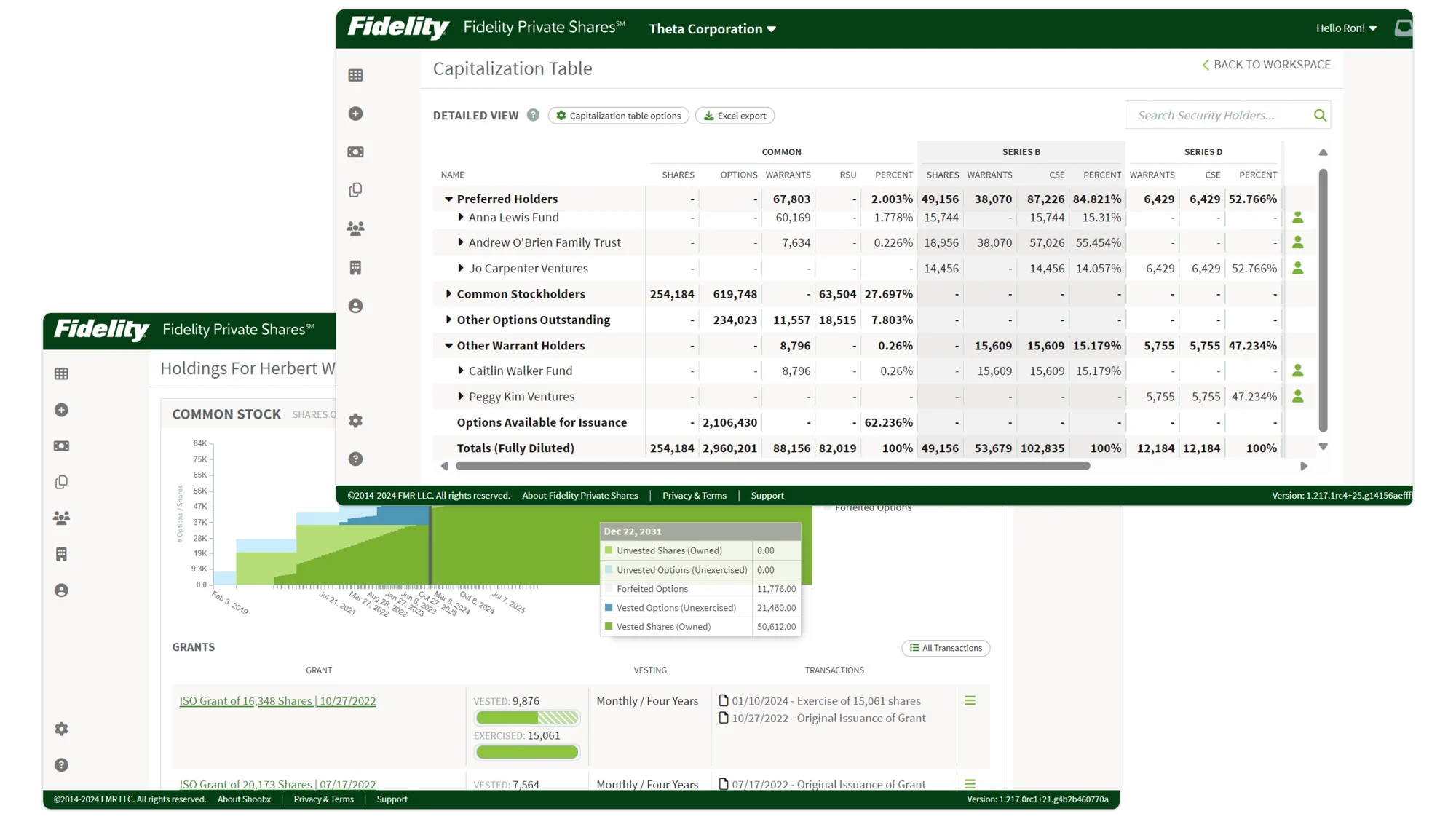
The heart of Fidelity Private Shares is its cap table management system. Let’s examine what it actually does and how it compares to managing equity manually or with spreadsheets.
Real-Time Cap Table Updates
One of the biggest frustrations with spreadsheet-based cap tables is version control. Someone updates the master file but forgets to share it. Another person works from an old version. Suddenly you have conflicting data about who owns what.
Fidelity Private Shares solves this with real-time updates. When you issue new shares, record an exercise, or close a funding round, the cap table reflects those changes instantly. Everyone with access sees the same current data.
This matters most during:
- Fundraising: Investors expect accurate, up-to-date ownership information. Outdated data creates doubt.
- Due diligence: Auditors and potential acquirers need to verify your cap table matches your legal documents.
- Board meetings: Directors reviewing equity decisions need current information.
- Employee questions: Team members asking about their options deserve accurate answers.
Stock Class and Structure Support
Private company equity isn’t simple. You might have:
- Common stock for founders and employees
- Preferred stock for investors (Series Seed, A, B, C, and beyond)
- SAFEs (Simple Agreements for Future Equity)
- Convertible notes
- Warrants
- Multiple option pools
Fidelity Private Shares handles all of these. The platform tracks each security type separately while showing you the fully diluted ownership picture when you need it.
This becomes especially useful when modeling future scenarios. Want to see what happens to everyone’s ownership if you raise a Series B at a $50 million valuation? The platform shows you without requiring manual calculations.
SAFE and Convertible Note Tracking
SAFEs and convertible notes add complexity because they don’t immediately create ownership. They convert into equity later, usually during a priced round. Tracking them properly requires understanding conversion terms, valuation caps, and discount rates.
The platform tracks:
- Investment amounts: How much each investor put in.
- Valuation caps: Maximum valuations at which the instruments convert.
- Discount rates: Percentage discounts to the next round’s price.
- Conversion triggers: What events cause conversion.
- Pro-rata rights: Whether investors can maintain their ownership percentage.
When conversion happens, Fidelity Private Shares calculates the resulting share counts and updates the cap table. You don’t need to manually work through the conversion math.
Option Pool Management
Employee equity compensation requires careful tracking. You need to know:
- How many options are authorized in your pool
- How many have been granted
- How many remain available for new grants
- Vesting schedules for each recipient
- Exercise prices (strike prices) for each grant
- Exercise activity and resulting share issuances
Fidelity Private Shares maintains all this data in one place. It tracks vesting automatically, so you always know how many vested options each employee holds.
The platform also helps with 409A valuations, which determine the fair market value for option strike prices. Getting this wrong creates serious tax problems for employees. Fidelity offers 409A valuation services that integrate directly with your cap table data.
Equity Compliance and Governance: Staying Audit-Ready
Equity compliance might not be exciting, but getting it wrong is expensive. Securities laws, tax regulations, and accounting standards all create requirements for how you manage and report equity. Fidelity Private Shares builds compliance into its workflow.
ASC 718 Reporting
ASC 718 is the accounting standard that governs stock-based compensation. If your company grants options or restricted stock to employees, you need to expense that compensation on your financial statements.
This requires calculating:
- Grant date fair values using acceptable methods
- Expense recognition over vesting periods
- Adjustments for forfeitures when employees leave
- Modifications when you change grant terms
Fidelity Private Shares generates ASC 718 reports that your finance team or auditors can use. You don’t need a separate system or complex spreadsheets to track stock compensation expense.
Document Management and Audit Trails
Every equity transaction should have supporting documentation. Stock purchase agreements, option grant letters, board consents, investor rights agreements. These documents prove that your cap table reflects real, legally binding transactions.
The platform includes an automated data room that stores and organizes these documents. When you record a transaction, you can attach the relevant paperwork. The system tracks who uploaded what and when.
This audit trail matters when:
- Preparing for due diligence in an acquisition
- Going through SEC registration for an IPO
- Responding to an IRS inquiry about equity compensation
- Resolving disputes about ownership or grant terms
Having organized, timestamped documentation makes these processes much smoother.
Government Filings and Deadlines
Private companies face various filing requirements depending on their state of incorporation, where they have employees, and what types of securities they’ve issued. Missing deadlines can create penalties or compliance problems.
Fidelity Private Shares helps track these requirements. The platform can alert you to upcoming deadlines so you don’t miss them. It’s not a replacement for legal counsel, but it helps you stay organized.
Controlled Stakeholder Access
Not everyone needs to see everything on your cap table. Employees might see their own grants but not company-wide ownership. Investors might see their holdings and company-level summaries but not individual employee details.
The platform offers role-based access control. You decide who sees what. This protects sensitive information while still giving stakeholders the visibility they need.
Fundraising Tools and Scenario Modeling

Raising capital is one of the most consequential activities for a private company. The terms you agree to shape ownership, control, and economics for years. Fidelity Private Shares includes tools designed specifically for fundraising preparation.
Dilution Modeling
Every funding round dilutes existing shareholders. Understanding exactly how much dilution you’re accepting requires modeling the transaction before you agree to terms.
Fidelity Private Shares lets you model different scenarios:
- What happens at different valuation levels?
- How does option pool expansion affect founder ownership?
- What’s the impact of different liquidation preferences?
- How do existing SAFEs or notes convert in this round?
You can compare scenarios side by side. This helps you negotiate from a position of knowledge rather than guessing at the numbers.
Investor-Grade Reporting
When investors evaluate your company, they want to see clean, professional cap table presentations. Sloppy equity records raise red flags. They suggest you might be sloppy in other areas too.
The platform generates reports that meet investor expectations:
- Summary cap tables: High-level ownership breakdowns by shareholder category.
- Detailed cap tables: Every shareholder, every security, every transaction.
- Vesting schedules: Option pool status and employee vesting progress.
- Convertible security summaries: Outstanding SAFEs and notes with their terms.
These reports export in formats investors expect. You don’t need to manually recreate data in their preferred format.
Due Diligence Readiness
When investors move to due diligence, they’ll request extensive documentation. They want to verify that your cap table is accurate and that all equity issuances were properly authorized.
With Fidelity Private Shares, much of this work is already done. Your documents are organized, your data is consistent, and you can quickly generate the reports they need.
As one user noted: “We do most of the work for you. While other solutions usually act like a dropbox where you need to organize your files, we know that may not be enough. Our data room automatically organizes your files and notifies you of any missing documents.”
Waterfall Analysis
Exit scenarios matter to everyone on the cap table. But not all shares are created equal. Preferred stock typically has liquidation preferences that mean investors get paid before common shareholders.
Waterfall analysis shows how exit proceeds would be distributed at different exit values. At a $10 million exit, what does everyone get? At $50 million? At $100 million?
This helps founders understand what their equity is actually worth in different scenarios. It also helps investors evaluate their downside protection and upside participation.
Switching to Fidelity Private Shares: The Migration Process
If you’re already using another cap table solution, switching platforms sounds daunting. Years of equity data, hundreds of transactions, complex security structures. How do you move all that without losing data or creating errors?
The Migration Workflow
Fidelity has built a structured migration process. Here’s how it works:
- Export your data: The Fidelity team tells you exactly which reports to export from your current provider. They know what data they need and how to get it.
- Fidelity builds your cap table: Their onboarding team doesn’t just import your data. They rebuild your cap table transaction by transaction, verifying accuracy along the way.
- Fill in gaps: If any information is missing or unclear, the team works with you to resolve it. They’ll identify issues you might not have known existed.
- Review and approve: You review the rebuilt cap table, verify it matches your records, and approve it for use.
This white-glove approach reduces the risk of migration errors. You’re not just copying data over and hoping for the best.
Why Companies Switch
Several factors drive companies to change cap table providers:
- Pricing changes: Some competitors have raised prices significantly in recent years.
- Service quality: Support responsiveness varies widely across platforms.
- Feature needs: As companies grow, they may outgrow their current solution’s capabilities.
- Trust concerns: Some founders want a platform backed by an established financial institution.
Darrell West, CFO and Co-Founder at DepositLink, described his experience: “From my experience with Fidelity, one of the biggest differentiators is customer support. When choosing a cap table platform, that matters. Too often, support means getting a bot that sends you to lengthy articles. But when something urgent comes up, you don’t have time to research. You need to talk to someone.”
Common Migration Sources
Fidelity Private Shares accepts migrations from all major cap table platforms. The most common sources include:
| Source Platform | Common Migration Reasons |
|---|---|
| Carta | Pricing increases, service complaints |
| Pulley | Feature limitations at scale |
| Shareworks | Desire for more modern interface |
| Excel spreadsheets | Outgrowing manual processes |
| Equity administration firms | Seeking in-house control |
One reviewer noted their experience: “Super happy with moving our Cap Table from Carta to Fidelity!”
Customer Support and Service Quality
Cap table management isn’t something you do once and forget. Questions come up. Situations change. When you need help, the quality of support matters a lot.
Support Philosophy
Fidelity Private Shares emphasizes human support over self-service documentation. That doesn’t mean they don’t have help articles. They do. But when you need to talk to someone, you can.
This approach reflects a key insight: equity mistakes are expensive. Issuing the wrong number of shares, missing a filing deadline, or miscalculating dilution can create problems that take months and thousands of dollars in legal fees to fix. Quick access to knowledgeable support reduces these risks.
Onboarding Support
New customers get hands-on onboarding help. This isn’t a self-serve setup where you watch tutorial videos and figure things out yourself. The Fidelity team:
- Reviews your existing equity records
- Identifies gaps or inconsistencies
- Sets up your cap table correctly from the start
- Trains your team on using the platform
- Answers questions specific to your situation
This level of support is especially valuable for companies with complex equity histories or limited internal equity expertise.
Ongoing Support Access
After onboarding, you still have access to support when you need it. The platform doesn’t shift to a purely self-service model once you’re up and running.
Support can help with:
- Recording complex transactions correctly
- Generating specific reports for auditors or investors
- Understanding how to model unusual scenarios
- Troubleshooting access or permission issues
- Preparing for funding rounds or exits
Pricing and Value Analysis
Cap table software pricing varies widely. Some platforms offer free tiers. Others charge thousands of dollars per year. Understanding what you’re getting for your money helps you make better decisions.
Fidelity’s Pricing Approach
Fidelity Private Shares doesn’t publish its pricing publicly. You need to request a demo to get specific numbers for your situation. This approach is common among enterprise-focused software providers.
Pricing typically depends on factors like:
- Company stage and complexity
- Number of shareholders
- Features needed
- Add-on services (like 409A valuations)
While this makes direct comparison harder, it also means pricing can be tailored to your actual needs. A pre-seed startup doesn’t need to pay for enterprise features it won’t use.
What You’re Paying For
When evaluating cap table software pricing, consider the full value equation:
| Value Component | What It Means |
|---|---|
| Software features | The actual tools and functionality you can use |
| Data security | Protection of sensitive ownership information |
| Support quality | Access to help when you need it |
| Compliance tools | Features that reduce regulatory and legal risk |
| Time savings | Hours not spent on manual equity management |
| Error prevention | Mistakes you don’t make because the system helps |
The cheapest option isn’t always the best value. An equity error that requires legal remediation can cost more than years of software subscription fees.
Comparison with Alternatives
Without specific pricing, we can still compare Fidelity Private Shares’ value proposition to alternatives:
Versus spreadsheets: Free, but time-consuming, error-prone, and doesn’t scale. Most companies outgrow spreadsheets by Series A.
Versus Carta: Carta is the market leader but has faced criticism for price increases and customer service changes. Fidelity offers similar features with potentially different pricing and support quality.
Versus Pulley: Pulley targets earlier-stage companies with simpler pricing. It may lack some features that growth-stage companies need.
Versus AngelList Stack: AngelList offers cap table management as part of a broader platform focused on fund management and SPVs. Good if you’re in that ecosystem, but not as focused on cap table depth.
Data Room and Document Management

Equity management isn’t just about numbers. It’s also about documents. Every share issued, every option granted, every funding round closed should have paperwork backing it up. Fidelity Private Shares includes data room functionality to handle this.
Automated Organization
Unlike generic file storage solutions, the Fidelity data room understands equity documents. It knows that a stock purchase agreement relates to a specific issuance. It can organize documents by transaction type, date, shareholder, or security class.
This automation matters because:
- You don’t have to manually organize hundreds of files
- Documents are findable when you need them
- Nothing gets lost in a cluttered folder structure
- Related documents stay connected to relevant transactions
Missing Document Alerts
One unique feature: the system can identify when documents are missing. If you record a transaction but don’t upload supporting paperwork, the platform notices.
This helps with:
- Audit preparation: Finding documentation gaps before auditors do.
- Due diligence readiness: Knowing you have complete records before investors ask.
- Compliance verification: Confirming that proper approvals exist for all transactions.
Secure Access and Sharing
Data rooms need security. Equity documents contain sensitive information about ownership, compensation, and company structure. The platform provides:
- Role-based access controls
- Secure external sharing for due diligence
- Activity tracking and audit logs
- Document expiration for time-limited access
When you share documents with potential investors or acquirers, you can control what they see and track what they’ve accessed.
Integration and Ecosystem
Cap table software doesn’t exist in isolation. It needs to work with other tools your company uses. Fidelity Private Shares fits into a broader ecosystem of private company services.
409A Valuation Integration
Setting option strike prices requires a 409A valuation. This determines fair market value for tax purposes. Getting it wrong creates serious problems for employees who exercise options.
Fidelity offers 409A valuation services that connect directly to your cap table. The valuation team can pull the data they need without requiring you to export and reformat information. The resulting valuation integrates back into your equity records.
Corporate Formation Services
For new companies, Fidelity offers incorporation services. This lets you set up your cap table correctly from day one, rather than recreating records later from formation documents.
API Access
For companies with technical resources, API access allows integration with internal systems. You might connect your cap table to:
- HR systems for employee equity visibility
- Financial reporting tools for stock compensation expense
- Board portals for director access
- Custom dashboards for management reporting
Company Stage Considerations
Different company stages have different equity management needs. Let’s look at how Fidelity Private Shares fits each stage.
Pre-Seed and Seed Stage
At the earliest stages, cap tables are usually simple. A few founders, maybe some early investors through SAFEs. The focus is on getting the basics right.
Fidelity Private Shares works for early-stage companies, but you should consider whether you need a full-featured platform yet. Some founders use simpler tools initially and migrate later.
That said, starting with a solid platform avoids the migration hassle later. And getting equity records right from the beginning prevents problems down the road.
Series A and B
At this stage, complexity increases substantially. You have:
- Multiple share classes with different rights
- Growing employee option pools
- Regular equity grant activity
- Board members and investors needing visibility
- Compliance requirements like ASC 718 reporting
This is where Fidelity Private Shares’ features become most valuable. Scenario modeling helps with fundraising. Compliance tools reduce audit risk. Support access helps navigate complex situations.
Growth Stage and Pre-IPO
Late-stage private companies face additional challenges:
- Larger shareholder bases with more tracking complexity
- Secondary transactions where existing shareholders sell
- Preparation for eventual public offering or exit
- More stringent compliance and governance requirements
- Greater scrutiny from auditors and potential acquirers
Fidelity’s positioning as a path “from day one to IPO and beyond” speaks to this use case. The platform scales to handle late-stage complexity.
Risk Reduction: Why Accuracy Matters

Cap table errors aren’t just annoying. They create real risks for your company, your employees, and your investors. Understanding these risks helps explain why dedicated software matters.
Common Cap Table Errors
Without proper systems, companies make mistakes like:
- Issuing more shares than authorized: This can invalidate issuances and require expensive legal remediation.
- Wrong exercise prices: Options priced below fair market value create tax problems for recipients.
- Missing board approvals: Equity issuances without proper authorization may not be valid.
- Incorrect vesting calculations: Employees may have more or fewer vested shares than you think.
- Lost records: Not knowing who owns what makes any transaction difficult.
Consequences of Errors
These mistakes lead to:
- Delayed fundraising: Investors won’t close until cap table issues are resolved.
- Failed acquisitions: Buyers walk away from deals with unclear ownership.
- Legal fees: Cleaning up errors requires lawyers, which costs money.
- Tax penalties: Incorrect option pricing can trigger IRS penalties.
- Employee lawsuits: Disputes about equity compensation sometimes end up in court.
How Software Reduces Risk
Fidelity Private Shares reduces these risks through:
| Risk Factor | Software Protection |
|---|---|
| Over-issuance | Tracks authorized shares and prevents exceeding limits |
| Exercise price errors | Integrates 409A valuations with grant records |
| Missing approvals | Links transactions to board consents and other authorizations |
| Calculation errors | Automates vesting, dilution, and conversion math |
| Lost records | Maintains complete, auditable transaction history |
The platform description notes: “Cap table management software should efficiently store data and reduce risk. Fidelity Private Shares is built for private-company equity complexity.”
User Experience and Interface
Features matter, but so does usability. If the software is hard to use, you won’t get full value from its capabilities.
Dashboard and Navigation
Fidelity Private Shares uses a dashboard-based interface. You see key metrics at a glance:
- Total shares outstanding
- Ownership breakdown by category
- Option pool status
- Recent activity
- Upcoming items needing attention
From the dashboard, you navigate to specific functions like cap table details, scenario modeling, or document management.
Cap Table Views
The platform offers multiple ways to view your cap table:
- Summary view: High-level ownership percentages by stakeholder group.
- Detailed view: Every shareholder and every security holding.
- Fully diluted view: Including all options, warrants, and convertible securities.
- Historical view: Cap table as of any past date.
This flexibility lets you quickly answer different questions without exporting data to external tools.
Transaction Recording
Recording equity transactions follows guided workflows. The system prompts you for required information and validates entries before saving. This reduces the chance of recording incomplete or incorrect data.
For complex transactions, the support team can help ensure you record things correctly.
Best Practices for Cap Table Management in 2026
Using good software is only part of the equation. You also need good processes. Here are current best practices that Fidelity Private Shares supports.
Start Clean, Stay Clean
The best time to set up proper cap table management is at company formation. The second best time is now. Starting with accurate records and maintaining them prevents the “cap table cleanup” project that many companies face before funding rounds.
Fidelity Private Shares’ onboarding process helps companies get to a clean state, even if their current records are messy.
Document Everything
Every equity transaction should have supporting documentation. This includes:
- Board resolutions authorizing issuances
- Signed agreements with recipients
- Evidence of payment for purchased shares
- Tax election filings when applicable
- Exercise notices and payment records
The automated data room makes documentation easier by prompting for documents and alerting you to gaps.
Review Regularly
Cap tables should be reviewed periodically, not just when problems arise. Quarterly reviews help catch issues early. The platform’s reporting makes these reviews straightforward.
Control Access Thoughtfully
Not everyone needs access to all cap table information. Think carefully about who sees what:
- Founders and executives: Full access to make decisions
- Finance team: Access for compliance and reporting
- HR: Access to employee equity information
- Board members: Read access to summary and detailed views
- Employees: Access only to their own holdings
- Investors: Access to their holdings and company summaries
Fidelity Private Shares’ role-based permissions support this tiered approach.
Plan for Scenarios
Don’t wait until you’re negotiating a term sheet to understand dilution implications. Use scenario modeling proactively to understand how different funding strategies affect ownership.
The platform’s modeling tools let you explore options before committing to anything.
Comparing Fidelity Private Shares to Alternatives
No review is complete without competitive context. Here’s how Fidelity Private Shares stacks up against other options in 2026.
Fidelity Private Shares vs. Carta
| Factor | Fidelity Private Shares | Carta |
|---|---|---|
| Market position | Growing challenger | Established market leader |
| Backing | Fidelity Investments | Venture-backed |
| Customer support | Emphasized as differentiator | Mixed reviews in recent years |
| Pricing | Quote-based | Tiered public pricing |
| Ecosystem | 409A, incorporation, data room | 409A, fund admin, liquidity |
| Migration support | White-glove service | Self-serve and assisted |
Carta has more market share and a broader ecosystem. Fidelity competes on stability, support quality, and the Fidelity brand’s trustworthiness.
Fidelity Private Shares vs. Pulley
| Factor | Fidelity Private Shares | Pulley |
|---|---|---|
| Target stage | All stages | Primarily early stage |
| Pricing | Quote-based | Transparent tiers, free starter |
| Features | Full enterprise capabilities | Core cap table focus |
| Support | High-touch | Varies by tier |
| Best for | Companies wanting full-service | Cost-conscious early startups |
Pulley is a good option for very early companies who want simple, affordable cap table management. Fidelity offers more capability but at likely higher cost.
Fidelity Private Shares vs. Spreadsheets
| Factor | Fidelity Private Shares | Spreadsheets |
|---|---|---|
| Cost | Subscription fee | Free (software) |
| Accuracy | Automated calculations, validation | Manual, error-prone |
| Scalability | Handles any complexity | Breaks down with growth |
| Collaboration | Multi-user, role-based | Version control nightmares |
| Compliance | Built-in reporting | Requires manual work |
| Audit trail | Automatic | Nonexistent or manual |
Spreadsheets work at the very earliest stage, but most companies should migrate to dedicated software before their first priced round.
Getting Started with Fidelity Private Shares
If this review has you interested, here’s how to move forward.
Schedule a Demo
The first step is scheduling a demo through the Fidelity Private Shares website. During the demo, you can:
- See the platform in action
- Discuss your specific situation
- Get pricing information for your needs
- Ask questions about features and support
- Understand the onboarding process
Prepare Your Information
To get the most from a demo, have information ready about:
- Your company’s current cap table situation
- What software or tools you currently use
- How many shareholders and securities you have
- What features matter most to you
- Your timeline for making a decision
Evaluate the Full Picture
Don’t choose cap table software based solely on features or price. Consider:
- Support quality: Will you get help when you need it?
- Company stability: Will the provider be around long-term?
- Growth fit: Will the platform work as your company scales?
- Integration needs: Does it work with your other tools?
- Team buy-in: Will the people using it daily like it?
Conclusion
Fidelity Private Shares offers a solid cap table management platform backed by a major financial institution. Its strengths include strong customer support, full-featured equity management, and the stability of the Fidelity brand. Companies frustrated with competitors or outgrowing spreadsheets should consider it seriously. The platform works best for companies that value service quality and want a provider they can trust for the long term.
Frequently Asked Questions About Fidelity Private Shares
| Who should use Fidelity Private Shares? | Private companies at any stage that need cap table management, equity compliance, and fundraising tools. It’s especially suited for companies that value customer support and want a platform backed by a stable financial institution. |
| Is Fidelity Private Shares free? | No, Fidelity Private Shares is not a free platform. Pricing is quote-based and depends on your company’s specific needs, stage, and complexity. You’ll need to schedule a demo to get pricing information. |
| How does Fidelity Private Shares compare to Carta? | Both platforms offer similar core features for cap table management. Fidelity differentiates on customer support quality and the backing of Fidelity Investments. Carta has more market share and a broader ecosystem of services. Companies switching from Carta often cite pricing increases and service changes as reasons. |
| Can I migrate my cap table from another platform to Fidelity Private Shares? | Yes. Fidelity offers a white-glove migration service. Their team rebuilds your cap table from your exported data, verifies accuracy, and works with you to fill any gaps. The process is designed to minimize errors and effort on your part. |
| Does Fidelity Private Shares offer 409A valuations? | Yes. Fidelity provides 409A valuation services that integrate directly with your cap table. This ensures your option strike prices are set correctly for tax compliance. |
| What types of securities can Fidelity Private Shares track? | The platform tracks common stock, preferred stock, stock options, restricted stock, SAFEs, convertible notes, and warrants. It handles complex multi-class structures and automatic conversion calculations. |
| Is Fidelity Private Shares good for early-stage startups? | Yes, the platform works for companies at any stage. Early-stage startups benefit from starting with accurate records and growing into more advanced features. Some very early companies may find simpler or lower-cost options sufficient initially. |
| What kind of customer support does Fidelity Private Shares provide? | The platform emphasizes human support over self-service documentation. Users report being able to talk to real people when urgent issues arise, rather than being directed to help articles or chatbots. |
| Does Fidelity Private Shares include a data room? | Yes. The platform includes an automated data room that organizes equity documents, links them to relevant transactions, and alerts you to missing paperwork. This helps with due diligence and audit preparation. |
| How secure is Fidelity Private Shares? | The platform is built by Fidelity Investments, which has decades of experience protecting sensitive financial data. It includes role-based access controls, activity tracking, and secure sharing features for due diligence. |






 Stack Insight is intended to support informed decision-making by providing independent information about business software and services. Some product details, including pricing, features, and promotional offers, may be supplied by vendors or partners and can change without notice.