
Altshare vs Astrella: A Complete Comparison of Cap Table Management Platforms in 2026
Choosing the right cap table management software can make or break your startup’s equity operations. Two platforms that keep coming up in conversations are Altshare and Astrella. Both promise to simplify equity management, but they take different approaches to solving the same problems.
This comparison guide breaks down everything you need to know about both platforms. We’ll look at features, pricing, user experience, and real-world applications. By the end, you’ll have a clear picture of which solution fits your company’s needs.
Whether you’re a founder managing your first cap table or a CFO overseeing complex equity structures, this guide will help you make an informed decision. Let’s dig into what makes each platform unique and where they overlap.
What Is Cap Table Management Software and Why Does It Matter?
Before we compare Altshare and Astrella directly, let’s establish why cap table management matters in the first place.
The Basics of Cap Table Management
A capitalization table tracks who owns what in your company. It lists all shareholders, their ownership percentages, and the types of securities they hold. Sounds simple enough. But things get complicated fast.
Once you start issuing stock options, bringing on investors, and running multiple funding rounds, spreadsheets fall apart. Manual errors creep in. Version control becomes a nightmare. One wrong formula can throw off your entire equity structure.
Cap table management software automates these processes. It keeps everything accurate and up to date. More importantly, it creates a single source of truth that everyone can trust.
Why Startups Need Dedicated Cap Table Tools
Many founders start with Excel or Google Sheets. That works fine when you have three co-founders and nothing else. But consider what happens as you grow:
- You hire employees and grant stock options
- You take money from angel investors
- You run a seed round with multiple investors
- You issue convertible notes or SAFEs
- You need 409A valuations for compliance
- You model different exit scenarios
Each of these adds complexity. A single funding round can introduce dozens of new line items. Stock options vest on different schedules. Convertible instruments need to be modeled for future conversion. The math gets hard.
Dedicated software handles all of this automatically. It reduces errors and saves countless hours of manual work. For growing companies, it’s not a luxury. It’s a necessity.
The Cost of Getting It Wrong
Cap table errors aren’t just annoying. They can derail funding rounds, trigger compliance issues, and create legal headaches. Imagine discovering your cap table is wrong during due diligence. That’s not a position you want to be in.
Bad equity data can also hurt employee trust. If your team doesn’t understand or trust their equity grants, you lose a powerful retention tool. Good cap table software provides transparency that builds confidence.
Introducing Altshare: Platform Overview and Core Philosophy

Altshare has built a reputation as a comprehensive equity management platform. The company focuses on serving startups and private companies across different growth stages.
Company Background and Market Position
Altshare positions itself as a full-service equity management solution. The platform aims to handle everything from initial cap table setup through IPO preparation. This end-to-end approach appeals to companies that want one tool for all their equity needs.
The platform serves a range of customers. Early-stage startups use it for basic cap table management. Larger private companies rely on it for complex equity administration. This flexibility is a core part of Altshare’s value proposition.
Core Features and Capabilities
Altshare offers a broad feature set designed to cover multiple equity management needs:
- Cap table management with real-time updates and scenario modeling
- Equity plan administration for managing stock option grants
- Compliance tools for regulatory requirements
- Document management for storing equity-related paperwork
- Reporting capabilities for board meetings and investor updates
- Valuation services including 409A valuations
The platform emphasizes accuracy and compliance. Every transaction is tracked and auditable. This matters especially for companies approaching liquidity events or regulatory scrutiny.
Target Audience and Use Cases
Altshare targets several distinct user groups. Founders use it to manage equity from day one. HR teams rely on it for employee stock plan administration. Finance teams use it for reporting and compliance.
The platform also serves external stakeholders. Law firms can access client cap tables. Fractional CFOs manage multiple company portfolios. Accelerators and VCs track their portfolio companies.
This multi-stakeholder approach means Altshare needs to balance different user needs. A founder wants simplicity. A CFO wants detailed reporting. A lawyer wants precision. The platform tries to serve all three.
Introducing Astrella: Platform Overview and Core Philosophy
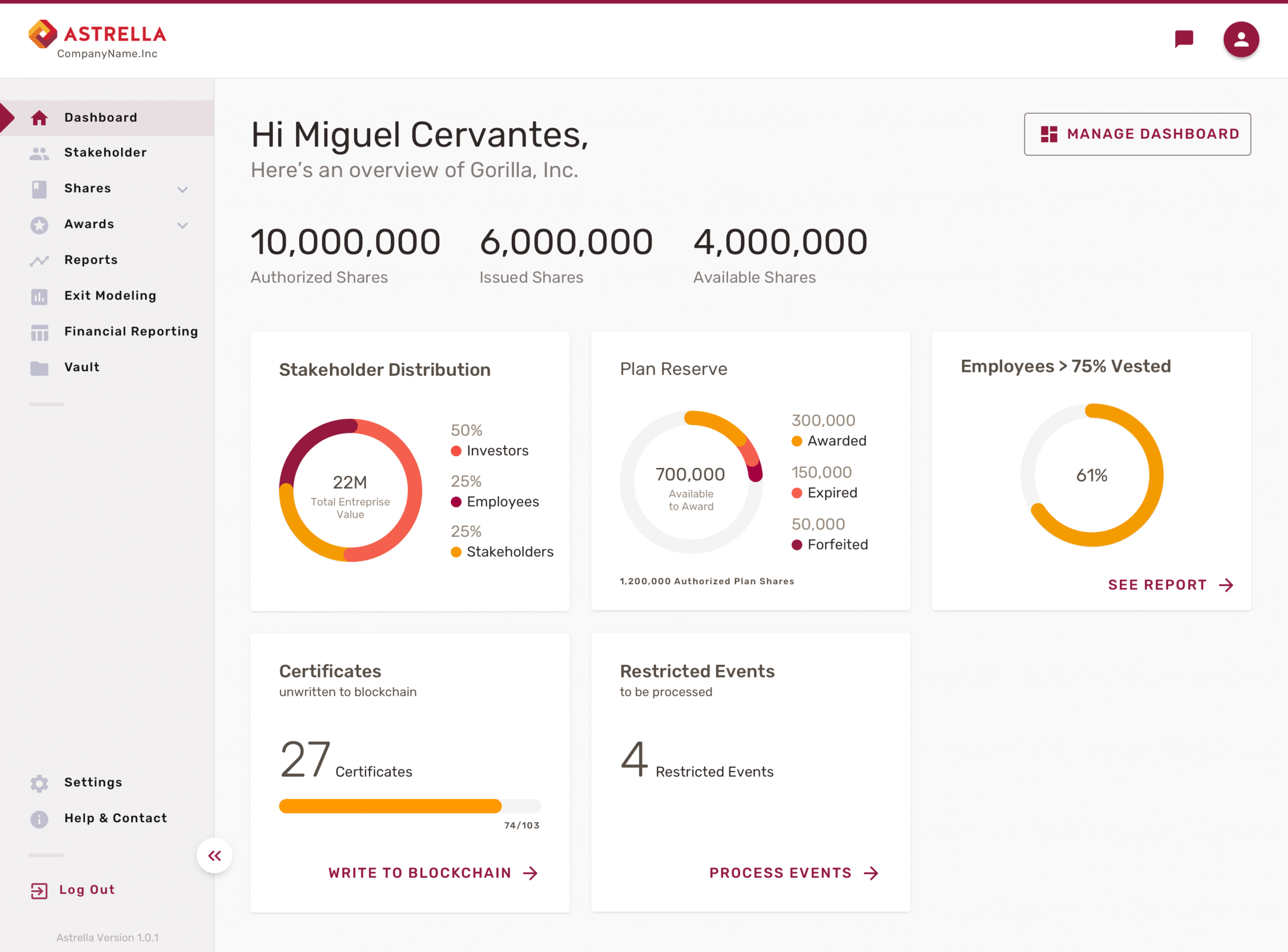
Astrella takes a technology-forward approach to cap table management. Founded in 2019, the company has built a platform that combines traditional equity management with modern tech innovations.
Company Background and Market Position
Astrella started with a clear mission: make cap table management simpler and more intelligent. The company saw an opportunity to bring automation and predictive capabilities to a traditionally manual process.
Based on their approach, Astrella positions itself as an innovative alternative to established players. They compete on technology, pricing, and user experience. This challenger mindset shapes their product development and marketing.
Core Features and Capabilities
Astrella’s feature set covers the core needs of equity management while adding some distinctive elements:
- Cap table management with intuitive software that automates administrative processes
- Simple and secure setup designed for quick onboarding
- Employee stock plan tracking with vesting schedule management
- Scenario planning tools for modeling different outcomes
- 409A valuations for compliance
- Board meeting documentation and reporting
- Document vault for secure storage of equity-related documents
- Predictive analytics for forecasting ownership actions
What sets Astrella apart is their use of artificial intelligence and blockchain technology. These tools automate administrative tasks and ensure data accuracy. It’s a modern approach to a traditional problem.
Target Audience and Use Cases
Astrella primarily targets startup founders and growing private companies. Their quick setup process appeals to early-stage companies that need to get organized fast.
The platform also serves finance professionals and advisors. One user testimonial captures this well:
“I have been using Astrella to manage the cap tables for multiple clients. In some cases, my clients have complex convertible notes and cap tables as well as employee stock plans that require a deep understanding of how angel investors, incubators and VCs make investments. Astrella allows me to capture the data correctly, easily provide reporting for board meetings and ensure my clients have their house in order in anticipation of a likely future exit.”
This flexibility to handle both simple and complex situations makes Astrella suitable for different company stages.
Altshare vs Astrella: User Interface and Ease of Use
The best features mean nothing if users can’t figure out how to access them. Let’s compare how both platforms approach user experience.
Onboarding and Initial Setup
Getting started with cap table software shouldn’t require a PhD. Both platforms recognize this, but they approach onboarding differently.
Astrella’s Approach: The platform emphasizes quick and easy setup. According to their documentation, “startup founders can have a clean cap table in no time. Simply sign up, enter your ownership data, and you’ll have immediate startup equity management at your fingertips.”
This self-service model works well for founders who want to get up and running fast. You don’t need to schedule calls or wait for implementation teams. Just enter your data and go.
Altshare’s Approach: Altshare offers a more guided onboarding experience. The platform provides support for migrating existing data and setting up complex equity structures. This hands-on approach takes longer but may result in a more accurate initial setup.
| Aspect | Altshare | Astrella |
|---|---|---|
| Setup Speed | Moderate – guided process | Fast – self-service focused |
| Data Migration | Supported with assistance | Self-service with tools |
| Learning Curve | Moderate | Low to moderate |
| Initial Support | High-touch available | Documentation-focused |
Day-to-Day Usability
Once you’re set up, how easy is it to actually use these platforms?
Astrella describes itself as having an “intuitive system” that “helps save time, so you can focus on the success and growth of your business.” Users report that the interface is clean and straightforward. Common tasks don’t require digging through menus.
Altshare focuses on providing comprehensive tools that serve multiple user types. This breadth means more features to learn. Power users appreciate the depth. Casual users may find it overwhelming.
Mobile Access and Flexibility
Modern equity management often happens on the go. Founders check cap tables between meetings. Employees review their equity grants from phones. Mobile access matters.
Both platforms offer web-based access that works across devices. Native mobile apps vary in availability and functionality. Check current offerings if mobile access is a priority for your team.
Collaboration Features
Cap table management isn’t a solo activity. You need to share access with co-founders, lawyers, investors, and employees. Both platforms support multi-user access with role-based permissions.
The key differences come in how external stakeholders interact with the platform. Can your lawyer access documents easily? Can employees view their equity grants without seeing sensitive company data? These details matter for daily operations.
Cap Table Management Features: A Deep Comparison
Now let’s get into the core functionality. How do Altshare and Astrella handle actual cap table management?
Creating and Maintaining Cap Tables
Both platforms let you create cap tables from scratch or import existing data. The basics are similar: track shareholders, share classes, and ownership percentages.
Astrella’s Strengths: The platform “simplifies cap table management with its intuitive software to automate administrative processes while maintaining transparency and control.” This automation reduces manual entry errors. The focus on simplicity means less room for user mistakes.
Altshare’s Strengths: The platform offers robust tools for complex cap table structures. Multiple share classes, different voting rights, various preference structures – all manageable within the system. This flexibility serves companies with sophisticated equity arrangements.
Handling Complex Securities
Real-world cap tables aren’t just common stock. They include preferred shares, convertible notes, SAFEs, warrants, and more. How platforms handle these matters a lot.
Astrella’s users specifically mention handling “complex convertible notes and cap tables.” The platform can model how these instruments convert under different scenarios. This capability is essential for early-stage companies that rely heavily on convertible instruments.
Altshare similarly supports various security types. The platform tracks conversion terms, discount rates, and valuation caps. Users can see the fully diluted cap table including all outstanding convertible securities.
| Security Type | Altshare Support | Astrella Support |
|---|---|---|
| Common Stock | Full support | Full support |
| Preferred Stock | Full support with multiple classes | Full support |
| Stock Options | Full support with vesting | Full support with vesting |
| Convertible Notes | Supported with conversion modeling | Supported with conversion modeling |
| SAFEs | Supported | Supported |
| Warrants | Supported | Supported |
Transaction Management
Every change to your cap table should be recorded as a transaction. Stock issuances, option grants, transfers, exercises – all need proper documentation.
Both platforms track transactions with full audit trails. You can see who made what change and when. This history becomes critical during due diligence or audits.
The differences come in how transactions are initiated and approved. Some platforms require multi-step approval workflows. Others allow faster processing with appropriate permissions. Your team’s needs will dictate which approach works better.
Real-Time Updates and Accuracy
Stale cap table data creates problems. Both Altshare and Astrella provide real-time updates. When someone exercises options or a new grant is issued, the cap table reflects it immediately.
Astrella emphasizes data accuracy through their technology approach. Their use of artificial intelligence helps catch potential errors before they become problems. The blockchain element provides an additional layer of data integrity.
Altshare maintains accuracy through structured workflows and validation rules. The platform checks for common errors and inconsistencies as data is entered.
Employee Stock Plan Administration: Altshare versus Astrella
Equity compensation is a major benefit for startup employees. Managing these plans requires dedicated tools. Let’s see how both platforms handle stock plan administration.
Setting Up Equity Compensation Plans
Before you can grant options, you need an equity plan. Both platforms support creating and managing these plans within the system.
Astrella offers “intuitive employee stock plan tracking, making it easy to issue equity and manage vesting schedules for employees.” The platform handles the administrative work of tracking plan pools, available shares, and grant allocations.
Altshare provides similar capabilities with equity plan administration tools. Users can create multiple plans, define terms, and track utilization against board-approved pools.
Granting Equity to Employees
The grant process should be straightforward for administrators. Both platforms let you:
- Create new grants with specified terms
- Set vesting schedules (standard four-year with one-year cliff, custom schedules, etc.)
- Define exercise prices based on current fair market value
- Generate grant documents for signatures
- Track outstanding grants by employee
The key difference is in workflow automation. Astrella emphasizes automation of administrative tasks. This means less manual work for HR teams processing grants. Altshare offers structured workflows with approval steps that provide more control but require more hands-on management.
Vesting Schedule Management
Vesting schedules determine when employees actually own their equity. Both platforms track vesting automatically based on defined schedules.
Standard vesting is four years with a one-year cliff. But variations exist. Performance-based vesting ties milestones to equity. Accelerated vesting kicks in under certain conditions. Custom schedules might follow company-specific rules.
Both Altshare and Astrella support these variations. The platforms calculate vested and unvested amounts automatically. Employees and administrators can see current vesting status at any time.
Exercise Processing
When employees exercise options, several things need to happen. The transaction must be recorded. Shares need to be issued. Tax implications must be calculated. Both platforms handle this workflow.
The experience differs in complexity. Simple platforms process exercises with minimal steps. More comprehensive platforms add compliance checks, tax calculations, and documentation generation. Your needs depend on your company’s size and complexity.
Employee Portal and Experience
Employees need visibility into their equity. Both platforms provide employee-facing portals where individuals can:
- View their equity grants
- Track vesting progress
- Understand current value based on company valuations
- Access grant documents
- Initiate exercises (if allowed)
The quality of this employee experience affects engagement with equity compensation. Clear, intuitive portals help employees understand and appreciate their equity. Confusing interfaces create frustration and support tickets.
409A Valuations and Compliance: Critical Considerations
Compliance isn’t optional. 409A valuations are required for setting exercise prices on stock options. Both platforms address this need, but their approaches differ.
Understanding 409A Requirements
Section 409A of the tax code requires that stock options be priced at or above fair market value. Getting this wrong creates tax problems for both companies and employees. An independent 409A valuation provides the safe harbor protection companies need.
Valuations typically need to be updated annually or after significant events. Funding rounds, major customer wins, or business changes can all trigger the need for a new valuation.
Astrella’s Valuation Approach
Astrella includes 409A valuations as part of their platform offering. They provide “comprehensive features” including “tools for cap table management, 409A valuations, equity plan administration, and compliance tracking.”
Having valuations integrated with cap table data creates efficiency. The valuation provider doesn’t need to request data separately. Everything they need is already in the system. This speeds up the process and reduces errors from data transfer.
Astrella’s platform supports “compliance with regulations such as ASC 718 and 409A valuations.” This accounting compliance is essential for companies with audited financial statements.
Altshare’s Valuation Approach
Altshare also offers valuation services as part of their platform. The integrated approach provides similar benefits in terms of data access and efficiency.
For companies that prefer using external valuation providers, both platforms can accept imported valuation reports. This flexibility matters for companies with existing valuation relationships.
Compliance Beyond 409A
409A is just one compliance requirement. Companies also need to consider:
- ASC 718: Accounting standard for stock-based compensation
- Securities law compliance: Proper exemptions for equity issuances
- Tax reporting: Forms 3921, 3922 for ISO exercises
- State-specific rules: Some states have additional requirements
Both platforms help with various compliance needs. The depth of compliance support varies. Larger platforms typically offer more comprehensive compliance tools. Smaller platforms may focus on core requirements.
| Compliance Area | Altshare | Astrella |
|---|---|---|
| 409A Valuations | Integrated offering | Integrated offering |
| ASC 718 Compliance | Supported | Supported |
| Tax Form Generation | Available | Available |
| Audit Support | Audit trails and reporting | Audit trails and reporting |
Scenario Planning and Financial Modeling Tools
Cap tables aren’t just about tracking the present. They help plan for the future. Both platforms offer tools for modeling different scenarios.
Funding Round Modeling
Before raising capital, founders need to understand dilution. How will a new round affect existing shareholders? What ownership percentage will new investors get? These questions require modeling.
Astrella provides “scenario planning tools” that help answer these questions. Users can create hypothetical funding rounds and see the impact on ownership. This helps founders negotiate from an informed position.
Altshare offers similar capabilities. Users can model multiple scenarios side by side. Different valuations, different round sizes, different investor allocations – all can be compared.
Exit Scenario Analysis
The ultimate goal for many startups is a successful exit. But who gets what in an exit depends on many factors. Preference stacks, participation rights, and other terms all affect distributions.
Astrella’s “predictive analytics opens the door for accurate short-term risk assessments as well as smart long-term goals.” Users can model exits at different valuations to understand potential outcomes.
Both platforms support waterfall analysis. This shows how proceeds flow through the cap table in an exit. Preferred shareholders get their preferences first. Common shareholders split what remains. Understanding this helps everyone set realistic expectations.
Option Pool Modeling
Companies regularly need to expand their option pools. New pools typically come before funding rounds, when dilution is shared with investors. Modeling helps determine the right pool size.
Both platforms let users model option pool expansions. You can see how different pool sizes affect dilution. This informs negotiations with investors about pool sizing.
Predictive Analytics and Forecasting
Astrella specifically mentions “precise forecasts of future ownership actions and outcomes.” This goes beyond basic modeling to predictive capabilities.
The platform “continuously learns and adapts to the needs of your startup.” This AI-driven approach aims to provide insights that simpler tools can’t offer. For companies that value data-driven decision making, this capability adds value.
Altshare focuses more on traditional modeling tools. Users define scenarios manually and analyze results. This approach is more hands-on but provides full control over assumptions.
Document Management and Data Security
Equity management involves sensitive documents and data. Both platforms need strong security and document management capabilities.
Document Storage and Organization
Astrella offers a “document vault for secure storage of equity-related documents.” This centralized storage keeps everything in one place. Stock certificates, grant agreements, board consents – all accessible within the platform.
Altshare provides similar document management capabilities. Users can upload, organize, and share documents related to equity transactions. Version control ensures everyone works from current documents.
The value of integrated document storage becomes clear during due diligence. Instead of scrambling to find files across email and shared drives, everything is organized and accessible. This alone can save days during a funding round or acquisition.
Data Security Measures
Cap table data is highly sensitive. Ownership percentages, valuations, and personal information all need protection. Both platforms implement standard security measures:
- Encryption for data in transit and at rest
- Role-based access controls
- Audit logging for all access and changes
- Regular security assessments
- Compliance with data protection regulations
Astrella mentions using blockchain technology for data integrity. This adds a layer of verification that data hasn’t been tampered with. For companies concerned about data accuracy, this provides additional assurance.
Access Controls and Permissions
Different users need different access levels. A founder needs full access. An employee should only see their own grants. A lawyer might need read-only access to specific documents.
Both platforms support granular permissions. Administrators can define who sees what and who can make changes. These controls are essential for maintaining data security while enabling collaboration.
Reporting and Board Meeting Support
Regular reporting is a core use case for cap table software. Both Altshare and Astrella provide reporting tools, but their approaches differ.
Standard Cap Table Reports
Basic reporting includes:
- Current cap table with all shareholders
- Fully diluted cap table including all outstanding securities
- Share class breakdowns
- Option pool utilization
- Vesting schedules by employee
Both platforms generate these standard reports. The formats vary, but the essential information is available. Export options typically include PDF and Excel for sharing outside the platform.
Board Meeting Materials
Astrella specifically mentions “board meeting documentation” as a feature. The platform helps users “easily provide reporting for board meetings.” This includes formatted reports suitable for board presentations.
Altshare similarly supports board reporting needs. Users can generate reports that show equity changes, option grants, and other activity between meetings.
Good board reporting saves time and builds credibility. Instead of manually creating presentations, you generate accurate reports directly from your cap table data. Board members appreciate the professionalism.
Investor Reporting
Investors want regular updates on their portfolio companies. Cap table reports are part of this communication. Both platforms support generating investor-appropriate reports.
The key is providing the right level of detail. Investors need to see their ownership and major changes. They don’t necessarily need every detail of employee equity grants. Good reporting tools let you customize what’s included.
Custom Reporting Options
Standard reports don’t cover every need. Sometimes you need custom analysis or specific data exports. Both platforms offer some level of customization.
Power users often export data to Excel for custom analysis. Look for platforms that make this export easy and provide complete data. Locked-in data that’s hard to extract creates problems down the road.
Pricing Comparison: Altshare vs Astrella Costs
Pricing matters, especially for early-stage companies watching every dollar. Let’s look at how both platforms approach pricing.
Astrella’s Pricing Approach
Astrella positions itself as competitively priced. According to their marketing, they offer “competitive pricing and even promises to halve your current Carta invoice.”
This aggressive pricing strategy appeals to companies feeling squeezed by established players. If you’re paying too much for your current solution, Astrella wants your business.
The actual pricing structure varies based on company size and needs. Contact Astrella directly for specific quotes. But the messaging is clear: they compete on price.
Altshare’s Pricing Approach
Altshare’s pricing reflects their comprehensive feature set. More features typically mean higher prices. The value proposition is that you get more for your money in terms of capabilities.
Like most B2B software, Altshare uses tiered pricing based on company size, number of shareholders, and feature requirements. Startups typically pay less than larger companies with complex needs.
Total Cost of Ownership
Platform subscription costs are just part of the picture. Consider total cost of ownership:
- Implementation costs: Time and resources to get set up
- Training costs: Getting your team productive
- Add-on services: 409A valuations, additional users, etc.
- Integration costs: Connecting with other systems
- Switching costs: If you need to migrate later
A cheaper platform that requires more manual work may cost more in the long run. An expensive platform that saves significant time may actually be cheaper. Calculate your specific situation.
| Cost Factor | Altshare | Astrella |
|---|---|---|
| Base Platform | Tiered based on needs | Competitive, claims to beat Carta pricing |
| 409A Valuations | Additional cost typically | Additional cost typically |
| Implementation | May include guided setup | Self-service focused |
| Per-User Fees | Varies by plan | Varies by plan |
Integration Capabilities and Technical Considerations
Cap table software doesn’t exist in isolation. It needs to work with your other tools. Let’s examine integration capabilities.
HR System Integrations
Employee data lives in HR systems. Stock grant data lives in cap table software. Connecting these systems reduces duplicate data entry and ensures consistency.
Both platforms offer some level of HR integration. The specific systems supported vary. Check compatibility with your current HRIS before committing to a platform.
Accounting System Connections
Stock compensation affects financial statements. ASC 718 compliance requires detailed calculations. Integrations with accounting systems streamline this process.
Look for platforms that can export data in formats your accounting team needs. At minimum, you want clean data exports. Better integrations push data directly to your general ledger.
Legal and Document Tools
Equity transactions involve legal documents. Connections with e-signature tools speed up the grant process. Integration with document management systems keeps everything organized.
Both platforms support electronic signatures. The specific tools and workflows vary. If you have existing tools you love, check compatibility.
API Access and Custom Development
Growing companies often need custom integrations. API access lets you build connections that aren’t available out of the box.
Astrella’s technology-forward approach suggests openness to integrations. Their use of modern technologies indicates API capabilities. Altshare similarly provides integration options for larger customers.
For most startups, pre-built integrations are sufficient. API access becomes more valuable as you scale and have specific technical requirements.
Customer Support and Service Quality
When something goes wrong or you have questions, support quality matters. Let’s compare support offerings.
Self-Service Resources
Good documentation reduces the need for support tickets. Both platforms provide:
- Knowledge bases with how-to articles
- Video tutorials for common tasks
- FAQ sections for quick answers
- In-app guidance and tooltips
The quality and completeness of these resources varies. Test drive them during your evaluation. Can you find answers to basic questions? Is the content current and accurate?
Direct Support Channels
Sometimes you need to talk to a person. Support channels typically include:
- Email support for non-urgent issues
- Chat support for quick questions
- Phone support for urgent matters
- Dedicated account managers for larger customers
Astrella emphasizes customer service as part of their value proposition. Smaller platforms often provide more personalized support. You’re not just a ticket number.
Altshare’s support model scales with customer size. Larger customers get more dedicated resources. Smaller customers rely more on self-service and standard support channels.
Response Times and Availability
Support availability varies by plan and platform. Key questions to ask:
- What are typical response times for support requests?
- Is support available outside business hours?
- What escalation paths exist for urgent issues?
- Are there dedicated resources for complex questions?
For routine cap table management, standard support is usually fine. During critical periods like funding rounds or exits, responsive support becomes much more valuable.
Pros and Cons: Direct Platform Comparison
Let’s summarize the strengths and weaknesses of each platform based on our analysis.
Altshare Pros
- Comprehensive feature set covering diverse equity management needs
- Scalable solution that grows with your company
- Multi-stakeholder support for founders, HR, finance, and external parties
- Strong compliance tools for regulated requirements
- Established market presence with proven track record
Altshare Cons
- Higher complexity may overwhelm simple use cases
- Potentially higher costs for comprehensive features
- Longer implementation for guided setup processes
Astrella Pros
- Quick and easy setup gets you running fast
- Competitive pricing with value-focused positioning
- AI and blockchain technology for automation and data integrity
- User-friendly interface reduces learning curve
- Predictive analytics for future planning
- Continuous innovation with modern technology approach
Astrella Cons
- Limited presence compared to larger established players
- May be more than needed for very simple cap table requirements
- Newer platform with less market history
As noted in independent reviews: “While Astrella has a global presence, it is not as widely recognized or used as Carta, which means extra work for investors and employees used to working on the Carta platform.”
Which Platform Is Right for Your Company?
The best choice depends on your specific situation. Here’s guidance for different company types.
Early-Stage Startups
If you’re pre-seed or seed stage with a simple cap table, ease of use and cost matter most. Astrella’s quick setup and competitive pricing appeal to this segment. Getting organized fast without breaking the budget is the goal.
Both platforms can handle early-stage needs. But paying for features you won’t use for years doesn’t make sense. Match your platform choice to your current complexity.
Growth-Stage Companies
Once you have multiple funding rounds, dozens of employees with equity, and complex compliance needs, comprehensive features matter more. Both platforms serve this stage.
Consider your growth trajectory. If you expect rapid scaling, choose a platform that handles complexity well. If you expect steady growth, either platform works.
Companies Preparing for Exit
Approaching an IPO or acquisition requires bulletproof cap table management. Accuracy, auditability, and professional reporting are critical.
Both platforms support exit preparation. Astrella users mention ensuring “their house in order in anticipation of a likely future exit.” The key is having clean data and complete documentation.
Multi-Entity Organizations
If you manage equity across multiple entities or portfolios, look for platforms that handle this complexity. Fractional CFOs managing multiple clients have different needs than single-company founders.
Both platforms serve advisors and firms managing multiple cap tables. Evaluate bulk management features and pricing for multi-entity use cases.
Making the Switch: Migration Considerations
If you’re currently using another platform or spreadsheets, migration is part of the decision. Here’s what to consider.
Data Migration Process
Moving cap table data requires care. Historical transactions need to be preserved. Current ownership must match perfectly. Any errors in migration create ongoing problems.
Both platforms support data migration. The level of assistance varies. Some companies prefer hands-on help from the platform team. Others prefer self-service imports with their own validation.
Timeline Expectations
Simple cap tables migrate quickly. Complex ones take longer. Plan for:
- Data preparation and cleaning (1-2 weeks)
- Initial import and validation (1 week)
- Testing and corrections (1-2 weeks)
- User training (ongoing)
Don’t rush migration. Running both old and new systems in parallel provides a safety net. Once you’re confident in the new platform, fully transition.
Stakeholder Communication
Changing cap table platforms affects multiple people. Employees access their equity through portals. Investors may receive reports from the platform. Lawyers need access for transactions.
Plan communication before making the switch. Let stakeholders know what’s changing and when. Provide guidance on new access procedures. A smooth transition maintains trust.
Future Trends in Cap Table Management
The cap table software market continues to evolve. Understanding trends helps you choose a platform positioned for the future.
Increased Automation
Manual cap table management is dying. Automation handles routine tasks better than humans. Expect platforms to automate more processes over time.
Astrella’s AI approach positions them well for this trend. Their platform “continuously learns and adapts” to user needs. This learning capability should improve automation over time.
Blockchain and Data Integrity
Astrella already uses blockchain technology for data accuracy. This trend may expand across the industry. Immutable records of equity transactions provide strong audit trails.
For companies concerned about data integrity, blockchain-backed systems offer additional assurance. This matters especially during due diligence and compliance reviews.
Integration Ecosystems
Standalone tools are giving way to connected ecosystems. Cap table data flows to and from HR, accounting, banking, and legal systems. Better integrations create more value.
Choose platforms that prioritize integrations. Closed systems create data silos. Open systems multiply the value of your cap table data.
Secondary Market Support
Private company stock transactions are becoming more common. Employees want liquidity before IPO. Investors want portfolio flexibility. Platforms are adding secondary transaction support.
If secondary transactions matter to you, evaluate platform capabilities. Not all cap table software handles these transactions well.
Conclusion
Choosing between Altshare and Astrella comes down to your specific needs. Astrella offers quick setup, competitive pricing, and modern technology that appeals to startups wanting efficiency. Altshare provides comprehensive features for companies needing robust equity management. Both platforms handle core cap table functions well. Your decision should reflect your company stage, complexity, and budget.
Frequently Asked Questions About Altshare vs Astrella Comparison
| Who should use Astrella instead of Altshare? | Astrella works best for startups wanting quick setup, competitive pricing, and modern technology features like AI and blockchain. If you value speed and cost efficiency, Astrella is worth considering. Companies with straightforward cap tables that want to get organized fast will appreciate Astrella’s self-service approach. |
| Who should use Altshare instead of Astrella? | Altshare suits companies needing comprehensive equity management across multiple stakeholders. If your cap table is complex, involves multiple entity types, or requires deep compliance tools, Altshare’s feature depth provides value. Larger companies and those approaching major liquidity events often prefer more established platforms. |
| Can I switch from Altshare to Astrella or vice versa? | Yes, both platforms support data migration from other systems. The process involves exporting your current data, mapping it to the new platform’s format, and validating accuracy. Plan for 2-4 weeks depending on complexity. Most companies run both systems briefly in parallel before fully switching. |
| Do Altshare and Astrella both offer 409A valuations? | Yes, both platforms include 409A valuation services. Having valuations integrated with your cap table data speeds up the process and reduces errors. Specific pricing and turnaround times vary, so request details from each provider for your situation. |
| Which platform is cheaper: Altshare or Astrella? | Astrella positions itself as competitively priced and claims to beat Carta pricing significantly. Altshare’s pricing reflects its comprehensive feature set. For specific pricing, contact both providers directly as costs vary based on company size, number of shareholders, and feature requirements. |
| How does Astrella use AI and blockchain technology? | Astrella uses artificial intelligence to automate administrative tasks and provide predictive analytics. The blockchain component ensures data integrity and accuracy. Together, these technologies reduce manual work while providing strong audit trails. This modern approach differentiates Astrella from traditional cap table tools. |
| Can either platform handle complex convertible notes? | Yes, both Altshare and Astrella handle complex convertible instruments including notes, SAFEs, and warrants. They model conversion scenarios showing how these instruments affect ownership at different valuations. User testimonials specifically mention handling “complex convertible notes and cap tables.” |
| What kind of support do Altshare and Astrella offer? | Both platforms provide documentation, email support, and some level of phone or chat support. Astrella emphasizes customer service and personalized attention. Altshare scales support with customer size. Evaluate support quality during your trial period before committing. |
| Are employee portals available in both platforms? | Yes, both Altshare and Astrella provide employee-facing portals. Employees can view their equity grants, track vesting progress, and access grant documents. The quality and features of these portals vary, so test the employee experience during your evaluation. |
| Which platform is better for early-stage startups comparing Altshare vs Astrella? | Astrella often appeals more to early-stage startups due to quick setup and competitive pricing. However, either platform can serve early-stage needs. The best choice depends on your specific requirements, budget constraints, and growth expectations. Start with a demo of both to see which interface feels more natural for your team. |



 Stack Insight is intended to support informed decision-making by providing independent information about business software and services. Some product details, including pricing, features, and promotional offers, may be supplied by vendors or partners and can change without notice.