
Altshare vs Carta: The Complete 2026 Comparison Guide for Equity Management
Managing equity is one of the most complex parts of running a startup or growing company. Your cap table tracks who owns what. It affects fundraising, employee compensation, and every major financial decision you make. Getting it wrong can cost you time, money, and investor trust.
Two platforms stand out in 2026 for cap table and equity management: Altshare and Carta. Both promise to simplify equity tracking. Both offer features for startups and larger companies. But they take different approaches, serve different markets, and come with different price tags.
This guide breaks down everything you need to know about Altshare versus Carta. We’ll compare features, pricing, ease of use, and more. By the end, you’ll know which platform fits your company’s needs.
Understanding Cap Table Management Software
Before we compare Altshare and Carta directly, let’s talk about what cap table software actually does. And why it matters so much.
What Is a Cap Table?
A cap table, short for capitalization table, is a record of your company’s ownership structure. It shows:
- Who owns shares in your company
- How many shares each person or entity holds
- What type of shares they own (common, preferred, options, etc.)
- The percentage of ownership each stakeholder has
- How ownership changes over time through funding rounds and grants
For early-stage startups, a spreadsheet might work fine. You have a few founders, maybe some early employees with options. Simple enough.
But things get complicated fast. You raise a seed round. Then Series A. You grant equity to employees. Some leave, some exercise options. You do a secondary transaction. Maybe there’s a note conversion involved.
Suddenly, your spreadsheet is a mess. And mistakes in your cap table can derail a funding round or cause serious legal problems down the line.
Why Dedicated Software Beats Spreadsheets
Cap table management software solves these problems. Here’s what good platforms offer:
- Automatic calculations when ownership changes
- Integration with legal documents so records stay accurate
- Scenario modeling for future funding rounds
- Compliance tracking for stock options and grants
- Secure document storage in one place
- Stakeholder portals so investors and employees can see their holdings
The right software saves hours of manual work. More importantly, it prevents costly errors that spreadsheets invite.
The Stakes Are High
Cap table mistakes aren’t just embarrassing. They can tank deals.
Imagine you’re closing a Series B round. Due diligence reveals your cap table doesn’t match your legal documents. Now you’re scrambling to reconcile records while investors wait. Some might walk away.
Or picture an employee exercising their options, only to find out the share count was recorded wrong. That’s a legal headache you don’t want.
This is why companies invest in proper cap table software. The question is: which one?
Altshare: Company Background and Platform Overview
Altshare is an Israeli fintech company that’s been in the equity management space since 2006. That’s nearly two decades of experience. They’re based in Ramat Hajayal, Israel, and serve startups, public companies, and venture capital firms.
Altshare’s Core Philosophy
Altshare positions itself around what they call Equity Management Intelligence. The idea is to bring all equity-related activity into a single interface. Rather than just tracking ownership, they want to help companies analyze and make decisions about their equity.
The platform aims to give you complete visibility into your equity structure. This means faster, better-informed decisions about funding, employee compensation, and exit scenarios.
Key Platform Capabilities
Altshare’s SaaS platform includes several core features:
- Automated cap table management that updates with every transaction
- 409A valuations for setting strike prices on employee options
- Waterfall modeling to see how different exit scenarios play out
- Stock-based compensation (SBC) expense reporting for accounting compliance
- Document management for equity-related legal paperwork
One standout feature is Altshare’s AI self-onboarding. The platform uses AI to pull data directly from legal documents. This makes your legal paperwork the single source of truth for company equity.
Why does this matter? Because cap tables often fall out of sync with the documents behind them. Altshare’s approach keeps digital records aligned with legal reality.
Who Uses Altshare?
Altshare serves a range of company sizes and types:
- Early-stage startups setting up their first proper cap table
- Growth-stage companies managing complex equity structures
- Public companies handling ongoing equity administration
- Venture capital firms tracking portfolio company ownership
The platform is positioned as a mid-market solution. It’s designed for companies that need real functionality without enterprise-level pricing.
Market Position and Focus
Altshare has carved out a niche by focusing on accuracy and intelligence. Their emphasis on legal document integration addresses a real pain point many companies face.
The company is smaller than Carta in terms of market presence. But they’ve built a loyal following, especially among companies that prioritize data accuracy and need strong valuation services.
Carta: Company Background and Platform Overview
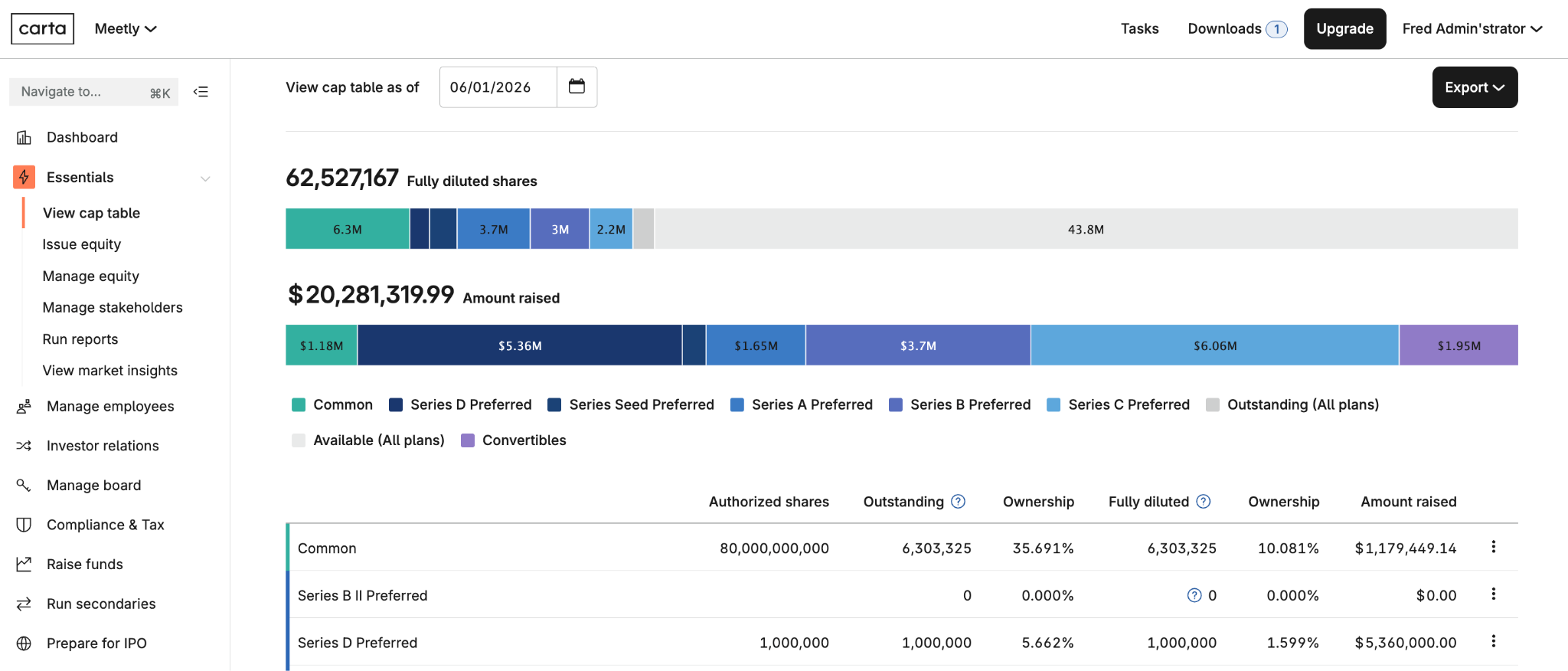
Carta is the bigger name in cap table management. The company works with over 17,000 companies and has become something of an industry standard, especially in the U.S. startup ecosystem.
Carta’s Growth Story
Carta started as a cap table management tool but has expanded significantly. Today, they offer a full suite of equity-related services. Their client base ranges from two-person startups to pre-IPO companies with thousands of stakeholders.
The platform has raised substantial venture funding and built partnerships across the startup ecosystem. Many law firms, accelerators, and investors recommend Carta as part of their standard toolkit.
Core Platform Features

Carta’s equity management platform includes:
- Cap table and security holder management in one dashboard
- Electronic securities issuance for shares and options
- Stock transfers processed directly through the platform
- Equity plan generation for employee stock option programs
- Electronic exercising when employees exercise options
- 409A valuations through their in-house team
- HRIS and payroll integrations for automatic stakeholder updates
Carta emphasizes being a single platform where you can issue shares, track ownership, and process payments. No more juggling multiple systems.
Scalability Focus
One of Carta’s big selling points is scalability. The platform promises to grow alongside your business.
Their marketing puts it simply: “No more spreadsheets, no more errors.”
For small companies, you get basic cap table tracking. As you grow, you add features like fundraising tools, investor updates, and complex equity plan management. The idea is that you never outgrow the platform.
Implementation and Onboarding
Carta promotes fast onboarding. According to their materials, smaller companies can be set up in a matter of hours. Larger companies with complex cap tables take longer, but Carta provides dedicated implementation support.
The platform also supports different entity types. LLCs, private equity firms, and traditional C-corps all work within Carta’s system.
Security and Compliance
Carta touts a “defense-in-depth” security strategy. Given that cap tables contain sensitive ownership data, this matters. The platform handles confidential information about investors, employees, and company financials.
They’ve built compliance features into the system to help companies meet reporting requirements around equity compensation.
Altshare vs Carta: Feature-by-Feature Comparison
Now let’s get into the details. Here’s how Altshare and Carta stack up across key features.
Cap Table Management Core Features
| Feature | Altshare | Carta |
|---|---|---|
| Basic cap table tracking | Full-featured interface with comprehensive tracking | Full-featured interface with comprehensive tracking |
| Automatic ownership calculations | Yes, updates after every transaction | Yes, updates after every transaction |
| Multiple security types | Common, preferred, options, warrants, SAFEs, convertibles | Common, preferred, options, warrants, SAFEs, convertibles |
| Historical cap table views | Available | Available |
| Document-based data verification | AI-powered legal document integration | Standard document storage |
Both platforms handle the basics well. Where they differ is in approach. Altshare emphasizes using legal documents as the primary data source. Carta focuses on being the central hub where you issue and track securities.
409A Valuation Services
Both platforms offer 409A valuations. These are required to set the strike price for employee stock options. Getting them wrong creates tax problems for employees and the company.
Altshare’s approach: Offers 409A valuations as part of their service suite. They position valuation services as a core competency, not just an add-on.
Carta’s approach: Provides 409A valuations through their in-house team. Because they have data on thousands of companies, they can benchmark valuations against market comparables.
The quality of 409A valuations matters more than most companies realize. A poorly defended valuation can be challenged by the IRS, creating headaches for everyone who received options.
Scenario Modeling and Waterfall Analysis
Waterfall modeling shows how proceeds from an exit would flow to different shareholders. This is critical for understanding investor preferences and employee payouts under different scenarios.
Altshare includes waterfall modeling as a key feature. You can model different exit values and see how the money splits based on liquidation preferences, participation rights, and other terms.
Carta also offers scenario modeling, though the depth varies by plan level. Higher-tier plans include more sophisticated modeling tools.
For companies with complex cap tables (multiple rounds, different investor terms), this feature matters a lot. Before agreeing to new terms, you want to see how they affect existing shareholders.
Employee Equity Plan Management
| ESOP Features | Altshare | Carta |
|---|---|---|
| Stock option plan management | Fully integrated | Fully integrated |
| Phantom shares | Supported | Supported |
| Electronic grant acceptance | Available | Available |
| Exercise processing | Available | Electronic exercising with payment processing |
| Tax withholding | Basic support | More advanced options for larger companies |
| Target company size for ESOPs | Startups and mid-market | All sizes, with advanced features for pre-IPO companies |
Carta has invested heavily in employee equity features. They’ve built out tools for larger companies approaching IPO, where equity plan administration gets very complex.
Altshare handles employee equity well for startups and mid-sized companies. But if you’re a 500+ person company heading toward public markets, Carta likely has more relevant features.
Reporting and Analytics
Both platforms generate standard cap table reports. But there are differences in depth and flexibility.
Altshare emphasizes intelligence and analysis. Their Equity Management Intelligence concept suggests going beyond basic reporting to actually help you make decisions.
Carta provides comprehensive reporting with integrations. The HRIS and payroll integrations mean stakeholder data stays current automatically.
For finance teams and CFOs, reporting capabilities matter a lot. You need data for board meetings, investor updates, and internal planning. The right platform saves hours of manual report preparation.
Pricing Comparison: Altshare versus Carta
Pricing is often the deciding factor, especially for early-stage companies watching every dollar. Let’s break down what you’ll actually pay.
Carta’s Pricing Structure
Carta uses per-stakeholder pricing. Based on available information:
- Starting price: $6 per stakeholder per month (monthly billing)
- Annual plans: Lower per-stakeholder rates available
- Enterprise plans: Custom pricing for larger companies
Stakeholders include anyone on your cap table: founders, investors, employees with equity, advisors, and former team members who still hold shares or options.
This pricing model means costs scale with your company. A startup with 20 stakeholders pays much less than a Series C company with 200 stakeholders.
Altshare’s Pricing Approach
Altshare’s pricing details aren’t as publicly available as Carta’s. They position themselves as a mid-market solution, suggesting competitive pricing compared to the larger players.
Companies interested in Altshare typically need to contact them for a quote based on:
- Company size and complexity
- Number of stakeholders
- Required services (cap table only vs. full suite including valuations)
- Entity type (startup, VC firm, public company)
Price Comparison with Similar Platforms
To give context, here’s how cap table software generally prices:
| Platform | Pricing Model | Approximate Starting Price |
|---|---|---|
| Carta | Per stakeholder/month | $6/stakeholder (monthly) |
| Capboard (competitor) | Per stakeholder/month | $2/stakeholder (annual), $4/stakeholder (monthly) |
| Pulley (competitor) | Tiered plans | Varies by company stage |
| Altshare | Custom quotes | Contact for pricing |
Carta is generally positioned as a premium option. You’re paying for the brand name, the ecosystem, and the extensive feature set.
Hidden Costs to Consider
When comparing pricing, watch for:
- 409A valuation fees: Often charged separately from cap table management
- Implementation costs: Some platforms charge for complex onboarding
- Add-on services: Secondary transactions, board portal access, advanced reporting
- Data migration: Moving from spreadsheets or another platform
The cheapest platform isn’t always the best value. Consider what you’re getting for your money and whether you’ll need features that cost extra.
Total Cost of Ownership
Think beyond monthly fees. Consider:
- Time savings: Better software saves hours of manual work
- Error prevention: Mistakes can cost far more than software fees
- Scalability: Will you outgrow the platform and need to migrate?
- Integration costs: What other tools will you need to connect?
A startup paying $200/month for Carta might find that cost trivial compared to the time saved and errors avoided. A bootstrapped company watching every expense might prefer a more economical option.
Ease of Use and User Experience
Software that’s hard to use doesn’t get used. Here’s how Altshare and Carta compare on user experience.
Onboarding Process
Carta promotes fast onboarding. Their implementation team provides support during setup. For smaller companies, the process can take just a few hours. Larger companies with complex cap tables need more time, but dedicated support helps.
The platform is designed for self-service use after initial setup. Most actions don’t require customer support involvement.
Altshare has introduced AI self-onboarding. The system reads your legal documents and populates your cap table automatically. This approach is clever because it:
- Reduces manual data entry
- Minimizes transcription errors
- Ensures your cap table matches legal reality from day one
For companies with messy cap table history, this AI-powered approach could save significant cleanup time.
Daily Use Interface
Both platforms offer web-based dashboards. You log in, see your cap table, and access features from there.
Carta’s interface has been refined over years of user feedback. The platform is generally intuitive for basic tasks like viewing ownership, issuing shares, or generating reports.
Some users report that advanced features have a learning curve. The platform does a lot, and finding specific capabilities sometimes takes exploration.
Altshare’s interface emphasizes simplicity and intelligence. The goal is to present complex equity information in an understandable way.
Without hands-on testing, it’s hard to declare a winner on interface design. Both platforms invest in user experience.
Stakeholder Experience
Your employees and investors will interact with whichever platform you choose. Their experience matters.
Carta offers stakeholder portals where employees can:
- View their equity holdings
- See vesting schedules
- Exercise options electronically
- Access tax documents
This reduces questions that would otherwise come to your HR or finance team.
Altshare also provides stakeholder access, though the specific features vary based on your plan and setup.
For companies where employee equity is a key retention tool, stakeholder portals are valuable. They help team members understand and appreciate their equity compensation.
Mobile Access
Cap table management isn’t typically a mobile-first activity. But sometimes you need quick access on the go.
Carta has mobile-friendly access for basic viewing and approvals. Altshare’s mobile capabilities depend on your plan and configuration.
For most companies, mobile access is nice to have rather than essential. The heavy lifting happens at a desk.
Integration Capabilities
Your cap table doesn’t exist in isolation. It connects to payroll, HR systems, accounting software, and more. Integrations matter.
Carta’s Integration Ecosystem
Carta has built extensive integrations over the years:
- HRIS systems: Sync employee data automatically
- Payroll providers: Process equity exercises through payroll
- Accounting software: Export data for financial reporting
- Legal platforms: Connect with document management tools
The HRIS integration is particularly valuable. When employees join, leave, or change roles, your cap table updates automatically. No manual updates needed.
Carta also connects with the broader startup ecosystem. Many law firms, banks, and investors use Carta, making data sharing easier.
Altshare’s Integration Approach
Altshare’s integration capabilities center on their document-based approach. The AI system reads legal documents, which means:
- Your cap table reflects actual legal agreements
- Changes in legal documents can trigger cap table updates
- Less manual reconciliation between systems
For standard business integrations (HRIS, payroll, accounting), you’ll want to verify Altshare’s specific capabilities for your tech stack.
API Access
Companies with custom needs may want API access to build their own integrations.
Carta offers API access on higher-tier plans. This lets companies pull cap table data into internal systems or build custom workflows.
Altshare’s API availability varies by plan. For companies needing custom integrations, this is worth clarifying during evaluation.
Data Export Capabilities
Sometimes you just need to get your data out. Both platforms allow data exports, but formats and ease vary.
Consider:
- Can you export in standard formats (CSV, Excel)?
- What data fields are included in exports?
- Can you export historical data, not just current state?
- Are there limits on export frequency?
You should never feel locked into a platform because your data is trapped. Verify export capabilities before committing.
Security and Compliance
Cap tables contain sensitive information. Ownership percentages, investor identities, employee compensation data. Security isn’t optional.
Carta’s Security Framework
Carta emphasizes their “defense-in-depth” security strategy. This typically includes:
- Data encryption at rest and in transit
- Access controls limiting who can see what
- Audit logs tracking all changes
- Regular security assessments and penetration testing
- SOC 2 compliance (industry standard for SaaS security)
Given Carta’s market position, they’ve invested heavily in security. A breach would be devastating for a company handling sensitive equity data for thousands of clients.
Altshare’s Security Measures
Altshare, as a fintech company, also prioritizes security. Specific measures typically include:
- Secure cloud infrastructure
- Role-based access controls
- Data backup and recovery
- Compliance with relevant regulations
For detailed security specifications, contact Altshare directly. Any serious evaluation should include a security review.
Regulatory Compliance
Equity management involves various compliance requirements:
- SEC regulations for securities issuance
- Tax reporting requirements for stock compensation
- State securities laws (blue sky laws)
- International regulations for global teams
Both platforms help with compliance, but specifics depend on your situation. U.S.-based companies have different needs than those with international structures.
Carta’s large U.S. customer base means they’ve built extensive compliance features for American companies. Altshare’s Israeli roots may offer advantages for companies with Middle Eastern or European operations.
Data Privacy Considerations
If you have employees or investors in different jurisdictions, data privacy laws apply:
- GDPR for European stakeholders
- CCPA for California residents
- Various other regional requirements
Verify that your chosen platform handles data in compliance with relevant privacy laws. This is especially important for companies with global teams.
Customer Support and Service Quality
When something goes wrong with your cap table, you need help fast. Support quality matters.
Carta’s Support Structure
Carta offers tiered support based on your plan:
- Self-service resources: Knowledge base, guides, tutorials
- Email support: Standard for most plans
- Phone support: Available on higher tiers
- Dedicated account managers: For enterprise customers
User reviews mention that Carta’s support quality has varied over time. As the company has grown, some customers report longer wait times. Others praise responsive, knowledgeable support staff.
For complex issues (mergers, unusual equity structures, complicated exercises), having access to knowledgeable support matters a lot.
Altshare’s Support Approach
Altshare positions itself as a mid-market solution. This typically means more personalized support than you’d get from a massive platform.
Specific support offerings include:
- Implementation support during onboarding
- Ongoing customer success management
- Technical support for platform issues
Smaller platforms often provide more attentive service. You’re not just a number. But they may also have fewer support resources overall.
Educational Resources
Good platforms help you learn, not just use the software.
Carta offers extensive educational content:
- Blog posts on equity topics
- Guides for founders and finance teams
- Webinars and events
- Templates and checklists
Altshare also provides educational resources, particularly around their core competencies in valuation and equity management.
For first-time founders, educational resources are valuable. You’re not just learning the software. You’re learning how equity works.
Community and Network Effects
Carta has built something of a community around their platform. Many startups use Carta, so:
- Your lawyers probably know the platform
- Your investors likely have Carta accounts
- Due diligence is faster when everyone’s on the same system
This network effect is a real advantage. It’s not about software features. It’s about ecosystem fit.
Altshare doesn’t have the same network effect, at least in the U.S. market. But in certain regions and industries, their relationships may be stronger.
Best Fit Scenarios: Which Platform for Which Company?
Let’s cut to practical recommendations. Here’s who should consider each platform.
Choose Altshare If:
- You prioritize data accuracy and want legal documents to be your source of truth
- You need strong valuation services as part of your equity management
- You’re a mid-market company that wants personalized attention
- You have operations in Israel or Europe and want a platform with that regional expertise
- Your cap table has gotten messy and you need AI help cleaning it up
- You want a unified platform for equity analysis and decision-making
Choose Carta If:
- You’re a U.S.-based startup that wants the industry standard platform
- Your investors and lawyers already use Carta and expect you to
- You’re scaling quickly and need a platform that grows with you
- You want extensive integrations with HRIS, payroll, and other systems
- You’re heading toward IPO and need sophisticated equity plan administration
- You value brand recognition and established track record
When Either Could Work
For many companies, both platforms would serve well. If you:
- Have a straightforward cap table
- Need basic equity management features
- Don’t have strong preferences on ecosystem
Then evaluate based on pricing, user experience, and support quality. Request demos from both and see which feels right.
When to Consider Alternatives
Neither platform might be right if:
- You’re pre-funding with just founders. A spreadsheet may suffice for now.
- You’re extremely budget-constrained. Cheaper alternatives exist (like Capboard at $2/stakeholder).
- You have highly unusual requirements. Custom solutions might be necessary.
Don’t over-buy software you don’t need yet. But don’t under-buy and create problems for future fundraising.
Migration and Implementation Considerations
Switching cap table platforms isn’t trivial. Here’s what to think about.
Migrating to Altshare
Altshare’s AI self-onboarding could make migration easier. The process typically involves:
- Gathering all equity-related legal documents
- Uploading documents to the platform
- AI extracts and populates cap table data
- Human review and verification
- Resolving any discrepancies between documents and prior records
The document-based approach is clever. It forces you to reconcile your cap table with legal reality, which you should do anyway.
Migrating to Carta
Carta has well-established migration processes:
- Export data from your current system
- Work with Carta’s implementation team to import
- Verify data accuracy after import
- Set up integrations and user access
- Train your team on the new platform
Carta handles migrations from spreadsheets and other platforms regularly. Their team knows the common pitfalls.
Data Accuracy During Migration
Migration is a perfect time to clean up your cap table. Before you move:
- Reconcile your current cap table with legal documents
- Identify any discrepancies or missing information
- Get sign-off from your lawyers that records are accurate
- Document any assumptions or estimations
Garbage in, garbage out. Don’t migrate bad data to a new platform.
Switching Costs
Beyond software fees, consider:
- Staff time for implementation and training
- Temporary productivity loss while learning new systems
- Potential service overlap during transition
- Any exit fees from your current platform
Plan for a transition period. Don’t switch right before a funding round or audit.
Future Outlook: Where Are These Platforms Headed?
Choosing software is a multi-year commitment. Consider where these platforms are going.
Carta’s Direction
Carta has been expanding beyond cap table management:
- Liquidity services for secondary transactions
- Fund administration for venture capital firms
- Compensation benchmarking using their data
- Cross-platform ecosystem connecting founders, investors, and employees
They’re trying to be the financial operating system for private companies. More services, more lock-in, more value if you stay in their ecosystem.
Altshare’s Direction
Altshare is doubling down on intelligence and accuracy:
- AI-powered features for document processing and analysis
- Enhanced valuation services
- Equity Management Intelligence for better decision-making
They’re differentiating on capabilities rather than trying to match Carta’s breadth.
Market Trends to Watch
The cap table software market is evolving:
- AI adoption is accelerating across platforms
- Integration expectations are rising
- Global expansion is creating new requirements
- Employee equity expectations are becoming more sophisticated
Whatever platform you choose, expect it to change over the coming years.
Making Your Final Decision
You’ve read a lot. Here’s how to actually decide.
Step 1: Define Your Requirements
Before evaluating platforms, know what you need:
- How complex is your cap table?
- How many stakeholders do you have?
- What integrations are essential?
- What’s your budget?
- Who will administer the system day-to-day?
- What are your growth plans over 2-3 years?
Write down your must-haves versus nice-to-haves.
Step 2: Request Demos
Both Altshare and Carta offer demos. Schedule them and come prepared with questions specific to your situation.
During demos, pay attention to:
- How the sales team handles your questions
- Whether the interface feels intuitive
- How specific features work for your use cases
- What’s included versus extra cost
Step 3: Check References
Ask each platform for customer references. Talk to companies similar to yours:
- What’s been their experience?
- What problems have they encountered?
- Would they choose the same platform again?
- How’s the support quality in practice?
Step 4: Involve Your Stakeholders
Your choice affects multiple people:
- Finance team: They’ll use it daily
- Legal counsel: They’ll need to work with it
- Investors: They may have preferences
- Board members: They’ll see reports from it
Get input from key stakeholders before finalizing.
Step 5: Negotiate Terms
Don’t just accept the first price quote. Both platforms have flexibility, especially for:
- Annual payment discounts
- Multi-year commitments
- Startup-friendly pricing for early-stage companies
- Bundle discounts for multiple services
Ask about what’s negotiable.
Conclusion
Altshare and Carta both solve the same core problem: managing your cap table accurately and efficiently. Carta is the larger, more established option with strong U.S. market presence and extensive features. Altshare offers a focused approach with AI-powered accuracy and strong valuation services. Your choice depends on your company’s size, location, complexity, and priorities. Take time to evaluate both platforms against your specific needs. The right choice will save you time, prevent errors, and support your company’s growth for years to come.
Frequently Asked Questions About Altshare vs Carta
| What is the main difference between Altshare and Carta? | Carta is a larger, U.S.-focused platform with extensive features and integrations. Altshare is an Israeli-based company emphasizing AI-powered document accuracy and Equity Management Intelligence. Carta has broader market presence while Altshare focuses on data accuracy and valuation services. |
| Which platform is better for early-stage startups? | Both platforms serve early-stage startups. Carta is more widely used in the U.S. startup ecosystem, which can make fundraising smoother. Altshare may offer more personalized service and competitive pricing for smaller companies. Evaluate based on your budget and investor expectations. |
| How much does Carta cost compared to Altshare? | Carta starts at approximately $6 per stakeholder per month on monthly billing. Altshare uses custom pricing based on company size and needs. For specific Altshare pricing, contact them directly for a quote tailored to your situation. |
| Can I switch from Carta to Altshare or vice versa? | Yes, migration between platforms is possible. Both offer implementation support for companies moving from other systems. Plan for a transition period and use the migration as an opportunity to verify your cap table accuracy against legal documents. |
| Which platform has better 409A valuation services? | Both offer 409A valuations. Carta has a large in-house team and benchmarking data from thousands of companies. Altshare positions valuation as a core strength. The quality of your 409A depends on the specific team and methodology, not just the platform name. |
| Is Altshare or Carta better for international companies? | Carta is stronger in the U.S. market with established relationships and compliance features. Altshare, based in Israel, may offer advantages for companies with European or Middle Eastern operations. Consider where your stakeholders are located when deciding. |
| How long does onboarding take for each platform? | Carta says smaller companies can onboard in hours. Larger companies take longer. Altshare’s AI self-onboarding can speed up the process by automatically extracting data from legal documents. Actual timing depends on your cap table complexity and data readiness. |
| Do employees and investors get portal access on both platforms? | Yes, both Altshare and Carta offer stakeholder portals. Employees can view holdings and vesting. Investors can see their ownership and documents. Portal features vary by plan level on both platforms. |
| Which platform integrates better with HRIS and payroll systems? | Carta has built extensive HRIS and payroll integrations over the years. This allows automatic stakeholder updates when employees join or leave. Verify Altshare’s specific integration capabilities for your tech stack during evaluation. |
| Should I use spreadsheets instead of Altshare or Carta? | Spreadsheets work for very early-stage companies with simple cap tables. Once you have investors, multiple rounds, or employee options, the risk of errors grows. Most companies should move to dedicated software before their first priced round to avoid problems during due diligence. |


 Stack Insight is intended to support informed decision-making by providing independent information about business software and services. Some product details, including pricing, features, and promotional offers, may be supplied by vendors or partners and can change without notice.