
Sweet Security vs Check Point CloudGuard: Complete 2026 Comparison Guide
Cloud security isn’t optional anymore. It’s a survival requirement. As organizations push more workloads into the cloud, the tools protecting those environments need to keep pace. Two platforms have emerged as strong contenders in the Cloud-Native Application Protection Platform (CNAPP) space: Sweet Security and Check Point CloudGuard.
Both promise to protect your cloud infrastructure, applications, and workloads. But they approach the problem differently. Sweet Security focuses heavily on runtime protection and real-time detection. Check Point CloudGuard brings decades of network security experience into the cloud-native world.
This comparison breaks down everything you need to know. We’ll examine features, pricing models, deployment options, and real-world use cases. By the end, you’ll have a clear picture of which platform fits your organization’s needs. Let’s dig in.
Understanding CNAPP: Why These Platforms Matter in 2026
Before comparing Sweet Security and CloudGuard, let’s establish what we’re actually talking about. CNAPP stands for Cloud-Native Application Protection Platform. It’s a category that emerged because traditional security tools couldn’t handle modern cloud environments.
The Problem CNAPP Solves
Cloud environments are different from on-premise data centers. They’re dynamic. Resources spin up and down constantly. Applications run in containers. Infrastructure is defined as code. Traditional perimeter-based security doesn’t work here.
CNAPP platforms combine several security capabilities into one solution:
- Cloud Security Posture Management (CSPM) – Finding misconfigurations and compliance issues
- Cloud Workload Protection (CWPP) – Securing running workloads and containers
- Cloud Detection and Response (CDR) – Identifying and responding to active threats
- Vulnerability Management – Finding and prioritizing security weaknesses
- Identity Security – Managing permissions and access across cloud environments
Both Sweet Security and Check Point CloudGuard deliver these capabilities. The differences lie in how they do it and what they emphasize.
Market Context for 2026
The CNAPP market has matured quickly. Check Point Software Technologies currently holds a ranking of #5 in this space, with an average rating of 9.0. Sweet Security sits at #14 with an 8.6 rating. But rankings don’t tell the whole story.
Check Point recently announced a partnership with Wiz. This partnership will reshape CloudGuard’s CNAPP capabilities. According to reports, Check Point’s own CNAPP solution will be replaced by Wiz’s offering inside the CloudGuard suite. This is a major shift worth watching.
Sweet Security has carved out a niche with its runtime-first approach. The company emphasizes real-time protection over static analysis. This philosophy attracts organizations dealing with active threats and sophisticated attackers.
Company Background: Sweet Security vs Check Point CloudGuard Origins
Check Point Software Technologies

Check Point isn’t a newcomer to security. The company invented the modern firewall in 1993. That’s over three decades of security experience. This heritage shapes how CloudGuard approaches cloud protection.
Check Point built its reputation on network security. Firewalls, intrusion prevention, VPNs. The company has protected enterprise networks for years. CloudGuard represents their push into cloud-native security.
The CloudGuard platform launched as Check Point recognized the shift toward cloud computing. Rather than building from scratch, Check Point extended its existing technology into cloud environments. This brings advantages and limitations.
Advantages include:
- Mature threat intelligence from decades of data collection
- Proven security engines tested across millions of deployments
- Strong relationships with enterprise customers
- Deep integration with Check Point’s broader security ecosystem
Potential limitations:
- Legacy architecture adapted for cloud rather than built for it
- Product complexity from years of acquisitions and additions
- Slower adoption of cloud-native paradigms
Sweet Security

Sweet Security is younger. The company was founded with cloud-native security as its sole focus. There’s no legacy baggage to carry. Every feature was designed for modern cloud environments from day one.
Sweet Security’s founding team came from elite cybersecurity backgrounds. This shows in the product’s emphasis on detection and response capabilities. The company positions itself as the leader in Runtime CNAPP.
What does “Runtime CNAPP” mean? It’s a focus on what’s actually happening in your cloud right now. Not just scanning for vulnerabilities. Not just checking configurations. But watching running applications and responding to threats in real-time.
Advantages include:
- Purpose-built for cloud-native environments
- Strong focus on runtime protection and detection
- Modern architecture without technical debt
- AI-powered threat detection capabilities
Potential limitations:
- Younger company with shorter track record
- Smaller customer base for validation
- Less extensive third-party integrations
Core Features Comparison: CloudGuard vs Sweet Security Capabilities
Let’s break down the specific features each platform offers. This is where the differences become clear.
Cloud Security Posture Management (CSPM)
Check Point CloudGuard CSPM:
CloudGuard Posture Management provides visibility across multi-cloud environments. The platform scans for misconfigurations, compliance violations, and security risks. It supports major cloud providers including AWS, Azure, and Google Cloud.
Key capabilities include:
- Automated compliance checking against frameworks like CIS, NIST, HIPAA, and PCI-DSS
- Network security group analysis
- IAM policy assessment
- Integration with Check Point’s threat intelligence
- Automated remediation workflows
CloudGuard’s CSPM benefits from Check Point’s experience with compliance requirements. Enterprise customers often find the compliance mapping helpful. The platform speaks the language of auditors.
Sweet Security CSPM:
Sweet Security approaches posture management differently. The platform still checks configurations and compliance. But it prioritizes findings based on runtime context.
Here’s what that means practically. Most CSPM tools generate hundreds or thousands of alerts. Security teams can’t address them all. Sweet Security uses runtime data to identify which misconfigurations actually present risk.
For example, an overly permissive IAM role might get flagged by any CSPM. But Sweet Security can tell you if that role is actually being used. If an attacker could actually exploit it. This context helps teams focus on what matters.
Key capabilities include:
- Runtime-contextualized risk prioritization
- Compliance framework mapping
- Multi-cloud visibility
- Integration with vulnerability and threat data
| CSPM Feature | Check Point CloudGuard | Sweet Security |
|---|---|---|
| Multi-cloud support | Yes – AWS, Azure, GCP | Yes – AWS, Azure, GCP |
| Compliance frameworks | Extensive (CIS, NIST, HIPAA, PCI, SOC2) | Major frameworks supported |
| Automated remediation | Yes | Yes |
| Runtime context for prioritization | Limited | Strong focus |
| Alert volume management | Standard filtering | Runtime-based prioritization |
Cloud Workload Protection (CWPP)
Check Point CloudGuard CWPP:
CloudGuard protects workloads across virtual machines, containers, and serverless functions. The platform uses Check Point’s threat prevention engines to block attacks.
The approach is prevention-first. CloudGuard tries to stop threats before they execute. This includes:
- Container image scanning for vulnerabilities
- Runtime protection for containers and Kubernetes
- Serverless security for AWS Lambda and Azure Functions
- Anti-malware for cloud workloads
- Network micro-segmentation
CloudGuard’s WAF (Web Application Firewall) deserves special mention. It’s AI-based and protects applications from common web attacks. OWASP Top 10 vulnerabilities, SQL injection, cross-site scripting. The WAF integrates with CloudGuard’s broader platform.
Sweet Security CWPP:
Sweet Security combines traditional workload protection with its runtime focus. The platform provides what the company calls “ADR, CDR, and CWPP combined.”
ADR stands for Application Detection and Response. This goes beyond infrastructure protection to secure applications themselves. Sweet Security watches application behavior, API calls, and data flows.
The platform’s vulnerability management spans “from code to cloud.” This means tracking vulnerabilities throughout the application lifecycle. Not just in production. From the development phase through deployment and runtime.
Key CWPP capabilities include:
- Container and Kubernetes security
- Application-layer visibility
- Behavioral analysis of workloads
- Vulnerability correlation with runtime data
- API security monitoring
| CWPP Feature | Check Point CloudGuard | Sweet Security |
|---|---|---|
| Container security | Yes | Yes |
| Kubernetes protection | Yes | Yes |
| Serverless security | Yes | Yes |
| Web Application Firewall | AI-based WAF included | API security focus |
| Application-layer visibility | Limited | Strong (ADR capability) |
| Behavioral analysis | Available | Core feature |
Cloud Detection and Response (CDR)
This is where the platforms differ most sharply. CDR focuses on identifying and responding to active threats. It’s security operations for the cloud.
Check Point CloudGuard CDR:
CloudGuard provides threat detection across cloud environments. The platform monitors cloud logs, network traffic, and workload behavior. When threats are detected, CloudGuard can trigger automated responses.
Detection capabilities draw on Check Point’s ThreatCloud intelligence. This is one of the world’s largest threat intelligence databases. It includes data from millions of Check Point deployments worldwide.
Response options include:
- Automated containment of compromised resources
- Integration with SIEM and SOAR platforms
- Incident investigation tools
- Forensic data collection
CloudGuard’s detection tends toward known threat patterns. The engines excel at identifying attacks they’ve seen before. Novel attack techniques may take longer to detect.
Sweet Security CDR:
Detection and response is Sweet Security’s core strength. The company positions CDR as central to its platform. Their tagline says it all: “Detect, investigate, and resolve cloud attacks in real time.”
Sweet Security’s CDR includes Cloud Detection and Response (CDR), Cloud Application Detection and Response (CADR), and Identity Threat Detection and Response (ITDR). This layered approach covers multiple attack surfaces.
The platform emphasizes speed. Sweet Security aims to detect threats as they happen, not hours or days later. Real-time detection requires watching runtime behavior continuously.
Key CDR capabilities include:
- Real-time threat detection
- AI-powered analysis
- Application-layer attack detection (CADR)
- Identity-based threat detection (ITDR)
- Automated investigation workflows
- Unified response across cloud, workload, and application
Sweet Security’s approach assumes attackers will get in. The question becomes how fast you can detect and stop them. This philosophy shapes the entire platform.
| CDR Feature | Check Point CloudGuard | Sweet Security |
|---|---|---|
| Real-time detection | Near real-time | Real-time (core focus) |
| AI-powered analysis | Yes | Yes (central to platform) |
| Application-layer detection | Limited | Strong (CADR) |
| Identity threat detection | Basic | Dedicated ITDR |
| Threat intelligence | ThreatCloud (extensive) | Proprietary + partners |
| Automated response | Yes | Yes |
Architecture and Deployment: How Each Platform Works
Check Point CloudGuard Architecture
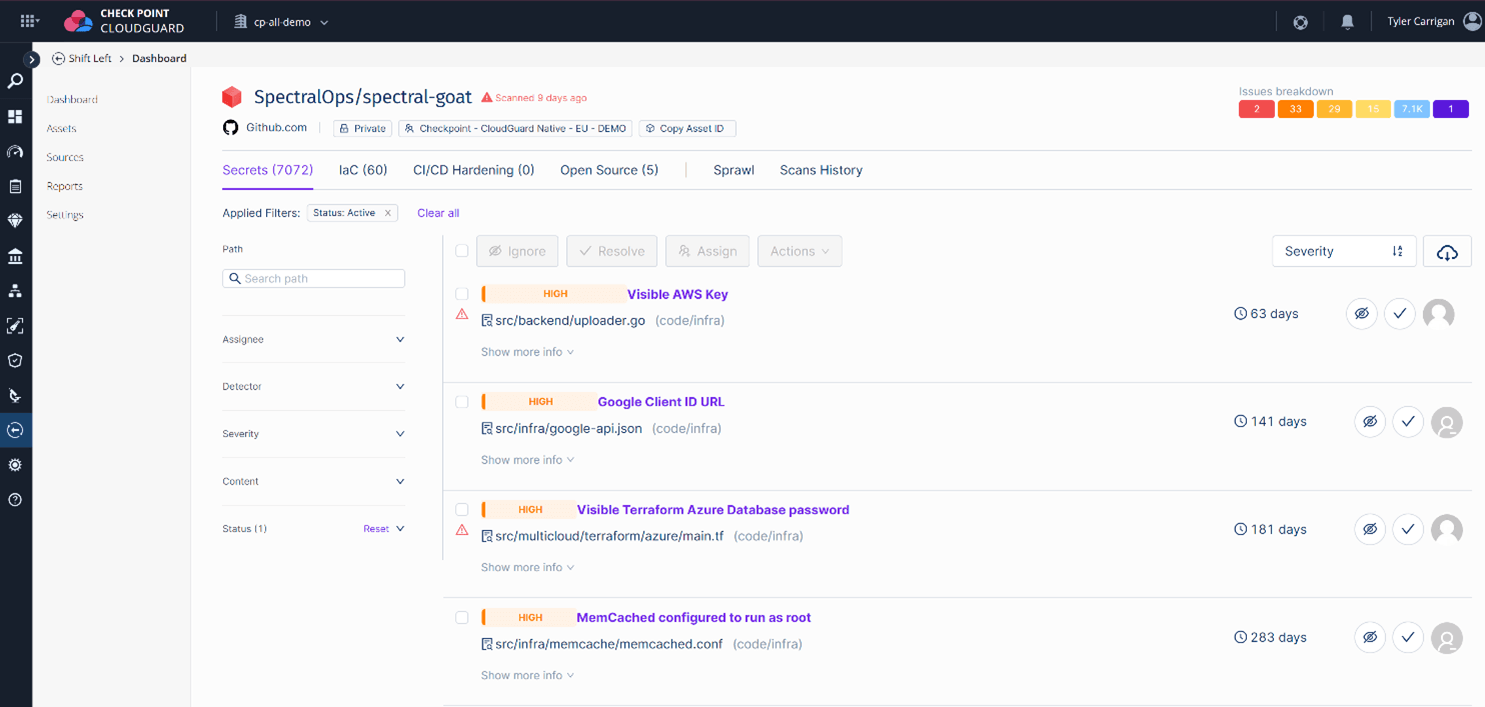
CloudGuard is a comprehensive platform with multiple components. Understanding the architecture helps predict how it will fit your environment.
CloudGuard Network Security: These are virtual security gateways deployed within your cloud networks. They provide firewall, IPS, and VPN capabilities. If you’re familiar with Check Point on-premise firewalls, the cloud version works similarly.
CloudGuard Posture Management: This is a SaaS-based service. It connects to your cloud accounts via APIs. No agents required for posture assessment. The service scans configurations and reports findings.
CloudGuard Workload Protection: This component requires agents installed on workloads. The agents provide runtime visibility and protection. For containers, CloudGuard uses admission controllers and runtime sensors.
CloudGuard WAF: The web application firewall can deploy as a reverse proxy or inline with your applications. It’s available as a SaaS service or self-hosted option.
Check Point offers different deployment models based on your needs:
- Public Cloud: Deploy CloudGuard directly in AWS, Azure, or GCP
- Private Cloud: Virtual appliances for on-premise or private cloud environments
- Hybrid: Unified management across public and private clouds
Technical requirements vary by component. Network Security gateways need specific instance sizes. Check Point publishes detailed specifications for each cloud provider. Memory, CPU, and storage requirements depend on throughput needs.
Sweet Security Architecture
Sweet Security’s architecture centers on runtime visibility. The platform uses lightweight sensors to collect data from running workloads and applications.
Runtime Sensors: Sweet Security deploys sensors at the workload and application level. These sensors watch what’s actually happening. System calls, network connections, file access, API requests. Everything gets monitored in real-time.
Cloud Integration: The platform connects to cloud provider APIs for posture management and cloud event monitoring. This provides the infrastructure context needed for full visibility.
AI Engine: Collected data flows to Sweet Security’s AI engine. This is where threat detection happens. The engine correlates events across cloud, workload, and application layers.
Management Console: A unified console provides visibility and control. Security teams can investigate threats, manage vulnerabilities, and configure policies from one place.
Sweet Security emphasizes low overhead. The sensors are designed to collect comprehensive data without impacting application performance. This is a common concern with runtime security tools.
The platform is cloud-native by design. There’s no on-premise option. Sweet Security assumes you’re protecting cloud workloads, not traditional data centers.
Deployment Comparison
| Deployment Aspect | Check Point CloudGuard | Sweet Security |
|---|---|---|
| Deployment model | SaaS, virtual appliances, hybrid | SaaS with lightweight agents |
| Agent requirements | Yes for workload protection | Yes (runtime sensors) |
| Agentless options | Yes for posture management | Limited |
| On-premise support | Yes | No |
| Setup complexity | Moderate to high | Lower |
| Time to value | Weeks to months | Days to weeks |
Runtime Protection: Sweet Security’s Primary Advantage
Let’s dig deeper into runtime protection. This is where Sweet Security stands out, and it’s worth understanding why runtime matters.
What Runtime Protection Actually Means
Most security tools work on static analysis. They scan code, configurations, and images before deployment. They look for known vulnerabilities and misconfigurations. This is valuable but incomplete.
Runtime protection watches what’s actually happening. When an application runs, it behaves in certain ways. It makes network connections. It reads and writes files. It calls APIs. Runtime security monitors this behavior.
Why does this matter? Because attackers don’t care about your scan results. They care about what they can do once they get access. Runtime protection catches attacks in progress.
Sweet Security’s Runtime Approach
Sweet Security built its platform around runtime visibility. The company’s tagline references “runtime context” repeatedly. This isn’t marketing speak. It’s a fundamental architectural choice.
How Sweet Security collects runtime data:
- eBPF-based sensors capture system-level events with minimal overhead
- Application instrumentation provides visibility into application behavior
- API monitoring tracks external and internal API calls
- Network flow analysis watches communication patterns
This data powers multiple capabilities:
Threat Detection: By establishing behavioral baselines, Sweet Security can spot anomalies. A container suddenly making unusual network connections? That gets flagged. An application accessing files it never touched before? Alert.
Vulnerability Prioritization: Not all vulnerabilities are equally dangerous. Sweet Security uses runtime data to identify which vulnerabilities are actually exploitable in your environment. A vulnerability in code that never executes isn’t a real risk.
Attack Investigation: When incidents occur, runtime data provides the context for investigation. What happened before the alert? What did the attacker do? Where did they go? Runtime data answers these questions.
CloudGuard’s Runtime Capabilities
Check Point CloudGuard also provides runtime protection, but with a different emphasis. CloudGuard focuses on prevention. The goal is stopping attacks before they succeed.
CloudGuard’s runtime approach:
- Signature-based detection for known threats
- Behavioral analysis for suspicious patterns
- Network-level protection through virtual firewalls
- Application-level protection through WAF
CloudGuard’s prevention-first philosophy makes sense given Check Point’s history. The company built its reputation on firewalls. Blocking bad traffic before it reaches its target. This translates to cloud security as blocking bad behavior before it causes damage.
The limitation is that sophisticated attackers find ways around prevention. Zero-day attacks, legitimate credential abuse, living-off-the-land techniques. These attacks may not trigger prevention controls. Detection and response become essential.
Runtime: Direct Comparison
Both platforms provide runtime security. But they prioritize differently.
Sweet Security: Runtime is the foundation. Everything builds from runtime visibility. Detection and response are primary. Prevention follows.
Check Point CloudGuard: Prevention is the foundation. Runtime protection exists but isn’t the primary focus. Network and perimeter controls remain central.
Which approach is better? It depends on your threat model. If you face sophisticated attackers who will get past prevention, Sweet Security’s detection focus helps. If you want to block as many attacks as possible before they start, CloudGuard’s prevention focus appeals.
Many organizations want both. The question becomes which platform balances these capabilities better for your specific needs.
AI and Machine Learning: Intelligence Behind the Detection
Both Sweet Security and Check Point CloudGuard use AI and machine learning. But they apply these technologies differently. Understanding the differences helps predict how each platform will perform.
Check Point’s AI Strategy
Check Point has invested heavily in AI across its product line. The company’s ThreatCloud AI is a major differentiator. This threat intelligence network processes data from millions of sensors worldwide.
ThreatCloud AI analyzes:
- Malware samples from global deployments
- Phishing campaigns and malicious URLs
- Attack patterns and techniques
- Vulnerability exploitation attempts
CloudGuard benefits from this intelligence. When a new threat appears anywhere in Check Point’s network, all customers get protection. The scale of data collection gives Check Point an advantage for known threats.
CloudGuard’s AI-based WAF deserves attention. Rather than relying only on signatures, the WAF uses machine learning to identify malicious requests. This helps catch attacks that don’t match known patterns.
Check Point also uses AI for:
- Automated policy recommendations
- Risk scoring for prioritization
- Anomaly detection in cloud behavior
- Predictive threat analysis
Sweet Security’s AI Strategy
Sweet Security positions AI as central to its platform. The company describes itself as providing “AI-powered cloud and AI stack security.” This double use of “AI” is intentional.
First, Sweet Security uses AI for security operations:
- Behavioral analysis to detect anomalies
- Correlation of events across cloud, workload, and application layers
- Automated investigation and response
- Prioritization of vulnerabilities and risks
Second, Sweet Security protects AI workloads:
This is newer territory. As organizations deploy AI and machine learning models, those systems need protection too. Sweet Security’s “AI stack security” addresses this emerging need.
AI workloads face unique threats:
- Model poisoning attacks
- Data exfiltration targeting training data
- Prompt injection attacks on LLMs
- Model theft and intellectual property theft
Sweet Security’s runtime approach fits AI security well. You need to watch what’s actually happening to catch attacks on AI systems.
AI Comparison
| AI Capability | Check Point CloudGuard | Sweet Security |
|---|---|---|
| Threat intelligence scale | Massive (ThreatCloud) | Growing |
| Behavioral analysis | Yes | Core focus |
| AI-powered WAF | Yes | Limited |
| AI workload protection | Limited | Specific focus |
| Automated investigation | Basic | Advanced |
| Correlation across layers | Moderate | Strong |
Identity Security: ITDR Capabilities Compared
Identity has become a primary attack vector in cloud environments. Attackers don’t break in anymore. They log in. Protecting identities is now central to cloud security.
The Identity Challenge in Cloud
Cloud environments have complex identity models. Human users, service accounts, applications, and automated processes all need access. Managing these identities and their permissions is difficult.
Common identity-related attacks include:
- Credential theft: Stealing usernames and passwords through phishing or data breaches
- Permission escalation: Exploiting misconfigured roles to gain more access
- Service account abuse: Compromising non-human identities with excessive permissions
- Access key compromise: Stealing API keys embedded in code or configurations
Sweet Security ITDR
Sweet Security includes dedicated Identity Threat Detection and Response (ITDR). This goes beyond access management to actively hunt identity-based threats.
ITDR capabilities include:
- Monitoring authentication events for anomalies
- Detecting impossible travel and unusual login patterns
- Identifying permission changes and privilege escalation
- Tracking service account usage
- Correlating identity events with other threat indicators
Sweet Security’s runtime approach helps here too. By watching what identities actually do, the platform can spot abuse. An admin account suddenly accessing resources it never touched? That’s suspicious.
The platform can establish behavioral baselines for each identity. When behavior deviates from normal, alerts fire. This catches compromised accounts even when credentials are valid.
CloudGuard Identity Security
Check Point CloudGuard addresses identity through its posture management and IAM analysis. The platform identifies risky configurations like overprivileged roles and unused permissions.
CloudGuard can:
- Analyze IAM policies for excessive permissions
- Identify unused roles and permissions for cleanup
- Detect misconfigurations in identity providers
- Monitor for policy changes
CloudGuard’s identity security focuses more on prevention through proper configuration. Find the risky settings before attackers exploit them. This complements Sweet Security’s detection-focused approach.
Check Point’s broader product line includes identity solutions. Harmony Email and Collaboration provides some identity protection for email-based attacks. But dedicated ITDR isn’t CloudGuard’s strength.
Identity Security Comparison
| Identity Feature | Check Point CloudGuard | Sweet Security |
|---|---|---|
| IAM policy analysis | Strong | Yes |
| Dedicated ITDR | No | Yes |
| Behavioral analysis of identities | Basic | Advanced |
| Impossible travel detection | Limited | Yes |
| Service account monitoring | Basic | Detailed |
| Real-time identity threat alerts | Limited | Yes |
API Security: Protecting Modern Application Interfaces
APIs are the backbone of modern applications. They connect services, enable integrations, and power mobile apps. They’re also a prime target for attackers. Both platforms address API security, but with different approaches.
Why API Security Matters
APIs expose application logic directly to the network. Unlike web interfaces designed for humans, APIs are designed for machines. This creates unique security challenges:
- Authentication weaknesses: APIs need proper authentication, but many don’t get it
- Authorization gaps: Just because you can authenticate doesn’t mean you should access everything
- Data exposure: APIs often return more data than needed
- Rate limiting: Without limits, APIs can be abused for denial of service or data scraping
- Business logic attacks: APIs can be manipulated to perform unintended actions
Sweet Security API Protection
Sweet Security lists API Security as a specific capability. The platform’s runtime approach fits API protection well. APIs need to be monitored during operation, not just scanned before deployment.
Sweet Security’s API security includes:
- API discovery: Finding all APIs in your environment, including shadow APIs
- Behavioral monitoring: Establishing normal API usage patterns
- Anomaly detection: Identifying unusual API calls or parameters
- Attack detection: Spotting API-specific attacks like BOLA (Broken Object Level Authorization)
- Data flow tracking: Understanding what data moves through APIs
The platform integrates API security with broader threat detection. An API attack often correlates with other suspicious activity. By watching everything together, Sweet Security can catch coordinated attacks.
CloudGuard API Protection
Check Point CloudGuard addresses API security primarily through its WAF. CloudGuard WAF protects APIs from common attacks.
The AI-based WAF can:
- Block known attack patterns targeting APIs
- Detect SQL injection and other injection attacks
- Identify malformed requests
- Enforce schema validation
- Provide rate limiting
CloudGuard takes a perimeter approach to API security. The WAF sits in front of APIs and filters traffic. This catches many attacks before they reach the application.
The limitation is visibility into API behavior. CloudGuard sees the traffic but may not understand the application context. An attack that looks like normal traffic might slip through.
API Security Comparison
| API Security Feature | Check Point CloudGuard | Sweet Security |
|---|---|---|
| API discovery | Limited | Yes |
| WAF protection | Strong (AI-based) | Basic |
| Behavioral monitoring | Limited | Strong |
| Business logic attack detection | Limited | Yes |
| Integration with threat detection | Moderate | Strong |
Network Security: CloudGuard’s Traditional Strength
Network security is where Check Point’s heritage shows. The company invented the modern firewall. CloudGuard brings decades of network security expertise to cloud environments.
CloudGuard Network Security
CloudGuard Network Security provides virtual firewall capabilities in the cloud. These aren’t simplified cloud-native tools. They’re full Check Point security gateways running as virtual appliances.
Capabilities include:
- Next-generation firewall: Application-aware traffic filtering
- Intrusion prevention (IPS): Blocking known attack patterns
- Threat prevention: Anti-malware, anti-bot, sandboxing
- VPN: Site-to-site and remote access VPN
- URL filtering: Controlling web access
- SSL inspection: Decrypting and inspecting encrypted traffic
CloudGuard Network Security deploys in public clouds like AWS, Azure, and GCP. It integrates with cloud networking constructs like VPCs, transit gateways, and load balancers.
For organizations already using Check Point on-premise, CloudGuard provides consistency. The same policies, the same management, the same threat intelligence. Just running in the cloud.
Micro-Segmentation
CloudGuard supports micro-segmentation in cloud environments. This means dividing your network into small segments and controlling traffic between them.
In traditional networks, once an attacker gets inside, they can move freely. Micro-segmentation limits lateral movement. Each workload or group of workloads gets its own security boundary.
CloudGuard’s micro-segmentation uses cloud-native constructs plus CloudGuard policies. You define which workloads can communicate with which. Everything else gets blocked.
Sweet Security Network Capabilities
Sweet Security approaches network security differently. The platform doesn’t provide traditional firewall capabilities. Instead, it focuses on network visibility and detection.
Sweet Security monitors network behavior:
- What connections are workloads making?
- Are there unusual network patterns?
- Is data leaving the environment unexpectedly?
- Are there signs of command-and-control communication?
This detection-focused approach complements prevention. Sweet Security doesn’t block traffic. It watches traffic to identify threats.
For network prevention, organizations using Sweet Security typically rely on cloud-native controls. Security groups, network ACLs, and cloud provider firewalls handle blocking. Sweet Security adds detection on top.
Network Security Comparison
| Network Feature | Check Point CloudGuard | Sweet Security |
|---|---|---|
| Virtual firewall | Yes (full NGFW) | No |
| IPS | Yes | No |
| VPN | Yes | No |
| Micro-segmentation | Yes | Limited |
| Network flow analysis | Yes | Yes |
| Lateral movement detection | Yes | Yes |
| Network anomaly detection | Yes | Yes |
Vulnerability Management: From Code to Cloud
Finding and fixing vulnerabilities is a core CNAPP function. Both platforms address vulnerability management, but their approaches differ meaningfully.
Sweet Security Vulnerability Management
Sweet Security describes its approach as “From Code to Cloud: Vulnerability Management Across the Cloud Application Lifecycle.” This suggests comprehensive coverage from development through production.
Key aspects include:
Vulnerability Discovery: Sweet Security scans for vulnerabilities across containers, hosts, and applications. This includes known CVEs (Common Vulnerabilities and Exposures) and configuration weaknesses.
Runtime Prioritization: Here’s where Sweet Security differentiates. Not all vulnerabilities are equal. A vulnerability in code that never executes poses less risk than one actively exposed to attackers.
Sweet Security uses runtime data to answer critical questions:
- Is this vulnerability in a running workload?
- Is the vulnerable function actually called?
- Is the vulnerability reachable from the network?
- Are there compensating controls in place?
This context dramatically reduces alert fatigue. Security teams focus on vulnerabilities that actually matter.
Remediation Guidance: Finding vulnerabilities is only half the battle. Sweet Security provides guidance for fixing issues. This includes identifying which packages need updates and testing remediation impact.
CloudGuard Vulnerability Management
Check Point CloudGuard provides vulnerability management through multiple components.
Image Scanning: CloudGuard scans container images for vulnerabilities before deployment. This shift-left approach catches issues early in the pipeline.
Runtime Scanning: Running workloads get scanned for vulnerabilities. CloudGuard can identify vulnerable packages and configurations in production.
Posture-Based Findings: CloudGuard Posture Management identifies configuration vulnerabilities. Missing patches, outdated software, insecure settings.
Prioritization: CloudGuard prioritizes vulnerabilities based on severity, exploitability, and asset value. The platform doesn’t have the same level of runtime context as Sweet Security for prioritization.
Vulnerability Management Comparison
| Vulnerability Feature | Check Point CloudGuard | Sweet Security |
|---|---|---|
| Container image scanning | Yes | Yes |
| Runtime scanning | Yes | Yes |
| Code-level scanning | Limited | Yes |
| Runtime prioritization | Basic | Advanced |
| Exploitability context | Moderate | Strong |
| Remediation guidance | Yes | Yes |
| CI/CD integration | Yes | Yes |
Compliance and Governance: Meeting Regulatory Requirements
Compliance isn’t optional for many organizations. Healthcare, finance, government, and other regulated industries must meet specific requirements. Both platforms help with compliance, but with different emphases.
Check Point CloudGuard Compliance
CloudGuard provides extensive compliance support. This reflects Check Point’s enterprise customer base, where audits and regulations are routine.
Supported frameworks include:
- CIS Benchmarks: Center for Internet Security best practices
- NIST: National Institute of Standards and Technology frameworks
- HIPAA: Healthcare data protection requirements
- PCI-DSS: Payment card industry standards
- SOC 2: Service organization controls
- GDPR: European data protection regulation
- ISO 27001: Information security management
CloudGuard maps its findings to specific compliance requirements. When a misconfiguration violates a regulation, CloudGuard tells you which regulation and which requirement. This helps during audits.
Compliance reports can be generated automatically. Security teams don’t need to manually compile evidence. CloudGuard produces audit-ready documentation.
Sweet Security Compliance
Sweet Security supports major compliance frameworks. The platform maps security findings to regulatory requirements.
The difference lies in approach. Sweet Security emphasizes continuous compliance monitoring through runtime visibility. Rather than periodic scans, the platform watches compliance status constantly.
This helps catch compliance drift. A system might be compliant after an audit, then drift out of compliance as changes occur. Sweet Security’s continuous monitoring catches these changes.
For organizations where compliance is the primary driver, CloudGuard’s extensive framework support may be more appealing. For organizations where security is primary and compliance follows, Sweet Security’s approach works well.
Compliance Comparison
| Compliance Feature | Check Point CloudGuard | Sweet Security |
|---|---|---|
| Framework coverage | Extensive | Major frameworks |
| Automated reporting | Yes | Yes |
| Continuous monitoring | Yes | Yes (runtime focus) |
| Audit documentation | Strong | Good |
| Compliance drift detection | Yes | Strong |
| Custom framework support | Yes | Yes |
Integration Capabilities: Fitting Into Your Security Stack
No security tool works alone. Both platforms need to integrate with existing tools, processes, and workflows. Integration capabilities can make or break a deployment.
Check Point CloudGuard Integrations
CloudGuard benefits from Check Point’s long history in enterprise security. The company has built integrations with most major security tools.
SIEM Integration: CloudGuard sends alerts and logs to SIEM platforms like Splunk, IBM QRadar, Microsoft Sentinel, and others. This enables centralized security monitoring.
SOAR Integration: Security orchestration and automated response platforms can trigger actions based on CloudGuard findings. This enables automated remediation workflows.
Ticketing Systems: CloudGuard integrates with ServiceNow, Jira, and other systems for tracking remediation.
Check Point Ecosystem: CloudGuard works seamlessly with other Check Point products. If you use Check Point firewalls on-premise, CloudGuard extends that protection to the cloud with unified management.
CI/CD Pipelines: CloudGuard integrates with Jenkins, GitLab, GitHub Actions, and other CI/CD tools for shift-left security.
Cloud Providers: Deep integration with AWS, Azure, and GCP native services.
Sweet Security Integrations
Sweet Security is newer, so its integration ecosystem is still growing. The platform focuses on the integrations that matter most for detection and response.
SIEM Integration: Sweet Security sends alerts to major SIEM platforms for centralized monitoring.
SOAR Integration: Automated response workflows can be triggered based on Sweet Security detections.
Cloud Providers: Integration with major cloud providers for posture management and event monitoring.
Communication Tools: Alerts can be sent to Slack, Microsoft Teams, and other collaboration platforms for rapid response.
Ticketing Integration: Findings can create tickets in tracking systems for remediation workflow.
Sweet Security’s API allows custom integrations for specific needs. The platform is designed to be extended.
Integration Comparison
| Integration Type | Check Point CloudGuard | Sweet Security |
|---|---|---|
| SIEM platforms | Extensive | Major platforms |
| SOAR platforms | Yes | Yes |
| Ticketing systems | Extensive | Major systems |
| CI/CD tools | Extensive | Growing |
| Cloud providers | AWS, Azure, GCP | AWS, Azure, GCP |
| Vendor ecosystem | Large (Check Point products) | Partner ecosystem |
| API for custom integration | Yes | Yes |
Pricing and Total Cost of Ownership
Pricing for security platforms is often opaque. Both vendors require discussions with sales teams for accurate quotes. But we can discuss pricing models and factors that affect cost.
Check Point CloudGuard Pricing
CloudGuard pricing varies by component and deployment model.
CloudGuard Network Security: Priced based on throughput and instance size. Higher performance requires larger (and more expensive) instances. Licensing can be perpetual or subscription-based.
CloudGuard Posture Management: Typically priced per cloud account or per asset. More accounts and more assets mean higher costs.
CloudGuard Workload Protection: Priced per protected workload. Containers, VMs, and serverless functions each count.
CloudGuard WAF: Priced based on applications protected and traffic volume.
Check Point offers bundled pricing for customers who want multiple components. Enterprise agreements can reduce per-unit costs.
Hidden costs to consider:
- Professional services for deployment and configuration
- Training for security teams
- Infrastructure costs for virtual appliances
- Operational overhead for managing multiple components
Sweet Security Pricing
Sweet Security uses SaaS pricing. The platform is subscription-based.
Pricing factors typically include:
- Number of protected workloads
- Data volume processed
- Feature tiers selected
As a newer company, Sweet Security may offer competitive pricing to win market share. Enterprise customers should negotiate for volume discounts.
Hidden costs to consider:
- Agent deployment across workloads
- Training for security teams
- Integration effort with existing tools
Total Cost of Ownership Factors
Comparing pricing directly is difficult without specific quotes. Focus on total cost of ownership instead:
Deployment Complexity: CloudGuard’s multiple components may require more deployment effort. Sweet Security’s unified platform may deploy faster.
Operational Overhead: Consider ongoing management costs. How many people does it take to run each platform?
Alert Volume: Platforms that generate excessive alerts create hidden costs. Teams waste time investigating false positives.
Time to Value: How quickly can you start getting security benefits? Faster time to value means faster ROI.
Risk Reduction: The ultimate measure is how much risk each platform reduces. A more expensive platform that better protects you may cost less in the long run.
Use Cases: Which Platform Fits Your Needs
Different organizations have different needs. Let’s examine specific use cases and which platform fits better.
Use Case 1: Enterprise with Existing Check Point Infrastructure
Best Fit: Check Point CloudGuard
If you already use Check Point firewalls on-premise, CloudGuard is a natural extension. Unified management across on-premise and cloud reduces complexity. Your team already knows Check Point tools. The learning curve is minimal.
CloudGuard lets you apply consistent policies everywhere. The same threat prevention that protects your data center protects your cloud.
Use Case 2: Cloud-Native Startup Focused on Speed
Best Fit: Sweet Security
Startups need to move fast. Sweet Security’s unified platform deploys quickly. There’s no on-premise legacy to integrate. The runtime focus provides immediate visibility into running applications.
Sweet Security’s modern architecture fits cloud-native development practices. The platform speaks the same language as engineering teams.
Use Case 3: Heavily Regulated Industry (Finance, Healthcare)
Consider: Check Point CloudGuard
Check Point’s extensive compliance framework support helps with audits. The company has years of experience working with regulated industries. Auditors often recognize Check Point’s reputation.
That said, Sweet Security’s continuous compliance monitoring has value too. Consider which compliance capabilities matter most for your specific requirements.
Use Case 4: Organization Facing Active Threats
Best Fit: Sweet Security
If you’re dealing with sophisticated attackers, detection speed matters. Sweet Security’s real-time detection and response capabilities shine here. The platform assumes attackers will get in and focuses on catching them fast.
ITDR capabilities help catch identity-based attacks. Application-layer visibility catches attacks that network tools miss.
Use Case 5: Multi-Cloud with Network Segmentation Needs
Best Fit: Check Point CloudGuard
CloudGuard’s network security capabilities are unmatched. Virtual firewalls provide granular control over traffic. Micro-segmentation limits lateral movement.
If network security is your primary concern, CloudGuard delivers.
Use Case 6: Organization Building AI/ML Applications
Consider: Sweet Security
Sweet Security specifically addresses AI stack security. As organizations deploy more AI workloads, protecting them becomes critical. Sweet Security’s focus on this emerging area is worth considering.
Use Case Comparison Table
| Use Case | Recommended Platform | Reason |
|---|---|---|
| Existing Check Point customer | CloudGuard | Unified management, familiar tools |
| Cloud-native startup | Sweet Security | Fast deployment, modern architecture |
| Regulated industry | CloudGuard | Extensive compliance frameworks |
| Active threat environment | Sweet Security | Real-time detection focus |
| Network segmentation needs | CloudGuard | Strong network security |
| AI/ML workloads | Sweet Security | AI stack security focus |
| Hybrid cloud (on-prem + cloud) | CloudGuard | Supports private cloud deployment |
| DevOps-centric organization | Sweet Security | Cloud-native approach |
The Wiz Partnership: How It Changes CloudGuard
We need to address the elephant in the room. Check Point announced a partnership with Wiz that will reshape CloudGuard. According to reports, Check Point’s own CNAPP solution will be replaced by Wiz’s offering inside the CloudGuard suite.
What This Means
Wiz is a leading CNAPP vendor known for agentless cloud security. The company has grown rapidly by making cloud security easy to deploy and understand.
By partnering with Wiz, Check Point is essentially outsourcing CNAPP capabilities. CloudGuard will focus on what Check Point does best: network security and threat prevention. Wiz will provide the cloud security posture management and workload protection.
Implications for CloudGuard Customers
Potential benefits:
- Access to Wiz’s highly-rated CNAPP capabilities
- Agentless deployment options
- Better integration between network security and cloud security
Potential concerns:
- Uncertainty during transition
- Potential feature gaps or overlaps
- Questions about long-term roadmap
How This Affects Sweet Security Comparison
The partnership complicates comparisons. Are you evaluating CloudGuard as it exists today? Or CloudGuard as it will exist after Wiz integration?
If you’re making a decision in 2026, consider:
- The timeline for Wiz integration into CloudGuard
- Whether integrated capabilities will match your needs
- Pricing implications of the bundled solution
Sweet Security remains unaffected by this partnership. The company continues its independent development of runtime CNAPP capabilities.
Strengths and Weaknesses Summary
Check Point CloudGuard Strengths
- Network security expertise: Decades of experience protecting networks
- Threat intelligence: ThreatCloud provides extensive threat data
- Enterprise-ready: Built for large, complex organizations
- Compliance coverage: Extensive regulatory framework support
- Hybrid support: Works across public, private, and hybrid clouds
- AI-based WAF: Strong web application protection
- Integration ecosystem: Connects with most enterprise security tools
Check Point CloudGuard Weaknesses
- Complexity: Multiple components can be difficult to manage
- Runtime focus: Less emphasis on real-time detection than Sweet Security
- Transition uncertainty: Wiz partnership creates questions about future direction
- Deployment time: Can take longer to fully deploy
- Cloud-native architecture: Some components adapted from on-premise rather than built for cloud
Sweet Security Strengths
- Runtime focus: Built from the ground up for real-time protection
- Modern architecture: Cloud-native design without legacy baggage
- AI-powered detection: Strong threat detection capabilities
- Unified platform: Single console for all capabilities
- ITDR: Dedicated identity threat detection
- API security: Strong application-layer visibility
- Fast deployment: Quicker time to value
- AI workload protection: Addresses emerging AI security needs
Sweet Security Weaknesses
- Younger company: Less track record than Check Point
- Network security: Limited firewall and network protection capabilities
- Hybrid support: No on-premise deployment option
- Smaller ecosystem: Fewer third-party integrations
- Enterprise scale: Less proven in very large deployments
Making Your Decision: Sweet Security vs Check Point CloudGuard
Choosing between these platforms requires honest assessment of your needs. Here’s a framework for decision-making.
Choose Check Point CloudGuard If:
- You already use Check Point products and want unified management
- Network security and micro-segmentation are top priorities
- You need support for hybrid environments including on-premise
- Compliance frameworks and audit support are critical
- You prefer prevention-first security philosophy
- Enterprise-scale deployment with proven vendor matters
Choose Sweet Security If:
- Real-time threat detection and response is your priority
- You want a unified, cloud-native platform
- Runtime visibility and context matter for vulnerability prioritization
- Identity-based threats are a concern
- You’re building or protecting AI/ML workloads
- Fast deployment and time to value are important
Consider Both or Alternatives If:
- You need network security (CloudGuard) plus runtime detection (Sweet Security)
- Your requirements don’t fit cleanly into either platform’s strengths
- You want to wait for CloudGuard’s Wiz integration to stabilize
Evaluation Checklist
Before making a final decision, evaluate both platforms against these criteria:
- Proof of concept: Run a POC with real workloads
- Reference customers: Talk to organizations similar to yours
- Integration testing: Verify connections with your existing tools
- Team training: Assess learning curve for your security team
- Total cost: Calculate all costs, not just licensing
- Roadmap alignment: Does the vendor’s direction match your needs?
Conclusion
Sweet Security and Check Point CloudGuard both provide strong CNAPP capabilities, but they serve different needs. CloudGuard brings enterprise maturity, extensive network security, and deep compliance coverage. Sweet Security delivers modern, runtime-focused protection with fast deployment. Your choice depends on what matters most: prevention-first network security or real-time detection and response. Evaluate both against your specific requirements, run proof of concepts, and choose the platform that fits your security strategy.
Frequently Asked Questions: Sweet Security vs Check Point CloudGuard
| What’s the main difference between Sweet Security and Check Point CloudGuard? | The main difference is their approach. Check Point CloudGuard focuses on prevention-first security with strong network controls and threat blocking. Sweet Security focuses on runtime detection and response, watching what’s actually happening in your cloud and catching attacks in real-time. CloudGuard comes from network security heritage, while Sweet Security was built cloud-native from day one. |
| Which platform is better for small companies or startups? | Sweet Security typically fits startups better. The platform deploys faster, has a unified interface, and doesn’t require managing multiple components. CloudGuard’s enterprise features may be more than a startup needs. That said, both platforms serve organizations of various sizes. |
| Can I use both Sweet Security and CloudGuard together? | Yes, some organizations do use multiple security tools. CloudGuard could provide network security and firewall capabilities while Sweet Security handles runtime detection and response. Both can send data to a central SIEM for unified visibility. The cost and complexity of running two platforms is the main drawback. |
| How does the Check Point and Wiz partnership affect CloudGuard? | Check Point announced that CloudGuard’s CNAPP capabilities will be replaced by Wiz’s offering within the CloudGuard suite. This means CloudGuard will focus on network security while Wiz provides cloud security posture management. The transition creates some uncertainty about features and roadmap in the near term. |
| Which platform has better threat detection for active attacks? | Sweet Security emphasizes real-time threat detection more strongly. The platform’s runtime focus means it’s watching for attacks as they happen. CloudGuard detects threats too, but prioritizes prevention over detection. If catching attackers who’ve already gained access is your primary concern, Sweet Security’s approach may fit better. |
| What about pricing? Which is more affordable? | Neither vendor publishes pricing publicly. CloudGuard’s pricing varies by component, with network security, posture management, and workload protection priced separately. Sweet Security uses SaaS pricing based on workloads and data volume. Getting accurate quotes requires discussions with each vendor. Consider total cost of ownership including deployment, training, and operations. |
| Does CloudGuard or Sweet Security work better with AWS? | Both platforms integrate well with AWS. CloudGuard has been available on AWS longer and has marketplace listings for various components. Sweet Security is also fully compatible with AWS. Neither has a clear advantage for AWS specifically. Azure and GCP support is similar for both platforms. |
| Which platform should I choose if compliance is my main concern? | Check Point CloudGuard has more extensive compliance framework coverage and audit-ready reporting. The platform supports a wide range of regulations including HIPAA, PCI-DSS, SOC 2, GDPR, and others. Sweet Security supports major frameworks too but with less depth. If compliance drives your security program, CloudGuard may be the stronger choice. |
| How long does deployment take for each platform? | Sweet Security typically deploys faster due to its unified SaaS architecture. Organizations often see initial value within days to weeks. CloudGuard deployment varies by component. Full deployment with network security, posture management, and workload protection can take weeks to months depending on environment complexity. |
| Do I need agents installed for either platform? | Both platforms use agents for runtime protection. Sweet Security deploys lightweight sensors for workload and application visibility. CloudGuard requires agents for workload protection but offers agentless options for posture management. If you want completely agentless cloud security, you’ll need to evaluate whether either platform’s agentless capabilities meet your needs. |

 Stack Insight is intended to support informed decision-making by providing independent information about business software and services. Some product details, including pricing, features, and promotional offers, may be supplied by vendors or partners and can change without notice.