
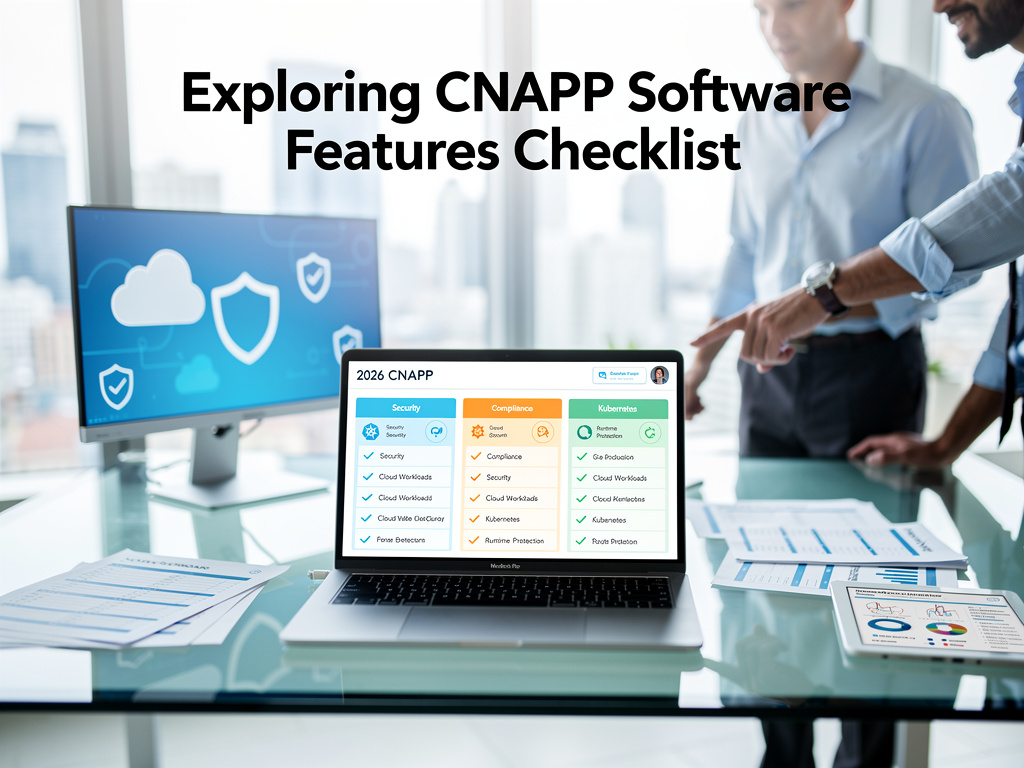
CNAPP Software Features Checklist: The Complete Guide to Evaluating Cloud-Native Application Protection Platforms in 2026
Cloud security has changed dramatically. Organizations running workloads across AWS, Azure, and Google Cloud face threats that traditional security tools simply can’t handle. That’s where Cloud-Native Application Protection Platforms come in.
CNAPP combines multiple security capabilities into one unified platform. You get cloud security posture management, workload protection, identity management, and runtime security all working together. But not every CNAPP solution delivers the same value.
This guide breaks down the features you need to look for when evaluating CNAPP vendors. We’ll cover everything from code-to-cloud visibility to runtime threat detection. By the end, you’ll have a complete checklist to compare solutions and pick the right one for your organization.
What Is CNAPP and Why Does It Matter in 2026?
A Cloud-Native Application Protection Platform is a unified security solution built specifically for cloud environments. It protects applications from development through deployment and into production runtime.
Gartner introduced the CNAPP category to address a growing problem. Security teams were juggling too many disconnected tools. They had separate products for:
- Cloud Security Posture Management (CSPM)
- Cloud Workload Protection Platform (CWPP)
- Cloud Infrastructure Entitlement Management (CIEM)
- Kubernetes Security Posture Management (KSPM)
- Application Security Posture Management (ASPM)
Each tool generated its own alerts. Security teams drowned in noise. Context got lost between platforms. Attackers exploited the gaps.
The Shift Toward Unified Cloud Security
CNAPP solves this fragmentation problem. It brings everything under one roof. You get a single view of security across your entire cloud footprint.
This matters more than ever in 2026. Cloud environments have grown more complex. Organizations run containers, serverless functions, and virtual machines across multiple providers. Traditional perimeter-based security doesn’t work here.
Modern attackers move laterally. They exploit misconfigurations. They abuse overprivileged identities. They target vulnerable container images. A CNAPP gives you the visibility to spot these threats before they cause damage.
Key Components That Make Up a CNAPP
Understanding what goes into a CNAPP helps you evaluate vendors more effectively. Here’s what a complete platform includes:
CSPM monitors your cloud configurations. It identifies misconfigurations, compliance violations, and risky settings across AWS, Azure, and GCP.
CWPP protects your workloads. This includes virtual machines, containers, and serverless functions running in production.
CIEM manages cloud identities. It spots overprivileged accounts, unused permissions, and risky access patterns.
KSPM secures your Kubernetes clusters. It checks configurations, network policies, and pod security settings.
ASPM shifts security left. It scans code, dependencies, and infrastructure-as-code templates during development.
Feature #1: Unified Platform Architecture
The most important feature on your CNAPP checklist is unified architecture. You need a platform that truly integrates its components rather than stitching together acquired products.
Many vendors claim to offer CNAPP. But dig deeper and you’ll find separate tools with different dashboards. Different databases. Different alert formats. That’s not real integration.
What True Unification Looks Like
A genuinely unified CNAPP shares data across all its components. When the CSPM module finds a misconfigured S3 bucket, that information feeds into the broader risk calculation. The platform knows which workloads access that bucket. It knows what data lives there.
This context changes everything. A public S3 bucket might be low priority if it only holds marketing images. But if it contains customer PII and connects to a compromised container, that’s a critical issue.
Single pane of glass isn’t just a marketing phrase. It should mean one dashboard, one alert queue, one risk score. You shouldn’t need to switch between tabs to understand your security posture.
Questions to Ask Vendors About Integration
When evaluating CNAPP vendors, ask these specific questions:
- Do all modules share the same underlying database?
- Can I correlate findings across CSPM, CWPP, and CIEM in a single query?
- Does the platform automatically connect vulnerabilities to runtime exposure?
- How long has the architecture been unified, or is it still integrating acquisitions?
The answers reveal whether you’re getting true unification or a bundled product suite.
Benefits of Unified Architecture
Unified architecture delivers concrete operational benefits:
Faster investigations. When everything lives in one place, you don’t waste time pivoting between tools. Security analysts can trace an attack path from code to cloud in minutes.
Better prioritization. Context from multiple sources helps you focus on what matters. A medium-severity vulnerability becomes critical when combined with internet exposure and overprivileged access.
Lower total cost. One platform costs less than five separate tools. You also save on training, integration work, and operational overhead.
Feature #2: Complete Code-to-Cloud Visibility
You can’t protect what you can’t see. That’s why visibility tops every CNAPP software features checklist. But visibility means more than just asset inventory.
You need to see the relationships between assets. You need to understand data flows. You need to track changes over time.
Asset Discovery and Inventory
Start with the basics. Your CNAPP should automatically discover every asset across all cloud accounts. This includes:
- Compute resources: VMs, containers, serverless functions, Kubernetes pods
- Storage: Object storage, block storage, databases, data warehouses
- Network components: VPCs, subnets, security groups, load balancers
- Identity resources: Users, roles, service accounts, policies
- Application components: APIs, microservices, message queues
Discovery should happen continuously. Cloud environments change constantly. Developers spin up resources without telling security. Your CNAPP needs to catch those changes in real time.
Agentless vs. Agent-Based Visibility
This is a key decision point. Agentless visibility uses cloud APIs to scan your environment. Agent-based visibility deploys software on each workload.
Agentless approaches offer faster deployment. You don’t need to install anything on workloads. Coverage is immediate across your entire footprint. But agentless scanning has gaps. It can miss some runtime behaviors.
Agent-based approaches provide deeper visibility. Agents see process activity, network connections, and file system changes in real time. But agents add overhead. They require deployment and maintenance.
The best CNAPPs offer both options. Use agentless scanning for broad coverage. Add agents to critical workloads that need deeper protection.
Mapping Relationships and Attack Paths
Asset inventory is just the starting point. Your CNAPP should map how assets connect. This reveals potential attack paths that individual findings miss.
Consider this scenario. Your CSPM finds an overprivileged IAM role. Your CWPP finds a vulnerable container image. Separately, these are medium-priority issues. But if that container uses that IAM role and faces the internet, an attacker has a clear path to your crown jewels.
Attack path analysis connects these dots automatically. It shows you which combinations of issues create real risk. This helps you prioritize remediation based on actual exploitability.
Multi-Cloud Visibility Requirements
Most organizations use multiple cloud providers. You might run production on AWS but use Azure for specific workloads. Some services might live on GCP.
Your CNAPP must provide consistent visibility across all providers. You shouldn’t need to learn different interfaces for each cloud. The platform should normalize data so you can compare apples to apples.
Check for native support of each cloud provider you use. Some CNAPPs started on AWS and added other clouds later. Their coverage might be uneven.
Feature #3: Cloud Security Posture Management (CSPM)
CSPM forms the backbone of any CNAPP solution. It continuously monitors your cloud configurations against security best practices and compliance frameworks.
Misconfigurations cause most cloud breaches. Open S3 buckets. Unrestricted security groups. Missing encryption. These mistakes happen constantly in fast-moving environments.
Configuration Assessment Capabilities
Your CNAPP should check configurations against multiple benchmarks. Look for support of:
- CIS Benchmarks for AWS, Azure, and GCP
- Cloud provider best practices from each vendor
- Custom policies specific to your organization
- Industry frameworks like NIST and ISO 27001
Configuration checks should run continuously, not just on a schedule. Cloud environments change constantly. Daily scans miss risky configurations that exist for hours.
Infrastructure as Code Security
CSPM should shift left into the development process. Infrastructure as Code (IaC) scanning catches misconfigurations before resources deploy.
Your CNAPP should scan Terraform, CloudFormation, ARM templates, and Kubernetes manifests. It should integrate with CI/CD pipelines to block risky deployments automatically.
This prevents the security debt that accumulates when teams deploy first and fix later. It’s cheaper and safer to catch issues in code review than in production.
Drift Detection and Continuous Monitoring
Configuration drift happens when running resources deviate from their defined state. Someone makes a manual change in the console. An automated process modifies settings. Suddenly your production environment doesn’t match your code.
Strong CSPM capabilities include drift detection. The platform should alert you when configurations change unexpectedly. It should show exactly what changed, when, and by whom.
This helps you maintain consistency and catch unauthorized modifications that might indicate compromise.
Automated Remediation Options
Finding problems is only half the battle. Your CNAPP should help fix them too.
Look for platforms that offer:
- One-click remediation for common misconfigurations
- Remediation scripts you can review before execution
- Pull request generation to fix IaC templates
- Automated fixes for critical issues (with appropriate guardrails)
Automation speeds up response times. But proceed carefully. Automated changes to production can cause outages if not properly tested.
Feature #4: Cloud Workload Protection Platform (CWPP)
CWPP protects your actual workloads—the VMs, containers, and serverless functions running your applications. It’s the runtime security component of your CNAPP.
While CSPM focuses on configuration, CWPP focuses on behavior. It watches what your workloads actually do and spots suspicious activity.
Container Security Capabilities
Containers dominate modern cloud deployments. Your CNAPP needs deep container security capabilities:
Image scanning checks container images for vulnerabilities, malware, and misconfigurations. This should happen in registries, CI/CD pipelines, and at runtime.
Runtime protection monitors container behavior during execution. It spots unexpected processes, network connections, and file system modifications.
Admission control enforces policies at deployment time. It can block vulnerable or misconfigured containers from entering your clusters.
Kubernetes Security Posture Management
Kubernetes adds another layer of complexity. Your CNAPP should include specific Kubernetes security capabilities:
- Cluster configuration assessment against CIS Kubernetes Benchmark
- Network policy analysis and recommendations
- Pod security standards enforcement
- RBAC permission analysis
- Secrets management validation
Kubernetes misconfigurations are common attack vectors. Overprivileged service accounts, missing network policies, and excessive pod capabilities create risk.
VM and Serverless Protection
Don’t forget traditional and emerging workload types. Your CNAPP should protect:
Virtual machines with vulnerability scanning, file integrity monitoring, and behavioral analysis. Even in containerized environments, VMs often run databases and legacy applications.
Serverless functions with code analysis, permission assessment, and runtime monitoring. Lambda, Azure Functions, and Cloud Functions need security too, even though you don’t manage the underlying infrastructure.
Vulnerability Management Integration
CWPP should integrate vulnerability management across all workload types. You need to see vulnerabilities in context:
- Which vulnerabilities exist in running workloads?
- Which vulnerabilities are actually exploitable based on configuration?
- Which vulnerabilities have public exploits available?
- Which vulnerabilities affect internet-facing workloads?
This context helps you prioritize. Not all critical vulnerabilities pose equal risk. A critical CVE in an air-gapped internal system matters less than a medium CVE in your public API gateway.
Feature #5: Cloud Infrastructure Entitlement Management (CIEM)
Identity is the new perimeter. In cloud environments, compromised credentials cause more breaches than network attacks. CIEM capabilities help you manage this risk.
Cloud IAM is complex. AWS alone has over 10,000 distinct permissions. Azure and GCP add thousands more. Humans can’t effectively analyze these permissions at scale.
Permission Analysis and Visualization
Your CNAPP should analyze effective permissions across all identities. This means understanding:
- What can each user, role, or service account actually do?
- How do permissions combine across multiple policies?
- Which permissions are granted but never used?
- Which identities have overly broad access?
Permission visualization helps you understand complex IAM structures. Look for platforms that show permission relationships graphically, not just in tables.
Least Privilege Recommendations
CIEM should help you implement least privilege. The platform should analyze actual permission usage and recommend right-sized policies.
This usually works by monitoring API calls over time. If a service account has S3 full access but only ever reads from one bucket, the CNAPP should recommend a tighter policy.
Least privilege recommendations should be specific and actionable. Generic advice to “reduce permissions” doesn’t help. You need exact policy language you can apply.
Cross-Cloud Identity Analysis
Organizations using multiple clouds face identity sprawl. Similar workloads might use different service accounts across AWS and Azure. Federation adds complexity.
Your CNAPP should correlate identities across clouds. It should spot inconsistencies where the same application has different permission levels in different environments.
Service Account Risk Assessment
Service accounts often have more access than human users. They’re also harder to monitor. Your CNAPP should pay special attention to:
- Service accounts with administrative privileges
- Service accounts that haven’t been rotated
- Service accounts with exposed credentials
- Service accounts used by internet-facing workloads
Compromised service accounts are a favorite attacker technique. CIEM helps you reduce this risk surface.
Feature #6: Runtime Threat Detection and Response
Prevention isn’t enough. Attackers will sometimes get through your defenses. Your CNAPP needs strong detection capabilities to catch threats that bypass preventive controls.
Runtime protection watches your environment in real time. It spots suspicious behavior, alerts your team, and can automatically respond to threats.
Cloud Detection and Response (CDR)
CDR extends traditional endpoint detection to cloud environments. It monitors control plane activities, network flows, and workload behaviors.
Your CNAPP should detect:
- Reconnaissance activities like unusual API enumeration
- Credential abuse including impossible travel and unusual access patterns
- Data exfiltration through unusual data transfer patterns
- Privilege escalation attempts within your environment
- Cryptomining and other resource abuse
Detection should correlate signals across multiple sources. An individual API call might seem normal. But combined with container behavior and network activity, it might indicate compromise.
Behavioral Analysis and Anomaly Detection
Signature-based detection misses novel attacks. Your CNAPP should use behavioral analysis to spot anomalies.
This requires establishing baselines of normal activity. What processes normally run in each container? What API calls do your workloads typically make? What data volumes do they usually transfer?
Deviations from these baselines trigger alerts. A database container suddenly running a shell and making outbound connections is suspicious, even without a specific signature match.
Automated Response and Containment
When threats are detected, speed matters. Manual response takes too long against automated attacks.
Look for CNAPP platforms that offer automated response options:
- Network isolation to quarantine compromised workloads
- Process termination to stop malicious activity
- Credential rotation to limit damage from compromised accounts
- Snapshot creation for forensic analysis
Automated response should be configurable. You might want full automation for some threat types and human-in-the-loop for others.
Forensics and Investigation Support
After detecting a threat, you need to investigate. Your CNAPP should support forensic analysis with:
- Historical activity logs for affected resources
- Timeline reconstruction of attack sequences
- Container and VM forensic snapshots
- Evidence collection and export capabilities
Good forensics help you understand what happened, contain the damage, and prevent recurrence.
Feature #7: Application Security Posture Management (ASPM)
Security should start in development, not deployment. ASPM capabilities shift security left by integrating with your development pipeline.
ASPM aggregates findings from various application security tools. It provides developers with actionable feedback during code review, not after production deployment.
Code Scanning Integration
Your CNAPP should include or integrate with code scanning tools:
SAST (Static Application Security Testing) analyzes source code for vulnerabilities. It finds SQL injection, cross-site scripting, and other code-level issues.
SCA (Software Composition Analysis) identifies vulnerabilities in third-party dependencies. Most modern applications include hundreds of open-source components.
Secret scanning detects hardcoded credentials, API keys, and other secrets in code repositories.
CI/CD Pipeline Integration
Security checks should run automatically in your build pipeline. Your CNAPP should integrate with:
- GitHub Actions and GitLab CI
- Jenkins and CircleCI
- Azure DevOps Pipelines
- Other popular CI/CD platforms
Integration should be straightforward. Developers shouldn’t need extensive security knowledge to benefit from automated checks.
Developer-Friendly Remediation Guidance
Finding vulnerabilities is only useful if developers can fix them. Your CNAPP should provide:
- Clear explanations of each issue
- Specific code examples showing the fix
- Links to relevant documentation
- Priority rankings based on actual risk
The goal is helping developers write secure code, not overwhelming them with alerts.
Correlating Development Findings with Runtime Risk
This is where ASPM integration with broader CNAPP capabilities shines. A vulnerability found in code review might be low priority. But if that same vulnerability appears in a production workload facing the internet, it becomes urgent.
Your CNAPP should connect development findings to production context. This helps prioritize fixes based on actual exposure, not just theoretical severity.
Feature #8: Compliance Monitoring and Reporting
Every organization faces compliance requirements. Whether it’s SOC 2, PCI DSS, HIPAA, or GDPR, your CNAPP should help you demonstrate compliance.
Compliance isn’t just about passing audits. It’s about maintaining consistent security practices over time.
Framework Support and Mapping
Your CNAPP should support the compliance frameworks relevant to your industry:
- SOC 2 for service organizations
- PCI DSS for payment card data
- HIPAA for healthcare data
- GDPR for European personal data
- FedRAMP for US government contractors
- ISO 27001 for information security management
The platform should map its controls to each framework. You should see exactly which CNAPP findings relate to which compliance requirements.
Continuous Compliance Monitoring
Point-in-time compliance assessments miss the full picture. Your environment might be compliant today and non-compliant tomorrow after a configuration change.
Your CNAPP should monitor compliance continuously. It should alert you immediately when changes affect your compliance posture.
Evidence Collection and Audit Support
Auditors need evidence. Your CNAPP should help you collect and organize it:
- Historical compliance status over time
- Screenshots and exports of control implementations
- Audit trails of configuration changes
- Reports formatted for auditor consumption
Good compliance reporting saves time during audits and reduces stress for your team.
Custom Policy Creation
Standard frameworks don’t cover everything. Your organization likely has internal security policies that go beyond external requirements.
Your CNAPP should support custom policy creation. You should be able to define your own rules and monitor compliance against them alongside standard frameworks.
Feature #9: AI and Automation Capabilities
Security teams face an impossible task. The volume of alerts, the pace of change, and the complexity of cloud environments exceed human capacity.
AI and automation help security teams scale. They handle routine tasks, surface important findings, and accelerate response.
AI-Powered Alert Prioritization
Not all alerts matter equally. AI can help prioritize based on multiple factors:
- Actual exploitability of vulnerabilities
- Business criticality of affected assets
- Attack path exposure
- Historical patterns and threat intelligence
Good AI prioritization dramatically reduces alert fatigue. Your team focuses on what matters instead of chasing false positives.
AI Copilot for Security Teams
Some CNAPPs now include AI assistants that help security teams work faster. These copilots can:
- Answer questions about your environment
- Explain complex findings in plain language
- Suggest remediation approaches
- Help write custom policies
AI copilots make expert security knowledge more accessible. Junior analysts can accomplish tasks that previously required senior expertise.
Automated Workflow and Ticketing Integration
Findings need to flow into your existing workflows. Your CNAPP should integrate with:
- SIEM platforms like Splunk and Microsoft Sentinel
- Ticketing systems like Jira and ServiceNow
- Collaboration tools like Slack and Microsoft Teams
- SOAR platforms for automated response
Integration should be bi-directional. When a ticket is closed, the CNAPP should know. This keeps your security data synchronized.
Predictive Risk Assessment
Advanced CNAPPs use machine learning to predict future risks. They identify patterns that suggest emerging threats or increasing attack likelihood.
Predictive capabilities help you stay ahead of attackers instead of constantly reacting to incidents.
Feature #10: Performance, Scalability, and Deployment Options
Your CNAPP must work at your scale. It should handle thousands of workloads across multiple clouds without performance degradation.
Deployment flexibility matters too. Some organizations need cloud-hosted SaaS. Others require on-premises deployment for data sovereignty or compliance reasons.
Scalability for Enterprise Environments
Enterprise cloud environments are massive. They include:
- Hundreds of cloud accounts
- Thousands of workloads
- Millions of daily events
- Petabytes of stored data
Your CNAPP must scale to match. Ask vendors about their largest deployments. Request references from organizations similar to yours.
Performance Impact on Workloads
Security tools shouldn’t slow down your applications. For agent-based components, verify:
- CPU and memory overhead on protected workloads
- Network bandwidth consumption
- Impact on container startup time
- Effect on application latency
Look for vendors who publish performance benchmarks and allow proof-of-concept testing in your environment.
Deployment Flexibility
Different organizations have different requirements. Your CNAPP should offer:
SaaS deployment for organizations that want managed infrastructure. This is the fastest to deploy and easiest to maintain.
Self-hosted deployment for organizations with data residency requirements. You run the platform in your own cloud or data center.
Hybrid options that combine cloud management with on-premises data processing.
Data Residency and Sovereignty
Where does your security data live? This matters for compliance with regulations like GDPR.
Verify that your CNAPP can keep data within required geographic regions. Understand what data flows to the vendor and what stays in your environment.
CNAPP Vendor Comparison: Top Features at a Glance
When comparing CNAPP vendors, use this table to evaluate how they stack up across key feature areas:
| Feature Category | Key Capabilities to Evaluate | Questions to Ask Vendors |
|---|---|---|
| Unified Platform | Single database, shared context, unified dashboard | How long ago did you achieve full integration? Do all modules share data natively? |
| Visibility | Asset discovery, relationship mapping, agentless and agent options | How quickly do you discover new assets? Can you map attack paths automatically? |
| CSPM | Configuration checks, IaC scanning, drift detection, auto-remediation | Which frameworks do you support out of the box? Can I create custom policies? |
| CWPP | Container security, Kubernetes protection, VM and serverless coverage | What’s the agent footprint? Do you support admission control? |
| CIEM | Permission analysis, least privilege recommendations, cross-cloud identity | How do you calculate effective permissions? Can you suggest right-sized policies? |
| Runtime Protection | Threat detection, behavioral analysis, automated response | What types of attacks do you detect? What automated response options exist? |
| ASPM | Code scanning, pipeline integration, developer guidance | Which CI/CD platforms do you integrate with? How do you correlate dev findings with runtime? |
| Compliance | Framework mapping, continuous monitoring, audit reporting | Which frameworks do you support? Can I track compliance over time? |
| AI/Automation | Alert prioritization, AI copilot, workflow integration | How does AI improve prioritization? What integrations do you support? |
| Deployment | SaaS, self-hosted, hybrid options, data residency | Where does my data live? Can you deploy on-premises? |
Building Your CNAPP Evaluation Criteria
Every organization’s needs differ. Use this section to build your customized evaluation criteria based on your specific situation.
For Organizations Just Starting Cloud Security
If you’re building cloud security from scratch, prioritize:
- Ease of deployment – You need quick time-to-value
- CSPM capabilities – Configuration management is foundational
- Built-in compliance – Use frameworks to structure your program
- Clear remediation guidance – Help your team learn as they fix
You can add advanced capabilities like runtime protection and CIEM later as your program matures.
For Organizations with Mature Security Programs
If you already have strong security fundamentals, focus on:
- Integration capabilities – Work with your existing tools
- Advanced threat detection – Catch sophisticated attacks
- Custom policy support – Enforce your specific requirements
- API access – Enable automation and custom workflows
Look for platforms that enhance rather than replace your existing investments.
For Highly Regulated Industries
Financial services, healthcare, and government organizations should emphasize:
- Comprehensive compliance support – Cover all required frameworks
- Detailed audit trails – Document everything for regulators
- Data residency options – Keep data in approved locations
- Strong CIEM capabilities – Regulators care about access controls
For Developer-Centric Organizations
If developers drive your cloud environment, prioritize:
- Strong ASPM capabilities – Shift security into development
- CI/CD integration – Meet developers where they work
- Developer-friendly interface – Make security accessible
- Low-friction deployment – Don’t slow down releases
Common CNAPP Implementation Mistakes to Avoid
Learning from others’ mistakes saves time and frustration. Here are the most common problems organizations face when deploying CNAPP.
Deploying Without Clear Objectives
Don’t just buy a CNAPP because it’s what everyone’s doing. Define specific goals first:
- What risks are you trying to reduce?
- Which compliance requirements must you meet?
- What capabilities do you need immediately vs. later?
- How will you measure success?
Clear objectives guide your vendor selection and implementation approach.
Underestimating Integration Effort
CNAPP works best when integrated with your existing tools and processes. Plan for:
- SIEM and SOAR integration
- Ticketing system connections
- CI/CD pipeline hooks
- Identity provider federation
Budget time and resources for this integration work. It’s often underestimated.
Ignoring Alert Tuning
Out-of-the-box CNAPP deployments generate too many alerts. You need to tune:
- Suppress false positives from known-good configurations
- Adjust severity levels based on your environment
- Create exceptions for approved deviations
- Customize policies for your specific needs
Plan for ongoing tuning, not just initial setup.
Failing to Involve Developers
CNAPP affects developers’ daily work. Involve them early:
- Get input on CI/CD integration approaches
- Explain what findings mean and how to fix them
- Listen to feedback about false positives
- Provide training on secure development practices
Security tools succeed when developers see them as helpful rather than obstacles.
The Future of CNAPP: Trends to Watch in 2026 and Beyond
CNAPP continues to evolve rapidly. Understanding emerging trends helps you make future-proof decisions.
AI Integration Deepens
AI capabilities in CNAPP will expand significantly. Expect:
- More accurate threat detection with fewer false positives
- Natural language interfaces for security queries
- Automated remediation becoming more reliable
- Predictive risk scoring based on threat intelligence
Choose vendors investing heavily in AI capabilities.
Shift Further Left
Security will move even earlier in development. CNAPPs will integrate more deeply with:
- IDE plugins for real-time security feedback
- Code repository security features
- Design-phase security assessment
- Threat modeling automation
Identity Security Becomes Central
Identity-based attacks will continue growing. CIEM capabilities will become more sophisticated:
- Just-in-time access provisioning
- Continuous identity verification
- Machine identity management
- Cross-cloud identity correlation
API Security Integration
APIs are critical attack surfaces. CNAPPs will add deeper API security capabilities:
- API discovery and inventory
- API vulnerability assessment
- Runtime API protection
- API-specific threat detection
Conclusion: Making Your CNAPP Decision
Choosing the right CNAPP requires careful evaluation across many dimensions. Start with your specific requirements. Map them to the feature categories we’ve covered. Use structured evaluation criteria to compare vendors objectively.
The best CNAPP for your organization depends on your cloud footprint, security maturity, compliance needs, and team capabilities. Don’t chase the most features. Choose the platform that best addresses your actual risks.
Take your time with proof-of-concept testing. See how each platform performs in your real environment with your actual workloads. The right CNAPP will become a foundation of your cloud security program for years to come.
Frequently Asked Questions About CNAPP Software Features Checklist
| What’s the difference between CNAPP and traditional cloud security tools? | Traditional tools address specific security functions separately. CSPM, CWPP, and CIEM each run as independent products with their own dashboards and alert streams. CNAPP unifies these capabilities into one platform. This provides better context, reduced complexity, and the ability to correlate findings across security domains. You see your entire cloud security posture in one place instead of piecing together information from multiple tools. |
| How long does it take to deploy a CNAPP solution? | Initial deployment varies by platform and scope. Agentless CSPM capabilities can show results within hours of connecting cloud accounts. Full deployment including agent-based workload protection, CI/CD integration, and custom policy configuration typically takes weeks to months. Plan for ongoing tuning and optimization for several months after initial deployment. |
| Should I choose agentless or agent-based CNAPP? | Most organizations benefit from both. Agentless scanning provides broad visibility with fast deployment and zero workload overhead. Agent-based protection delivers deeper runtime visibility and real-time threat detection. Start with agentless to get immediate coverage, then add agents to workloads that need enhanced protection. The best CNAPPs support both deployment models. |
| What compliance frameworks should my CNAPP support? | This depends on your industry and regulatory requirements. At minimum, look for CIS Benchmarks for each cloud provider you use. Financial services need PCI DSS. Healthcare needs HIPAA. Organizations handling European data need GDPR. Government contractors need FedRAMP. SOC 2 applies to most service organizations. Choose a CNAPP that supports your required frameworks and allows custom policy creation for internal requirements. |
| How does CNAPP fit with my existing security tools? | CNAPP should integrate with your existing security stack rather than replace everything. Look for integrations with your SIEM for centralized logging and correlation, SOAR for automated response workflows, ticketing systems for remediation tracking, and identity providers for authentication. API access enables custom integrations where native connectors don’t exist. |
| What’s the typical cost structure for CNAPP solutions? | Most CNAPP vendors price based on protected workloads, cloud resources monitored, or data volume. Some charge per cloud account. Pricing models vary significantly between vendors. Request detailed pricing for your specific environment. Consider total cost of ownership including implementation, integration, training, and ongoing management. Free trials or proof-of-concept periods help you validate value before committing. |
| How do I measure CNAPP ROI? | Measure CNAPP ROI through several metrics: reduction in security incidents and breaches, time saved on compliance audits and reporting, reduced manual effort in security operations, faster mean time to detect and respond to threats, and reduction in cloud misconfiguration-related risks. Establish baselines before deployment so you can demonstrate improvements over time. |
| What team skills do I need to run a CNAPP effectively? | CNAPP requires some cloud security expertise but shouldn’t demand a large specialized team. Look for platforms with intuitive interfaces and guided remediation. Core skills needed include cloud platform knowledge (AWS, Azure, GCP), basic security operations, understanding of container and Kubernetes concepts, and familiarity with CI/CD pipelines. Many organizations successfully run CNAPP with small teams by using automation and AI capabilities. |
| Can CNAPP protect multi-cloud environments effectively? | Yes, protecting multi-cloud environments is a core CNAPP use case. The best platforms provide consistent visibility and policy enforcement across AWS, Azure, GCP, and sometimes other clouds. Look for vendors with native support for all your cloud providers, not just add-on integrations. Verify that features work equally well across all clouds, not just the vendor’s primary focus. |
| When should I consider replacing my current cloud security tools with CNAPP? | Consider CNAPP when you’re struggling with tool sprawl, alert fatigue from multiple disconnected products, inability to correlate security findings across domains, or compliance gaps that require multiple reports to address. CNAPP consolidation often reduces total cost while improving security outcomes. However, if your current tools work well and integrate effectively, a gradual transition may make more sense than rip-and-replace. |




 Stack Insight is intended to support informed decision-making by providing independent information about business software and services. Some product details, including pricing, features, and promotional offers, may be supplied by vendors or partners and can change without notice.