
Carta vs Cake Equity: The Complete 2026 Comparison Guide for Startup Founders
Picking the right equity management platform can save you thousands of dollars. It can also save you countless hours of frustration. But with so many options out there, how do you choose?
Two names keep coming up in founder conversations: Carta and Cake Equity. Both promise to handle your cap table, equity grants, and compliance needs. Both have loyal users who swear by them.
But they’re built for very different companies. Carta started as a cap table tool and grew into a massive platform serving fund managers, institutional investors, and large enterprises. Cake Equity focused on growing startups where founders or CFOs manage equity alongside a hundred other things.
This guide breaks down every angle. We’ll compare pricing, features, user experience, support quality, migration processes, and more. By the end, you’ll know exactly which platform fits your company’s stage and needs.
What Is Carta and Who Is It Built For?
Carta launched in 2012 under the name eShares. The company is headquartered in San Francisco. Over the years, it transformed from a simple cap table tool into something much bigger.
Today, Carta’s core business centers on fund administration, transfer agent services, and LP management for institutional portfolios. The startup cap table product is just one piece of that larger ecosystem.
Carta’s Target Audience
Carta works best for:
- Large companies with dedicated equity administration teams
- Venture capital funds needing LP reporting and fund management
- Private equity firms managing complex portfolio structures
- Late-stage startups with full-time CFOs and legal teams
- Companies preparing for IPO with extensive compliance requirements
If your company has a full-time person managing equity compensation, Carta’s depth might make sense. The platform offers extensive features for complex scenarios.
Carta’s Business Model
Here’s something founders often miss: Carta makes significant revenue from fund administration and investor services. This shapes how they build their product.
When you use Carta as a startup, you’re paying for infrastructure designed to serve institutional investors. Features built for fund CFOs and LP management get bundled into your pricing.
That’s not necessarily bad. But it means you might pay for capabilities your Series A company won’t use for years.
Carta’s Market Position
Carta became the default choice for many startups through aggressive growth. They captured market share early. Many accelerators and VC firms recommended them.
But that dominance created problems. As the company scaled, support quality dropped. Pricing climbed. User experience became more complex.
This opened the door for alternatives like Cake Equity to attract founders looking for something different.
What Is Cake Equity and What Makes It Different?
Cake Equity positions itself as “equity that motivates everyone.” The platform covers cap table management, compliance, and company culture. But its approach differs from Carta in important ways.
Cake built its product specifically for growing startups. The target user isn’t a dedicated equity administrator. It’s a founder or CFO juggling twenty different responsibilities.
Cake Equity’s Design Philosophy
The platform prioritizes simplicity without sacrificing depth. Users describe it as intuitive from day one. Features work the way you’d expect them to work.
Cake designed its interface for people who don’t manage equity full-time. You shouldn’t need training to issue shares or run a scenario model.
This matters more than it sounds. When equity management feels complicated, founders avoid it. They put off important decisions. They make mistakes that create legal headaches later.
Cake’s Approach to Growth
The company describes itself as “a system of action, not just a system of record.” That phrase captures something real about the difference.
Cake wants to move with your company from first SAFE to most complex round. The platform scales up as you grow. You don’t outgrow it after Series A.
Features like scenario modeling, investor portals, and 409A valuations integrate into the core experience. They’re not bolted on as expensive add-ons.
Cake’s Market Recognition
On the G2 Winter 2026 report, Cake Equity ranks ahead of Carta across every index measured:
- Implementation
- Usability
- Results
- Momentum
- Relationship
The platform holds a 4.8/5 overall rating on G2 with over 145 reviews. Users consistently praise the interface and support quality.
Pricing Comparison: Carta vs Cake Equity Costs
Let’s talk money. Pricing differences between these platforms can reach tens of thousands of dollars annually.
This section breaks down exactly what you’ll pay with each option.
Carta Pricing Structure
Carta uses quote-based enterprise pricing. You won’t find straightforward rates on their website. Actual costs depend on company size, feature needs, and negotiation.
Based on user reports and industry data, here’s what Carta typically charges:
- Cap table + 409A bundle: $6,000 to $15,000+ per year
- 409A valuations alone: $3,000+ as a separate service
- Migration from other platforms: Charged separately
These numbers climb as your company grows. More stakeholders mean higher fees. More complex equity structures push you into pricier tiers.
Cake Equity Pricing Structure
Cake takes a transparent approach. Their pricing shows up clearly on their website. You know what you’ll pay before signing anything.
Here’s Cake’s pricing breakdown:
- Free tier: Up to 5 stakeholders at no cost
- Paid plans: Starting at $1,000/year
- Cap table + 409A: $2,750/year
- 409A valuation add-on: $1,500 when you need it
- Migration: Free
Side-by-Side Pricing Comparison Table
| Feature | Cake Equity | Carta |
|---|---|---|
| Cap table + 409A bundle | $2,750/year | $6,000–$15,000+/year |
| 409A valuation standalone | $1,500 add-on | $3,000+ separate service |
| Entry-level pricing | Free (up to 5 stakeholders) | Quote-based |
| Migration costs | Free | Charged separately |
| Pricing transparency | Published on website | Requires sales call |
Real Cost Savings When Switching
Companies switching from Carta to Cake save an average of 48%. But the dollar amounts vary based on company size.
Founders moving to Cake typically save between $3,000 and $16,000 annually. That’s real money you could put toward hiring, marketing, or product development.
Lemonlight, for example, saved $3,000 per year after switching from Carta. They didn’t give up features. They just stopped paying for things they didn’t use.
Dave Christianson, Legal Counsel at Tracksuit, explained his company’s decision:
“Cost wasn’t the primary driver for us. But Cake was significantly cheaper than Carta. So when it’s basically ahead on all those features, it was a no-brainer decision for us to choose to move to Cake.”
Understanding the Price Gap
Why does Carta cost so much more? Remember their business model. You’re paying for infrastructure built for fund administrators and institutional investors.
That infrastructure costs money to maintain. Carta passes those costs to all customers, including startups that don’t use those features.
Cake built specifically for startup needs. No fund administration overhead. No LP management tools inflating the price. You pay for what you actually use.
Cap Table Management Features Compared
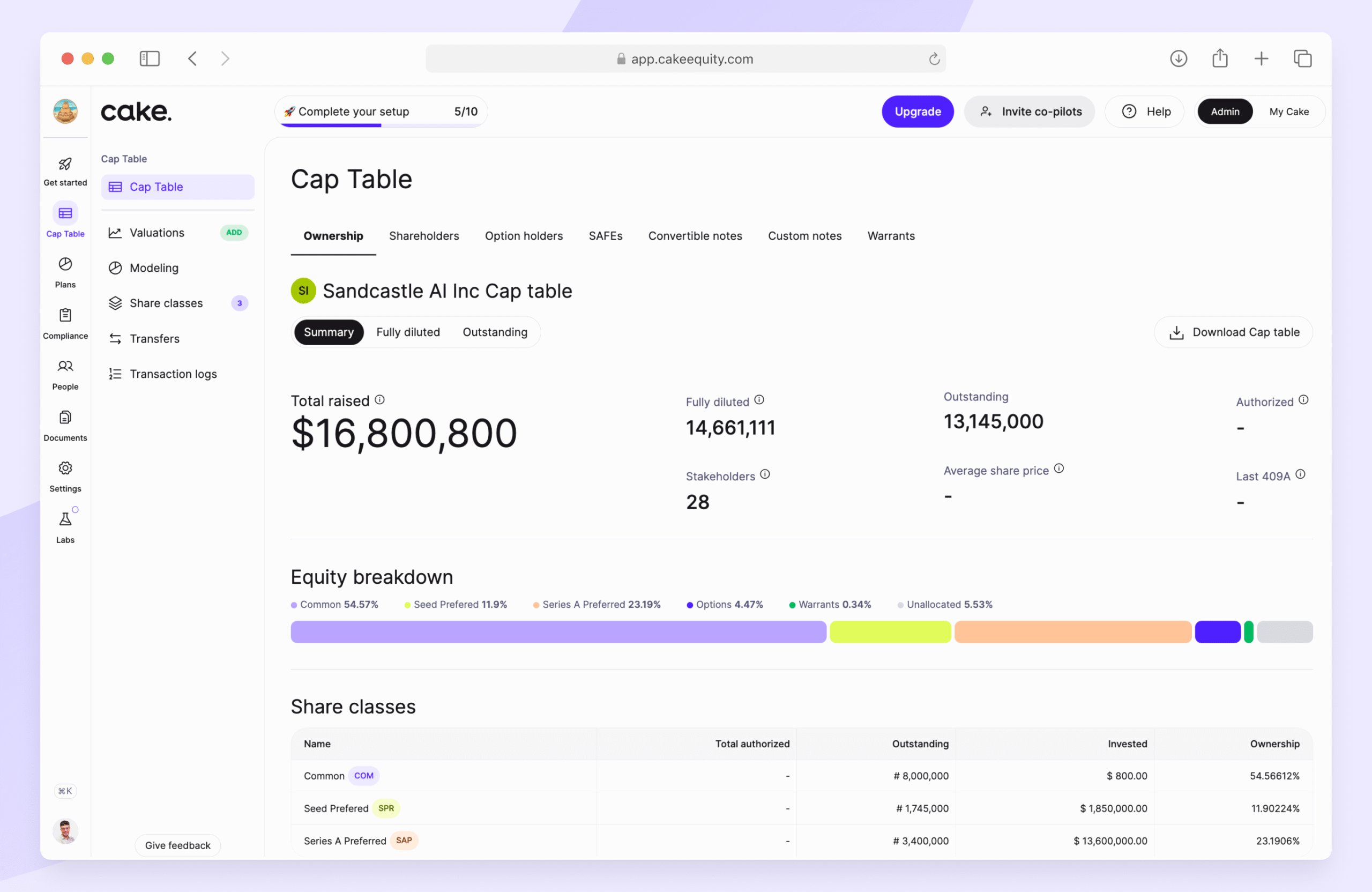
Both platforms handle the basics of cap table management. But the details matter. Let’s look at what each offers and how they differ.
Core Cap Table Functionality
Carta’s Cap Table Features:
- Ownership tracking across all stakeholder types
- Equity plan management
- Document generation and storage
- Waterfall analysis
- Round modeling
- Transfer agent services
- SEC compliance tools
Carta’s cap table tool developed over more than a decade. It handles complex scenarios well. Late-stage companies appreciate the depth.
Cake Equity’s Cap Table Features:
- Full ownership tracking from day one
- Employee and advisor grant management
- SAFE and convertible note tracking
- Document generation
- Waterfall and ownership analysis
- Round modeling
- Investor and employee portals
Cake offers the same core depth. The difference shows up in how you access these features. Cake’s interface feels more intuitive for non-specialists.
Equity Types Supported
Growing companies need flexibility. Both platforms support multiple equity types:
| Equity Type | Cake Equity | Carta |
|---|---|---|
| Common Stock | Yes | Yes |
| Preferred Stock | Yes | Yes |
| SAFEs | Yes | Yes |
| Convertible Notes | Yes | Yes |
| ISOs | Yes | Yes |
| NSOs | Yes | Yes |
| RSUs | Yes | Yes |
| RSAs | Yes | Yes |
Neither platform limits you here. Both handle the full range of equity instruments startups use.
Scenario Modeling Capabilities
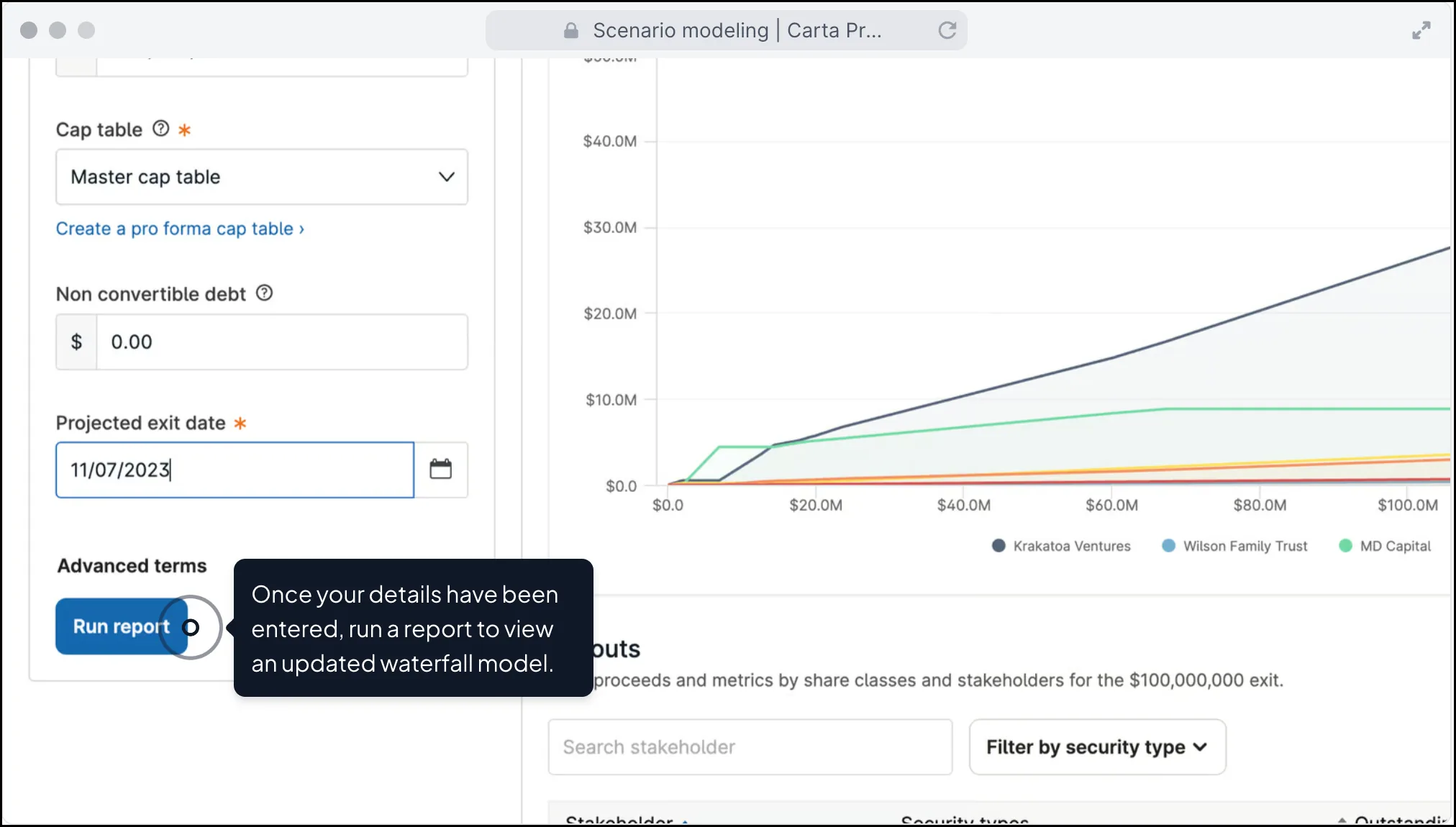
Scenario modeling helps you understand how future rounds affect ownership. It’s critical for fundraising negotiations and board discussions.
Carta’s scenario modeling works well for complex situations. You can model multiple rounds, different valuations, and various exit scenarios.
Cake’s scenario modeling offers the same power. Founders report it feels easier to use. You don’t need training to build useful models.
For Series B and beyond, advanced scenario modeling becomes increasingly important. Both platforms handle this well. Cake specifically mentions this feature as something that scales with company complexity.
Stakeholder Management
Managing stakeholders gets complicated fast. Founders, employees, advisors, and investors all need different information and access levels.
Carta provides stakeholder management through its broader platform. The interface reflects its enterprise focus. Some users find it overwhelming.
Cake built its stakeholder management for the full equity team. The portal works for investors checking their holdings and employees understanding their grants.
Both platforms let stakeholders access their own information. The experience of doing so differs between them.
409A Valuations: Carta vs Cake Equity Approach
Every startup issuing equity needs 409A valuations. The IRS requires them. Skipping this step creates serious tax problems for your employees.
Both platforms offer 409A services. But pricing and delivery differ.
What Is a 409A Valuation?
A 409A valuation determines the fair market value of your company’s common stock. You need a new one whenever something significant changes:
- Raising a funding round
- Major revenue milestones
- Significant product launches
- At least every 12 months regardless
Without a valid 409A, your employees face immediate tax liability on their stock options. That’s a big deal.
Carta’s 409A Process
Carta offers 409A valuations as a separate service. You pay around $3,000 or more each time you need one.
The service works through their platform but feels disconnected from cap table management. It’s an add-on, not an integrated feature.
Turnaround times vary. Some users report delays, especially during busy periods.
Cake’s 409A Process
Cake integrates 409A valuations more tightly. Their bundled price of $2,750/year includes both cap table management and 409A support.
If you prefer unbundled pricing, the 409A add-on costs $1,500 when you need it. That’s half what Carta charges.
The integration means less friction. Your cap table data flows directly into the valuation process. No manual exports or data reconciliation.
409A Comparison Table
| Aspect | Cake Equity | Carta |
|---|---|---|
| Bundled with cap table | Yes ($2,750/year total) | Separate service |
| Standalone price | $1,500 add-on | $3,000+ |
| Integration level | Fully integrated | Add-on service |
| Data flow | Automatic from cap table | May require exports |
Compliance and Reporting Features
Equity management creates compliance obligations. Both platforms help you meet them. But the depth and ease of compliance tools differ.
Tax Reporting Requirements
Companies issuing equity need to handle several tax forms and reports:
- ASC 718 reporting: Stock compensation expense for financial statements
- Form 3921: ISO exercise reporting to the IRS
- QSBS attestation: Documentation for Qualified Small Business Stock benefits
Getting these wrong creates problems with auditors, investors, and tax authorities.
Carta’s Compliance Tools
Carta offers extensive compliance features. The platform handles ASC 718, Form 3921, and other requirements.
These tools developed over years of serving enterprise clients. They’re comprehensive but sometimes feel over-engineered for smaller companies.
Cake’s Compliance Tools
Cake includes ASC 718 and Form 3921 reporting as you go. These aren’t expensive add-ons. They’re part of the platform.
QSBS attestation is available as an add-on when you need it. The feature helps founders and investors document their qualification for valuable tax benefits.
Compliance Feature Comparison
| Compliance Feature | Cake Equity | Carta |
|---|---|---|
| ASC 718 reporting | Included | Available |
| Form 3921 filing | Included | Available |
| QSBS attestation | Add-on available | Available |
| Audit support | Yes | Yes |
User Experience and Interface Design

You’ll spend hours in your equity management platform. The interface matters more than you might think.
A confusing interface leads to mistakes. It slows you down. It makes you avoid tasks you should handle promptly.
Carta’s User Interface
Carta’s interface reflects its evolution from startup tool to enterprise platform. Features accumulated over years without always fitting together smoothly.
New users often need training to feel comfortable. The learning curve exists. Some founders report feeling overwhelmed by options they don’t understand.
The interface works well once you learn it. But that learning takes time you might not have.
Cake’s User Interface
Cake designed its interface for busy founders. The platform assumes you’re not an equity specialist. It meets you where you are.
Users describe the experience as “simpler than expected.” That phrase appears frequently in reviews. Features work intuitively without sacrificing capability.
One founder noted: “What I hear most from founders who switch to Cake is that it’s simpler than expected. Not fewer features, just features that work intuitively for every stage of growth.”
G2 Usability Ratings
Third-party ratings confirm the user experience difference:
| Rating Category | Cake Equity | Carta |
|---|---|---|
| Overall G2 rating | 4.8/5 | 4.4/5 |
| Usability index | #1 in category | Lower ranked |
| Implementation index | #1 in category | Lower ranked |
Mobile Experience
Founders check their equity data from phones and tablets. Both platforms offer mobile access. The quality of that experience differs.
Cake’s mobile experience maintains the simplicity of the desktop version. You can check key information without frustration.
Carta’s mobile access exists but reflects the desktop complexity. Some features work better than others on smaller screens.
Customer Support Quality Comparison
Support quality makes a huge difference during critical moments. Closing a funding round at midnight? You need help now, not in three business days.
Carta’s Support Experience
Carta’s support changed as the company grew. Early users remember responsive help. That reputation faded.
Current users frequently mention ticket queues. Getting fast answers became harder. Complex issues sometimes take days to resolve.
The support team knows the platform well. But access to that expertise frustrates many users.
Cake’s Support Experience
Cake emphasizes human support. The team responds quickly. Users don’t feel stuck in automated ticket systems.
G2 rates Cake’s support at 9.8 out of 10. Carta’s support rating sits at 8.2 out of 10. That 1.6 point gap represents real difference in user satisfaction.
When you’re trying to close a funding round or fix an equity issue, response time matters. Cake consistently delivers faster.
Support Comparison Table
| Support Aspect | Cake Equity | Carta |
|---|---|---|
| G2 support rating | 9.8/10 | 8.2/10 |
| Response approach | Human, direct | Ticket queues |
| Speed perception | Fast | Variable |
| User satisfaction | High | Mixed |
Support During Critical Moments
Equity issues often arise at bad times. You’re closing funding late at night. A board member needs information immediately. An employee has a question before a deadline.
Cake’s support model handles these situations better. Human response means someone actually looks at your specific problem.
Carta’s ticket system works fine for routine questions. It falls short when urgency matters.
Migration Process: Switching Between Platforms
If you’re on Carta and considering Cake, migration matters. Can you switch without losing data or history?
Migrating from Carta to Cake
Cake offers free migration from Carta and other platforms. The process preserves your complete cap table history.
You don’t lose records of past transactions. Historical equity grants, exercises, and transfers all move over. Your audit trail stays intact.
The migration team handles the technical work. They’ve done this hundreds of times. The process feels smooth for most companies.
Migration Cost Comparison
| Migration Aspect | Cake Equity | Carta |
|---|---|---|
| Migration cost | Free | Charged separately |
| Data preservation | Full history | Varies |
| Migration support | Included | Additional fee |
What Gets Migrated
During migration from any platform to Cake, you can expect transfer of:
- Complete ownership records
- Historical transactions
- Equity grant details
- Vesting schedules
- Stakeholder information
- Document attachments
The goal is making your new platform feel like you’ve always used it. Historical continuity matters for audits, investor due diligence, and compliance.
Migration Timeline
Most migrations complete within a few weeks. Complex cap tables take longer. Simple ones move faster.
Cake assigns a dedicated person to guide your migration. You’re not figuring it out alone through documentation.
SPV and Advanced Structure Support
Some companies need more than basic cap table management. Special purpose vehicles, complex holding structures, and multi-entity setups require additional capabilities.
Carta’s SPV and Fund Tools
This is Carta’s strength. Their fund administration business means extensive SPV management features.
If you’re a VC fund or manage multiple SPVs, Carta built tools for you. LP reporting, fund valuations, and portfolio management all integrate.
For startups, these features often go unused. But you still pay for the infrastructure supporting them.
Cake’s SPV Support
Cake offers SPV management as an available feature for complex structures. It’s there when you need it.
The approach fits companies that occasionally need SPV functionality without building their business around it.
When SPV Features Matter
You need SPV support if you:
- Roll up multiple small investors into a single entity
- Create special investment vehicles for specific purposes
- Manage international holding structures
- Handle complex acquisition or spin-off scenarios
Most early-stage startups don’t face these situations. By Series B or C, SPV needs sometimes emerge.
Investor and Employee Portals
Your equity stakeholders need access to their information. Both platforms provide portals for investors and employees. The experience differs.
Investor Portal Functionality
Investors want to check their holdings, download documents, and track company progress. A good investor portal reduces your administrative burden.
Carta’s investor portal works well for institutional investors familiar with the platform. Many VCs already use Carta for their fund management, so the interface feels familiar.
Cake’s investor portal focuses on clarity. Investors see what they need without navigating complex menus. Angel investors and first-time investors appreciate the simplicity.
Employee Portal Functionality
Employees need to understand their equity. They want to know what their options are worth, when they vest, and what happens if they leave.
Both platforms provide employee portals. Cake’s interface tends to feel more approachable for employees unfamiliar with equity terms.
Good employee equity education reduces questions hitting your inbox. It also helps with retention. Employees who understand their equity value it more.
Portal Comparison
| Portal Feature | Cake Equity | Carta |
|---|---|---|
| Investor access | Yes | Yes |
| Employee access | Yes | Yes |
| Interface simplicity | High | Moderate |
| Document access | Yes | Yes |
| Vesting visibility | Yes | Yes |
Scalability: From Seed to Series B and Beyond
Your equity management needs change as you grow. A seed-stage company tracks a handful of stakeholders. A Series C company manages hundreds.
Which platform handles that growth better?
Carta’s Scalability
Carta scales well for large companies. The platform handles thousands of stakeholders without performance issues.
But that scalability comes at a cost. Literally. As your stakeholder count grows, Carta’s pricing climbs accordingly.
Late-stage companies with dedicated equity teams find value in Carta’s depth. The complexity that frustrates early-stage founders serves later needs.
Cake’s Scalability
Cake built its platform to grow with companies. From first hire to IPO, the same platform serves changing needs.
Early features like basic cap table management remain simple. Advanced features like complex scenario modeling activate as you need them.
The pricing structure scales more predictably than Carta’s. You won’t face sudden jumps as you hit stakeholder thresholds.
Growth Stage Fit Analysis
| Company Stage | Better Fit | Why |
|---|---|---|
| Pre-seed | Cake Equity | Free tier, simple interface |
| Seed | Cake Equity | Lower cost, easy onboarding |
| Series A | Cake Equity | Right features without bloat |
| Series B | Either | Both handle this stage well |
| Series C+ | Either or Carta | Depends on team structure |
| Pre-IPO | Carta | IPO-specific features |
Integration Capabilities
Your equity management platform doesn’t exist in isolation. It connects to accounting software, HR systems, and other tools.
Carta’s Integrations
Carta integrates with major accounting and HR platforms. The company’s enterprise focus means robust integration options.
Connections to QuickBooks, Xero, and various HRIS platforms exist. API access allows custom integrations for companies with specific needs.
Cake’s Integrations
Cake offers integrations with the tools startups commonly use. The focus stays on practical connections rather than exhaustive lists.
Data flows between systems without manual exports. This reduces errors and saves time.
Integration Needs by Stage
Early-stage companies often don’t need complex integrations. Your accounting might still happen in spreadsheets.
As you grow, integration value increases. Both platforms can connect to your growing tech stack.
Security and Data Protection
Equity data is sensitive. Your cap table contains information about ownership, valuations, and employee compensation. Security matters.
Carta’s Security
Carta invests heavily in security given its enterprise client base. The platform meets SOC 2 requirements and other compliance standards.
Data encryption, access controls, and audit logging all exist. Large enterprises require these features, and Carta delivers.
Cake’s Security
Cake takes security seriously despite its startup focus. The platform protects data with industry-standard measures.
Your equity information stays safe. Compliance with relevant data protection regulations is maintained.
Security isn’t a differentiator here. Both platforms protect your data appropriately.
Making the Right Choice for Your Company
Which platform should you choose? The answer depends on your specific situation.
Choose Cake Equity If You:
- Run an early to mid-stage startup
- Don’t have a dedicated equity administrator
- Want transparent, predictable pricing
- Value fast, human support
- Need features without complexity
- Want to save money without sacrificing capability
- Plan to switch from Carta and want free migration
Choose Carta If You:
- Have a dedicated equity administration team
- Need extensive fund management features
- Manage LP relationships for investment vehicles
- Are preparing for IPO with specific requirements
- Already integrated deeply with Carta’s ecosystem
- Your investors insist on the platform
The Middle Ground
Many companies fall between these profiles. A Series B company with a part-time CFO handling equity might fit either platform.
In those cases, consider trying both. Cake’s free tier lets you explore without commitment. Carta requires talking to sales.
What Users Say About Switching from Carta to Cake
Real user experiences tell the story better than feature comparisons. Here’s what companies report after switching.
Common Reasons for Switching
Companies leave Carta for several recurring reasons:
- Cost: Pricing climbed too high for the value received
- Support: Ticket queues frustrated users needing quick help
- Complexity: Interface felt overwhelming for actual needs
- Value alignment: Paying for fund features they don’t use
The Switching Experience
Founders who switch describe the process as smoother than expected. Data migrates cleanly. Historical records transfer.
The most common positive surprise: Cake’s simplicity doesn’t mean fewer features. It means features that work without training.
Post-Switch Satisfaction
Cake cites that switchers from Carta save an average of 48%. But as noted earlier, price triggers the switch while the product keeps them.
Users stay because daily experience improves. Tasks take less time. Questions get answered faster. Equity management feels less burdensome.
The Competitive Landscape Beyond Carta and Cake
Other players exist in the equity management space. Understanding the broader market helps contextualize your choice.
Other Alternatives to Consider
- Pulley: Another startup-focused alternative with competitive pricing
- Capshare: Web-based platform with in-house valuation team
- Shoobx: Document automation and equity management combined
- Optio Incentives: International equity compensation focus
- J.P. Morgan Workplace Solutions: Enterprise-scale equity administration
Where Cake Ranks Among Competitors
CB Insights lists Cake Equity competitors including Optio Incentives, Shoobx, Pulley, J.P. Morgan, Carta, Solium Capital, and Capshare.
Among these, Cake stands out for G2 ratings. The platform ranks #1 in Implementation, Usability, Results, Momentum, and Relationship as rated by startup founders, investors, and attorneys.
Why This Comparison Focuses on Carta
Carta dominates mindshare among startup founders. Many default to Carta without considering alternatives. This comparison exists because that default choice isn’t always right.
Understanding how Cake differs from the market leader helps founders make informed decisions.
Final Verdict: Carta vs Cake Equity
The choice between Carta and Cake Equity comes down to fit. Neither platform is objectively better. Each serves different needs well.
Carta built a powerful platform for large companies, fund managers, and institutional investors. If that describes you, Carta might be right.
Cake Equity built specifically for growing startups. The platform offers the same cap table depth and compliance infrastructure without bloat, ticket queues, or fund administrator pricing. If you’re a founder or CFO managing equity alongside everything else, Cake likely fits better.
Price catalyzes many switches. The product keeps companies on the new platform. Consider what you actually need, not what might matter someday. Your equity management platform should serve today’s reality while growing with you.
Frequently Asked Questions About Carta vs Cake Equity
| Can I switch from Carta to Cake Equity without losing my cap table history? |
| Yes, Cake offers free migration from Carta and other platforms. Your complete cap table history transfers, including all historical transactions, equity grants, and stakeholder information. The migration team handles the technical work to ensure nothing gets lost. |
| How much can I save by switching from Carta to Cake Equity? |
| Companies switching from Carta to Cake save an average of 48%. In dollar terms, founders typically save between $3,000 and $16,000 per year. For example, Lemonlight saved $3,000 annually after switching. The exact savings depend on your company size and feature needs. |
| Does Cake Equity offer 409A valuations like Carta? |
| Yes, Cake offers 409A valuations either bundled with cap table management ($2,750/year total) or as a standalone add-on ($1,500). Carta charges $3,000+ for 409A valuations as a separate service. Cake’s 409A integrates more tightly with the cap table for smoother data flow. |
| Which platform is better for early-stage startups? |
| Cake Equity generally fits early-stage startups better. The platform offers a free tier for up to 5 stakeholders, transparent pricing, and an interface designed for founders without equity administration experience. Carta’s complexity and enterprise pricing make it less suitable for seed and Series A companies. |
| Does Cake Equity support the same equity types as Carta? |
| Yes, both platforms support the full range of equity instruments: common stock, preferred stock, SAFEs, convertible notes, ISOs, NSOs, RSUs, and RSAs. Neither platform limits you on equity type flexibility. |
| How does customer support compare between Carta and Cake Equity? |
| Cake rates 9.8/10 for support on G2, compared to Carta’s 8.2/10. Cake emphasizes human, direct support rather than ticket queues. Users report faster response times and more satisfactory resolutions with Cake, especially during time-sensitive situations like funding rounds. |
| When does Carta make more sense than Cake Equity? |
| Carta fits better for companies with dedicated equity administration teams, fund managers needing LP reporting, and pre-IPO companies with specific requirements. If you manage investment vehicles or need extensive fund administration features, Carta’s infrastructure serves those needs. |
| How long does migration from Carta to Cake take? |
| Most migrations complete within a few weeks. Complex cap tables take longer, while simpler ones move faster. Cake assigns a dedicated person to guide your migration so you’re not figuring it out alone. |
| Is Cake Equity’s free tier actually usable for real companies? |
| Yes, Cake’s free tier works for up to 5 stakeholders with full cap table functionality. This covers many pre-seed and early seed companies. As you add more stakeholders, you move to paid tiers starting at $1,000/year. |
| Which platform has better user ratings overall? |
| Cake Equity rates 4.8/5 on G2 compared to Carta’s 4.4/5. Cake also ranks #1 in Implementation, Usability, Results, Momentum, and Relationship on the G2 Winter 2026 report. These ratings come from startup founders, investors, and attorneys using both platforms. |




 Stack Insight is intended to support informed decision-making by providing independent information about business software and services. Some product details, including pricing, features, and promotional offers, may be supplied by vendors or partners and can change without notice.