
Carta vs Fidelity Private Shares: A Complete Comparison Guide for Private Companies in 2026
Picking the right equity management platform can feel overwhelming. There are dozens of options out there, but two names keep coming up in conversations among founders, CFOs, and HR leaders: Carta and Fidelity Private Shares. Both promise to simplify cap table management, help with 409A valuations, and make equity compensation easier to handle. But they’re not the same. They come from different backgrounds, serve slightly different audiences, and take different approaches to solving similar problems.
In this guide, we’ll break down everything you need to know about these two platforms. We’ll look at pricing, features, 409A valuations, integrations, customer support, and much more. By the end, you’ll have a clear picture of which platform makes sense for your company’s stage, size, and specific needs. Let’s get into it.
Understanding the Companies Behind the Platforms
Carta’s Background and Market Position
Carta started in 2012 under a different name: eShares. The company rebranded to Carta in 2017. Since then, it’s become one of the most recognized names in equity management software. The platform now serves thousands of private companies, from tiny startups to late-stage companies approaching IPO.
Carta is venture capital-backed and based in San Francisco. It’s raised hundreds of millions of dollars from major investors. This funding has helped Carta build out an extensive feature set and grow its team. The company employs a large in-house valuation team that handles 409A assessments. This is a big differentiator we’ll explore later.
Over the years, Carta has expanded beyond basic cap table management. It now offers:
- Fund administration services for venture capital firms
- Carta Total Comp for compensation benchmarking
- CartaX for secondary transactions
- Investor services and portfolio management tools
Carta’s broad product suite makes it attractive to companies that want everything under one roof. But this breadth can also mean complexity and higher costs for companies that don’t need all the bells and whistles.
Fidelity Private Shares: The Newcomer with a Big Name

Fidelity Private Shares has a different origin story. The platform started as a company called Shoobx, which focused on equity management for private companies. In January 2023, Fidelity acquired Shoobx and rebranded it as Fidelity Private Shares.
This acquisition matters for several reasons. Fidelity is one of the largest financial services companies in the world. Having Fidelity’s name attached to an equity management platform brings instant credibility. It also opens doors for integration with Fidelity’s broader financial services ecosystem.
Fidelity Private Shares positions itself as a platform for private companies at every stage of growth. The marketing materials emphasize clarity, structured systems, and simplicity. The tagline “Equity gets complicated. Your tools shouldn’t” captures this positioning well.
Unlike Carta, Fidelity Private Shares is newer to the market as a standalone brand. It doesn’t have the same track record or the same volume of customers. But it’s growing fast, and the Fidelity backing gives it resources to compete.
Key Differences in Company Philosophy
Carta built its reputation in the startup ecosystem. It’s deeply connected to Silicon Valley’s venture capital world. Many VCs recommend Carta to their portfolio companies, and this network effect has fueled growth.
Fidelity Private Shares comes from a different angle. Fidelity’s core business is helping individuals and institutions manage investments. This background shapes how Fidelity Private Shares thinks about equity management. There’s a stronger focus on liquidity events and secondary transactions.
Think of it this way: Carta grew up serving startups and expanded to serve larger companies. Fidelity Private Shares comes from a financial services giant that’s now moving into the startup tools space. Both approaches have merit, but they result in different strengths and weaknesses.
Pricing Comparison: Carta vs Fidelity Private Shares
Free Tier Breakdown
Here’s good news for early-stage founders: both platforms offer free tiers that are nearly identical.
Carta Launch is free for new customers with:
- Up to 25 stakeholders
- Up to $1 million raised
Fidelity Private Shares Launch is free for companies with:
- Up to 25 stakeholders
- Less than $1 million raised
At the entry point, this is basically a coin flip. If you’re a pre-seed or seed-stage company with a small cap table, you can use either platform without paying anything. This makes it easy to get started and test the waters.
The free tier matters because it reduces friction. You don’t have to commit money before you understand what you’re getting. Both companies clearly understand that capturing early-stage companies creates long-term customers as those companies grow.
Paid Tier Pricing Structure
Once you outgrow the free tier, pricing structures diverge somewhat. Let’s look at what each platform charges as you scale.
| Tier | Carta Pricing | Fidelity Private Shares Pricing |
|---|---|---|
| Launch (Free) | Up to 25 stakeholders, $1M raised | Up to 25 stakeholders, under $1M raised |
| Growth Tier | Starts at approximately $6/stakeholder/month | Competitive with Carta; includes one 409A valuation |
| Scale Tier | Custom pricing based on company size | Includes additional features and one 409A valuation |
| Enterprise | Custom contracts, premium support | Custom pricing for large organizations |
Carta’s pricing has historically been on the higher end compared to competitors. Some alternatives, like Capboard, charge as little as $2 per stakeholder per month with annual billing. Carta typically starts around $6 per stakeholder per month on paid plans.
Fidelity Private Shares pricing is competitive with Carta but includes some bundles that Carta doesn’t. The inclusion of 409A valuations in higher tiers is notable. We’ll dig into that more in the valuation section.
Hidden Costs to Watch For
Pricing pages never tell the whole story. Here are costs that might surprise you:
With Carta:
- 409A valuations are included in the subscription, which is a major plus
- Additional services like fund administration have separate fees
- Premium support tiers cost extra
- Secondary transaction fees through CartaX
With Fidelity Private Shares:
- Additional 409A valuations beyond what’s included cost $1,229 to $3,199 depending on stock class count
- Third-party integration costs may apply
- Some advanced features require higher tiers
The 409A cost difference deserves special attention. If your company needs multiple valuations per year, Carta’s bundled approach could save thousands of dollars. Fidelity Private Shares charges per additional valuation, which adds up.
Value for Money Analysis
Which platform gives you more bang for your buck? It depends on your situation.
Carta offers better value if:
- You need frequent 409A valuations (more than one per year)
- You want an all-in-one platform with fund administration
- You value extensive integrations with other tools
- You’re planning to use secondary market features
Fidelity Private Shares offers better value if:
- You’re a growing company that values Fidelity’s financial services ecosystem
- You need strong liquidity event support
- You prefer a simpler, more focused platform
- You only need one 409A valuation per year (included in Growth/Scale tiers)
For very early-stage companies, the free tiers are identical. The decision comes down to which platform you think you’ll want to stick with as you grow. Switching platforms later is possible but creates friction and costs.
Cap Table Management Features: A Head-to-Head Comparison
Core Cap Table Functionality
Both Carta and Fidelity Private Shares handle the basics well. You can track ownership percentages, manage share classes, record transactions, and maintain historical records. But the devil is in the details.
Carta’s cap table features include:
- Real-time ownership tracking across all share classes
- Automatic dilution calculations
- Historical transaction records with full audit trails
- Convertible note and SAFE tracking
- Warrant management
- Option pool tracking and planning
- Waterfall analysis for exit scenarios
Fidelity Private Shares’ cap table features include:
- Full-featured cap table management in one place
- Equity-related document organization
- Streamlined interface designed for clarity
- Scenario modeling and planning tools
- Structured system for complex ownership tracking
Carta has been building its cap table features for over a decade. This shows in the depth of functionality. There are more edge cases covered, more customization options, and more ways to slice and dice the data.
Fidelity Private Shares is newer but designed with lessons learned from the market. The interface tends to be cleaner and less cluttered. For companies that don’t need every possible feature, this simplicity is a benefit.
Document Management and Storage
Equity management creates a lot of paperwork. Stock purchase agreements, option grants, board consents, investor rights agreements… the list goes on. Both platforms help you keep this organized.
Carta stores all equity-related documents alongside your cap table. You can generate documents from templates, collect electronic signatures, and maintain a complete paper trail. The integration between data and documents is tight.
Fidelity Private Shares also keeps equity documents organized in one place. The platform emphasizes having a “single structured system” for all ownership information. Documents are linked to transactions and stakeholders.
Neither platform is dramatically better at document management. Both do the job well. Your preference might come down to interface design and workflow rather than core capabilities.
User Interface and Experience
Carta’s interface has evolved over many years. It’s powerful but can feel overwhelming to new users. There are lots of menus, options, and screens to learn. The learning curve is real, especially for founders who aren’t naturally drawn to financial admin tasks.
Fidelity Private Shares emphasizes simplicity. The tagline about tools that “shouldn’t be complicated” reflects the design philosophy. Users often report that getting started is easier, even if some advanced features are harder to find.
Think about who in your company will use the platform most often. If it’s a seasoned CFO or finance team, Carta’s power tools make sense. If it’s a founder wearing multiple hats, Fidelity’s cleaner interface might be less intimidating.
Scenario Modeling Capabilities
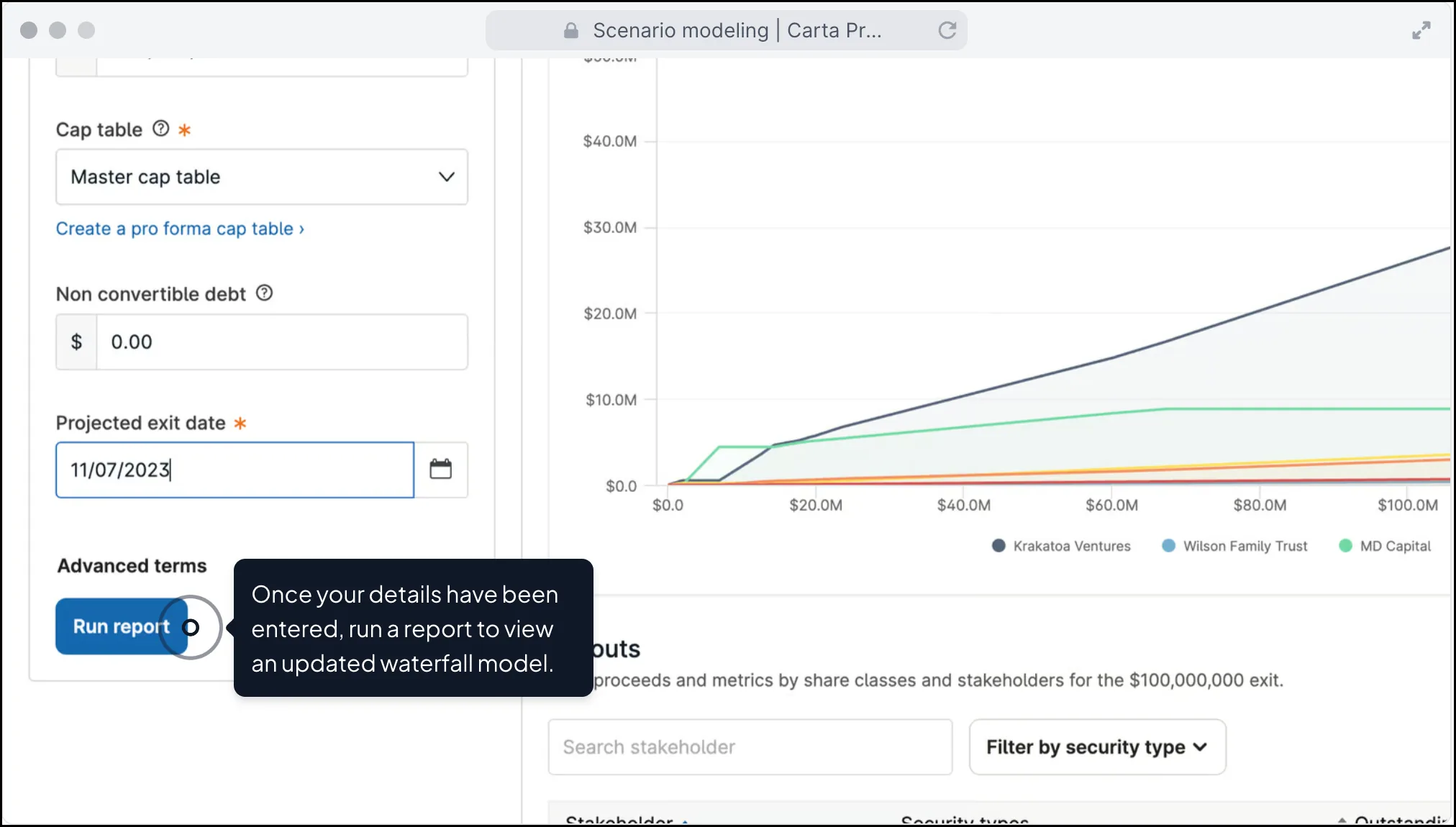
One of the most valuable features in any cap table platform is scenario modeling. This lets you answer questions like:
- What happens to ownership if we raise $5 million at a $30 million pre-money valuation?
- How much will employees get in different exit scenarios?
- What’s the impact of adding a new option pool?
- How do different liquidation preferences affect payouts?
Carta offers robust scenario modeling. You can create multiple what-if scenarios and compare them side by side. The waterfall analysis shows exactly how proceeds would flow in an exit. This is helpful for board presentations and investor conversations.
Fidelity Private Shares includes scenario modeling and planning tools in its feature set. The platform lets you model fundraising rounds and understand dilution impacts. It may not have quite as many bells and whistles as Carta, but it covers the core use cases.
Real-World Example: Using Cap Table Features
Let’s say you’re a Series A company about to raise a Series B round. Here’s how each platform helps:
On Carta: You’d go to the scenario modeling section and input the proposed terms. The system would show your ownership changes, create a new hypothetical cap table, and generate visualizations for your board deck. You could share a read-only view with potential investors for due diligence.
On Fidelity Private Shares: You’d use the scenario modeling tool to run similar projections. The interface would walk you through the inputs and show the outcomes. You could export reports and share information with stakeholders through the platform.
Both get the job done. Carta might have more granular controls for complex situations. Fidelity Private Shares might get you to an answer faster for straightforward scenarios.
409A Valuations: The Biggest Difference Between Carta and Fidelity Private Shares
Why 409A Valuations Matter
Every private company that grants stock options needs a 409A valuation. This determines the fair market value of common stock, which sets the exercise price for options. Get it wrong, and you’re looking at serious tax problems for your employees and company.
The IRS requires that option exercise prices be set at or above fair market value. A 409A valuation from a qualified appraiser provides a “safe harbor” that protects you. Without one, your option grants are risky.
Most companies need a new 409A valuation:
- At least once every 12 months
- After any material event (fundraising, significant revenue changes, etc.)
- Before granting new options if the existing valuation is outdated
This means 409A valuations are a recurring cost and recurring hassle. How each platform handles them is a critical differentiator.
Carta’s In-House Valuation Approach
Carta handles 409A valuations with its own team. The company says an experienced in-house valuation team delivers more than 16,000 audit-defensible 409A valuations each year. That’s a lot of valuations.
Key points about Carta’s 409A service:
- Valuations are done by Carta employees, not third parties
- 409A valuations are included in cap table management subscriptions
- No separate per-valuation invoice
- One vendor, one accountable team
- Tight integration between cap table data and valuation process
The in-house model has advantages. Carta’s valuators already have access to your cap table data. They don’t need to request documents or wait for you to upload information. This speeds up the process and reduces errors.
Having valuations included in the subscription is a big deal for budget planning. You know your costs upfront. If you need a new 409A after a funding round, you’re not paying extra.
Fidelity Private Shares’ Third-Party Valuation Model
Fidelity Private Shares takes a different approach. Instead of doing valuations in-house, the platform partners with third-party 409A providers. Growth and Scale tiers include one valuation, but it’s performed by a partner firm.
Additional valuation pricing:
- One stock class: $1,229
- Two stock classes: $1,899
- Three or more stock classes: $3,199
If your company needs multiple valuations per year, these costs add up fast. A company needing three valuations in a year could pay almost $10,000 on top of their subscription fees.
The third-party model has some benefits:
- Independence between platform and valuator
- Ability to choose different providers if desired
- Specialists who focus only on valuations
But most companies see the third-party model as a negative. It adds friction, increases costs, and creates coordination challenges.
Head-to-Head 409A Comparison
| Aspect | Carta | Fidelity Private Shares |
|---|---|---|
| Who performs valuations | In-house team | Third-party partners |
| Annual volume | 16,000+ valuations/year | Not disclosed |
| Included in subscription | Yes, typically | One included in Growth/Scale tiers |
| Additional valuation cost | Usually none | $1,229 – $3,199 each |
| Data integration | Direct access to cap table | May require manual data sharing |
| Turnaround time | Generally fast due to data access | Depends on third-party provider |
Which 409A Approach is Better?
For most companies, Carta’s model is superior. Here’s why:
Cost predictability: You’re not surprised by valuation bills throughout the year. This matters for startups with tight budgets.
Speed: The valuator already has your data. No back-and-forth to get documents and information.
Consistency: The same team understands your company’s history and trajectory.
Accountability: One vendor handles everything. If something goes wrong, there’s no finger-pointing between platform and valuator.
Fidelity’s third-party approach isn’t bad, but it creates friction that Carta has eliminated. The per-valuation fees especially hurt companies that need frequent updates.
That said, some auditors prefer seeing an independent valuation from a third party. There’s an argument that having your cap table provider also do your valuation creates a conflict of interest. In practice, this rarely causes issues, but it’s worth mentioning.
Equity Compensation Management: Stock Options, RSUs, and More
Employee Stock Option Plan Administration
Stock options remain the most common form of equity compensation for private companies. Both platforms handle option plan administration, but with different levels of sophistication.
Carta offers:
- Full lifecycle management from grant to exercise
- Automated vesting schedules
- Electronic acceptance of option grants
- Exercise workflows with payment processing
- Early exercise capabilities
- 83(b) election reminders and templates
- Tax withholding calculations
Carta’s option management is battle-tested. Thousands of companies use it to handle millions of option grants. The platform knows the edge cases and handles them gracefully.
Fidelity Private Shares offers:
- Integrated ESOP management for stock options
- Phantom share tracking
- Vesting schedule administration
- Employee equity plan governance
- Compliance tracking
Fidelity Private Shares is fully integrated for managing stock options and other equity compensation. It’s designed to handle standard ESOP needs without unnecessary complexity.
Beyond Traditional Stock Options
Equity compensation has gotten more complex over the years. Companies now use RSUs, phantom stock, profits interests, and other instruments. How do the platforms handle these?
Carta’s expanded equity types:
- Restricted Stock Awards (RSAs)
- Restricted Stock Units (RSUs)
- Stock Appreciation Rights (SARs)
- Phantom stock plans
- Profits interests for LLCs
- Carried interest tracking for funds
Fidelity Private Shares covers:
- Stock options
- Phantom shares
- Various equity compensation structures
- Integration with broader equity management
Carta has more depth here. If your company uses unusual compensation structures or plans to implement RSUs before an IPO, Carta’s experience shows. Fidelity Private Shares handles the common cases well but may have gaps for exotic instruments.
Employee Experience and Portal Access
Your employees interact with equity compensation through self-service portals. The quality of this experience affects how employees feel about their equity.
Carta’s employee portal:
- Clean dashboard showing total equity value
- Vesting schedule visualization
- Exercise workflows
- Tax documentation access
- Educational content about equity compensation
- Mobile app for on-the-go access
Carta has invested heavily in the employee experience. Employees can see not just what they have, but what it might be worth in different scenarios. This helps with retention and reduces equity-related questions to HR.
Fidelity Private Shares employee access:
- Stakeholder portal for viewing equity
- Document access and signing
- Ownership information in structured format
- Integration with Fidelity’s consumer services
Fidelity Private Shares benefits from Fidelity’s consumer finance expertise. The portal is professional and reliable. The potential for integration with Fidelity brokerage accounts is interesting for companies approaching liquidity events.
Equity Education and Employee Communication
Most employees don’t understand equity compensation. ISOs vs NSOs? 83(b) elections? AMT implications? These topics confuse even sophisticated professionals.
Carta provides extensive educational content. Blog posts, guides, and in-app explanations help employees understand what they have. The platform can send automated reminders about important deadlines (like the 30-day window for 83(b) elections).
Fidelity Private Shares offers support articles, free guides, and reports. The educational content is solid but not as extensive as Carta’s library. Fidelity’s broader reputation in consumer finance may give employees more confidence in the platform.
Compliance and Governance Features
Securities Law Compliance
Equity issuance triggers securities law obligations. Rule 701 limits, state blue sky filings, accredited investor verifications… there’s a lot to keep track of.
Carta helps with:
- Rule 701 compliance tracking
- State securities law reminders
- Accredited investor questionnaires
- Exemption tracking for each issuance
- Audit trails for all transactions
Fidelity Private Shares offers:
- Equity compliance and governance tools
- Structured compliance workflows
- Document retention and organization
- Governance support for private companies
Both platforms take compliance seriously. Carta’s longer track record means more edge cases have been discovered and addressed. Fidelity Private Shares, being backed by a heavily regulated financial institution, also understands compliance well.
Board Management and Corporate Governance
Growing companies need to manage board meetings, consents, and corporate records. Some equity platforms expand into this territory.
Carta offers board meeting management tools, including scheduling, document distribution, and e-signature collection for consents. It’s not as full-featured as dedicated board management software, but it covers the basics.
Fidelity Private Shares includes governance features in its platform. The focus is on keeping corporate records organized and accessible. For companies that need more robust board management, a dedicated tool might be necessary.
Audit Readiness
As companies grow, they face audits from accounting firms, potential acquirers, and (eventually) IPO underwriters. Being audit-ready saves time and money.
Carta’s emphasis on audit-defensible valuations extends to the whole platform. Transaction histories are complete, documents are organized, and data is exportable in auditor-friendly formats. Many accounting firms are familiar with Carta, which smooths the process.
Fidelity Private Shares’ structured system approach supports audit readiness. The single source of truth for ownership information helps auditors get what they need quickly. Fidelity’s financial services background means the platform was built with regulatory scrutiny in mind.
Fundraising and Investor Management
Fundraising Support Features
Raising money is stressful enough without wrestling with software. Both platforms try to make fundraising administration easier.
Carta’s fundraising features:
- Term sheet modeling
- Document generation for financing rounds
- Investor due diligence data rooms
- SAFE and convertible note tracking
- Pro-rata rights calculations
- Investor portal for existing stakeholders
Fidelity Private Shares fundraising tools:
- Scenario modeling for fundraising rounds
- Due diligence checklist resources
- Keys to VC fundraising success guides
- Equity financing vs debt financing education
- Planning tools for different fundraising outcomes
Carta has deeper integrations with the VC ecosystem. Many investors already use Carta for their fund administration, which creates a smooth experience when you’re raising from them. Information can flow between company and investor without manual re-entry.
Fidelity Private Shares provides strong educational content around fundraising. The guides and resources help founders understand what they’re getting into. The platform handles the mechanics of fundraising transactions well.
Investor Relations and Reporting
After you raise money, you need to keep investors informed. Quarterly updates, annual reports, and ad-hoc communications all matter.
Carta offers investor relations tools within the platform. You can share cap table information, distribute updates, and maintain a history of communications. Investors can log in to see their holdings and relevant documents.
Fidelity Private Shares also supports investor communication and reporting. The structured system approach means investors get consistent, organized information. Reports can be generated and shared through the platform.
Managing SAFE and Convertible Notes
Early-stage companies often raise money through SAFEs (Simple Agreements for Future Equity) or convertible notes before priced rounds. Tracking these instruments and modeling their conversion is tricky.
Carta has robust SAFE and note tracking. You can model different conversion scenarios, understand dilution impacts, and keep all stakeholders informed about where things stand. The platform handles the complexity of multiple SAFEs with different terms converting in the same round.
Fidelity Private Shares supports these instruments as well. The scenario modeling tools let you see how conversions will play out. The interface might be simpler, which could be a plus or minus depending on your complexity level.
Secondary Transactions and Liquidity Events
Secondary Market Access
Employees and early investors sometimes want liquidity before an IPO or acquisition. Secondary transactions let them sell shares to new buyers. Both platforms approach this differently.
Carta’s approach with CartaX:
- CartaX is Carta’s marketplace for secondary transactions
- Connects buyers and sellers in a structured environment
- Integrates with cap table for automatic record updates
- Supports tender offers and company-facilitated liquidity programs
- Handles transfer restrictions and ROFR compliance
Fidelity Private Shares’ liquidity focus:
- Designed to simplify secondary transactions from the start
- Focus on liquidity event management
- Leverages Fidelity’s broader financial services network
- Particularly strong for later-stage companies approaching IPO
Fidelity Private Shares was built with liquidity in mind. The company’s positioning emphasizes helping companies “from early rounds through IPO.” Fidelity’s connections in the institutional investment world could be valuable when facilitating large secondary transactions.
Carta has more experience with secondary transactions given its longer presence in the market. CartaX has facilitated billions of dollars in secondary trades. The integration between cap table and marketplace reduces friction.
Preparing for IPO
Companies approaching IPO need their equity house in order. Errors in cap tables or missing documents can delay or derail public offerings.
Carta has helped numerous companies through the IPO process. The platform’s audit trails, documentation, and reporting capabilities are designed with public market readiness in mind. Many bankers and lawyers are familiar with Carta, which helps during due diligence.
Fidelity Private Shares emphasizes support “from early rounds through IPO.” The Fidelity backing provides credibility when dealing with IPO participants. Fidelity’s institutional relationships could smooth the transition from private to public.
Acquisition and Exit Support
Most private companies exit through acquisition rather than IPO. The equity platform plays a key role in making this smooth.
When a company gets acquired, you need to:
- Provide accurate cap table data to the acquirer
- Calculate payouts for all stakeholders
- Handle escrow and holdback mechanics
- Process final exercises and terminations
- Issue tax documentation
Both platforms handle these mechanics. Carta’s waterfall analysis shows exactly who gets what in different exit scenarios. Fidelity Private Shares’ structured approach ensures clean data for the transaction.
The platform you choose probably won’t make or break your exit. But having clean data and organized documents will make the process faster and less stressful.
Integrations and Ecosystem Connectivity
HR and Payroll Integrations
Equity compensation intersects with HR and payroll. New hires get option grants. Terminations trigger vesting stop dates. Tax withholding flows through payroll. Integrations between systems reduce manual work and errors.
Carta integrates with:
- Major HRIS platforms (Workday, BambooHR, Rippling, etc.)
- Payroll systems for tax withholding
- ADP and similar payroll providers
- Single sign-on providers
Fidelity Private Shares integrations:
- Growing list of HR and payroll connections
- Fidelity’s own financial services ecosystem
- Standard API connectivity
Carta has more integrations due to its longer presence in the market and larger customer base. If you use a specific HR system, check whether it integrates with your chosen equity platform. Manual data entry between systems creates errors and costs time.
Accounting System Connections
Stock-based compensation accounting (ASC 718) requires detailed information from your equity platform. Integration with accounting systems makes this easier.
Carta provides ASC 718 reporting and can connect with major accounting software. The platform generates the journal entries needed for stock compensation expense. This saves hours of accountant time each quarter.
Fidelity Private Shares supports accounting needs as well. The structured data approach makes generating accounting reports straightforward. Integration depth varies by accounting system.
Legal and Document Platforms
Equity transactions generate legal documents. Option agreements, board consents, and stockholder approvals all need to be drafted, signed, and stored.
Carta includes document generation and e-signature capabilities. You can create documents from templates and collect signatures without leaving the platform. Documents are stored with the relevant transactions.
Fidelity Private Shares also handles documents within the platform. The single organized system approach keeps documents connected to the underlying transactions. E-signature capabilities are included.
The Fidelity Ecosystem Advantage
Fidelity Private Shares has a unique advantage: connection to Fidelity’s massive financial services ecosystem. This matters more as companies grow.
Potential benefits include:
- Employee brokerage accounts at Fidelity for post-exercise shares
- Integration with Fidelity retirement plans
- Access to Fidelity’s institutional services
- Potential pathways for company investments in Fidelity products
For companies that anticipate significant employee stock exercises or that want a single financial services partner, the Fidelity connection is compelling. Carta doesn’t have this kind of financial services depth behind it.
Customer Support and Service Quality
Support Channels and Availability
When something goes wrong with your equity platform, you need help fast. A misrecorded transaction or error before a board meeting is stressful.
Carta support includes:
- Email support for all customers
- Chat support for higher tiers
- Phone support for premium customers
- Dedicated customer success managers for larger accounts
- Extensive self-service help center
Fidelity Private Shares support:
- Support articles and self-service resources
- Email and chat support
- Fidelity’s institutional support infrastructure
- Free guides and educational materials
Carta’s support has gotten mixed reviews over the years. As the company grew rapidly, some customers reported declining support quality. Carta has invested in improving this, but experiences vary.
Fidelity Private Shares benefits from Fidelity’s customer service culture. Fidelity handles millions of customer interactions across its consumer and institutional businesses. This operational expertise likely influences support quality.
Onboarding and Implementation
Getting started on a new equity platform involves migrating data, setting up users, and learning the system. Both platforms offer onboarding support.
Carta provides guided onboarding for new customers. This includes importing your existing cap table data, setting up option plans, and training key users. The process can take days to weeks depending on complexity.
Fidelity Private Shares also offers onboarding assistance. The platform’s emphasis on simplicity may make initial setup faster. Fidelity’s incorporation services suggest they can help companies even before they have equity to manage.
Community and Educational Resources
Beyond direct support, educational resources help you get more value from your platform.
Carta provides:
- Carta Blog with industry insights
- Webinars and events
- Founder guides and playbooks
- Benchmark data from their customer base
- Carta Total Comp for compensation benchmarking
Fidelity Private Shares offers:
- Guide to 409A valuations
- Top venture capital trends reports
- Fundraising due diligence checklists
- Keys to VC fundraising success content
- Blog with regular updates
Both platforms invest in education. Carta’s content library is larger given its longer history. Fidelity Private Shares’ content benefits from Fidelity’s research capabilities and market insights.
Target Audience: Which Companies Should Choose Each Platform
Ideal Companies for Carta
Carta fits best for companies that:
- Are deeply embedded in the VC ecosystem: If your investors use Carta for fund administration, there’s natural synergy.
- Need frequent 409A valuations: The bundled valuation model saves money for companies granting options regularly.
- Want comprehensive features: If you need fund administration, secondary markets, and advanced reporting, Carta has it all.
- Have complex equity structures: Multiple share classes, international subsidiaries, and unusual compensation types are handled well.
- Plan to use CartaX for secondary transactions: The integrated marketplace is convenient.
Carta is also a strong choice for companies that value having the market leader. There’s safety in choosing the most established option. Your lawyers, accountants, and investors are probably familiar with Carta.
Ideal Companies for Fidelity Private Shares
Fidelity Private Shares fits best for companies that:
- Value the Fidelity brand and ecosystem: If you want integration with Fidelity’s financial services, this is the obvious choice.
- Prioritize simplicity over feature depth: The cleaner interface appeals to companies that don’t need every possible feature.
- Are planning for liquidity events: Fidelity’s expertise in managing money during transitions is valuable.
- Only need one 409A valuation per year: The included valuation in Growth/Scale tiers works well for stable companies.
- Want a newer platform built on modern architecture: Sometimes starting fresh beats iterating on legacy systems.
Fidelity Private Shares also appeals to companies that are skeptical of the VC-backed startup world. Fidelity is a stable, established financial institution. Some founders prefer that backing to venture-funded competitors.
Company Stage Considerations
Pre-seed and Seed Stage:
At this stage, both platforms are identical. Use whichever free tier appeals to you more. Consider which platform you’ll want to grow into.
Series A and B:
This is where differences start to matter. Carta’s deeper integrations and included valuations become valuable. Fidelity’s simpler approach might still be sufficient.
Late Stage and Pre-IPO:
Both platforms can handle this stage. Carta has more experience here. Fidelity’s connections in the institutional investing world could be valuable. The choice might depend on your specific IPO timeline and advisors.
Post-IPO:
Neither platform is really designed for public companies. You’ll likely transition to different tools after going public.
Migration Considerations: Switching Between Platforms
Moving from Carta to Fidelity Private Shares
Some companies on Carta might consider switching to Fidelity Private Shares. Reasons include:
- Dissatisfaction with Carta support or pricing
- Interest in Fidelity’s financial services ecosystem
- Preference for a simpler interface
- Company cultural fit with Fidelity’s approach
Migration involves exporting data from Carta and importing it to Fidelity Private Shares. Both platforms support data export. The process requires careful attention to ensure all transactions, documents, and historical records transfer correctly.
Plan for the migration to take several weeks. You’ll want to run both systems in parallel briefly to verify data accuracy. Make sure ongoing transactions (like option exercises) are paused during the transition.
Moving from Fidelity Private Shares to Carta
Moving in the other direction is also possible. Reasons might include:
- Outgrowing Fidelity’s feature set
- Investor preference for Carta
- Need for Carta’s fund administration tools
- Desire for Carta’s secondary market access
The migration process is similar. Export from Fidelity Private Shares, import to Carta, verify everything transferred correctly. Carta’s onboarding team can assist with migrations from competitor platforms.
Avoiding Migration Altogether
The best migration is no migration. Switching equity platforms is disruptive and risky. Errors during migration can create legal and tax problems.
Choose your platform carefully upfront. Think about where your company will be in 5 years, not just today. The free tier you choose now might lock you into a platform for years.
If you’re unhappy with your current platform, address specific issues before deciding to migrate. Sometimes problems can be solved without the disruption of a full platform change.
Recent Developments and Industry Context
The Broader Equity Management Market
Carta and Fidelity Private Shares don’t exist in a vacuum. Other competitors include:
- Pulley: A newer entrant focusing on simplicity and lower pricing
- Capboard: A European option with competitive pricing ($2/stakeholder/month)
- Shareworks by Morgan Stanley: Enterprise-focused solution
- Equity Track Software: Various niche players
The market has gotten more competitive over the years. Carta was once the clear default choice. Now founders have real alternatives, which is good for customers.
SaaStr Community Perspectives
The SaaStr community, a major hub for SaaS founders and operators, has discussed both platforms. Founders share experiences with pricing, support, and features in forums and on social media.
Common themes in community discussions:
- Carta’s pricing has increased over time, frustrating some long-time customers
- Support quality varies and has been a pain point for some
- Fidelity’s entrance adds credibility to the space
- The 409A valuation difference is frequently cited
These community perspectives provide real-world context beyond marketing materials. Listen to what actual users say about their experiences.
Privacy and Data Concerns
Both platforms handle sensitive financial data. Cap tables reveal ownership stakes, compensation levels, and company valuations. Security matters.
Carta has faced questions about data practices in the past. Some customers worried about how Carta used cap table data across its business. The company has addressed these concerns with updated policies.
Fidelity Private Shares benefits from Fidelity’s enterprise-grade security infrastructure. Financial services companies face strict regulatory requirements around data protection. This background should provide comfort about security practices.
Making Your Decision: Carta vs Fidelity Private Shares
Decision Framework
Here’s a structured way to think about the choice:
Step 1: Assess your current stage and needs
If you’re very early, both free tiers are fine. Don’t overthink it. Pick one and move on.
Step 2: Consider your 409A needs
How many valuations will you need per year? If more than one, Carta’s included valuations save money. If one is enough, Fidelity works fine.
Step 3: Evaluate ecosystem fit
Are your investors on Carta? Do you want Fidelity’s financial services connections? These ecosystem factors matter.
Step 4: Test the interfaces
Both platforms offer free tiers. Sign up for both. See which interface feels more intuitive to you and your team.
Step 5: Project future needs
Where will your company be in 3-5 years? Choose the platform that will serve you well at that stage.
Summary Comparison Table
| Criteria | Carta | Fidelity Private Shares | Winner |
|---|---|---|---|
| Free tier | 25 stakeholders, $1M raised | 25 stakeholders, under $1M raised | Tie |
| 409A valuations | In-house, included in subscription | Third-party, extra cost for additional | Carta |
| Cap table features | Deep, comprehensive | Clean, straightforward | Carta (for complexity) |
| Interface simplicity | Powerful but complex | Simpler, more intuitive | Fidelity Private Shares |
| Secondary transactions | CartaX marketplace | Liquidity focus, Fidelity network | Depends on needs |
| Brand credibility | VC ecosystem leader | Fidelity financial services backing | Tie (different types) |
| Integrations | Extensive | Growing | Carta |
| Pricing transparency | Moderate | Moderate | Tie |
| IPO readiness | Proven track record | Fidelity institutional connections | Slight edge to Carta |
Final Recommendations
Choose Carta if:
- You need frequent 409A valuations
- Your investors and lawyers already use Carta
- You want maximum features and integrations
- You’re planning to use secondary market features
- You prefer the market leader
Choose Fidelity Private Shares if:
- You value the Fidelity brand and ecosystem
- You want a simpler, cleaner interface
- You’re focused on eventual liquidity events
- One included 409A per year is enough
- You prefer a newer platform
If you genuinely can’t decide:
Go with Carta. It’s the safer choice simply because it’s more established. More people know it, more integrations exist, and more edge cases have been discovered and fixed. You won’t be wrong choosing Carta, even if Fidelity Private Shares might theoretically be a better fit.
Conclusion
Carta and Fidelity Private Shares both solve the same core problem: managing equity for private companies. Carta has the longer track record, deeper features, and included 409A valuations. Fidelity Private Shares offers simplicity, Fidelity’s financial services backing, and a fresh approach. For most companies, Carta remains the default choice, but Fidelity Private Shares is a legitimate alternative worth considering. Your specific needs around valuation frequency, ecosystem connections, and interface preferences should guide your decision. Try both free tiers before committing.
FAQs About Carta vs Fidelity Private Shares
| Which platform is better for early-stage startups, Carta or Fidelity Private Shares? |
| Both platforms offer nearly identical free tiers for early-stage companies with up to 25 stakeholders and under $1 million raised. At this stage, either platform works well. The choice matters more as you grow and need paid features. Consider which ecosystem (VC-connected Carta or Fidelity’s financial services) aligns better with your long-term plans. |
| How do 409A valuation costs compare between Carta and Fidelity Private Shares? |
| This is the biggest difference. Carta includes 409A valuations in its subscription and performs them in-house. Fidelity Private Shares includes one valuation in Growth/Scale tiers but uses third-party providers and charges $1,229 to $3,199 for additional valuations. If you need multiple valuations per year, Carta typically saves money. |
| Can I migrate from Carta to Fidelity Private Shares or vice versa? |
| Yes, migration between platforms is possible. Both support data export, and both can import from competitors. Plan for several weeks to complete a migration properly. Run systems in parallel briefly to verify data accuracy. Migration is disruptive, so choose carefully upfront to avoid it. |
| Which platform has better customer support? |
| Both platforms offer tiered support with more access for higher-paying customers. Carta has more extensive self-service resources given its longer history. Fidelity Private Shares benefits from Fidelity’s customer service culture. Real experiences vary, so check recent reviews from companies similar to yours. |
| Is Fidelity Private Shares the same as Fidelity Investments? |
| Fidelity Private Shares is owned by Fidelity (acquired in January 2023) but operates as a separate platform. It started as Shoobx before the acquisition. The Fidelity connection provides credibility and potential integration with Fidelity’s broader financial services, but it’s not the same as Fidelity’s consumer investing platform. |
| Which platform is better for companies approaching IPO? |
| Carta has more experience helping companies through IPOs and is familiar to most investment bankers and lawyers. Fidelity Private Shares has institutional connections through Fidelity that could be valuable during the IPO process. Both can handle pre-IPO requirements. Carta has the slight edge due to track record. |
| Do both Carta and Fidelity Private Shares handle employee stock options? |
| Yes, both platforms offer comprehensive stock option management including grant administration, vesting tracking, exercise processing, and employee portals. Carta has deeper features for complex equity types like RSUs and phantom stock. Fidelity Private Shares handles standard ESOP needs well but may have gaps for unusual instruments. |
| What integrations are available with each platform? |
| Carta has extensive integrations with HR systems (Workday, BambooHR, Rippling), payroll providers, and accounting software built up over years. Fidelity Private Shares has a growing integration list and unique connections to Fidelity’s financial services ecosystem. Check specific integrations for your tech stack before deciding. |
| Which platform should I choose if I’m not sure what I need? |
| If you’re genuinely undecided, Carta is the safer default choice. It’s more established, more widely known, and handles more edge cases. You won’t make a mistake choosing Carta even if Fidelity Private Shares might be slightly better suited. Start with a free tier on either platform to test before committing. |





 Stack Insight is intended to support informed decision-making by providing independent information about business software and services. Some product details, including pricing, features, and promotional offers, may be supplied by vendors or partners and can change without notice.