

Carta vs EquityList: The Complete Comparison Guide for 2026
Picking the right cap table software can feel overwhelming. You’ve got spreadsheets that don’t cut it anymore. And you’ve got platforms that promise everything but charge a fortune.
Two names keep coming up in conversations: Carta and EquityList. Both handle equity management. Both promise to make your life easier. But they’re built for different companies at different stages.
Carta has been around since 2012. It’s the giant in this space. Over 17,000 companies use it. EquityList is newer, leaner, and positions itself as a modern alternative. It’s designed for companies that want power without complexity.
This comparison digs into everything that matters. Pricing, features, support, ease of use, and more. By the end, you’ll know which platform fits your company best. Let’s get into it.
Understanding Cap Table Software and Why It Matters
What Is Cap Table Management?
A cap table tracks who owns what in your company. Sounds simple. It isn’t.
Every share matters. Every option grant needs documentation. Every funding round changes the math. Miss something, and you’ve got problems during due diligence.
Spreadsheets worked when you had three co-founders and zero investors. They break down fast. Formulas get corrupted. Version control becomes a nightmare. One wrong cell can misrepresent ownership by millions of dollars.
Cap table software automates everything. It connects your equity data to your stock plans. It generates legal documents. It keeps investors updated. Most importantly, it reduces errors that can derail funding rounds.
Why Startups Are Moving Away From Spreadsheets
Here’s what typically happens with spreadsheets:
- Someone updates the wrong version
- Formulas break during copy-paste operations
- SAFE conversions get calculated incorrectly
- Option pools show wrong vesting dates
- Investor reports take hours to compile
EquityList puts it well: “Cap table management is critical for businesses, far surpassing spreadsheets in effectiveness.”
Software fixes these problems. But not all software works the same way. Carta and EquityList take different approaches to solving these challenges.
The Real Cost of Errors
Wrong cap table data creates real consequences. Investors discover discrepancies during due diligence. Employees find out their options aren’t what they thought. Legal disputes emerge years later.
One founder told us about spending $40,000 in legal fees to fix cap table errors before a Series A. The software subscription would have cost less than $2,000 annually.
Prevention beats correction every time. The question is which prevention tool fits your situation.
Company Background: Carta vs EquityList Origins
Carta’s History and Market Position
Carta launched in 2012. It grew into a dominant force in equity management. The company works with over 17,000 businesses today.
They started focused on cap table management. Over time, they added:
- 409A valuations
- Fund administration
- Compensation benchmarking
- Liquidity programs
Carta became the default choice for many startups. When investors mention cap table software, Carta usually comes up first. That brand recognition matters.
But size brings challenges. As Cake Equity notes: “While Carta maintains a dominant position in the cap table market, it can also become too complex and too costly for startups.”
Larger companies with complex needs love Carta. Early-stage startups sometimes find it overwhelming.
EquityList’s Approach and Philosophy
EquityList positions itself as a modern alternative. It describes itself as “a comprehensive equity management platform designed for modern companies.”
Their focus sits squarely on user experience. The platform aligns departments like HR, Legal, and Finance around equity data. Everything connects.
What stands out is their speed. EquityList claims companies can be onboarded in under 24 hours. That’s aggressive compared to enterprise platforms that take weeks.
They also target price-sensitive customers directly. Their messaging acknowledges that “smaller companies often struggle to transition to platforms due to budget constraints.”
The strategy is clear: get startups on the platform early, grow with them, convert them to paid plans later.
Different Companies, Different Goals
Carta wants to be everything for everyone. They serve startups, growth companies, pre-IPO giants, and even private equity firms.
EquityList picks its battles. They focus on delivering core equity management features with exceptional support and speed.
This difference shapes every aspect of both products. Keep it in mind as we compare features.
Pricing Comparison: Carta vs EquityList Costs
EquityList Pricing Structure
EquityList leads with affordability. Their Starter plan begins at $11 per stakeholder per year.
That’s a low barrier to entry. A company with 10 stakeholders pays around $110 annually. Compare that to Carta’s minimum pricing.
EquityList also offers special deals. For YC startups, they provide 50% off the first year. They include free migration from Pulley or Carta.
The philosophy shows in their pricing page: remove barriers for growing companies. Let them succeed. They’ll return for paid features when ready.
This approach works well for bootstrapped startups and companies watching every dollar.
Carta Pricing Structure
Carta pricing starts higher. Based on available data, plans begin around $6 per stakeholder per month. That’s $72 per stakeholder annually.
The math gets interesting at scale. A company with 50 stakeholders might pay:
| Platform | 50 Stakeholders Annual Cost |
|---|---|
| EquityList (Starter) | $550 |
| Carta (Base Plan) | $3,600+ |
Carta also uses quote-based enterprise pricing for larger companies. This creates uncertainty. Several reviewers mention “surprise price increases” as a concern.
One industry analysis found: “Founders switching from Carta to alternatives typically save between $3,000 and $16,000 a year.”
Hidden Costs to Consider
Sticker price tells only part of the story. Consider these factors:
Implementation costs: How long does setup take? EquityList’s 24-hour onboarding means less staff time. Carta’s enterprise implementations can stretch weeks.
Training costs: Complex platforms require more training. Simple platforms get used correctly faster.
Support costs: Do you need to hire consultants to manage the platform? Or can your existing team handle it?
Migration costs: Both platforms offer migration help. EquityList includes free migration from competitors.
Value Per Dollar Analysis
Cheaper isn’t always better. But paying for features you don’t use wastes money.
Early-stage startups rarely need advanced features like fund administration or liquidity programs. They need solid cap table management, SAFE tracking, and basic modeling.
EquityList delivers those core features at lower cost. Carta delivers more features at higher cost.
The question: which features do you actually need today? And in the next 12 months?
Core Features: Cap Table Management Compared
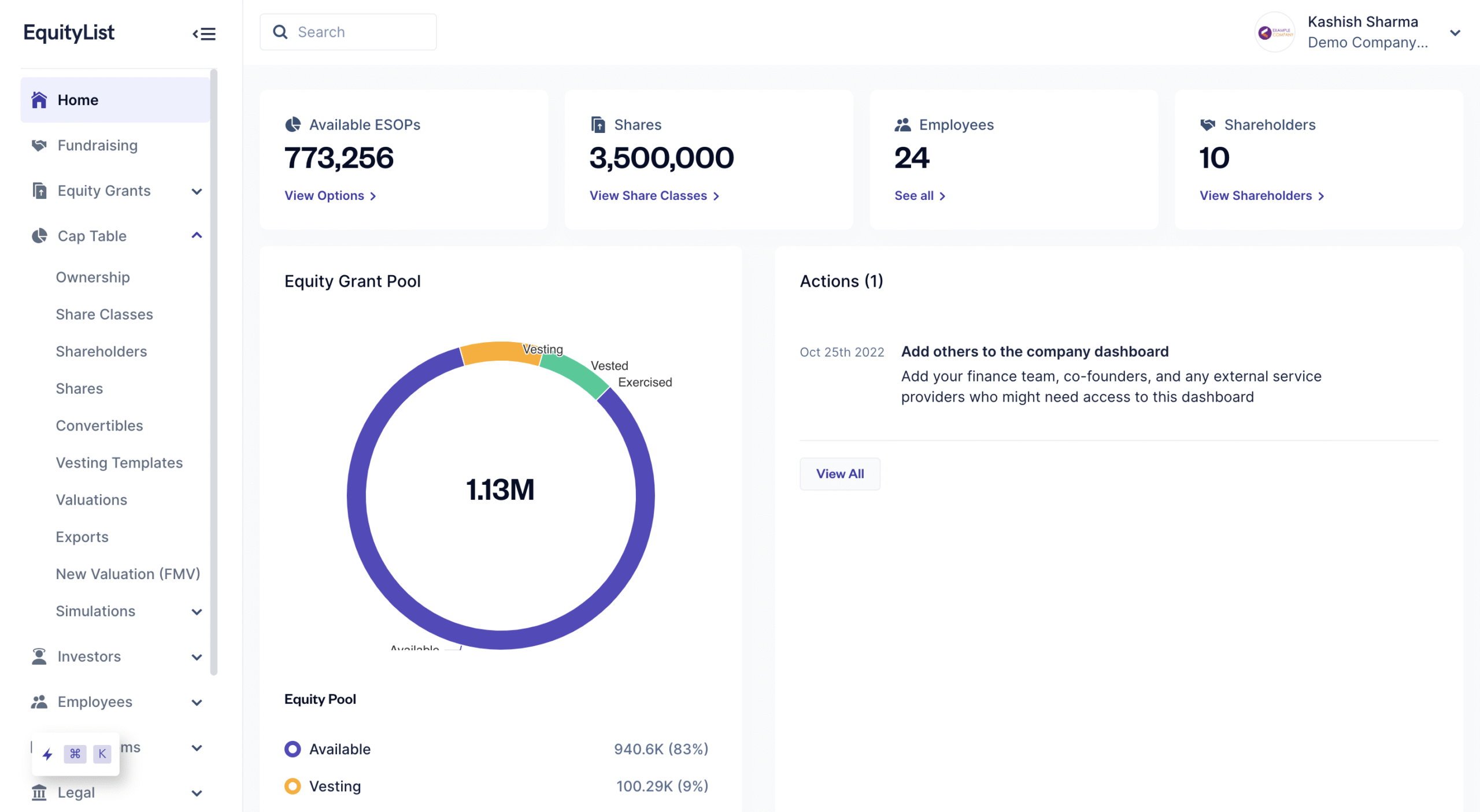
How Carta Handles Cap Tables
Carta built its reputation on cap table management. The platform handles:
- Cap table and security holder tracking
- Electronic securities issuance
- Stock transfers
- Full audit trails
Carta’s cap table interface shows ownership clearly. You see shares, percentages, and valuations at a glance. The system updates automatically when you issue new securities.
Their pitch: “Cap table management that scales with you. Easily view, track, and issue equity on a secure platform that grows alongside your business. No more spreadsheets, no more errors.”
Advanced features include scenario modeling, waterfall analysis, and complex instrument tracking. These matter for companies with multiple funding rounds and various share classes.
Carta also handles LLCs and Private Equity structures. “Carta has helped hundreds of LLCs and Private Equity firms implement equity plans and manage ownership.”
How EquityList Handles Cap Tables
EquityList focuses on intuitive design. The platform emphasizes “ensuring an intuitive user experience.”
Core cap table features include:
- Complete ownership tracking
- Share class management
- Historical records
- Real-time updates
The platform connects equity data across departments. HR sees what they need for option grants. Legal sees documentation requirements. Finance sees valuation impacts.
EquityList provides ready-to-use equity documents and spreadsheets. These templates save time when you’re moving fast.
They also offer a SAFE Calculator to estimate conversion outcomes. This helps founders understand dilution before deals close.
Feature-by-Feature Breakdown
| Feature | Carta | EquityList |
|---|---|---|
| Cap table management | Full | Full |
| SAFE & note tracking | Full | Full |
| Scenario modeling | Full | Full |
| Investor portal | Full | Full |
| Employee equity app | Full | Full |
| 409A valuation | Full | Available |
| Electronic securities | Full | Full |
| Document templates | Available | Free to download |
Both platforms cover the basics well. Differences emerge in execution and user experience.
SAFE and Convertible Note Tracking
SAFEs complicate cap tables. They’re not equity yet, but they will be. Tracking them incorrectly misleads founders about their actual ownership.
Carta handles SAFE tracking through its instruments feature. You can model conversions across different scenarios and pricing caps.
EquityList includes a dedicated SAFE Calculator. This tool estimates conversion outcomes before you sign anything. It helps founders negotiate better terms.
Both platforms track convertible notes similarly. Interest accrual, conversion triggers, and maturity dates all get recorded.
Employee Equity Plans: ESOP Management Compared
Building Equity Plans on Carta
Carta offers comprehensive equity plan management. Features include:
- Equity plan generation
- Electronic exercising
- Vesting schedules
- Tax tracking
The platform supports various equity types: ISOs, NSOs, RSUs, and more. Each type has different tax implications. Carta tracks these automatically.
Employees get their own portal. They see their grants, vesting status, and estimated values. This transparency reduces HR questions and improves satisfaction.
Carta also handles exercise workflows electronically. Employees can exercise options and pay through the platform. Carta processes the securities issuance automatically.
For larger companies, Carta includes ASC 718 compliance reporting. This accounting standard governs stock compensation. Getting it wrong creates audit problems.
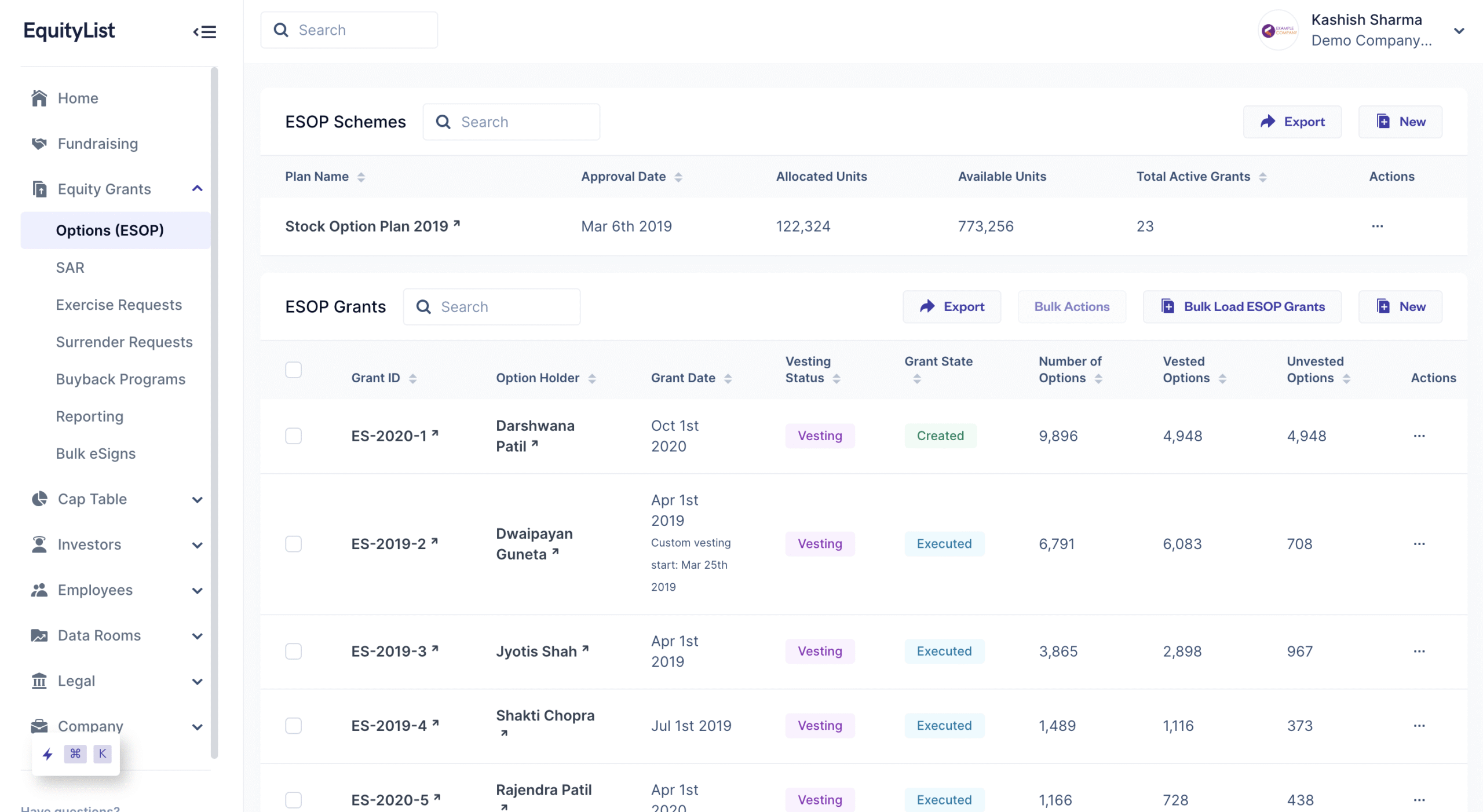
Building Equity Plans on EquityList
EquityList integrates employee equity into its core platform. There’s no separate module to configure.
Key capabilities include:
- Option grant management
- Vesting tracking
- Exercise processing
- Employee communications
The platform connects equity data to HR workflows. When someone joins, HR can initiate grants directly. No jumping between systems.
EquityList also offers HRIS and payroll integration. This keeps employee records synchronized. Changes in one system reflect in others.
The employee experience stays simple. Stakeholders see what they own without wading through complex interfaces.
Comparing Employee Experience
Employees don’t care about your backend systems. They want answers:
- How many shares do I have?
- When do they vest?
- What are they worth?
- How do I exercise?
Both platforms answer these questions. The difference is in clarity and accessibility.
Carta’s employee portal is feature-rich. This helps sophisticated users but can overwhelm others. Stock options are confusing enough already.
EquityList prioritizes simplicity. Fewer features visible means less confusion. Employees find what they need faster.
Stock Option Administration Workflows
Administering equity involves repetitive tasks. New grants, terminations, exercises, and updates happen constantly.
Carta automates many workflows but requires configuration. You’ll spend time setting up approval chains, notification rules, and document templates.
EquityList aims for out-of-box functionality. Default settings work for most situations. Customization is available but not required.
Consider your administrative capacity. Do you have dedicated equity administrators? Carta rewards that expertise. Running lean? EquityList asks less of you.
Valuations and Compliance: 409A and Beyond
Carta’s Valuation Services
Carta offers 409A valuations directly. This makes them a one-stop shop for companies needing annual valuations.
A 409A valuation determines the fair market value of your common stock. You need one to issue options at the right strike price. Get it wrong, and employees face tax penalties.
Carta’s valuation team produces compliant reports. These satisfy IRS requirements and investor due diligence.
Additional compliance features include:
- 83(b) election tracking
- 3921 reporting
- ASC 718 calculations
- QSBS attestation letters
This comprehensive compliance coverage appeals to growth-stage companies with complex requirements.
EquityList’s Approach to Valuations
EquityList handles valuations through the platform. They focus on making compliance accessible to smaller companies.
The platform tracks valuation-related data automatically. When you need a 409A, relevant information is ready to export.
EquityList may partner with third-party valuation firms for actual reports. This gives customers flexibility in choosing providers.
For early-stage companies, EquityList’s approach often works well. You don’t need enterprise-grade valuation services for a seed-stage startup.
Compliance Tracking Compared
| Compliance Area | Carta | EquityList |
|---|---|---|
| 409A valuation | In-house service | Supported |
| 83(b) election tracking | Full | Full |
| 3921 IRS reporting | Full | Supported |
| ASC 718 accounting | Full | Available |
| QSBS documentation | Full | Supported |
Carta’s compliance features are more mature. They’ve spent years building enterprise-grade reporting.
EquityList covers the basics well. Most early and growth-stage companies won’t hit gaps.
When Compliance Complexity Matters
Your compliance needs depend on several factors:
- Company stage: Pre-seed companies have simple needs. Pre-IPO companies have complex ones.
- Employee count: More employees means more equity events to track.
- Entity structure: Multiple entities, international employees, or LLC structures add complexity.
- Investor requirements: Some investors demand specific reporting formats.
Match your compliance needs to platform capabilities. Don’t pay for enterprise compliance when startup-grade works fine.
User Experience and Interface Design
Navigating Carta’s Platform
Carta’s interface reflects its feature set. Lots of options. Lots of menus. Lots of capability.
New users face a learning curve. The platform does so much that finding specific functions takes time. Training helps, but it’s still complex.
Power users love Carta’s depth. Once you know where everything is, you can accomplish almost anything. Custom reports, complex modeling, and detailed analysis are all possible.
The trade-off is accessibility. Occasional users struggle. Team members who touch equity quarterly may forget how to do basic tasks.
Carta has improved onboarding over time. “Once you sign up, the implementations team will provide full support as you get started. Depending on the size of your company, you can be onboarded onto Carta in a matter of hours.”
Navigating EquityList’s Platform
EquityList built its platform around simplicity. The interface presents common tasks clearly.
Their design philosophy: “Our platform is designed to ensure an intuitive user experience.”
New users find their way quickly. Common functions sit where you’d expect them. Less clicking through menus. Faster task completion.
The trade-off is feature depth. Advanced users may want options that aren’t there. Customization possibilities are more limited.
EquityList’s approach works best when you want standard workflows. Unusual requirements might push against platform boundaries.
Onboarding Speed Comparison
Getting started matters. Slow onboarding delays value.
EquityList emphasizes speed: “Companies have been onboarded in under 24 hours.”
That’s aggressive. Most implementations involve data migration, verification, and training. Doing all of that in 24 hours requires efficiency.
Carta’s onboarding varies by company size. Small companies might onboard in hours. Larger companies with complex histories take longer.
Both platforms offer migration assistance. Moving from spreadsheets or other platforms is supported.
Mobile Experience
Equity management happens mostly at desks. But mobile access matters for quick checks and approvals.
Both platforms offer mobile-responsive interfaces. Stakeholders can view their holdings from phones.
Full administrative tasks typically require desktop access. Complex workflows need screen space and precision.
Customer Support: Getting Help When You Need It
Carta’s Support Model
Carta serves over 17,000 companies. That scale affects support availability.
Common concerns about Carta include “lackluster customer support.” Large customer bases strain support teams. Response times can vary.
Carta offers tiered support. Higher-paying customers get faster responses and dedicated representatives. Smaller accounts use standard support channels.
Self-service resources are extensive. Help documentation, videos, and community forums answer common questions.
For complex issues, Carta’s depth of experience helps. They’ve seen most situations before. Edge cases that confuse smaller vendors are routine for Carta.
EquityList’s Support Model
EquityList emphasizes support quality. Their G2 reviews highlight customer support as a strength.
With a smaller customer base, EquityList can provide more personal attention. Response times tend to be faster. Interactions feel less transactional.
The support team helps with onboarding directly. You’re not just handed documentation and left alone.
EquityList’s size is both advantage and limitation here. Personal service is great. But they have less experience with rare edge cases.
Support Comparison Table
| Support Aspect | Carta | EquityList |
|---|---|---|
| Response time | Varies by tier | Generally fast |
| Dedicated support | Higher tiers only | Available broadly |
| Self-service resources | Extensive | Growing |
| Onboarding assistance | Full | Full |
| Community/forums | Yes | Limited |
What Good Support Actually Means
Support quality matters most during problems. A grant issued incorrectly. A cap table discrepancy. An urgent investor request.
In those moments, you need fast, knowledgeable help. Not chatbots. Not ticket queues that take days.
Consider your risk tolerance. How critical is rapid support response to your operations?
If equity administration is core to your business, invest in support access. If it’s occasional, standard support may suffice.
Integrations and Ecosystem Connectivity
Carta’s Integration Options
Carta connects to various business systems. Key integrations include:
- HRIS systems for employee data
- Payroll platforms for compensation sync
- Accounting software for expense tracking
- Banking for payment processing
These connections reduce manual data entry. When someone joins your company, their information flows from HRIS to Carta automatically.
Carta also offers APIs for custom integrations. Technical teams can build connections to proprietary systems.
The ecosystem around Carta is mature. Many service providers understand Carta’s data formats and workflows.
EquityList’s Integration Options
EquityList provides “HRIS integration” and “payroll integration” as core features.
These connections align equity data with employee records. Changes sync automatically.
For early-stage companies, basic integrations usually suffice. You need equity connected to HR. You need payment processing. EquityList covers these.
Advanced integration scenarios may require workarounds. Smaller platforms have fewer pre-built connections.
Integration Priorities by Stage
Early stage (under 25 employees):
- Basic HRIS sync
- Payment processing
- Document storage
Growth stage (25-200 employees):
- Payroll integration
- Accounting sync
- Advanced HRIS features
Late stage (200+ employees):
- Custom API integrations
- Enterprise system connections
- Compliance reporting feeds
Match your integration needs to current reality. Don’t buy enterprise connectivity you won’t use.
Investor Relations and Stakeholder Communication
Investor Portals Compared
Investors want visibility into their holdings. Both platforms provide investor portals.
Carta’s investor portal shows:
- Current holdings
- Ownership percentage
- Company documents
- Transaction history
Investors can access their information without bothering you. This self-service reduces administrative burden.
EquityList offers similar investor portal functionality. Stakeholders see their positions and relevant documents.
The key difference is scale. Carta’s portal handles complex investor structures. Multiple fund entities, carried interest allocations, and portfolio views work smoothly.
EquityList’s portal works well for standard investor relationships. Simple equity stakes and basic reporting needs are covered.
Stakeholder Updates and Communication
Carta mentions “automatic stakeholder updates” as a feature. When equity events happen, affected parties get notified.
This automation saves time. You don’t manually email every stakeholder after a funding round.
EquityList handles communications through its platform as well. Updates go out based on events.
Consider your communication preferences. Do you want automated notifications for everything? Or do you prefer manual control over messaging?
Due Diligence Support
Funding rounds trigger due diligence. Investors examine your cap table closely.
Both platforms help here. Clean cap table data exports easily. Document histories show audit trails.
Carta’s longer track record means investors see familiar formats. They know how to read Carta reports.
EquityList data works for due diligence too. Professional investors care about accuracy, not specific platform branding.
Security and Data Protection
Carta’s Security Infrastructure
“Carta has a robust defense-in-depth strategy to safeguard customers’ data.”
Equity data is sensitive. Ownership information, valuations, and personal details all need protection.
Carta invests heavily in security. Large customer bases demand it. Enterprise clients require specific certifications.
Security measures typically include:
- Encryption at rest and in transit
- Multi-factor authentication
- Role-based access controls
- Regular security audits
- SOC 2 compliance
EquityList’s Security Approach
EquityList protects customer data through modern security practices. The platform handles sensitive information responsibly.
Smaller platforms can actually move faster on security updates. Fewer systems to patch. Fewer legacy issues to manage.
Verify specific certifications before committing. Ask about encryption, access controls, and audit procedures.
Security Questions to Ask Both Vendors
Before choosing either platform, get answers to:
- What certifications do you maintain? (SOC 2, ISO 27001, etc.)
- Where is data stored geographically?
- How long are backups retained?
- What happens to data if we leave?
- Who can access our data internally?
Both vendors should answer these questions clearly. Hesitation suggests gaps.
Scenario Modeling and Financial Planning
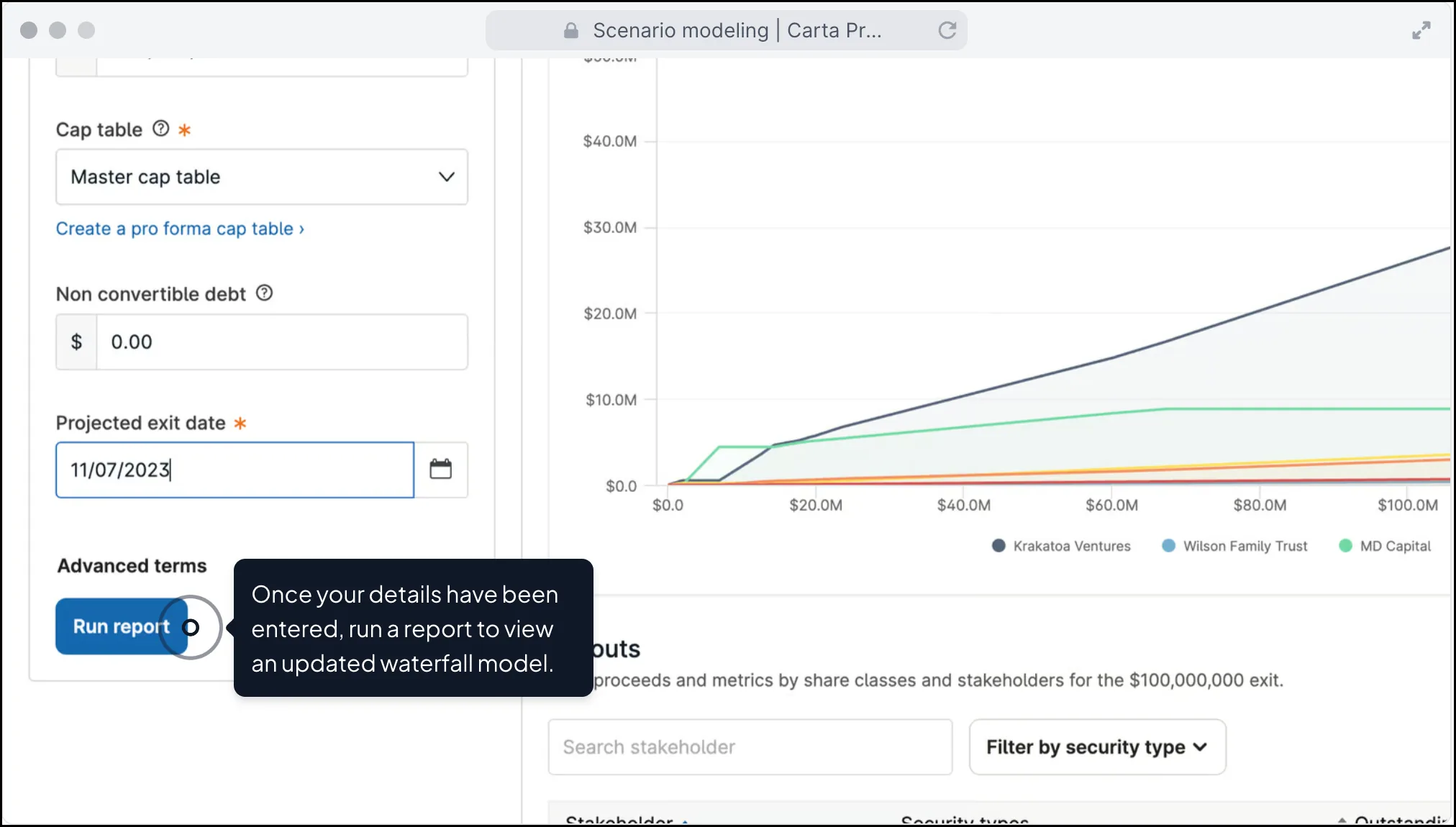
Modeling Funding Rounds
Before raising capital, you need to understand dilution. Scenario modeling shows the impact of different deal terms.
Carta’s modeling capabilities are extensive. You can:
- Model multiple scenarios side by side
- Adjust valuations and round sizes
- See waterfall distributions
- Compare liquidation preferences
This helps during negotiations. You know your walk-away points. You understand investor motivations.
EquityList includes scenario modeling as well. Core functionality lets you test different outcomes.
The depth differs. Carta handles exotic instruments and complex structures. EquityList covers standard scenarios well.
Exit Modeling
Everyone wants to know: what do I get if we sell?
Exit modeling calculates distributions at different sale prices. Liquidation preferences, participation rights, and share classes all affect the math.
Both platforms handle basic exit modeling. Enter a sale price. See who gets what.
Carta’s advanced modeling handles complex waterfalls. Multiple preferred share classes with different terms. Carve-outs and acceleration provisions. Edge cases that occur in larger transactions.
Early-stage companies rarely need this complexity. Simple preferred/common splits model easily on either platform.
Using Models for Negotiation
Good modeling informs better deals. When you understand the math, you negotiate smarter.
Run scenarios before term sheet discussions. Know how different valuations affect your ownership. Understand how option pool changes dilute founders.
Share models with your board. Get alignment before negotiations start.
Both platforms support this workflow. The interface and speed differ. Try both during evaluation.
Migration and Switching: Moving Between Platforms
Moving to EquityList
EquityList explicitly targets companies switching from competitors. They offer “free migration from Pulley or Carta.”
Migration involves:
- Exporting data from current platform
- Cleaning and validating records
- Importing into new platform
- Verifying accuracy
Free migration reduces switching costs. You’re not paying twice during transition.
EquityList’s fast onboarding helps here too. The goal is minimal disruption.
Moving to Carta
Carta migrates companies from spreadsheets and other platforms. Their implementation team handles the process.
Migration complexity depends on your situation. Clean data migrates quickly. Messy data requires cleanup first.
Carta has migrated thousands of companies. They’ve seen most data formats and issues.
Migration Considerations
Switching platforms isn’t trivial. Consider:
Timing: Don’t migrate during a funding round. Cap table changes create confusion.
Historical data: Make sure all historical transactions transfer. Gaps create compliance issues later.
Stakeholder communication: Investors and employees need portal access updated.
Document retention: Verify all documents migrate or archive from the old platform.
Training: Team members need to learn the new system.
Can You Switch Without Losing History?
Yes. Both platforms support full data migration.
“Can I switch from Carta or Pulley without losing my cap table history?” The answer is yes, with proper migration procedures.
Work with the new platform’s implementation team. They handle data extraction and import.
Who Should Choose Carta?
Ideal Carta Customers
Carta works best for:
Growth-stage companies (Series B+): Complex cap tables benefit from advanced features. Multiple funding rounds, various share classes, and sophisticated instruments need robust tracking.
Companies approaching exit: Pre-IPO compliance requirements are extensive. Carta’s maturity helps here.
Private equity and LLCs: Non-standard structures need specialized handling. Carta supports these explicitly.
Companies wanting one vendor: If you want cap table, valuations, fund admin, and liquidity from one place, Carta offers that.
Enterprises with dedicated equity administrators: Complex platforms reward dedicated expertise. If you have full-time equity staff, they’ll use Carta’s capabilities.
Carta Strengths Summary
- Most comprehensive feature set
- Deep compliance capabilities
- In-house 409A valuations
- Mature ecosystem and integrations
- Handles complex structures well
- Strong brand recognition with investors
Carta Limitations to Consider
- Higher pricing, especially at scale
- Potential complexity for simple needs
- Support quality concerns at lower tiers
- Possible price increases over time
- May pay for features you don’t use
Who Should Choose EquityList?
Ideal EquityList Customers
EquityList works best for:
Early-stage startups (Pre-seed through Series A): Budget matters. Core features suffice. EquityList delivers both.
Budget-conscious companies: At $11 per stakeholder per year, costs stay manageable.
YC and accelerator companies: Special pricing and quick onboarding match accelerator timelines.
Teams wanting simplicity: Less complexity means faster adoption. More team members can use it confidently.
Companies migrating from spreadsheets: The first step into software should be easy. EquityList makes that transition smooth.
EquityList Strengths Summary
- Affordable pricing structure
- Fast onboarding (under 24 hours possible)
- Intuitive user experience
- Strong customer support ratings
- Free migration from competitors
- YC startup discounts available
EquityList Limitations to Consider
- Less mature than Carta
- Fewer advanced features
- Smaller user community
- May outgrow as company scales
- Less investor brand recognition
Making Your Decision: A Framework
Questions to Answer First
Before choosing, answer these honestly:
What’s your annual budget for equity software?
If under $1,000, EquityList likely fits better. If budget is flexible, consider both.
How complex is your cap table?
Simple structures (common stock, options, one or two investors) work on either. Complex structures may need Carta.
Who will administer the platform?
Dedicated equity staff can use complex tools. Part-time administrators need simpler interfaces.
What integrations do you need?
Basic HRIS and payroll work on both. Advanced enterprise connections favor Carta.
How important is rapid support?
EquityList’s smaller scale enables faster responses. Carta’s premium tiers offer dedicated support.
Decision Matrix
| Factor | Choose Carta If… | Choose EquityList If… |
|---|---|---|
| Budget | Cost is secondary to features | Cost is a primary concern |
| Company stage | Series B+ or approaching exit | Pre-seed through Series A |
| Cap table complexity | Multiple share classes, complex instruments | Standard structures |
| Team expertise | Dedicated equity administrators | Part-time administrators |
| Timeline | Can invest in longer onboarding | Need to be live quickly |
| Valuation needs | Want integrated 409A service | Will use third-party valuators |
Trial Both If Possible
Nothing beats hands-on experience. Both platforms offer ways to evaluate before committing.
Upload sample data. Run through common workflows. See how the interface feels.
Involve the people who’ll use the platform daily. Their comfort matters more than feature lists.
Plan for the Future
Your needs will change. Seed stage companies become growth stage. Simple cap tables become complex.
Consider migration paths. If you start with EquityList and outgrow it, can you move to Carta? Yes. Both platforms support migration.
Starting simple isn’t permanent. You can always upgrade later.
Conclusion
Carta and EquityList both solve real problems. Carta offers depth and maturity for complex needs. EquityList offers simplicity and affordability for growing companies.
Your right choice depends on your situation. Stage, budget, complexity, and team all factor in.
Start with your current needs. Don’t pay for features you won’t use. And remember: you can always switch later if requirements change. Both platforms want your business. Both will work hard to earn it.
Frequently Asked Questions About Carta vs EquityList
| What is the main difference between Carta and EquityList? | Carta is a larger, more established platform with comprehensive features for companies at all stages, including valuations and fund administration. EquityList is a newer, more affordable option focused on core equity management with an emphasis on user experience and fast onboarding. Carta costs more but offers more features. EquityList costs less and focuses on simplicity. |
| How much does Carta cost compared to EquityList? | EquityList starts at $11 per stakeholder per year. Carta starts around $6 per stakeholder per month ($72 per year). For a company with 50 stakeholders, EquityList costs approximately $550 annually while Carta costs $3,600 or more. Founders switching from Carta to alternatives often save $3,000 to $16,000 annually. |
| Can I migrate from Carta to EquityList without losing data? | Yes. EquityList offers free migration from Carta and other platforms. Your complete cap table history transfers during the migration process. Work with EquityList’s implementation team to ensure all transactions and documents move correctly. |
| Which platform is better for early-stage startups? | EquityList is generally better for early-stage startups (pre-seed through Series A). The pricing is more affordable, onboarding is faster (under 24 hours possible), and the interface is simpler. Early-stage companies rarely need Carta’s advanced features and shouldn’t pay for them. |
| Which platform is better for growth-stage companies? | Carta is typically better for growth-stage companies (Series B and beyond). Complex cap tables with multiple share classes, sophisticated compliance requirements, and integrated valuations benefit from Carta’s mature feature set. The higher cost is justified by the deeper capabilities. |
| Do both Carta and EquityList offer 409A valuations? | Carta offers in-house 409A valuation services directly through their platform. EquityList supports 409A valuations but may partner with third-party valuation firms. If you want valuations from your cap table provider directly, Carta has an advantage here. |
| How long does onboarding take for each platform? | EquityList emphasizes speed, with companies onboarded in under 24 hours in some cases. Carta’s onboarding varies by company size. Small companies may onboard quickly, while larger companies with complex histories take longer. Both offer migration assistance. |
| Which platform has better customer support? | EquityList receives strong customer support ratings on G2 and can provide more personal attention due to its smaller customer base. Carta’s support quality varies by pricing tier. Higher-paying Carta customers get dedicated representatives, while lower tiers use standard support channels. |
| Can both platforms handle SAFEs and convertible notes? | Yes. Both Carta and EquityList track SAFEs and convertible notes. EquityList offers a dedicated SAFE Calculator to estimate conversion outcomes. Both platforms model how these instruments convert during funding rounds. |
| Is there a free trial for Carta or EquityList? | Pricing and trial options change over time. EquityList offers special deals including 50% off the first year for YC startups and free migration from competitors. Contact both vendors directly to ask about current trial or pilot options before committing. |





 Stack Insight is intended to support informed decision-making by providing independent information about business software and services. Some product details, including pricing, features, and promotional offers, may be supplied by vendors or partners and can change without notice.