
Qapita vs Cake Equity: The Complete 2026 Comparison Guide for Equity Management
Picking the right equity management platform can make or break your startup’s cap table hygiene. Get it wrong, and you’re stuck with messy records, compliance headaches, and frustrated employees who don’t understand their stock options. Get it right, and you’ve got a clean foundation that grows with your company from seed round to IPO.
This comparison between Qapita and Cake Equity breaks down everything you need to know. We’ll look at features, pricing, compliance capabilities, global reach, and real-world use cases. Both platforms handle core cap table functions well. But the differences show up when your company crosses borders, scales past Series A, or needs audit-ready financial reporting.
By the end, you’ll know exactly which platform fits your company’s stage, geography, and growth plans.
Understanding Equity Management Platforms: Why Your Choice Matters
Before we dig into the Qapita versus Cake Equity comparison, let’s talk about why this decision carries weight. Your cap table isn’t just a spreadsheet. It’s the legal record of who owns what in your company.
The Real Cost of Getting Cap Table Management Wrong
Bad cap table management creates problems that compound over time. Here’s what happens when companies use the wrong tools or outgrow their platform:
- Due diligence delays during fundraising when investors can’t verify ownership records
- Tax compliance failures that trigger penalties for both the company and employees
- Equity disputes between founders, investors, and employees over vesting schedules
- Audit nightmares when financial statements don’t match cap table data
- Employee confusion about the value of their equity compensation
A platform that works at 10 employees might completely fail at 100. One that handles US-only operations might collapse when you hire your first engineer in Singapore.
What Makes a Good Equity Management Platform
The best platforms share certain characteristics. They maintain a single source of truth for all ownership data. They automate compliance workflows. They generate investor-ready reports without manual work. And they scale without forcing you to migrate to a new system every two years.
Both Qapita and Cake Equity check many of these boxes. The question is which one checks them for your specific situation.
Company Backgrounds: Qapita and Cake Equity Origins
Understanding where each platform comes from helps explain their design choices and target markets.
Qapita: Built for Global Complexity
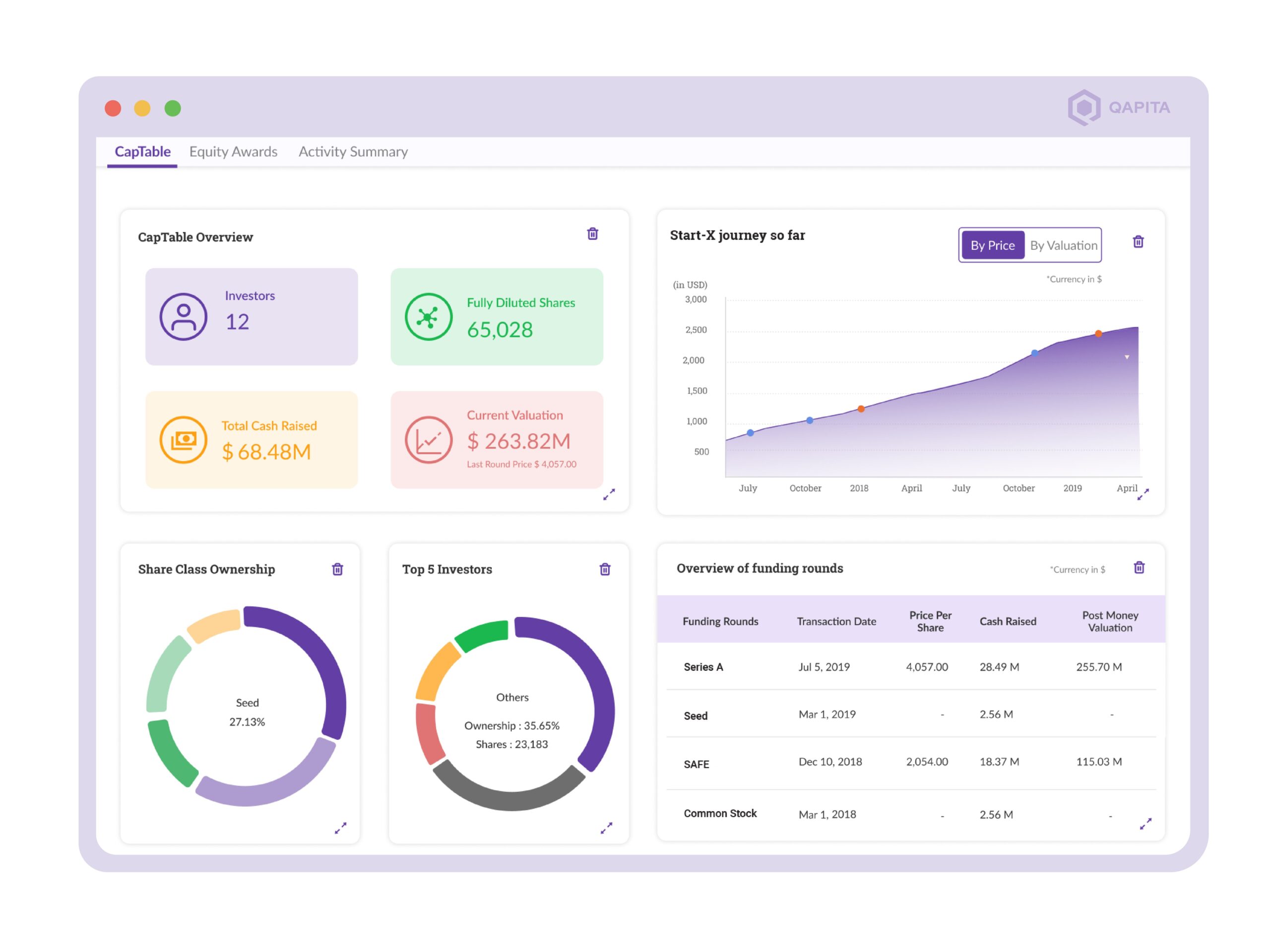
Qapita positions itself as a global equity management platform serving startups and listed companies. The company built its infrastructure to handle multi-entity, multi-jurisdiction equity from the start. This isn’t a feature they bolted on later. It’s in the platform’s DNA.
Qapita offers cap table management tools for startup founders. It also provides VCs with portfolio company views, fund administration capabilities, and portfolio valuation tools. The platform includes consulting services for equity compensation design, valuations, and financial reporting.
The company recently announced a strategic partnership with Countsy, which expands their service offerings for growing companies. This partnership signals Qapita’s focus on companies that need more than just software. They want an ecosystem of services that support equity management at scale.
Cake Equity: Focused on Early-Stage Simplicity
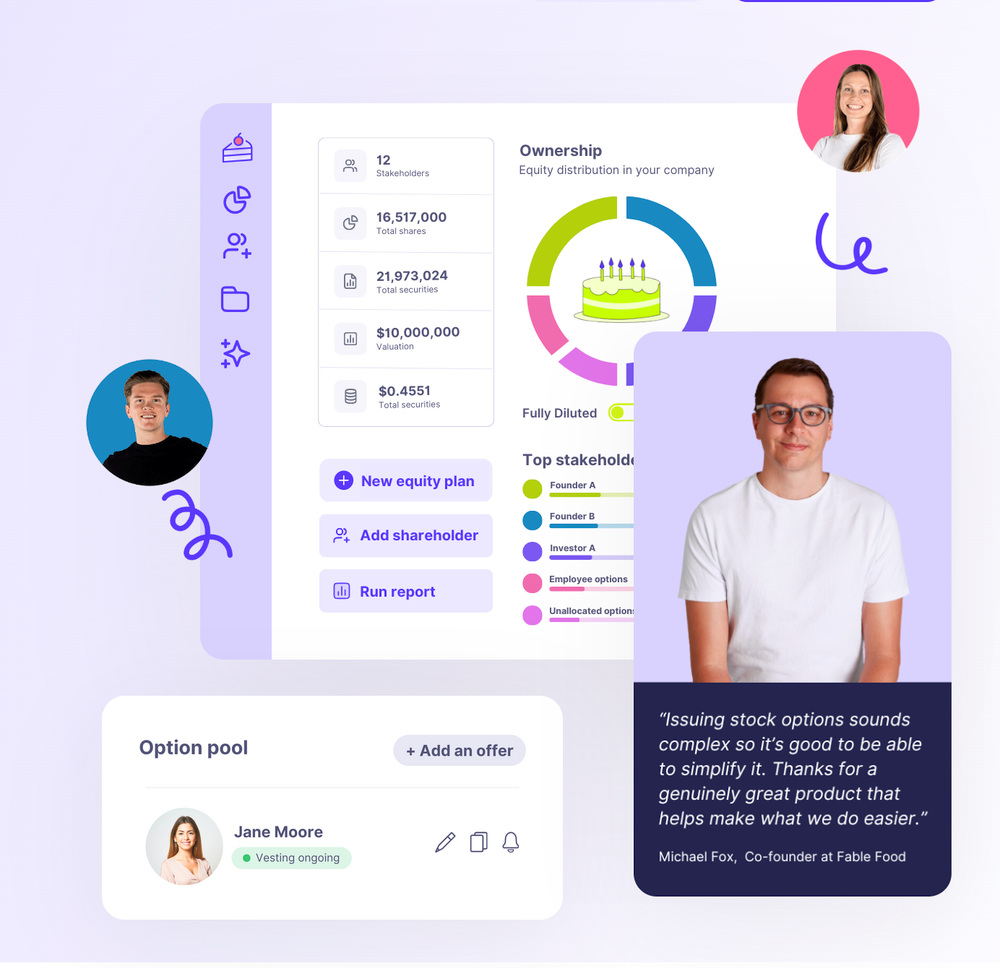
Cake Equity built its platform with early-stage startups in mind. The product works well for companies operating primarily in a single market, particularly the US. Their design philosophy favors simplicity and ease of use for founders who are managing equity for the first time.
This focus has pros and cons. Early-stage founders love the clean interface and straightforward workflows. But companies that grow quickly or expand internationally often find they need more than Cake provides.
Target Market Differences
Here’s a telling statistic about each platform’s user base. Cake Equity’s reviewers are 68% small business. Qapita’s reviewers are 49% mid-market and 26% enterprise. That means three-quarters of Qapita’s reviews come from companies past the simple stage.
This matters when you’re reading feature comparisons and reviews. A platform that earns high ratings from seed-stage companies might perform differently when handling complex enterprise structures.
Cap Table Management: Core Feature Comparison
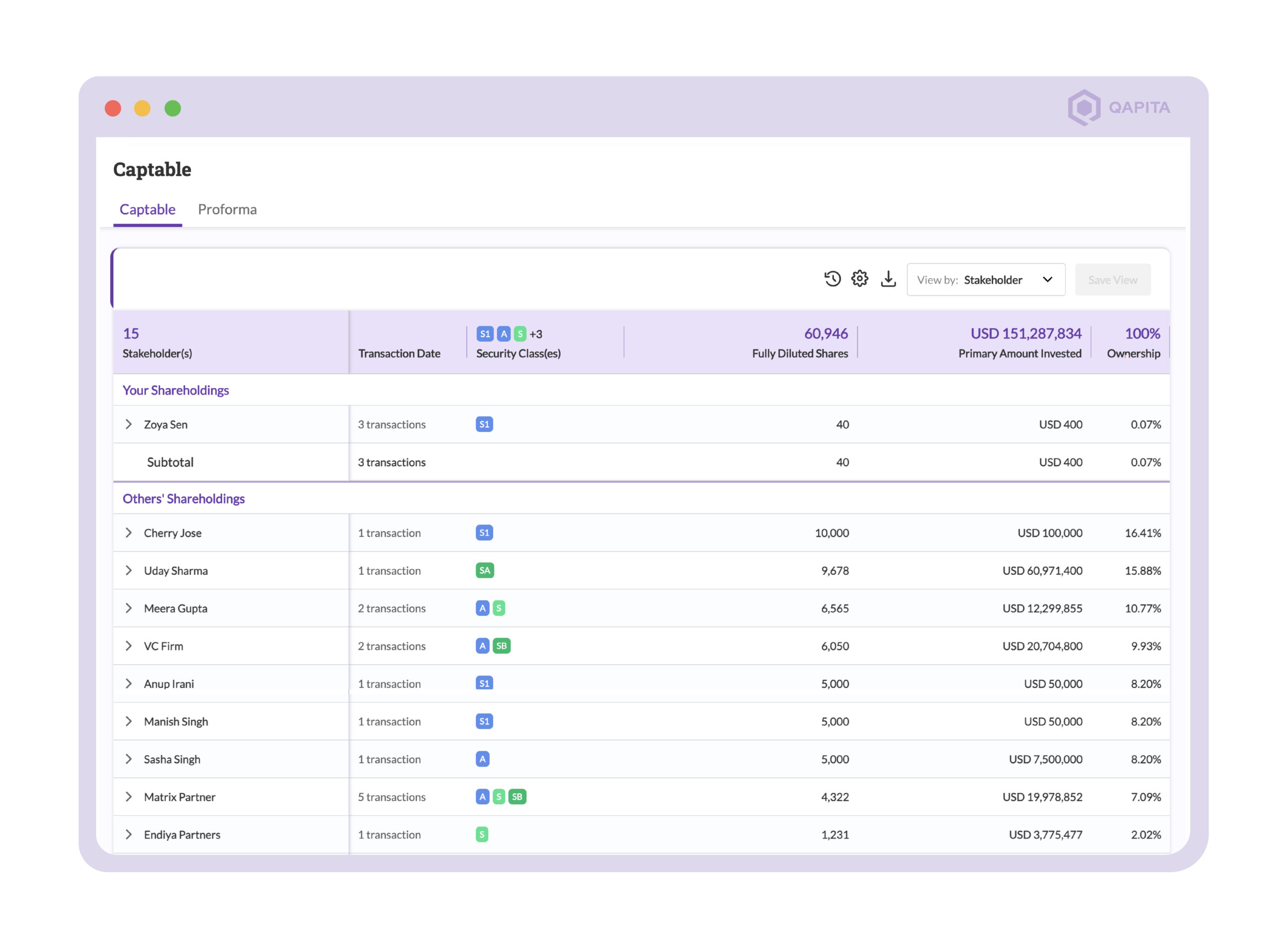
Both platforms handle basic cap table functions. Let’s look at how they differ in execution and depth.
Setting Up Your Cap Table
Qapita’s approach: The platform is built as an end-to-end cap table management solution. It helps teams set up a clean cap table from day one. Every equity event gets captured with proper approvals and documentation. The system turns ownership data into clear scenarios for new rounds, option pool changes, and exits.
Transferring existing data into Qapita is straightforward. The platform accepts both complete historical records and point-in-time snapshots through simple spreadsheet uploads. You can import:
- Stakeholder information
- Transaction histories
- Share class structures
- Vesting details
- Convertible securities
The system lets you map stakeholder data and process bulk imports. Then you activate transactions once everything looks right.
Cake Equity’s approach: Cake offers a free tier that covers basic cap table setup for early-stage startups. The interface is designed for founders who might be creating their first cap table. It’s clean and intuitive, but the depth of customization is more limited.
Ongoing Cap Table Maintenance
Managing a cap table isn’t a one-time event. Every new hire grant, every option exercise, every secondary sale changes your ownership structure.
Qapita: The platform automates tracking of equity transactions. It updates ownership records automatically and generates detailed reports. The audit trail captures every change, which matters during due diligence and financial audits.
Qapita provides proper workflows and complete transparency. The reports are investor-ready without manual cleanup. You get real human support from day one, not just a help desk.
Cake Equity: Cake handles standard equity transactions well for simpler cap tables. The platform tracks common events like new grants, vesting updates, and basic exercises. More complex transactions may require manual intervention or workarounds.
Scenario Modeling and Fundraising
When you’re raising a new round, you need to model different scenarios. What happens at a $20M valuation versus $30M? How does a new option pool affect existing shareholders?
| Feature | Qapita | Cake Equity |
|---|---|---|
| Fundraising modeling | Included | Included |
| Waterfall analysis | Full support | Basic support |
| Exit scenario planning | Detailed | Basic |
| Dilution calculations | Advanced | Standard |
| Custom share classes | Unlimited | Limited |
Both platforms let you model future rounds. Qapita’s modeling tools go deeper, which matters when you’re dealing with complex cap tables that include multiple share classes, convertible notes, and SAFEs.
Stock Option Administration: Qapita vs Cake Equity
Stock options are where equity management gets complicated. You’re not just tracking ownership. You’re managing vesting schedules, exercise windows, tax implications, and employee communications.
Grant Management
Qapita: The platform handles the full lifecycle of stock option grants. From board approval to employee acceptance to exercise and sale. Each step has proper documentation and approval workflows.
Qapita’s system works across 150+ countries. This matters because stock options are taxed differently everywhere. A grant to an employee in Germany has different tax treatment than one in India or the US. Qapita’s platform knows that Germany taxes at vesting while India taxes at exercise. It reconciles both under one policy.
Cake Equity: Cake handles standard US-style option grants well. The platform supports ISO and NSO grants with standard vesting schedules. For companies operating primarily in the US with straightforward equity plans, Cake covers the basics.
Stock Option Exercising
When employees exercise their options, the process needs to be smooth. Bad exercise workflows create confusion and potential tax problems.
| Feature | Qapita | Cake Equity |
|---|---|---|
| Stock option exercising | Included | Included |
| Exercise documentation | Automated | Semi-automated |
| Tax withholding calculations | Multi-jurisdiction | US-focused |
| Payment processing | Integrated | Limited |
| Exercise notifications | Automated | Basic |
Employee Equity Education
Most employees don’t understand equity compensation. They don’t know the difference between ISOs and NSOs. They don’t understand vesting cliffs. They definitely don’t know the tax implications of early exercise.
Qapita: The platform includes employee equity education features. Employees get access to easy dashboard views that show their equity position clearly. Training and support help employees understand what they own and what it means.
Cake Equity: Cake provides basic employee views and some educational resources. The depth of education materials is more limited than Qapita’s offering.
Valuation Services: 409A and Beyond
If you’re granting stock options in the US, you need a 409A valuation. It’s not optional. The IRS requires it. Getting it wrong creates tax penalties for your employees and potential liability for your company.
409A Valuation Comparison
Both platforms offer 409A valuations, but they’re positioned differently in the pricing tiers.
| Platform | 409A Availability | Tier Required |
|---|---|---|
| Qapita | Yes | Growth (Tier 3) onwards or standalone |
| Cake Equity | Yes | Team (Tier 2) |
Qapita: Beyond the standard 409A, Qapita offers comprehensive valuation services. They handle portfolio valuation for VCs, which gives them deep expertise in startup valuations. Their consulting services include financial reporting expertise that goes beyond a basic checkbox valuation.
Cake Equity: Cake’s 409A valuations serve early-stage companies well. The turnaround time and pricing work for startups with simpler capital structures. More complex valuations may require additional services.
International Valuation Considerations
409A is a US requirement. But if you have employees in other countries, you may need valuations for local tax purposes too.
Qapita’s global infrastructure means they understand valuation requirements across jurisdictions. This becomes critical when you’re granting equity to employees in multiple countries and need defensible valuations in each location.
Compliance and Reporting: Where Platforms Really Differ
This is where Qapita and Cake Equity diverge most clearly. Compliance gets complicated fast, and your platform either handles it or it doesn’t.
US Compliance Requirements
US companies with equity compensation face several reporting requirements. Here’s how each platform handles them:
| Requirement | Qapita | Cake Equity |
|---|---|---|
| Cap table, 83(b), ISO management | Free (Spark tier) | Free / Build tier |
| Form 3921 reporting | Growth tier onwards | Pro (top tier) |
| Rule 701 tracking | Growth tier onwards | Pro (top tier) |
| ASC 718 / US GAAP reporting | Enterprise tier | Pro (top tier) |
Form 3921 Reporting
What it is: When employees exercise ISOs, companies must file Form 3921 with the IRS and provide copies to employees. Miss this, and you face penalties.
Qapita: Form 3921 reporting is available from the Growth tier. The platform automates the data collection and form generation, reducing manual work and error risk.
Cake Equity: This feature requires the Pro tier (top tier). For companies that need this compliance capability, the required tier is higher on Cake than on Qapita.
Rule 701 Tracking
What it is: Rule 701 exempts certain stock issuances from SEC registration. But there are limits. Once you exceed the thresholds, you need to provide additional disclosures to recipients.
Qapita: Rule 701 tracking is built into the Growth tier. The platform monitors your issuances against the limits and alerts you when you’re approaching thresholds.
Cake Equity: Available at the Pro tier only.
ASC 718 and Financial Reporting
Public companies and companies preparing for IPO need ASC 718 compliant stock compensation expense calculations. Even private companies with investors or potential acquirers may need this reporting.
Qapita: Full ASC 718 and US GAAP reporting at the Enterprise tier. The platform also handles IFRS 2 reporting for international accounting standards. This dual capability matters for companies with global operations or those preparing for international listings.
Cake Equity: ASC 718 support at the Pro tier. IFRS 2 support is more limited.
IFRS 2 Reporting
If your company reports under international accounting standards, you need IFRS 2 compliant expense calculations.
| Feature | Qapita | Cake Equity |
|---|---|---|
| IFRS 2 reporting | Full support | Limited |
| Dual GAAP/IFRS | Yes | Limited |
Global Equity Management: The Biggest Difference
Here’s where the Qapita versus Cake Equity comparison gets really clear. If your company operates in multiple countries, this section determines your choice.
Cross-Border Equity Plans
Qapita: The platform handles multi-entity, multi-jurisdiction equity with built-in legal and tax frameworks for 150+ countries. This isn’t just about storing grants. It’s about understanding the implications.
Consider this scenario: Your cap table sits in Delaware. Your engineering team is split between Bangalore, Singapore, and Berlin. Each country has different:
- Tax treatment (timing, rates, withholding requirements)
- Securities laws (registration, exemptions, disclosures)
- Employment law considerations
- Documentation requirements
- Currency considerations
Qapita’s platform tells you that Germany taxes at vesting while India taxes at exercise. It reconciles both under one policy. Most platforms will store those grants. Fewer will actually guide you through the compliance requirements.
Cake Equity: Cake is built for early-stage startups in one country. The platform works well for US-focused companies. Cross-border equity support is limited compared to Qapita’s global infrastructure.
Specific Country Considerations
Let’s look at what global equity management actually means in practice:
India: Stock options are taxed at exercise based on the fair market value at that time. Companies need to handle TDS (tax deducted at source) requirements. ESOP documentation must comply with Companies Act provisions.
Singapore: Options are taxed at exercise or sale, depending on the scheme structure. IRAS (tax authority) has specific reporting requirements. Companies need to track deemed exercise dates for employees who leave Singapore.
Germany: Tax is triggered at vesting for most equity awards. The “dry income” problem (taxation before any cash realization) is a big issue. Recent legislation has improved this somewhat, but compliance is complex.
United Kingdom: EMI schemes offer favorable tax treatment but have strict requirements. Unapproved schemes have different treatment. National Insurance contributions add another layer.
Qapita’s platform handles these variations. Cake Equity’s US-centric design means international grants require more manual work and external expertise.
Plan Design and Drafting
| Service | Qapita | Cake Equity |
|---|---|---|
| Plan design consulting | Included | Limited |
| International plan drafting | 150+ countries | US-focused |
| Sub-plan creation | Full support | Limited |
| Legal review integration | Yes | Basic |
Creating equity plans that work across borders requires expertise. You can’t just use your US plan documents in Germany. You need country-specific sub-plans that comply with local requirements while maintaining consistency with your overall equity philosophy.
Pricing Structure: What You Actually Pay
Understanding pricing requires looking beyond the sticker price. What features do you get at each tier? When will you need to upgrade?
Free Tier Comparison
Both platforms offer free tiers for early-stage companies.
Qapita Spark (Free):
- Cap table management
- 83(b) election tracking
- ISO management
- Basic reporting
Cake Equity Free/Build:
- Cap table management
- Basic grant tracking
- Standard reporting
Both free tiers work for very early-stage companies with simple cap tables and no complex compliance needs.
Paid Tier Comparison
Here’s where pricing gets interesting. The question isn’t just “how much?” but “what do I get?”
| Feature | Qapita Tier Required | Cake Equity Tier Required |
|---|---|---|
| 409A valuation | Growth (Tier 3) | Team (Tier 2) |
| Form 3921 reporting | Growth (Tier 3) | Pro (Top tier) |
| Rule 701 tracking | Growth (Tier 3) | Pro (Top tier) |
| ASC 718 reporting | Enterprise (Top tier) | Pro (Top tier) |
| Cross-border equity | All paid tiers | Limited |
Cake Equity’s 409A is available earlier in the tier structure. But critical compliance features like Form 3921 and Rule 701 require the top tier. Qapita makes these available at a mid-tier level.
Total Cost of Ownership
The platform price is just one cost. Consider also:
- External legal fees for plan documents (higher if platform doesn’t support your jurisdictions)
- Accounting fees for financial reporting (lower if platform generates compliant reports)
- Tax advisor fees for international grants (lower if platform handles local requirements)
- Migration costs if you outgrow the platform and need to switch
- Time costs for manual workarounds and compliance tracking
A cheaper platform that doesn’t support your compliance needs may cost more in external services than a more expensive platform that handles everything.
Liquidity Programs: Structured Secondary Sales
As companies stay private longer, employees want liquidity before an IPO or acquisition. Both platforms approach this differently.
Qapita’s Liquidity Solutions
Qapita offers structured liquidity programs. This means they help companies run organized secondary sales where employees can sell some of their vested shares to approved buyers.
The platform handles:
- Tender offer administration
- Buyer qualification and matching
- Transaction documentation
- Transfer execution on the cap table
- Tax reporting for sellers
Running a liquidity program involves legal complexity, compliance requirements, and operational logistics. Qapita’s platform integrates these elements so companies don’t need to coordinate multiple vendors.
Cake Equity’s Liquidity Approach
Cake Equity’s liquidity capabilities are more limited. Early-stage companies rarely need structured liquidity programs. By the time they do, they may have outgrown Cake’s feature set.
Why Liquidity Matters
Employee retention improves when people can get some value from their equity before a full exit. Top talent expects liquidity options at growth-stage companies. If your platform can’t support this, you’re either not offering liquidity or you’re running it outside your equity system.
Integration and Ecosystem: How Platforms Connect
Your equity platform doesn’t exist in isolation. It needs to work with your HRIS, accounting software, payroll system, and other tools.
Qapita’s Integration Approach
Qapita’s partnership with Countsy shows their ecosystem strategy. They’re building connections with service providers that support growing companies. The platform integrates with:
- HRIS systems for employee data
- Accounting platforms for financial reporting
- Payroll systems for tax withholding
- Legal document management
- Investor reporting tools
The VC-focused features mean Qapita also integrates with fund administration and portfolio management workflows. If your investors use Qapita for their portfolio management, data flows smoothly between company and investor systems.
Cake Equity’s Integration Approach
Cake offers standard integrations appropriate for early-stage companies. The depth and breadth of integrations is narrower than Qapita’s, reflecting the simpler needs of their target market.
Data Import and Export
Getting data in and out matters. You don’t want to be locked into a platform with data you can’t access.
Qapita: The platform supports comprehensive data import through spreadsheet uploads. You can export all your data for backup, audit, or migration purposes. The system maintains complete transaction histories that can be exported.
Cake Equity: Standard import/export capabilities for basic data. Some complex data structures may require manual handling.
Support and Service: What Happens When You Need Help
Equity management isn’t something you can figure out from documentation alone. When you have questions about RSU taxation in Singapore or need to model a complex waterfall, you need real help.
Qapita’s Support Model
Qapita emphasizes human support from day one. “You get real human support from day one, not just a help desk.”
The company offers:
- Dedicated customer success managers
- Onboarding assistance and training
- Consulting services for complex equity questions
- Plan design expertise
- Valuation consulting
When you go live on Qapita, “everyone gets easy dashboard access and training, ensuring smooth transition.” The dedicated support continues post-implementation “to keep adoption seamless.”
Cake Equity’s Support Model
Cake provides support appropriate for their early-stage target market. Response times and support depth reflect the simpler needs of their typical customer. Companies with complex questions may find they need external experts to supplement platform support.
Onboarding Experience
Qapita: The platform guides companies through setup with structured onboarding. Data migration support helps companies transfer existing cap table data accurately. Training ensures all users understand the platform.
Cake Equity: Self-service onboarding works well for simple cap tables. More complex migrations may require more effort.
Security and Audit: Protecting Your Data
Your cap table contains sensitive data. Ownership percentages, personal information, compensation details. Security isn’t optional.
Audit Trail Requirements
Investors, auditors, and regulators want to see who changed what and when. Both platforms maintain audit trails, but depth matters.
Qapita: Complete audit trails capture every change with timestamps, user identification, and before/after states. This level of detail satisfies financial auditors and due diligence requests.
Cake Equity: Basic audit logging tracks changes. The depth may not satisfy enterprise audit requirements.
Data Security Standards
Both platforms follow standard security practices including encryption, access controls, and secure infrastructure. Verify current certifications and compliance standards directly with each vendor as these evolve.
Who Should Choose Each Platform: Decision Framework
Let’s cut through the feature comparisons and talk about who actually fits each platform.
Choose Cake Equity If:
- You’re an early-stage startup (seed through Series A)
- Your company operates primarily in the US
- Your cap table is relatively simple (few share classes, no complex convertibles)
- You don’t have international employees yet
- You want the simplest possible interface
- Your compliance needs are basic
- You’re comfortable potentially migrating to a new platform as you grow
Choose Qapita If:
- You have employees in multiple countries
- You’re past Series A and complexity is growing
- You need serious compliance capabilities (Form 3921, Rule 701, ASC 718, IFRS 2)
- You’re preparing for larger financing rounds or potential exit
- Your investors use Qapita for portfolio management
- You want to avoid platform migration as you scale
- You need liquidity program support
- You operate in markets like India, Singapore, or Southeast Asia
The Growth Question
Here’s the key question: Where is your company headed?
“It depends on where your company is headed. Cake suits single-market US teams from first SAFE through Series A. Qapita is built for companies with employees across multiple countries, particularly the US, India, and Southeast Asia, that need cap table management, stock option administration, and 409A valuations on one platform.”
If you’re confident you’ll stay US-only and relatively simple, Cake works fine. If there’s any chance you’ll expand internationally or grow past the Series A stage significantly, starting on Qapita avoids a painful migration later.
Real-World Scenarios: Platform Choice in Action
Abstract comparisons only go so far. Let’s look at specific scenarios.
Scenario 1: US-Only Early-Stage Startup
Company profile: 15 employees, all in San Francisco. Seed funding from US angels and one micro-VC. Standard SAFE and option plan.
Recommendation: Either platform works. Cake’s simplicity might be preferable. The free tier handles the basics. When you need a 409A, Cake’s Team tier is accessible.
Watch out for: If you plan to hire remote internationally, start thinking about platform capabilities now.
Scenario 2: US Company with Indian Engineering Team
Company profile: 40 employees total. 25 in US, 15 in India. Series A closed, planning Series B. Option grants to employees in both countries.
Recommendation: Qapita. The cross-border equity requirements make this clear. You need a platform that understands Indian tax treatment, handles TDS requirements, and generates compliant documentation.
Key benefits: Single platform for both jurisdictions. Tax treatment differences handled automatically. No need for separate India-specific tools or consultants.
Scenario 3: Southeast Asian Startup Going Global
Company profile: Singapore-headquartered company. 80 employees across Singapore, Indonesia, Vietnam, and the US. Series B, considering Series C.
Recommendation: Qapita. The platform’s strength in APAC markets and US cross-border capability fits perfectly. Cake isn’t designed for this complexity.
Key benefits: Native understanding of Southeast Asian jurisdictions. US compliance for any employees or entities there. Single source of truth across all locations.
Scenario 4: Pre-IPO Company Needing Audit-Ready Reporting
Company profile: 300 employees. Multiple equity plans over several years. Preparing for IPO within 18-24 months. Need ASC 718 and potentially IFRS 2 reporting.
Recommendation: Qapita Enterprise. The financial reporting requirements and audit trail needs exceed Cake’s capabilities. The human support becomes critical during IPO preparation.
Key benefits: Investor-ready reports without manual cleanup. Complete audit trail. Dual GAAP/IFRS capability if needed.
Migration Considerations: Switching Platforms
If you’re already on a platform and considering a switch, migration complexity matters.
Migrating to Qapita
Qapita’s migration process is structured:
- Data export from current platform
- Spreadsheet mapping to Qapita format
- Bulk import of stakeholder and transaction data
- Validation and reconciliation
- Activation once verified
- Training for all users
“Your cap table, grants, and records are live, with automated updates. We’ll stay close with dedicated support to keep adoption seamless.”
The platform accepts complete historical records, so you don’t lose transaction history. You can also import a point-in-time snapshot if full history isn’t available or needed.
Migrating from Qapita
Qapita allows data export, so you’re not locked in. All transaction data and stakeholder information can be exported for migration to another platform if needed.
Migration Risk Factors
Any migration carries risk:
- Data accuracy: Errors in migration can create cap table discrepancies
- Historical continuity: Some platforms may not accept full transaction history
- User disruption: Employees and investors need to learn new interfaces
- Timing: Don’t migrate during a fundraise or audit
The best approach is choosing the right platform from the start. But if you need to migrate, proper planning and support minimize risk.
Feature-by-Feature Summary Table
Here’s a comprehensive comparison of features discussed throughout this article:
| Feature | Qapita | Cake Equity |
|---|---|---|
| Free plan | Yes (Spark) | Yes (Build) |
| Entry paid plan | Growth | Team |
| Fundraising modeling | Yes | Yes |
| Stock option exercising | Yes | Yes |
| 409A valuation | Growth tier+ | Team tier |
| Form 3921 reporting | Growth tier | Pro tier only |
| Rule 701 tracking | Growth tier | Pro tier only |
| ASC 718 reporting | Enterprise tier | Pro tier |
| IFRS 2 reporting | Full support | Limited |
| Cross-border equity plans | 150+ countries | US-focused |
| Plan design and drafting | Yes | Limited |
| Employee equity education | Yes | Basic |
| Structured liquidity | Yes | Limited |
| VC portfolio tools | Yes | No |
| Human support | Dedicated CSM | Standard support |
| Target company stage | Seed to IPO | Seed to Series A |
| Primary user base | 49% mid-market, 26% enterprise | 68% small business |
The Bottom Line: Making Your Decision
Choosing between Qapita and Cake Equity comes down to where your company is and where it’s going.
Cake Equity does what it does well. For US-only early-stage startups with simple cap tables and basic compliance needs, it’s a solid choice. The interface is clean. The free tier is genuinely useful. You can get started quickly.
Qapita is built for companies that will get complicated. Multiple countries. Multiple entity structures. Complex compliance requirements. Financial reporting that needs to satisfy auditors and investors. If that’s your trajectory, Qapita handles it without forcing a platform migration as you scale.
“Cake is built for early-stage startups in one country. Qapita is built to keep working from seed to IPO, more employees, more countries, bigger plans. Cap table, stock options, valuations, compliance, and employee equity all sit in one place, in 150+ countries.”
The migration risk matters. Switching platforms mid-flight is painful and risky. If there’s reasonable probability you’ll need Qapita’s capabilities within 2-3 years, starting there saves you the migration headache.
Both platforms are legitimate choices for the right company. Match your selection to your reality and your roadmap. Your future self will thank you.
Frequently Asked Questions About Qapita vs Cake Equity
| Which platform is better for US-only startups? | Both platforms work for US-only companies. Cake Equity is designed specifically for this market and offers a simpler experience for early-stage US startups. Qapita also fully supports US operations and may be better if you anticipate international expansion or need advanced compliance features like Form 3921 or Rule 701 tracking at lower tier levels. |
| Can I start with Cake Equity and switch to Qapita later? | Yes, you can migrate between platforms. But migrations carry risk and require effort. You’ll need to export data from Cake, map it to Qapita’s format, import and validate, then retrain users. If you’re likely to need Qapita’s capabilities within a few years, starting there avoids the migration entirely. |
| How do Qapita and Cake Equity compare on pricing? | Both offer free tiers for basic cap table management. Cake Equity’s 409A valuations are available at the Team tier (Tier 2). Qapita requires Growth tier (Tier 3) for 409A. But Qapita includes Form 3921 and Rule 701 at Growth tier, while Cake requires Pro (top tier) for these features. Total cost depends on which features you need. |
| Which platform handles international employees better? | Qapita is clearly stronger for international equity management. The platform supports legal and tax frameworks in 150+ countries and understands jurisdiction-specific requirements like German vesting taxation versus Indian exercise taxation. Cake Equity is US-focused and requires more manual work for international grants. |
| Do both platforms offer 409A valuations? | Yes. Both platforms offer 409A valuations. They’re available at different pricing tiers but both provide IRS-defensible valuations for stock option pricing. Qapita also offers more extensive valuation services including portfolio valuations for VCs. |
| What types of companies use Qapita versus Cake Equity? | Cake Equity’s users are 68% small business. Qapita’s users are 49% mid-market and 26% enterprise, meaning three-quarters come from companies past the simple stage. This reflects each platform’s design focus and feature depth. |
| Can Qapita handle my company from seed stage to IPO? | Yes. Qapita is designed to scale from seed to IPO. The platform handles simple early-stage cap tables and grows with you through complex multi-entity structures, international expansion, and IPO-ready financial reporting. You won’t need to migrate as you scale. |
| Which platform is better for employee equity education? | Qapita includes more comprehensive employee equity education features. The platform provides easy dashboard access for employees and training resources. Cake Equity offers basic employee views and some educational materials but less depth than Qapita. |
| Do either Qapita or Cake Equity support secondary sales and liquidity events? | Qapita offers structured liquidity programs including tender offer administration, buyer matching, transaction documentation, and tax reporting. Cake Equity has more limited liquidity capabilities, reflecting its early-stage focus where secondary sales are less common. |
| What kind of support does each platform provide? | Qapita emphasizes human support from day one with dedicated customer success managers, onboarding assistance, and consulting services for complex equity questions. Cake Equity provides standard support appropriate for simpler use cases. Companies with complex needs may need external experts to supplement Cake’s support. |



 Stack Insight is intended to support informed decision-making by providing independent information about business software and services. Some product details, including pricing, features, and promotional offers, may be supplied by vendors or partners and can change without notice.