
Armo Review


ARMO Review 2026: Complete Analysis of Kubernetes-Native Security and CADR Platform
Kubernetes security has become one of the biggest headaches for DevOps and security teams. You’ve got containers spinning up and down constantly. Microservices talking to each other across clusters. Cloud resources scattered across multiple providers. And through all of this, you need to keep everything secure without slowing down deployments.
ARMO steps into this chaos with a different approach. Instead of bolting security onto your cloud infrastructure from the outside, ARMO built their platform specifically for Kubernetes from the ground up. They call their approach Cloud Application Detection and Response (CADR). It’s designed to cut through the noise that traditional security tools create and show you what actually matters.
In this review, we’ll dig into every aspect of ARMO’s platform. We’ll look at how it compares to traditional CNAPP and CSPM solutions. We’ll examine the technology behind their runtime security. And we’ll help you figure out if ARMO is the right fit for your organization’s cloud security needs.
What Is ARMO and What Problem Does It Solve?
ARMO is a cloud-native security company that focuses on protecting Kubernetes environments and cloud applications. The company started with an open-source project called Kubescape, which quickly became one of the most popular Kubernetes security tools in the community.
The core problem ARMO tackles is simple to describe but hard to solve. Traditional security tools weren’t built for cloud-native environments. They generate thousands of alerts. Most of those alerts don’t matter because they flag theoretical risks, not actual threats.
The Alert Fatigue Problem
Here’s what typically happens with older security tools:
- Your scanner finds 10,000 CVEs across your container images
- Your team spends weeks triaging these findings
- You discover that 95% of those CVEs are in code paths that never execute
- Meanwhile, an actual attack slips through because nobody saw the one alert that mattered
ARMO’s solution uses runtime intelligence to show you what’s actually exploitable. If a vulnerable library never loads into memory during your application’s execution, it drops in priority. If a process spawns that shouldn’t exist based on your application’s normal behavior, you get an immediate alert.
Kubernetes-Native Architecture
ARMO built their platform specifically for Kubernetes. This matters more than you might think. Generic cloud security tools often treat Kubernetes as just another cloud resource. They scan configs. They check permissions. But they don’t understand how Kubernetes actually works.
ARMO’s approach is different:
- Deep understanding of Kubernetes objects and their relationships
- Native integration with the Kubernetes API
- Awareness of how containers, pods, and services interact
- Runtime visibility into what’s happening inside your clusters
Understanding CADR: Cloud Application Detection and Response
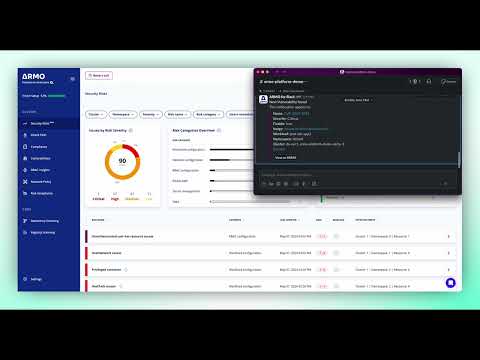
ARMO positions itself as the first runtime behavioral CADR solution. But what does CADR actually mean? And how is it different from the alphabet soup of security acronyms you already know?
The Evolution from CNAPP to CADR
To understand CADR, you need to know where it came from. The 2025 Latio Cloud Security Market Report traced five years of evolution in cloud security. Here’s how that evolution happened:
| Era | Focus | Primary Tool | Limitation |
|---|---|---|---|
| Early Cloud Security | Configuration scanning | CSPM | Only theoretical risk |
| Workload Protection | Container security | CWPP | Limited runtime context |
| Unified Platforms | Combined approach | CNAPP | Still too many alerts |
| Runtime-Driven | Actual exploitability | CADR | Current state of the art |
The Latio report recognized ARMO as both a Cloud Security Innovator and CADR Leader. This positions them among the select vendors defining the next decade of cloud defense.
What Makes CADR Different
CADR unifies detection across your entire stack:
- Cloud infrastructure
- Kubernetes clusters
- Containers
- Application code
The goal isn’t just to tell you that something suspicious happened. CADR shows you how attacks actually progress through your environment. It connects the dots between events that would otherwise look unrelated.
As ARMO puts it: “Cloud security’s future lies not in more dashboards, but in runtime-aware defense that turns noise into action.”
Runtime Behavioral Analysis
The “behavioral” part of ARMO’s CADR approach is critical. Traditional security tools work from static rules. They know what bad things look like, and they alert when they see those patterns.
ARMO’s approach learns what normal looks like for your specific applications. Then it flags deviations from that baseline. This catches:
- Zero-day attacks that don’t match known signatures
- Insider threats that use legitimate credentials
- Supply chain compromises that slip through code reviews
- Novel attack techniques that traditional tools miss
ARMO Platform Architecture: How It Works Under the Hood
Understanding ARMO’s architecture helps you see why it performs differently than traditional security tools. The platform combines several technologies to create a complete security picture.
eBPF-Powered Runtime Sensor
At the heart of ARMO’s runtime capabilities is an eBPF sensor. eBPF (extended Berkeley Packet Filter) is a technology that lets you run programs inside the Linux kernel without changing kernel source code or loading kernel modules.
This matters for security because:
- The sensor sees everything happening at the system level
- It runs with minimal performance overhead
- Attackers can’t easily detect or disable it
- It works across different container runtimes and Kubernetes distributions
The eBPF sensor collects data about:
- Process execution and system calls
- Network connections and data flows
- File system access patterns
- Memory operations and library loading
Agentless Cloud Scanning
While runtime security requires an agent (the eBPF sensor), ARMO also provides agentless scanning for cloud resources. This gives you:
- Configuration analysis across AWS, Azure, and GCP
- Compliance checking against industry frameworks
- Risk assessment powered by runtime insights
- No need to deploy agents to every cloud resource
The combination of agent-based runtime security and agentless cloud scanning creates a complete picture of your security posture.
The Kubescape Foundation
ARMO’s commercial platform is powered by Kubescape, their open-source Kubernetes security project. Kubescape has become one of the most popular tools in the CNCF (Cloud Native Computing Foundation) ecosystem.
This open-source foundation provides several benefits:
- Thousands of community contributors improve the core technology
- Security research from the community feeds into detection capabilities
- You can try the basic functionality before committing to the commercial platform
- The technology is battle-tested across diverse environments
Key Features: Deep Analysis of ARMO’s Capabilities
Let’s break down the specific features ARMO offers and examine how each one works in practice.
Runtime Threat Detection and Response
ARMO’s threat detection goes beyond simple signature matching. The platform uses anomaly analysis to identify threats.
How it works:
- The eBPF sensor builds a baseline of normal behavior for each workload
- It monitors for deviations from that baseline in real time
- When anomalies occur, the system correlates them with known attack patterns
- Alerts include full context about what happened and why it matters
Automatic response capabilities:
- Kill malicious processes before they can cause damage
- Block suspicious network connections
- Quarantine compromised containers
- Alert your team with actionable information
The automatic response feature is configurable. You can set it to block threats automatically in production. Or you can run it in detection-only mode while you build confidence in the system.
CVE Prioritization with Runtime Reachability
This is one of ARMO’s standout features. Every security team deals with massive lists of CVEs. ARMO helps you focus on the ones that actually matter.
Traditional CVE scanning tells you:
- This container image has 500 known vulnerabilities
- These packages are out of date
- These severity scores come from CVSS databases
ARMO’s runtime reachability analysis tells you:
- These 15 CVEs are in code that actually executes
- These 3 CVEs are reachable from the network
- This 1 CVE has been actively probed by attackers
The difference is dramatic. Instead of triaging 500 vulnerabilities, your team focuses on the handful that represent real risk.
Kubernetes Compliance Automation
ARMO automates compliance checking against multiple frameworks:
| Framework | Use Case | ARMO Coverage |
|---|---|---|
| NSA/CISA Kubernetes Hardening Guide | Government and defense contractors | Full coverage with automated remediation |
| CIS Kubernetes Benchmark | General security best practices | Complete checks with fix suggestions |
| SOC 2 | Service organizations | Mapped controls with evidence collection |
| HIPAA | Healthcare organizations | Technical controls validation |
| PCI-DSS | Payment card processing | Requirement mapping and validation |
The compliance features include:
- Continuous monitoring against framework requirements
- Automated evidence collection for audits
- Drift detection when configurations change
- Remediation guidance specific to your environment
Cloud Security Posture Management
ARMO’s CSPM capabilities detect, contextualize, and help remediate cloud risks across providers. The key difference from traditional CSPM is the runtime context.
When ARMO finds a misconfiguration, it doesn’t just tell you the theoretical risk. It shows you:
- Whether the misconfigured resource is actually being exploited
- What other resources it connects to
- The potential blast radius if compromised
- The actual priority based on your environment
Full Stack Visibility
ARMO provides what they call “a fully explainable and traceable runtime security story spanning the entire cloud technology stack.”
This means you can trace security events from:
- The cloud infrastructure level (VPCs, security groups, IAM)
- Through the Kubernetes layer (clusters, namespaces, workloads)
- Into the container level (images, processes, network connections)
- Down to the application code (functions, libraries, dependencies)
This end-to-end visibility helps security teams understand how attacks progress. It also helps DevOps teams understand why security matters for their specific applications.
ARMO vs. Traditional CNAPP and CSPM Solutions: Head-to-Head Comparison
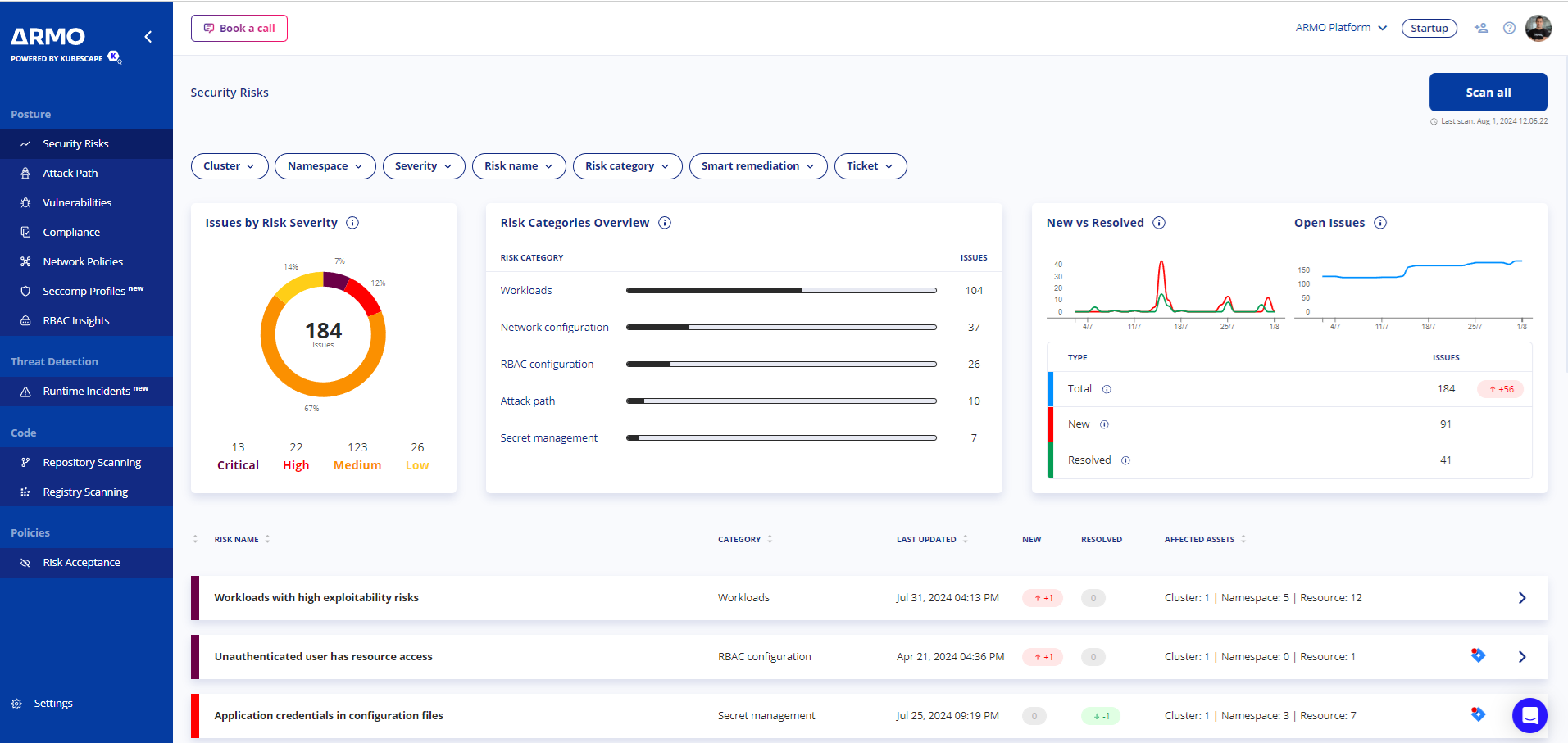
ARMO explicitly positions itself against traditional CNAPP and CSPM tools. Let’s examine how they compare across different dimensions.
Approach to Risk Assessment
| Dimension | Traditional CNAPP/CSPM | ARMO |
|---|---|---|
| Risk basis | Static analysis of configurations | Runtime behavior combined with static analysis |
| CVE prioritization | CVSS scores and vendor severity | Actual reachability in your environment |
| Threat detection | Known signatures and rules | Behavioral anomaly detection |
| Alert volume | High (thousands of findings) | Reduced (filtered by runtime context) |
Kubernetes-Native vs. Cloud-First
Traditional CNAPP tools typically started with cloud infrastructure security. They added Kubernetes support later. ARMO started with Kubernetes and expanded to cover cloud infrastructure.
Why this matters:
- Kubernetes-native tools understand Kubernetes concepts deeply
- They integrate naturally with kubectl and Kubernetes APIs
- They’re designed for the DevOps workflow from the start
- They handle Kubernetes-specific security concerns better
If your primary workloads run on Kubernetes, ARMO’s native approach provides advantages. If you have significant non-Kubernetes cloud workloads, you might need to supplement ARMO with additional tools.
Alert Quality and Noise Reduction
One of ARMO’s biggest selling points is noise reduction. Let’s look at how this works in practice.
Scenario: Container image with 200 CVEs
Traditional CNAPP approach:
- Scans image and finds 200 CVEs
- Ranks them by CVSS score
- Shows 50 critical and high severity findings
- Your team must investigate all 50
ARMO approach:
- Scans image and finds 200 CVEs
- Monitors runtime to see which packages load
- Discovers only 30 packages actually execute
- Of those, only 8 have CVEs in reachable code paths
- Your team investigates 8 findings instead of 50
This isn’t about ignoring vulnerabilities. It’s about focusing your limited time on what actually creates risk.
Deployment and Operations
| Factor | Traditional CNAPP | ARMO |
|---|---|---|
| Deployment model | Often SaaS-only | SaaS or self-hosted options |
| Kubernetes integration | API-based, sometimes requires sidecars | Native Kubernetes operators |
| Performance impact | Varies widely | Low overhead with eBPF |
| DevOps workflow fit | Often requires workflow changes | Integrates with existing CI/CD |
Runtime Security Deep Dive: Why Posture Management Isn’t Enough
To really understand ARMO’s value, you need to understand the difference between posture management and runtime security.
What Posture Management Tells You
Posture management (CSPM, configuration scanning) tells you what could be vulnerable. It works by:
- Scanning configurations against best practices
- Comparing settings to security benchmarks
- Identifying known CVEs in your images
- Checking compliance against frameworks
This is valuable information. But it’s theoretical. It shows risk based on settings, not reality.
What Runtime Security Tells You
Runtime security tells you what’s actually being attacked or is realistically exploitable. It works by:
- Watching live behavior in your environment
- Tracking which libraries load into memory
- Monitoring which processes spawn
- Recording which network paths are used
This is operational truth. It shows what’s actually happening, not what might happen.
The Gap Between Theory and Reality
Consider this example:
Posture management finding: “Your container image contains Log4j version 2.14.1, which is vulnerable to CVE-2021-44228 (Log4Shell). Severity: Critical.”
What posture management doesn’t tell you:
- Is Log4j actually loaded in your running containers?
- Is the vulnerable code path reachable from external input?
- Has anyone attempted to exploit this vulnerability?
- What would happen if this exploit succeeded?
Runtime security insight: “Log4j 2.14.1 is present in 12 containers. Runtime analysis shows it only loads in 3 containers. Of those, 1 container processes external input through the vulnerable JNDI lookup feature. Exploit attempts detected: 47 in the last 24 hours. Automatic blocking engaged.”
The second scenario gives you everything you need to understand and respond to the threat.
Zero-Day Protection
Runtime behavioral analysis also protects against zero-day attacks. Traditional signature-based tools can only detect threats they know about. ARMO’s behavioral approach can catch:
- Unknown malware that behaves anomalously
- Novel exploitation techniques
- Supply chain compromises that evade code review
- Insider threats using legitimate access
ARMO describes this as “zero-day and every day protection for your cloud applications.”
ARMO for Different Team Roles: Security, DevOps, and Platform Engineering
Different teams interact with ARMO differently. Understanding these perspectives helps you evaluate whether it fits your organization.
For Security Teams
Security teams get:
- Reduced alert volume through runtime prioritization
- Clear visibility into what’s actually at risk
- Automated response capabilities for known threats
- Compliance reporting and evidence collection
- Full attack chain visibility across the stack
One user quoted on ARMO’s website said: “ARMO is a powerful and essential tool for Cloud and Kubernetes security. I highly recommend it for anyone managing cloud-native environments.”
Security teams particularly benefit from ARMO’s approach to threat contextualization. Instead of getting alerts about isolated events, they see how events connect across the environment.
For DevOps Teams
DevOps teams get:
- Security feedback integrated into existing CI/CD pipelines
- Clear remediation guidance that’s actionable
- Prioritized vulnerability lists they can actually work through
- Less friction between security requirements and deployment velocity
- Kubernetes-native tooling that fits their workflow
The Kubescape CLI integrates directly with kubectl. DevOps teams can scan configurations, images, and running clusters without leaving their familiar environment.
For Platform Engineering Teams
Platform engineering teams get:
- Cluster-wide visibility across multiple environments
- Policy enforcement at the platform level
- Self-service security capabilities for development teams
- Integration with existing platform tooling
- Compliance automation that scales across teams
Platform teams can set security policies centrally and let ARMO enforce them automatically across all clusters.
For SOC Teams
Security Operations Center teams get:
- Runtime alerts with full context
- Attack chain reconstruction
- Integration with SIEM and SOAR platforms
- Reduced investigation time through pre-correlated events
- Automatic response capabilities for known threats
ARMO hosts a series called “CADR:CON” focused on “the future of cloud runtime security and its implications on the SOC team.” This shows their focus on making cloud security operational, not just theoretical.
Deployment and Integration: Getting Started with ARMO
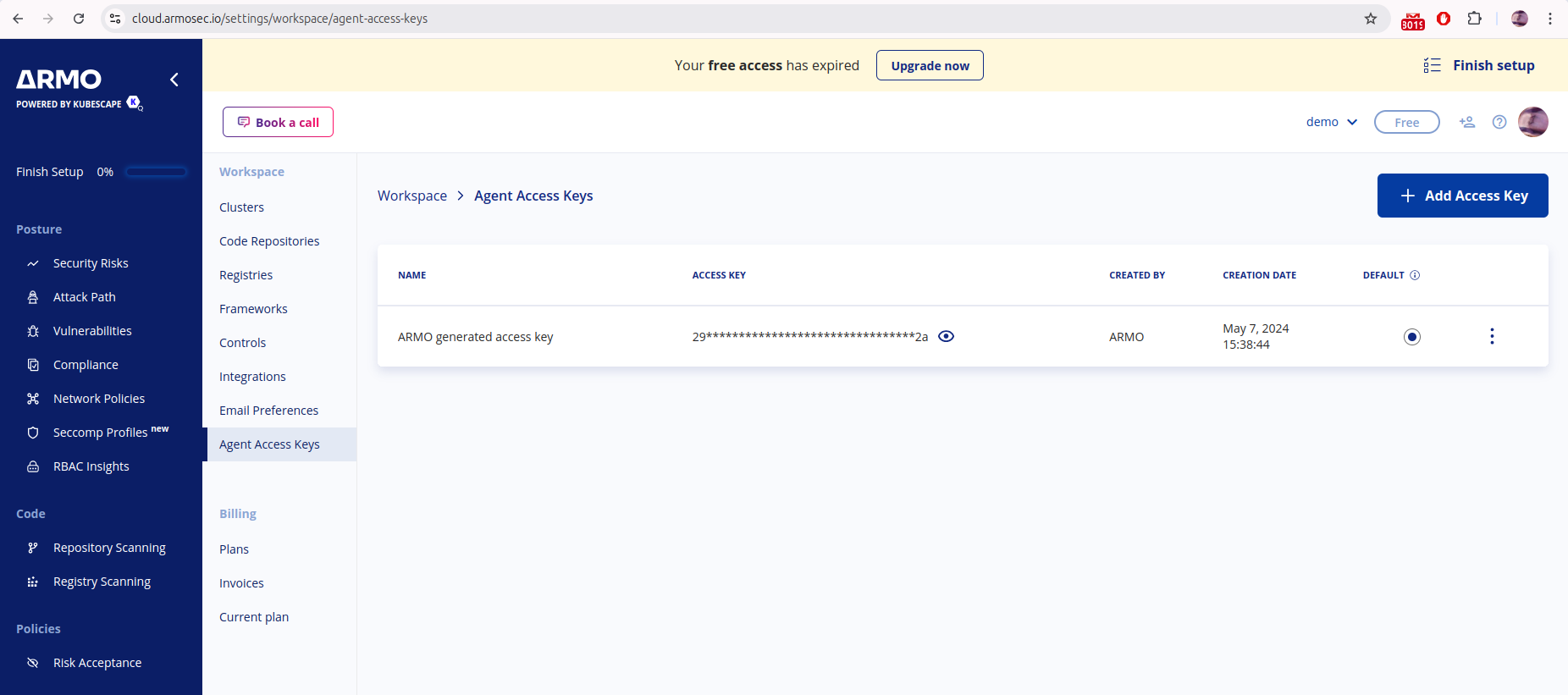
Understanding how ARMO deploys and integrates helps you evaluate the implementation effort required.
Deployment Options
ARMO offers multiple deployment models:
- SaaS platform: ARMO manages the backend, you deploy sensors to your clusters
- Self-hosted: You run the entire platform in your own environment
- Hybrid: Some components managed by ARMO, others in your environment
The SaaS option is fastest to deploy. The self-hosted option gives you complete data sovereignty.
Kubernetes Installation
Installing ARMO in a Kubernetes cluster typically follows this process:
- Add the ARMO Helm repository
- Configure your cluster connection settings
- Deploy the ARMO operator via Helm
- The operator automatically deploys the eBPF sensor
- Connect to the ARMO console to see your cluster
Most teams report getting initial visibility within hours, not days.
CI/CD Integration
ARMO integrates with common CI/CD platforms:
| Platform | Integration Method |
|---|---|
| GitHub Actions | Native action in marketplace |
| GitLab CI | CLI integration |
| Jenkins | Plugin and CLI options |
| Azure DevOps | Extension available |
| CircleCI | Orb integration |
The CI/CD integration lets you shift security left. Scans run on every pull request. Deployments can be blocked if critical issues are found. Developers get feedback before code reaches production.
Cloud Provider Integration
ARMO’s agentless cloud scanning integrates with major providers:
- AWS: Read-only IAM role for configuration scanning
- Azure: Service principal with reader permissions
- GCP: Service account with viewer role
The agentless approach means no agents to deploy on cloud resources. Just connect your accounts, and ARMO starts analyzing configurations.
SIEM and SOAR Integration
For security operations teams, ARMO integrates with:
- Splunk
- Microsoft Sentinel
- Elasticsearch/OpenSearch
- Custom webhooks for other platforms
Alerts flow from ARMO to your existing security operations tools. This lets SOC teams respond to cloud-native threats using their existing workflows.
Pricing and Licensing: What to Expect
ARMO offers multiple tiers to match different organization sizes and needs.
Open Source (Kubescape)
The open-source Kubescape project is free. It provides:
- Configuration scanning for Kubernetes
- Image vulnerability scanning
- Compliance checking against major frameworks
- CLI and CI/CD integration
This is a great way to evaluate ARMO’s approach before committing to the commercial platform.
Commercial Platform Tiers
ARMO’s commercial offerings typically include:
- Free tier: Limited features for small environments or evaluation
- Team tier: Full features for smaller teams
- Enterprise tier: Advanced features, custom integrations, premium support
Pricing usually scales based on:
- Number of protected nodes or containers
- Number of clusters
- Feature set required
- Support level needed
Contact ARMO directly for current pricing. Cloud security pricing changes frequently as the market evolves.
Total Cost of Ownership Considerations
When evaluating ARMO’s cost, consider:
- Time saved on alert triage: Runtime prioritization means fewer false positives to investigate
- Reduced tool sprawl: ARMO combines capabilities that might otherwise require multiple tools
- Faster incident response: Better context means faster resolution
- Compliance automation: Less manual work for audits
The total cost often looks different from just the license fee when you account for operational efficiency.
Strengths and Limitations: Honest ARMO Assessment
No security tool is perfect for every situation. Here’s an honest look at where ARMO excels and where it might fall short.
Where ARMO Excels
Kubernetes-native environments: If Kubernetes is your primary platform, ARMO’s native approach provides advantages over tools that bolt on Kubernetes support.
Alert fatigue reduction: The runtime prioritization genuinely reduces the number of alerts teams must handle.
DevOps workflow integration: ARMO fits naturally into existing Kubernetes and CI/CD workflows.
Compliance automation: The automated compliance checking and evidence collection saves significant time for regulated industries.
Runtime threat detection: The behavioral approach catches threats that signature-based tools miss.
Open source foundation: The Kubescape project provides transparency and community-driven improvement.
Potential Limitations
Non-Kubernetes workloads: If you have significant workloads outside Kubernetes (traditional VMs, serverless functions), you might need additional tools.
On-premises coverage: While ARMO is expanding beyond cloud, their primary strength is cloud-native environments.
Market maturity: As a newer platform, ARMO may have fewer integrations than established competitors.
Learning curve: Teams unfamiliar with Kubernetes concepts may need ramp-up time.
Best Fit Scenarios
ARMO is likely a good fit if you:
- Run most workloads on Kubernetes
- Struggle with alert fatigue from current tools
- Need to meet compliance requirements
- Want runtime visibility, not just configuration scanning
- Have DevOps teams who will interact with security tools
ARMO might not be the best fit if you:
- Don’t use Kubernetes at all
- Have primarily traditional on-premises infrastructure
- Need a general-purpose cloud security tool with broad coverage
ARMO vs. Competitors: Market Position Analysis
How does ARMO compare to other players in the cloud security market? Let’s examine the competitive landscape.
ARMO vs. Traditional CNAPP Vendors
Large CNAPP vendors (Palo Alto Prisma Cloud, Wiz, Lacework) offer broader cloud coverage. They support more cloud services and have deeper integrations with major cloud providers.
ARMO differentiates through:
- Deeper Kubernetes expertise
- Runtime-first approach
- Lower alert volume
- Open source foundation
Choose traditional CNAPP if you need broad cloud coverage. Choose ARMO if Kubernetes depth matters more.
ARMO vs. Kubernetes-Specific Tools
Other Kubernetes-focused security tools (Sysdig, Aqua Security, StackRox) also provide strong Kubernetes coverage.
ARMO’s advantages include:
- The CADR approach to detection and response
- eBPF-powered runtime analysis
- Strong open source community backing
- Emphasis on noise reduction
ARMO vs. Open Source Alternatives
Free tools like Falco, Trivy, and kube-bench provide specific capabilities.
ARMO’s commercial platform adds:
- Unified console across tools
- Managed correlation and prioritization
- Enterprise support and SLAs
- Advanced features not in open source
Many teams use open source for evaluation, then move to ARMO’s commercial platform for production.
Implementation Best Practices: Getting the Most from ARMO
If you decide to deploy ARMO, these practices will help you succeed.
Start with Visibility
Don’t try to enforce policies on day one. Start by:
- Deploying ARMO in monitoring mode
- Learning what normal looks like in your environment
- Reviewing the initial findings without blocking anything
- Building confidence in the detections
This approach prevents false positives from disrupting production while you tune the system.
Prioritize by Business Impact
Not all clusters are equal. Focus first on:
- Production environments
- Clusters handling sensitive data
- Internet-facing workloads
- Regulated workloads (PCI, HIPAA)
Get these environments protected before expanding to development and test clusters.
Integrate with Existing Workflows
ARMO works best when integrated into how your teams already work:
- Add scans to CI/CD pipelines
- Send alerts to existing ticketing systems
- Include security metrics in existing dashboards
- Make findings visible in developer tools
Security tools that require workflow changes often get ignored. Tools that fit existing workflows get adopted.
Build Cross-Team Ownership
Cloud-native security requires collaboration between security, DevOps, and platform teams. Use ARMO to:
- Give developers self-service access to scan results
- Let platform teams define policies
- Enable security teams to focus on real threats
- Create shared dashboards for visibility
Continuously Tune and Improve
ARMO learns your environment over time. Help it by:
- Reviewing and resolving findings regularly
- Providing feedback on false positives
- Updating policies as your environment evolves
- Taking advantage of new features as they release
The Future of ARMO and Cloud Security
Where is ARMO heading, and what does the future of cloud security look like?
Industry Trends ARMO Is Addressing
The 2025 Latio report identified several trends that ARMO is well-positioned to address:
- Move from visibility to runtime prioritization: Security tools are focusing on what’s truly exploitable, not theoretical risk
- Expansion beyond cloud: Security tools are covering hybrid and on-premises environments
- Detection and response: Moving from finding problems to automatically fixing them
- Reduced noise: Tools that generate fewer, higher-quality alerts
ARMO’s Continued Development
Based on ARMO’s positioning and market direction, expect to see:
- Expanded cloud provider coverage
- Deeper runtime analysis capabilities
- More automated response options
- Enhanced compliance frameworks support
- Broader ecosystem integrations
The CADR Category
ARMO is helping define the CADR category. As this category matures, expect:
- More vendors adopting CADR terminology
- Increased focus on runtime-aware security
- Better tooling for attack chain visibility
- More automation in threat response
Conclusion: Is ARMO Right for Your Organization?
ARMO offers a compelling approach to Kubernetes and cloud security. Their CADR platform combines runtime visibility with automated threat detection and response. The focus on reducing alert noise addresses one of the biggest pain points in cloud security today.
For organizations running significant Kubernetes workloads, ARMO deserves serious consideration. The Kubernetes-native architecture, eBPF-powered runtime analysis, and open source foundation create a strong technical base. The recognition from industry analysts confirms ARMO’s position as an innovator in this space.
Start with the open-source Kubescape project to evaluate the approach. Then consider the commercial platform if you need the full CADR capabilities, enterprise support, and advanced features.
Frequently Asked Questions About ARMO Review
| What type of organization is ARMO best suited for? | ARMO is ideal for organizations running significant Kubernetes workloads who need runtime security and compliance automation. It’s particularly valuable for teams struggling with alert fatigue from traditional security tools. Companies in regulated industries benefit from the automated compliance features. |
| How does ARMO differ from traditional CNAPP solutions? | Traditional CNAPP focuses on static configuration scanning and theoretical risk. ARMO’s CADR approach adds runtime analysis to show what’s actually exploitable. This reduces alert volume and helps teams focus on real threats rather than theoretical vulnerabilities. |
| Is ARMO difficult to deploy in existing Kubernetes environments? | No, ARMO is designed for easy Kubernetes deployment. Most teams get initial visibility within hours using Helm charts. The platform integrates with existing CI/CD pipelines and doesn’t require significant workflow changes. |
| Can I try ARMO before committing to the commercial platform? | Yes, ARMO’s open-source Kubescape project provides configuration scanning, image vulnerability analysis, and compliance checking for free. This lets you evaluate the approach before considering the full commercial platform. |
| What cloud providers does ARMO support? | ARMO supports AWS, Azure, and GCP for agentless cloud scanning. The Kubernetes runtime security works across any Kubernetes distribution, including EKS, AKS, GKE, and self-managed clusters. |
| How does ARMO’s runtime prioritization actually work? | ARMO’s eBPF sensor monitors which code actually executes in your containers. When a vulnerability exists in a library that never loads into memory, it’s deprioritized. Vulnerabilities in actively running code paths get elevated priority. |
| Does ARMO replace or complement existing security tools? | It depends on your current stack. ARMO can replace Kubernetes-specific security tools. It integrates with SIEM and SOAR platforms to complement your existing security operations. For broad cloud security beyond Kubernetes, you might use ARMO alongside other tools. |
| What compliance frameworks does ARMO support? | ARMO supports NSA/CISA Kubernetes Hardening Guide, CIS Kubernetes Benchmark, SOC 2, HIPAA, PCI-DSS, and other major frameworks. The platform provides automated checks and evidence collection for audits. |
| How does ARMO handle zero-day threats? | ARMO’s behavioral analysis learns normal patterns for your applications. When behavior deviates from that baseline, it generates alerts even without a known signature. This catches novel attacks that traditional tools miss. |
| What kind of support does ARMO provide? | Support levels vary by tier. The open-source project has community support. Commercial tiers include direct support from ARMO’s team, with enterprise tiers getting premium support with faster response times and dedicated contacts. |



 Stack Insight is intended to support informed decision-making by providing independent information about business software and services. Some product details, including pricing, features, and promotional offers, may be supplied by vendors or partners and can change without notice.