
Sweet Security vs Aqua Security: The Complete 2026 Comparison Guide
Picking the right cloud-native application protection platform (CNAPP) can feel overwhelming. There are dozens of options out there, and they all promise to keep your cloud safe. But the details matter. A lot.
Two names keep coming up in conversations about cloud security: Sweet Security and Aqua Security. Both offer CNAPP solutions, but they take different approaches. Sweet Security focuses heavily on runtime protection and real-time threat detection. Aqua Security has been around longer and offers a broader feature set that spans the entire application lifecycle.
This guide breaks down everything you need to know about both platforms. We’ll look at their core features, pricing models, deployment options, and more. By the end, you’ll have a clear picture of which solution fits your needs.
What Is a CNAPP and Why Does It Matter?
Before we dig into the comparison, let’s talk about what CNAPP actually means. A Cloud Native Application Protection Platform combines multiple security tools into one unified solution. Instead of juggling separate products for vulnerability scanning, configuration management, and runtime protection, you get everything in one place.
The Problem CNAPP Solves
Cloud environments are messy. They contain:
- Software vulnerabilities hiding in container images
- Misconfigured infrastructure settings
- Exposed secrets and credentials
- Insecure runtime behaviors
- Identity and access management gaps
- API security weaknesses
Traditional security tools weren’t built for this complexity. They can’t keep up with the speed of cloud deployments. CNAPP platforms address this by providing protection from code to cloud. They secure applications during development, in the CI/CD pipeline, and while running in production.
Why the CNAPP Market Is Growing
Organizations are moving more workloads to the cloud every year. With that shift comes new attack surfaces. Bad actors know this. They’re targeting cloud infrastructure, containers, and Kubernetes clusters with increasing sophistication.
A CNAPP gives security teams a fighting chance. It provides visibility across the entire cloud estate. It helps prioritize the risks that actually matter. And it can detect and respond to threats before they become full-blown incidents.
Both Sweet Security and Aqua Security play in this space. But they approach the problem differently. Let’s explore those differences in detail.
Company Background: Sweet Security and Aqua Security
Sweet Security: The Runtime-First Newcomer

Sweet Security positions itself as a Runtime CNAPP provider. The company focuses on detecting and responding to cloud attacks in real time. Their philosophy centers on the idea that runtime insights provide the most accurate picture of actual risk.
Sweet combines several capabilities into their platform:
- Application Detection and Response (ADR)
- Cloud Detection and Response (CDR)
- Cloud Workload Protection Platform (CWPP)
- Identity Threat Detection and Response (ITDR)
The company describes their approach as “protecting your cloud at unparalleled speed.” They emphasize real-time detection over static analysis alone. This makes sense for organizations that need to catch threats as they happen, not hours or days later.
Sweet has also moved into AI security. They offer solutions for protecting AI workloads and applications. This positions them well for organizations adopting generative AI and machine learning technologies.
Aqua Security: The Established Leader
Aqua Security has been in the cloud-native security game longer. They’ve built a comprehensive CNAPP that covers the full application lifecycle. From development through production, Aqua aims to secure every stage.
Their platform includes:
- Code and supply chain security
- Container image scanning
- Kubernetes security
- Cloud security posture management
- Runtime protection
- Compliance automation
Aqua provides complete visibility into multi-cloud environments. They help organizations identify and fix misconfigurations before attackers can exploit them. Their vulnerability prioritization looks at what’s actually running in your environment, not just what exists in your codebase.
The company has a strong presence in enterprises and regulated industries. Their focus on compliance makes them attractive to organizations with strict security requirements.
Core Architecture: How Each Platform Works
Sweet Security’s Runtime-Centric Design
Sweet Security built their platform around runtime intelligence. This means they focus on what’s actually happening in your cloud environment right now. Not what could happen. Not what might happen. What is happening.
Their architecture uses lightweight sensors deployed across your cloud infrastructure. These sensors collect telemetry from:
- Applications running in containers
- Cloud workloads on VMs
- Kubernetes clusters and nodes
- Serverless functions
- Cloud APIs and services
This data flows into Sweet’s analysis engine. The engine correlates events across different layers of your stack. When something suspicious happens at the application layer, Sweet can connect it to related activity in the infrastructure layer.
Key architectural elements include:
Unified Context: Sweet brings together insights from applications, workloads, and cloud infrastructure. This unified view helps teams understand the full scope of an attack.
Real-Time Processing: The platform processes events as they happen. There’s no waiting for scheduled scans to complete.
Low Overhead: Their sensors are designed to have minimal performance impact on running workloads.
Aqua Security’s Full-Lifecycle Approach
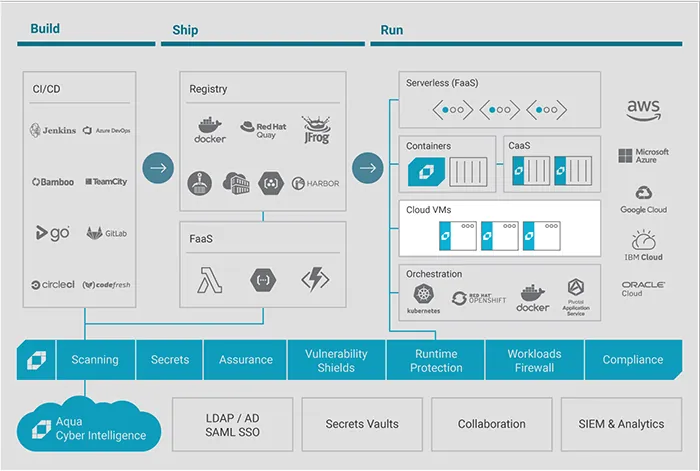
Aqua takes a different architectural approach. They built their platform to cover every phase of the application lifecycle. Security starts in the IDE and continues through production.
The architecture includes multiple integrated components:
- Development-time scanning integrated into developer workflows
- CI/CD pipeline security that gates deployments
- Registry scanning for container images
- Admission controllers for Kubernetes
- Runtime agents for workload protection
- Cloud connectors for posture management
Aqua’s philosophy is that security should shift left. Find problems early in the development process. Fix them before they reach production. But also maintain strong runtime protection for anything that slips through.
Key architectural elements include:
Multi-Layer Coverage: Aqua protects at every layer. Code, container, cluster, and cloud.
Policy Engine: A central policy engine lets you define and enforce security rules consistently.
Agent and Agentless Options: Aqua offers both approaches depending on your needs.
Architecture Comparison Table
| Aspect | Sweet Security | Aqua Security |
|---|---|---|
| Primary Focus | Runtime detection and response | Full lifecycle protection |
| Deployment Model | Lightweight runtime sensors | Multiple agents and connectors |
| Data Processing | Real-time streaming analysis | Combination of scheduled and real-time |
| Integration Points | Cloud infrastructure, workloads, apps | IDE, CI/CD, registry, runtime, cloud |
| Context Correlation | Unified cross-layer correlation | Layered correlation by phase |
Runtime Protection Capabilities: Sweet Security vs Aqua Security
Runtime protection is where these two platforms overlap most directly. Both offer capabilities to protect running workloads. But their approaches and strengths differ.
Sweet Security’s Runtime Detection and Response
Sweet Security treats runtime as the ground truth. Their platform watches what applications actually do, not just what they’re supposed to do. This behavior-based approach catches threats that signature-based tools miss.
Cloud Detection and Response (CDR):
Sweet’s CDR capability monitors cloud infrastructure for malicious activity. It detects:
- Unusual API calls to cloud services
- Suspicious identity behavior and privilege escalation
- Data exfiltration attempts
- Cryptomining and resource hijacking
- Lateral movement between services
When Sweet detects a threat, it provides context about what happened and why it matters. Security teams can investigate and respond without jumping between multiple tools.
Application Detection and Response (ADR):
Sweet goes deeper than most platforms by monitoring at the application layer. Their ADR capability tracks:
- Application behavior patterns
- Abnormal function calls and code execution
- Database queries and data access patterns
- Internal and external API interactions
- Process spawning and file system changes
This application-level visibility helps catch attacks that operate within the bounds of normal cloud activity but behave strangely at the app layer.
Cloud Workload Protection Platform (CWPP):
Sweet’s CWPP features protect the workloads themselves. This includes:
- Container security with runtime monitoring
- Host-based protection for VMs
- Serverless function security
- File integrity monitoring
- Network behavior analysis
Aqua Security’s Runtime Protection Suite
Aqua Security also offers strong runtime protection, though it’s part of their broader platform rather than the sole focus.
Runtime Policies:
Aqua lets you define policies for what workloads can and can’t do at runtime. These policies control:
- Which processes can run in containers
- Network connections allowed and blocked
- File system access permissions
- System calls permitted
- User and privilege restrictions
Aqua can enforce these policies in audit mode or blocking mode. Audit mode alerts you to violations. Blocking mode prevents them from happening.
Drift Prevention:
One of Aqua’s standout runtime features is drift prevention. Containers should be immutable. If something changes inside a running container that wasn’t in the original image, that’s drift. It often indicates a compromise.
Aqua detects drift in real time and can block it. This prevents attackers from modifying containers after deployment.
Network Microsegmentation:
Aqua provides network controls that limit how workloads communicate. You can restrict container-to-container traffic, block unnecessary external connections, and detect anomalous network behavior.
Behavioral Profiling:
Aqua builds behavioral profiles for your workloads. It learns what normal looks like. Then it alerts when something deviates from that baseline. This helps catch zero-day attacks and insider threats.
Runtime Protection Comparison
| Feature | Sweet Security | Aqua Security |
|---|---|---|
| Detection Speed | Real-time, sub-second | Near real-time |
| Application Layer Visibility | Deep application monitoring | Container and OS level focus |
| Cloud Infrastructure Monitoring | Comprehensive CDR | CSPM with runtime enrichment |
| Drift Prevention | Available | Strong, well-established |
| Network Controls | Behavior analysis | Microsegmentation and policies |
| Response Automation | Automated playbooks | Policy-based enforcement |
Vulnerability Management: Finding and Fixing Security Gaps
Both platforms help you find vulnerabilities in your cloud environment. But they approach the problem from different angles.
Sweet Security’s Runtime-Informed Vulnerability Management
Sweet Security recently released enhanced vulnerability management features. Their approach uses runtime context to prioritize what actually matters.
Why Runtime Context Matters for Vulnerabilities:
Not all vulnerabilities are equal. A critical CVE in a library that never gets loaded into memory is less urgent than a medium-severity bug in code that runs constantly. Sweet uses runtime data to understand which vulnerable packages are actually in use.
This helps security teams focus on fixing what matters. Instead of drowning in thousands of CVEs, you see which ones pose real risk to your running applications.
From Code to Cloud Coverage:
Sweet’s vulnerability management spans the application lifecycle:
- Source code analysis for vulnerable dependencies
- Container image scanning before deployment
- Runtime verification of which vulnerabilities are exploitable
- Correlation with active threats targeting known CVEs
Prioritization Factors:
Sweet considers multiple factors when ranking vulnerabilities:
- Is the vulnerable code actually running?
- Is the vulnerable function reachable from external input?
- Are there known exploits in the wild?
- What’s the potential impact if exploited?
- What compensating controls exist?
Aqua Security’s Comprehensive Vulnerability Scanning
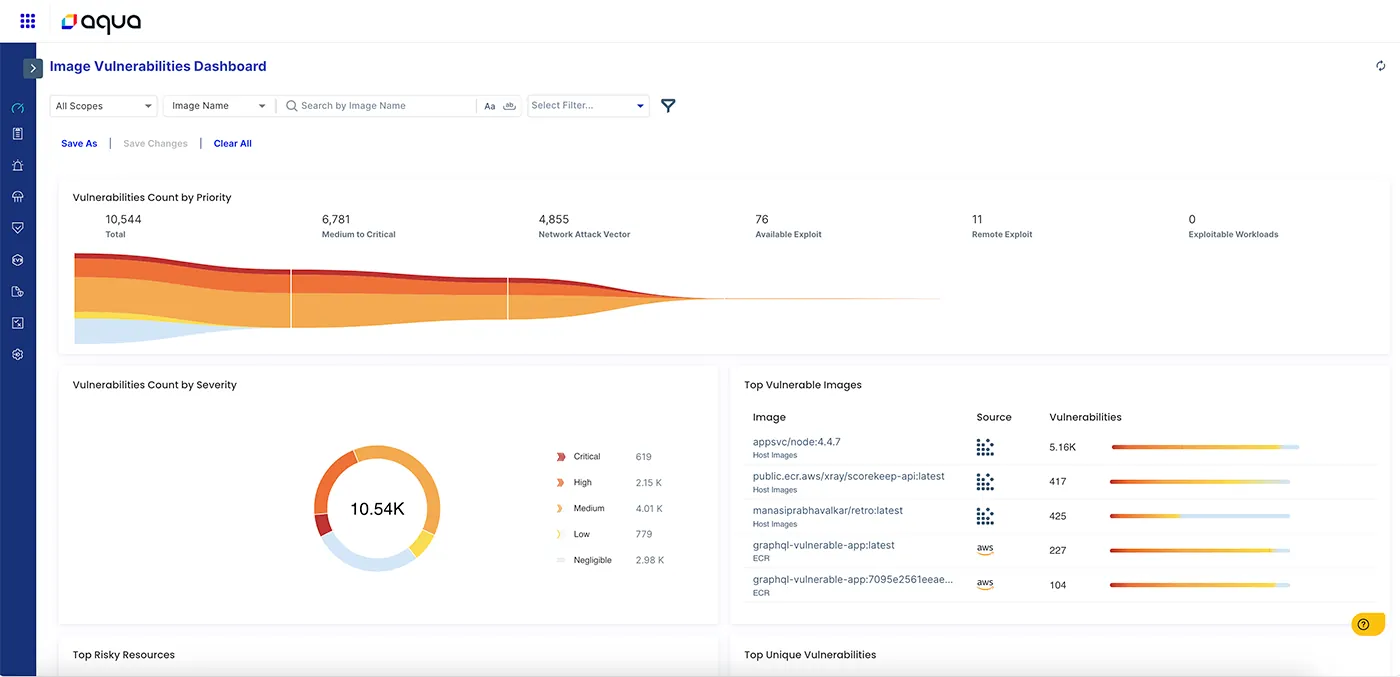
Aqua has years of experience in vulnerability management. Their scanning capabilities are thorough and cover multiple asset types.
Image Scanning:
Aqua scans container images for vulnerabilities in:
- Operating system packages
- Application dependencies (npm, pip, Maven, etc.)
- Embedded binaries
- Configuration files
Scanning happens at multiple points: in the CI/CD pipeline, in registries, and at runtime. This catches vulnerabilities early and continues monitoring as new CVEs are discovered.
Code Scanning:
Aqua extends scanning into the development phase with:
- Software composition analysis (SCA)
- Infrastructure as code (IaC) scanning
- Secret detection in code and configs
- License compliance checking
Risk-Based Prioritization:
Aqua’s prioritization considers:
- Workload context and deployment status
- Exploit availability in the wild
- Level of exploitability (network accessible vs. local)
- Business criticality of affected applications
- Reachability analysis for exposed components
Remediation Guidance:
Aqua doesn’t just find vulnerabilities. It tells you how to fix them. The platform provides:
- Recommended package versions to upgrade to
- Links to relevant advisories and patches
- Suggested workarounds when patches aren’t available
- Integration with ticketing systems for tracking fixes
Vulnerability Management Comparison
| Capability | Sweet Security | Aqua Security |
|---|---|---|
| Image Scanning | Yes | Yes, extensive |
| Code Scanning | Yes | Yes, including IaC and secrets |
| Runtime Prioritization | Core strength | Available with runtime context |
| Exploit Intelligence | Integrated | Integrated |
| Registry Integration | Supported | Deep integration |
| CI/CD Integration | Supported | Extensive with gates |
Cloud Security Posture Management (CSPM)
Misconfigurations cause a huge percentage of cloud breaches. Both Sweet Security and Aqua Security help you find and fix these issues.
Sweet Security’s Approach to CSPM
Sweet includes CSPM as part of their unified platform. They focus on connecting posture issues to real-world risk.
Configuration Assessment:
Sweet scans cloud infrastructure for misconfigurations across:
- AWS, Azure, and Google Cloud resources
- IAM policies and permissions
- Network security groups and firewall rules
- Storage bucket access settings
- Encryption and key management
- Logging and monitoring configurations
Runtime-Enhanced Context:
What sets Sweet apart is how they connect CSPM findings to runtime data. A publicly accessible S3 bucket is bad. A publicly accessible S3 bucket that’s actively being accessed by suspicious IP addresses is an incident.
Sweet correlates posture issues with runtime activity to show which misconfigurations are being actively exploited or probed.
Compliance Mapping:
Sweet maps findings to compliance frameworks including:
- CIS Benchmarks
- SOC 2
- PCI DSS
- HIPAA
- GDPR
Aqua Security’s CSPM Capabilities
Aqua’s CSPM is a mature part of their platform with extensive coverage.
Multi-Cloud Visibility:
Aqua provides complete visibility into multi-cloud environments. You can see all your cloud resources in one place, regardless of provider. The platform discovers:
- Compute instances and containers
- Storage resources and databases
- Network infrastructure
- Identity and access resources
- Serverless functions
- Managed services
Misconfiguration Detection:
Aqua identifies and corrects misconfigurations that leave you exposed. Their checks cover hundreds of potential issues across cloud providers. The platform explains why each misconfiguration matters and how to fix it.
Drift Detection:
Cloud environments change constantly. Aqua tracks those changes and alerts when configurations drift from your defined standards. This helps catch unauthorized changes or accidental misconfigurations.
Policy Customization:
Aqua lets you define custom policies beyond built-in checks. You can create rules specific to your organization’s requirements and enforce them consistently.
Compliance Reporting:
Aqua’s compliance features support audits and regulatory requirements. The platform generates reports mapped to major frameworks and tracks compliance status over time.
CSPM Feature Comparison
| Feature | Sweet Security | Aqua Security |
|---|---|---|
| Multi-Cloud Support | AWS, Azure, GCP | AWS, Azure, GCP, more |
| Built-in Checks | Comprehensive | Extensive library |
| Custom Policies | Available | Flexible policy engine |
| Runtime Correlation | Deep integration | Available |
| Compliance Frameworks | Major frameworks | Extensive framework support |
| Remediation Guidance | Step-by-step fixes | Detailed remediation |
Identity and Access Security
Identity is the new perimeter in cloud security. Both platforms address identity-related threats, though with different emphasis.
Sweet Security’s Identity Threat Detection and Response (ITDR)
Sweet includes ITDR as a core component of their platform. They recognize that identity compromise is a primary attack vector in cloud environments.
What ITDR Detects:
- Compromised credentials being used
- Unusual identity behavior patterns
- Privilege escalation attempts
- Access to sensitive resources from new locations or devices
- Service account abuse
- Cross-account suspicious activity
How Sweet Monitors Identity:
Sweet tracks identity activity across your cloud environment. They monitor both human and machine identities. The platform builds baselines of normal behavior and alerts when something deviates.
For example, if a service account that normally only accesses one database suddenly starts querying resources across your entire environment, Sweet flags it.
Response Capabilities:
When Sweet detects an identity threat, it provides context for investigation. You can see exactly what the compromised identity accessed, when, and from where. The platform can integrate with identity providers to trigger automated responses.
Aqua Security’s Identity and Access Controls
Aqua addresses identity security through their CSPM and runtime protection features.
IAM Configuration Analysis:
Aqua scans IAM policies for issues like:
- Overly permissive policies
- Unused permissions that should be removed
- Cross-account access risks
- Missing MFA requirements
- Service account misconfigurations
Least Privilege Enforcement:
Aqua helps implement least privilege principles. The platform identifies where permissions can be tightened without breaking functionality.
Runtime Identity Monitoring:
Through their runtime agents, Aqua can monitor workload identity usage and detect anomalies in how service accounts and roles are being used.
Identity Security Comparison
| Capability | Sweet Security | Aqua Security |
|---|---|---|
| Dedicated ITDR | Yes, core feature | Integrated with CSPM/runtime |
| Behavioral Analysis | Strong | Available |
| IAM Configuration Checks | Yes | Comprehensive |
| Privilege Escalation Detection | Real-time | Yes |
| Machine Identity Monitoring | Yes | Yes |
Kubernetes Security Features
Kubernetes environments present unique security challenges. Both platforms offer dedicated Kubernetes security capabilities.
Sweet Security’s Kubernetes Protection
Sweet monitors Kubernetes clusters as part of their unified platform.
Cluster-Level Monitoring:
- API server activity tracking
- Admission request monitoring
- Control plane security
- Node security assessment
Workload Security:
- Pod behavior monitoring
- Container runtime protection
- Suspicious process detection
- Network policy monitoring
Runtime Detection in Kubernetes:
Sweet’s runtime focus extends to Kubernetes. They detect attacks happening inside clusters, including container escapes, cryptomining, and lateral movement between pods.
Aqua Security’s Kubernetes Capabilities
Aqua has extensive Kubernetes security features built up over years of development.
Kubernetes Security Posture Management (KSPM):
Aqua assesses cluster configurations against security standards. They check for:
- CIS Kubernetes Benchmark compliance
- Pod security standards enforcement
- Network policy coverage
- RBAC configuration issues
- Secrets management practices
Admission Control:
Aqua’s admission controller prevents problematic deployments from entering your clusters. You can block containers that:
- Run as root unnecessarily
- Contain known vulnerabilities
- Come from untrusted registries
- Request excessive privileges
- Violate your security policies
Workload Hardening:
Aqua provides recommendations for hardening Kubernetes workloads. The platform suggests security context settings, resource limits, and network policies to improve your security posture.
Runtime Protection:
Aqua’s runtime agents protect workloads running in Kubernetes. They enforce policies, detect drift, and monitor for malicious behavior inside containers.
Kubernetes Security Comparison
| Feature | Sweet Security | Aqua Security |
|---|---|---|
| KSPM | Included | Comprehensive |
| Admission Control | Available | Mature, flexible |
| CIS Benchmark Checks | Yes | Yes |
| Runtime Detection | Strong | Strong |
| Network Policy Management | Monitoring | Creation and enforcement |
| RBAC Analysis | Yes | Detailed analysis |
API Security Capabilities
APIs are a major attack vector in modern applications. Both platforms include API security features.
Sweet Security’s API Security
Sweet includes API security as part of their application-layer monitoring.
API Discovery:
Sweet automatically discovers APIs running in your environment. This includes both documented and undocumented endpoints. Shadow APIs that security teams don’t know about pose serious risks. Sweet helps find them.
API Threat Detection:
Sweet monitors API traffic for malicious patterns:
- Injection attacks targeting API endpoints
- Authentication bypass attempts
- Excessive data exposure
- Rate limit abuse
- Broken authorization exploits
Runtime API Monitoring:
Because Sweet operates at runtime, they see actual API behavior. They can detect anomalies based on how APIs are actually being used, not just how they should be used.
Aqua Security’s API Protection
Aqua addresses API security through their broader platform capabilities.
Container API Security:
Aqua protects APIs running in containers by monitoring network traffic and application behavior. Their runtime agents can detect API-level attacks.
Kubernetes API Server Protection:
Aqua specifically monitors the Kubernetes API server, which is a frequent target. They detect suspicious API calls and unauthorized access attempts.
Integration with API Gateways:
Aqua can integrate with API gateway solutions to provide additional protection layers.
Supply Chain Security
Software supply chain attacks are a growing concern. Both platforms help secure your supply chain, though with different emphasis.
Sweet Security’s Supply Chain Approach
Sweet addresses supply chain security primarily through their vulnerability management and runtime monitoring.
Vulnerable Dependency Detection:
Sweet scans for vulnerable dependencies in your applications. They track which vulnerable packages are actually being used at runtime.
Runtime Exploit Detection:
If a supply chain compromise leads to malicious code execution, Sweet’s runtime detection catches it. Their behavioral monitoring detects unusual activity even from trusted components.
Aqua Security’s Supply Chain Protection
Aqua takes a more comprehensive approach to supply chain security.
Software Composition Analysis:
Aqua scans your codebase for vulnerabilities in third-party dependencies. This happens in the IDE, in CI/CD pipelines, and in registries.
Image Assurance:
Aqua’s image assurance features verify container images meet your security requirements before deployment. You can enforce:
- Image signing requirements
- Base image standards
- Vulnerability thresholds
- Allowed registries
Build Pipeline Security:
Aqua prevents security risks from becoming incidents by detecting and fixing issues in your build tools and delivery pipelines. They scan for:
- Malware in dependencies
- Exposed secrets in build configs
- Compromised build tools
- Tampering indicators
SBOM Generation:
Aqua can generate Software Bills of Materials for your applications. SBOMs help you understand what’s in your software and respond quickly when new vulnerabilities are discovered.
Integration and Deployment Options
Sweet Security Integration Ecosystem
Sweet integrates with common tools in the security and DevOps ecosystem.
Cloud Provider Integrations:
- AWS native services and CloudTrail
- Azure Monitor and Activity Log
- Google Cloud Logging and APIs
SIEM and SOAR Integrations:
- Splunk
- Elastic Security
- Microsoft Sentinel
- Chronicle
- Various SOAR platforms
Notification Integrations:
- Slack
- Microsoft Teams
- PagerDuty
- Webhooks for custom integrations
Deployment Requirements:
Sweet deploys lightweight sensors in your environment. The sensors have minimal resource requirements and don’t significantly impact workload performance.
Aqua Security Integration Ecosystem
Aqua has extensive integrations built up over years of development.
CI/CD Integrations:
- Jenkins
- GitLab CI
- GitHub Actions
- Azure DevOps
- CircleCI
- Bamboo
- And many more
Container Registry Integrations:
- Docker Hub
- Amazon ECR
- Azure Container Registry
- Google Container Registry
- JFrog Artifactory
- Harbor
Orchestration Integrations:
- Kubernetes (all major distributions)
- Amazon ECS and EKS
- Azure AKS
- Google GKE
- Red Hat OpenShift
- VMware Tanzu
SIEM and Ticketing Integrations:
- Splunk
- Elastic
- ServiceNow
- Jira
- PagerDuty
Deployment Options:
Aqua offers multiple deployment models:
- SaaS (Aqua-hosted)
- Self-hosted on-premises
- Hybrid configurations
Integration Comparison
| Integration Type | Sweet Security | Aqua Security |
|---|---|---|
| CI/CD Pipelines | Growing list | Extensive coverage |
| Container Registries | Major registries | Comprehensive |
| SIEM Platforms | Major platforms | Major platforms |
| Cloud Providers | AWS, Azure, GCP | AWS, Azure, GCP, more |
| Deployment Flexibility | Cloud-based with sensors | SaaS, self-hosted, hybrid |
Pricing and Licensing Models
Pricing is always tricky to compare directly because both companies offer customized quotes. But we can discuss their general approaches.
Sweet Security Pricing
Sweet Security is a newer player in the market. Their pricing typically follows a consumption-based model tied to the cloud resources you’re protecting.
Typical Pricing Factors:
- Number of workloads monitored
- Cloud resources protected
- Features and modules selected
- Data retention requirements
Sweet positions itself as providing strong value through faster detection and response. Their argument is that catching threats in real time reduces incident costs.
Aqua Security Pricing
Aqua Security offers multiple pricing tiers and models to accommodate different organization sizes.
Pricing Tiers:
- Free tier for small deployments and evaluation
- Team tier for small to mid-sized organizations
- Enterprise tier for large organizations with advanced needs
Typical Pricing Factors:
- Number of developers (for shift-left features)
- Number of workloads (for runtime)
- Cloud accounts connected
- Feature modules selected
- Support level required
Aqua’s longer market presence means they have more established pricing models and may offer more flexibility in negotiations.
Cost Considerations
| Factor | Sweet Security | Aqua Security |
|---|---|---|
| Free Tier | Trial available | Yes, limited |
| Pricing Model | Consumption-based | Multiple options |
| Enterprise Discounts | Available | Available |
| Hidden Costs | Data retention may add cost | Advanced features may require higher tier |
Use Cases: When to Choose Each Platform
When Sweet Security Makes More Sense
Organizations Focused on Detection Speed:
If your priority is catching active threats as fast as possible, Sweet’s runtime focus is a major advantage. Their real-time detection can mean the difference between catching an attacker early and discovering a breach weeks later.
Teams with Strong Shift-Left Security Already:
If you already have good pre-production security tools and need better runtime visibility, Sweet fills that gap well.
Companies Dealing with Advanced Threats:
Sweet’s behavioral detection catches sophisticated attacks that bypass signature-based tools. Organizations facing targeted attacks benefit from this approach.
AI and Modern Application Environments:
Sweet’s focus on AI security makes them a good fit for organizations building or deploying AI applications.
When Aqua Security Makes More Sense
Organizations Wanting Full Lifecycle Coverage:
If you want one platform to cover everything from code to cloud, Aqua’s comprehensive approach is attractive. You get development security, pipeline security, and runtime protection in one package.
Heavily Regulated Industries:
Aqua’s mature compliance features help organizations in healthcare, finance, and government meet regulatory requirements.
Large Enterprise Deployments:
Aqua’s deployment flexibility, including on-premises options, suits enterprises with specific infrastructure requirements.
Organizations with Complex CI/CD Pipelines:
Aqua’s extensive CI/CD integrations make them a good choice for organizations with sophisticated build and deployment processes.
Decision Framework
| Your Priority | Better Choice |
|---|---|
| Fastest possible threat detection | Sweet Security |
| Full lifecycle security coverage | Aqua Security |
| Application-layer visibility | Sweet Security |
| CI/CD pipeline security | Aqua Security |
| Compliance reporting | Aqua Security |
| AI workload protection | Sweet Security |
| On-premises deployment option | Aqua Security |
| Identity threat detection | Sweet Security |
Strengths and Limitations of Each Platform
Sweet Security Strengths
- Unmatched runtime detection speed catches threats in real time
- Deep application layer visibility that competitors don’t offer
- Unified context connecting cloud, workload, and application events
- Strong ITDR capabilities for identity threat detection
- AI security focus for modern workloads
- Lower noise through runtime-prioritized findings
Sweet Security Limitations
- Newer platform with less market maturity
- Smaller integration ecosystem than established competitors
- Less emphasis on shift-left compared to full-lifecycle platforms
- Limited deployment options compared to on-premises alternatives
Aqua Security Strengths
- Comprehensive lifecycle coverage from code to cloud
- Mature platform with years of development
- Extensive integration ecosystem for CI/CD and registries
- Flexible deployment options including on-premises
- Strong compliance features for regulated industries
- Established customer base and proven at scale
Aqua Security Limitations
- More complex platform with steeper learning curve
- May require multiple modules to get full protection
- Less focus on real-time detection compared to Sweet
- Application layer visibility not as deep
Final Verdict: Sweet Security vs Aqua Security
Both Sweet Security and Aqua Security are strong CNAPP solutions. But they serve different needs.
Choose Sweet Security if:
- Real-time threat detection is your top priority
- You need deep application-layer visibility
- Identity threats are a major concern
- You’re building AI applications
- You want runtime-prioritized vulnerability data
Choose Aqua Security if:
- You want comprehensive lifecycle coverage
- CI/CD pipeline security is critical
- You need on-premises deployment options
- Compliance requirements drive your decisions
- You prefer a mature, established platform
Many organizations might benefit from evaluating both. Request demos, run proofs of concept, and see which platform fits your specific environment and workflows better. The right choice depends on your unique security priorities, infrastructure, and team capabilities.
Frequently Asked Questions About Sweet Security vs Aqua Security
| What is the main difference between Sweet Security and Aqua Security? |
| Sweet Security focuses primarily on runtime protection and real-time threat detection. Their platform is built around catching attacks as they happen. Aqua Security takes a broader approach, covering the entire application lifecycle from development through production. Sweet excels at detection speed, while Aqua offers more comprehensive coverage. |
| Which platform is better for Kubernetes security? |
| Both platforms offer strong Kubernetes security features. Aqua has more mature KSPM and admission control capabilities built up over years. Sweet provides excellent runtime detection for threats happening inside Kubernetes clusters. If you need comprehensive Kubernetes posture management, Aqua has an edge. If runtime threat detection in Kubernetes is your focus, Sweet performs well. |
| Can I use Sweet Security and Aqua Security together? |
| Technically yes, though most organizations choose one primary CNAPP. Some companies use Aqua for shift-left security and pipeline scanning, then add Sweet for runtime detection. This creates overlap but maximizes coverage. The added complexity and cost make this approach more common in large enterprises with specific requirements. |
| Which platform handles vulnerability prioritization better? |
| Sweet Security’s runtime-informed approach often produces more actionable vulnerability data. By knowing which vulnerable components are actually loaded and running, they reduce false positives. Aqua also offers runtime prioritization but has traditionally focused more on comprehensive scanning. For teams drowning in CVEs, Sweet’s approach can be more helpful. |
| How do the platforms compare for small teams versus large enterprises? |
| Aqua Security has more established pricing tiers including a free tier, which helps smaller teams get started. Their enterprise features support large deployments well. Sweet Security’s focused approach can be easier for smaller teams to manage, but their pricing is typically geared toward mid-market and enterprise customers. |
| Which platform is better for compliance requirements? |
| Aqua Security has more mature compliance features with extensive framework support and audit-ready reporting. They’ve been serving regulated industries for longer. Sweet Security covers major compliance frameworks but with less depth. If compliance is a primary driver, Aqua is usually the safer choice. |
| Does either platform support serverless security? |
| Yes, both platforms support serverless workloads. Aqua has specific features for AWS Lambda, Azure Functions, and Google Cloud Functions. Sweet’s runtime monitoring extends to serverless environments as well. Check current documentation for specific serverless platform support. |
| How quickly can each platform detect an active attack? |
| Sweet Security emphasizes real-time detection, often within seconds of malicious activity. Their architecture is built for speed. Aqua’s detection is near real-time but may not match Sweet’s speed for certain attack types. For organizations where detection speed is critical, Sweet typically has an advantage. |
| What kind of support do Sweet Security and Aqua Security offer? |
| Both companies offer tiered support options. Aqua has more established support structures given their longer market presence, including extensive documentation and community resources. Sweet Security provides dedicated support and is known for responsive customer service. Enterprise tiers from both include premium support options. |
| Which platform is better for organizations adopting AI and machine learning? |
| Sweet Security has made AI security a specific focus area. They offer features designed for protecting AI workloads and applications. Aqua Security can protect containers and infrastructure running AI workloads but doesn’t have the same dedicated AI security focus. Organizations building generative AI applications should look closely at Sweet’s AI security capabilities. |

 Stack Insight is intended to support informed decision-making by providing independent information about business software and services. Some product details, including pricing, features, and promotional offers, may be supplied by vendors or partners and can change without notice.