
Sweet Security vs Sysdig Secure: Complete Comparison Guide for 2026
Choosing the right cloud-native application protection platform (CNAPP) can make or break your security strategy. With cloud threats evolving faster than ever, teams need tools that deliver real visibility and actionable protection. Two platforms stand out in this space: Sweet Security and Sysdig Secure.
Both solutions target the same market. Both promise to protect your cloud-native workloads. But they take different approaches to solving similar problems. Sweet Security brings AI-powered runtime protection with a focus on real-time threat intelligence. Sysdig Secure offers deep container security with runtime insights powered by Falco.
This comparison breaks down everything you need to know. We’ll look at features, pricing, deployment, support, and real-world performance. By the end, you’ll have a clear picture of which platform fits your organization’s needs.
Understanding Cloud-Native Application Protection Platforms
Before we compare Sweet Security and Sysdig Secure directly, let’s establish what CNAPP actually means. The term gets thrown around a lot, but not every vendor defines it the same way.
What Makes a True CNAPP Solution
A CNAPP is a unified security platform. It protects cloud-native applications across their full lifecycle. This means covering everything from development through production.
True CNAPP consolidates multiple security functions:
- Cloud Security Posture Management (CSPM)
- Cloud Workload Protection Platform (CWPP)
- Cloud Infrastructure Entitlement Management (CIEM)
- Container and Kubernetes security
- Runtime protection and threat detection
The key differentiator? Integration. A real CNAPP connects posture, identity, workload, and runtime into a single view of risk. It’s not just a collection of tools sharing a dashboard.
Why Runtime Protection Matters in 2026
Many platforms focus heavily on posture management. They scan for misconfigurations and compliance issues. That’s valuable, but it’s not enough.
Attackers don’t wait for your scheduled scans. They exploit vulnerabilities in real time. Runtime protection catches threats as they happen. It watches what’s actually running in your environment.
Both Sweet Security and Sysdig Secure emphasize runtime capabilities. This sets them apart from CNAPP vendors who are strong on posture but thin on live threat detection.
The Market Landscape in 2026
The CNAPP market has grown crowded. According to recent data, Sysdig holds approximately 3.1% mindshare in the CNAPP category. Sweet Security sits at about 1.5% mindshare.
These numbers tell only part of the story. Market share doesn’t always reflect product quality. Smaller players often bring innovation that larger competitors can’t match.
Interestingly, both platforms boast 100% user recommendation rates. Users who choose either solution tend to be satisfied with their decision.
Sweet Security: Platform Overview and Capabilities

Sweet Security positions itself as a runtime CNAPP with AI-powered cloud security. The company takes a modern approach to threat detection and vulnerability management.
Core Technology and Architecture
Sweet Security builds its platform around artificial intelligence. Machine learning models analyze behavior patterns across your cloud environment. This helps distinguish normal activity from potential threats.
The platform focuses heavily on:
- Real-time visibility into vulnerabilities and threats
- AI-powered threat intelligence with continuous updates
- Customizable dashboards for different team needs
- AI stack security for protecting machine learning workloads
What stands out is Sweet Security’s attention to the AI stack itself. As organizations deploy more machine learning models, those systems become attack targets. Sweet Security addresses this emerging attack surface directly.
Real-Time Monitoring Capabilities
Sweet Security’s real-time monitoring goes beyond simple alerting. The platform provides continuous visibility into what’s happening across your cloud estate.
Users report that the real-time visibility feature enables significant insights into vulnerabilities. You can see threats as they develop rather than discovering them in post-incident analysis.
The monitoring system includes:
- Live threat tracking across containers and workloads
- Behavioral analysis to detect anomalies
- Automated correlation of security events
- Visual attack chain mapping
Threat Intelligence Integration
Threat intelligence feeds directly into Sweet Security’s detection engine. The platform pulls data from multiple sources to identify known attack patterns.
But it doesn’t stop at known threats. AI models learn from your environment’s normal behavior. When something deviates from that baseline, the system flags it for investigation.
This combination of external intelligence and internal learning creates layered protection. You catch both documented threats and novel attacks.
Dashboard and User Experience
Sweet Security offers customizable dashboards that adapt to different user roles. Security analysts see different views than DevOps engineers or compliance officers.
The interface prioritizes actionable information. Users can drill down from high-level risk summaries to specific vulnerable resources. This helps teams focus on what actually needs attention.
Customization options include:
- Role-based views with relevant metrics
- Custom alert configurations
- Saved queries and filters
- Report templates for different stakeholders
Sysdig Secure: Platform Overview and Capabilities
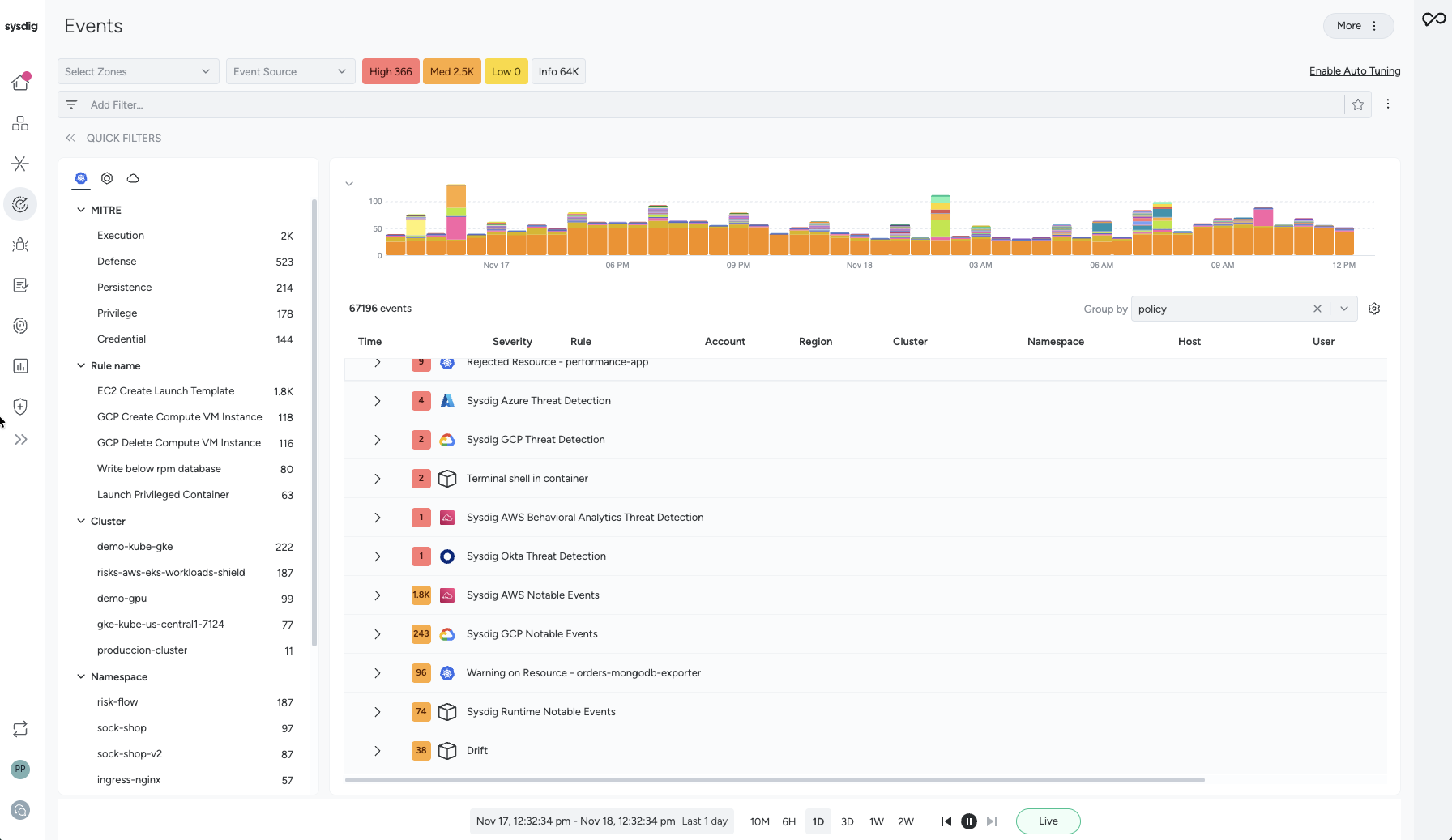
Sysdig Secure has established itself as a leading CNAPP solution. The platform builds on deep expertise in container security and observability.
Runtime Insights Powered by Falco
Sysdig’s biggest technical advantage is Falco. This open-source project has become the standard for Kubernetes threat detection. Sysdig Secure integrates Falco directly into its runtime protection.
Falco performs real-time process analysis. It watches system calls at the kernel level. This gives visibility that application-layer monitoring can’t match.
The runtime insights approach uses knowledge of what’s actually running. This helps zero in on the most urgent security issues. You’re not just seeing potential risks. You’re seeing active threats in your live environment.
Cloud Attack Graph Technology
Sysdig differentiates with its Cloud Attack Graph feature. This technology maps attack paths through your infrastructure.
The Attack Graph shows how an attacker could move laterally. It connects vulnerabilities, misconfigurations, and access patterns into visual attack chains.
Key capabilities include:
- Attack path analysis across cloud resources
- Risk prioritization based on exploitability
- Blast radius assessment for each vulnerability
- Remediation guidance with clear next steps
This helps security teams understand which vulnerabilities matter most. Not every CVE deserves immediate attention. The Attack Graph shows which ones create real risk.
Sysdig Sage AI Analyst
Sysdig introduced Sysdig Sage as their AI-powered security analyst. This feature uses natural language processing to make security investigation faster.
Users can ask questions in plain English. Sage translates those queries into the technical searches needed to find answers. It’s like having a security expert available around the clock.
Sysdig describes it as “the first ever cloud security AI analyst with real conversational skills.” Teams can accelerate their ability to detect, investigate, and respond to threats.
Sage handles tasks like:
- Natural language query translation
- Automated investigation workflows
- Context gathering for security events
- Response recommendations
Container and Kubernetes Security
Sysdig’s roots are in container security. The platform provides comprehensive protection for containerized workloads and Kubernetes clusters.
Coverage includes:
- Image scanning in CI/CD pipelines
- Runtime container protection
- Kubernetes admission control
- Network policy management
- Drift detection for container changes
The Kubernetes security capabilities are particularly mature. Sysdig has years of experience securing container orchestration environments.
Compliance and Policy Management
Sysdig Secure includes strong compliance capabilities. The platform maps security controls to major frameworks automatically.
Supported frameworks include PCI-DSS, HIPAA, SOC 2, NIST, and CIS benchmarks. Custom policy creation is also available for organization-specific requirements.
Compliance reports generate with a few clicks. This saves hours of manual evidence collection during audits.
Feature-by-Feature Comparison: Sweet Security vs Sysdig Secure
Now let’s put these platforms side by side. We’ll examine specific capabilities and how each solution handles them.
Comparison Table: Core Features
| Feature | Sweet Security | Sysdig Secure |
|---|---|---|
| Runtime Protection | AI-powered behavioral analysis | Falco-based kernel-level monitoring |
| Threat Intelligence | Built-in AI-driven intelligence | Community and enterprise feeds |
| Attack Path Analysis | Available with AI correlation | Cloud Attack Graph technology |
| AI Assistant | AI-powered platform throughout | Sysdig Sage with NLP queries |
| Container Security | Full container protection | Industry-leading capabilities |
| Kubernetes Support | Native K8s security | Deep Kubernetes integration |
| CSPM | Included | Included |
| CWPP | Included | Included |
| Custom Dashboards | Highly customizable | Customizable with templates |
| AI Stack Security | Dedicated capabilities | Standard workload protection |
Runtime Detection Approaches Compared
Both platforms excel at runtime detection. But they use different technical approaches.
Sweet Security relies on AI-powered behavioral analysis. Machine learning models establish baselines for normal activity. Deviations trigger alerts and investigation workflows.
This approach adapts automatically to your environment. The system learns what’s normal for your specific workloads. It doesn’t require extensive manual tuning to reduce false positives.
Sysdig Secure uses Falco for kernel-level visibility. System calls are intercepted and analyzed against detection rules. This provides extremely granular visibility into process behavior.
Falco’s approach is deterministic. Rules define exactly what triggers an alert. This gives precise control but requires more ongoing rule management.
The bottom line: Sweet Security offers more automated detection out of the box. Sysdig Secure provides deeper control for teams willing to invest in rule tuning.
Vulnerability Management Comparison
Finding vulnerabilities is easy. Prioritizing them is hard. Both platforms address this challenge differently.
Sweet Security uses real-time visibility to show which vulnerabilities exist in running workloads. The AI correlates vulnerability data with threat intelligence. This highlights which CVEs are actively exploited in the wild.
Sysdig Secure combines vulnerability scanning with runtime insights. The platform knows which packages are actually loaded into memory. Vulnerabilities in unused code get deprioritized automatically.
Sysdig’s “in use” filtering dramatically reduces alert noise. If a vulnerable library is present but never loaded, it presents less risk than active vulnerabilities.
Both approaches beat traditional scanning that treats all vulnerabilities equally. Context matters for prioritization.
Investigation and Response Capabilities
When incidents happen, speed matters. How quickly can you understand what happened and contain the threat?
Sweet Security provides automated investigation workflows. The AI correlates related events into cohesive incident timelines. Analysts see the full attack chain rather than isolated alerts.
The customizable dashboards help different team members contribute to investigations. Security analysts, DevOps engineers, and managers each see relevant information.
Sysdig Secure offers Sysdig Sage for investigation acceleration. Natural language queries let analysts ask questions without complex query syntax. “Show me all container network connections in the last hour” returns immediate results.
Sysdig also provides detailed forensic data. System call captures can be analyzed after an incident to understand exactly what happened.
Pricing and Cost Structure Analysis
Budget matters. Let’s examine what you’ll spend on each platform and what you get for that investment.
Sweet Security Pricing Model
Sweet Security is positioned at a higher price point according to available comparisons. The platform offers innovative features that come with premium pricing.
Pricing typically depends on:
- Number of protected workloads
- Cloud provider coverage
- Feature tier selected
- Support level required
The higher cost reflects Sweet Security’s focus on AI-powered capabilities. Organizations willing to pay more get access to advanced threat intelligence and automated analysis.
For teams with smaller budgets, the premium pricing may be challenging. But for enterprises prioritizing cutting-edge protection, the investment can pay off through reduced breach risk.
Sysdig Secure Pricing Model
Sysdig Secure has an advantage in pricing according to comparison data. The platform offers competitive rates while delivering comprehensive capabilities.
Sysdig uses consumption-based pricing in most cases. You pay for:
- Number of hosts or containers protected
- Runtime hours consumed
- Data retention requirements
- Add-on features selected
The open-source foundation of Falco contributes to Sysdig’s pricing advantage. Core detection technology doesn’t require the same R&D investment as purely proprietary solutions.
Sysdig offers multiple tiers. Teams can start with basic protection and add capabilities as needed. This flexibility helps organizations scale their security investment with their growth.
Total Cost of Ownership Considerations
License cost tells only part of the story. Total cost of ownership includes deployment, maintenance, and staffing requirements.
| Cost Factor | Sweet Security | Sysdig Secure |
|---|---|---|
| License Cost | Higher | More competitive |
| Deployment Effort | Moderate | Moderate |
| Ongoing Maintenance | Lower (AI automation) | Moderate (rule tuning) |
| Training Requirements | Moderate | Moderate to High |
| Integration Costs | Standard | Standard |
Sweet Security’s AI automation may reduce ongoing operational costs. Less manual rule tuning means fewer staff hours required for maintenance.
Sysdig’s Falco expertise is widely available in the market. Finding engineers familiar with the technology is easier. This can reduce training and hiring costs.
Support and Customer Service Evaluation
When things go wrong, support quality matters. Let’s compare what each vendor offers.
Sweet Security Support Options
Sweet Security provides support as part of their premium positioning. Response times and access levels vary by subscription tier.
Support channels typically include:
- Email and ticketing system
- Phone support for urgent issues
- Dedicated account managers for enterprise customers
- Documentation and knowledge base
As a newer player in the market, Sweet Security often provides more personalized attention. Smaller customer bases mean more availability for individual accounts.
The trade-off is less extensive community resources. Sweet Security doesn’t have the same ecosystem of user forums, third-party tutorials, and community contributions.
Sysdig Secure Support Options
Sysdig Secure has an advantage in support according to comparison data. The company has built mature support operations over years in the market.
Support offerings include:
- 24/7 support options for enterprise tiers
- Extensive documentation and guides
- Active community forums
- Regular webinars and training sessions
- Professional services for complex deployments
The Falco open-source community adds another support layer. Users can tap into community knowledge for troubleshooting and best practices.
Sysdig’s longer market presence means more resources exist. Blog posts, case studies, and integration guides help teams solve common challenges independently.
Community and Ecosystem Comparison
Community strength affects long-term platform value. Active ecosystems drive innovation and provide peer support.
Sysdig benefits from the Falco project. Thousands of contributors have built detection rules, integrations, and extensions. This community investment accelerates the platform’s capabilities.
Falco’s rules are shared openly. Security teams worldwide contribute detection logic for new threats. This crowdsourced intelligence benefits all Sysdig users.
Sweet Security has a smaller but growing community. The focus on AI-powered security attracts forward-thinking organizations. As adoption grows, community resources will expand.
Deployment and Integration Options
Getting a security platform running smoothly requires careful deployment planning. Let’s examine what each solution requires.
Sweet Security Deployment Process
Sweet Security deploys across major cloud providers. The platform uses agent-based collection combined with cloud API integration.
Deployment typically involves:
- Cloud account connection for API access
- Agent deployment to protected workloads
- Policy configuration for detection rules
- Dashboard customization for team workflows
- Integration setup with existing tools
The AI-powered features require a learning period. The system needs time to establish behavioral baselines. Initial deployments may see more noise before the models tune themselves.
Sweet Security supports integration with common security and DevOps tools. SIEM platforms, ticketing systems, and CI/CD pipelines can all connect.
Sysdig Secure Deployment Process
Sysdig Secure offers flexible deployment options. The platform can run as SaaS or on-premises for organizations with specific requirements.
Recently, Sysdig introduced what they call the first headless cloud security platform. This allows agent-only deployment without requiring a separate management console.
Standard deployment includes:
- Sysdig agent installation on hosts or Kubernetes clusters
- Cloud provider integration for posture management
- Falco rule configuration and customization
- Alert routing setup to response teams
- Integration configuration with existing tooling
Kubernetes deployment is particularly streamlined. Helm charts and operators make installation straightforward for container-native environments.
Integration Ecosystem Comparison
Both platforms integrate with the tools security teams already use. The depth and breadth of integrations differ somewhat.
| Integration Type | Sweet Security | Sysdig Secure |
|---|---|---|
| SIEM Platforms | Major platforms supported | Extensive SIEM integrations |
| Cloud Providers | AWS, Azure, GCP | AWS, Azure, GCP, and more |
| CI/CD Tools | Jenkins, GitLab, others | Comprehensive CI/CD support |
| Ticketing Systems | Jira, ServiceNow | Jira, ServiceNow, PagerDuty |
| Communication Tools | Slack, Teams | Slack, Teams, and more |
| Kubernetes | Native support | Deep native integration |
Sysdig’s longer market presence shows in integration breadth. The platform connects with more tools out of the box.
Sweet Security covers the essentials. Most organizations will find the integrations they need. Specialized requirements may require custom development.
Use Cases and Ideal Customer Profiles
Different organizations have different needs. Let’s explore which platform fits which scenarios best.
When Sweet Security Makes More Sense
Sweet Security fits organizations prioritizing:
- AI and machine learning workload protection
- Automated threat detection with minimal tuning
- Real-time visibility as a primary requirement
- Custom dashboard needs for different teams
- Innovative security capabilities over cost optimization
Organizations running AI workloads should look closely at Sweet Security. The platform’s AI stack security capabilities address an emerging attack surface. Traditional CNAPPs treat machine learning models as generic workloads.
Teams without deep security engineering resources may prefer Sweet Security’s automation. Less rule tuning means faster time to value and lower operational burden.
Budget shouldn’t be the primary constraint. Sweet Security’s premium positioning requires organizations willing to invest more for advanced capabilities.
When Sysdig Secure Makes More Sense
Sysdig Secure fits organizations prioritizing:
- Deep container and Kubernetes security
- Cost-effective protection at scale
- Kernel-level visibility and forensics
- Open-source foundation and community support
- Mature compliance and audit capabilities
Container-heavy environments benefit from Sysdig’s deep Kubernetes expertise. Years of focus on this space show in the platform’s maturity.
Organizations with strong security engineering teams can maximize Sysdig’s value. Custom Falco rules allow precise detection tailored to specific environments.
Budget-conscious teams get more capability per dollar with Sysdig. The competitive pricing doesn’t sacrifice core functionality.
Industry-Specific Considerations
Different industries face different compliance and threat landscapes.
Financial Services: Both platforms support PCI-DSS and SOC 2 compliance. Sysdig’s mature compliance reporting may have an edge for audit-heavy environments.
Healthcare: HIPAA compliance requires strong access controls and audit trails. Both platforms provide necessary capabilities. Sweet Security’s real-time monitoring may help with breach detection requirements.
Technology Companies: Organizations running modern microservices architectures benefit from either platform. The choice depends on specific technical requirements and budget.
AI/ML Companies: Sweet Security’s AI stack security gives it an advantage for organizations building machine learning products. Protecting AI infrastructure requires specialized capabilities.
Performance and Scalability Assessment
Security tools can’t slow down your applications. Let’s examine how each platform handles performance demands.
Agent Performance Impact
Both platforms deploy agents to protected workloads. Agent overhead affects application performance.
Sweet Security uses lightweight agents designed for minimal impact. AI processing happens primarily in the cloud rather than on protected hosts. This keeps resource consumption low.
Sysdig Secure agents handle significant processing locally. Falco’s kernel-level monitoring requires system resources. Sysdig has optimized agents over years of development, but some overhead is unavoidable.
Real-world performance depends on workload characteristics. Testing in your specific environment is recommended before production deployment.
Scalability for Large Environments
Enterprise environments may have thousands of workloads. Both platforms claim to scale effectively.
Sysdig Secure has proven scalability in large deployments. Major enterprises run Sysdig across massive container fleets. The architecture handles high data volumes.
Sweet Security positions itself for enterprise scale as well. AI-powered analysis may face challenges at extreme volumes. Cloud-based processing helps manage computational demands.
Organizations with very large environments should evaluate both platforms with realistic test loads. Vendor reference customers can provide insights into production scalability.
Data Retention and Storage Considerations
Security data accumulates quickly. Retention policies affect both cost and investigation capabilities.
| Consideration | Sweet Security | Sysdig Secure |
|---|---|---|
| Default Retention | Varies by tier | Varies by tier |
| Extended Retention Options | Available | Available |
| Data Export Capabilities | Supported | Comprehensive |
| Storage Cost Impact | Included in pricing | May affect total cost |
Both platforms allow data export to external storage. Teams requiring long-term retention for compliance can archive to cloud storage.
Security Effectiveness and Detection Quality
Ultimately, security platforms must catch threats. Let’s evaluate detection effectiveness for each solution.
Threat Detection Capabilities Compared
Both platforms detect a wide range of cloud-native threats. Detection approaches differ in important ways.
Sweet Security strengths:
- AI-driven anomaly detection catches novel threats
- Automated baseline learning reduces false positives over time
- Threat intelligence correlation identifies known bad actors
- Real-time visibility enables immediate response
Sysdig Secure strengths:
- Kernel-level visibility catches low-level attacks
- Community-contributed rules cover broad threat landscape
- Deterministic detection for predictable alerting
- Deep forensic data for post-incident analysis
Neither platform catches everything. Defense in depth remains important. Both solutions improve your security posture significantly.
False Positive Rates and Alert Quality
Too many false positives overwhelm security teams. Alert quality matters as much as detection breadth.
Sweet Security addresses this through AI learning. Models improve over time as they understand your environment. Initial deployment may produce more noise before tuning takes effect.
Sysdig Secure uses runtime insights to reduce false positives. Only vulnerabilities in active use trigger high-priority alerts. Unused vulnerable packages get deprioritized automatically.
The “in use” filtering is particularly valuable for vulnerability management. Traditional scanners report every vulnerability equally. Sysdig’s approach focuses attention on real risk.
Attack Coverage Comparison
Modern attacks span multiple techniques. Comprehensive coverage requires addressing various attack vectors.
| Attack Type | Sweet Security | Sysdig Secure |
|---|---|---|
| Container Escape | Detected | Strong detection |
| Cryptomining | Detected | Detected |
| Lateral Movement | AI correlation | Attack Graph mapping |
| Supply Chain Attacks | Image scanning | Image scanning |
| Privilege Escalation | Behavioral detection | Kernel-level detection |
| Data Exfiltration | Network monitoring | Network monitoring |
Real-World Implementation Considerations
Planning matters for successful deployment. Here’s what to consider before choosing either platform.
Team Readiness Assessment
Your team’s skills affect platform success. Honest assessment helps set realistic expectations.
For Sweet Security:
- Team should understand cloud-native architectures
- Comfort with AI-driven security concepts helps
- Less need for deep detection engineering skills
- Dashboard customization requires some training
For Sysdig Secure:
- Kubernetes expertise is valuable
- Falco rule writing skills maximize value
- System-level security knowledge helps
- Larger community resources available for learning
Neither platform requires massive staffing changes. But playing to your team’s strengths improves outcomes.
Proof of Concept Planning
Both vendors offer trial periods or proof of concept engagements. Plan your evaluation carefully.
Successful POC activities include:
- Define clear success criteria before starting
- Test with realistic workloads in non-production environments
- Evaluate integration with your existing tools
- Measure detection effectiveness against known test cases
- Assess alert quality and false positive rates
- Get feedback from teams who’ll use the platform daily
Involve multiple stakeholders in evaluation. Security analysts, DevOps engineers, and compliance officers each bring different perspectives.
Migration Considerations
Switching from an existing security tool requires planning. Data migration and policy recreation take time.
Key migration questions:
- Can detection rules or policies transfer?
- How long should tools run in parallel?
- What training do teams need?
- How will historical data be handled?
Both vendors provide migration support. Engage professional services early for complex environments.
Future Roadmap and Innovation Trajectory
Security threats evolve constantly. Platform roadmaps indicate future capabilities.
Sweet Security Development Direction
Sweet Security continues investing heavily in AI capabilities. The platform’s differentiation depends on staying ahead in machine learning-driven security.
Expected development areas include:
- Expanded AI stack protection for emerging ML frameworks
- Enhanced automated response capabilities
- Deeper threat intelligence integration
- Broader cloud provider support
As a newer market entrant, Sweet Security may iterate faster. Smaller organizations can often ship features more quickly than established competitors.
Sysdig Secure Development Direction
Sysdig continues building on its strong foundation. Recent innovations like Sysdig Sage show commitment to AI-powered capabilities.
Expected development areas include:
- Continued Sysdig Sage evolution with broader capabilities
- Enhanced Cloud Attack Graph functionality
- Deeper Kubernetes security features
- Expanded compliance automation
Sysdig’s investment in open source through Falco benefits the broader community. This creates a virtuous cycle of innovation and adoption.
Industry Trends Affecting Both Platforms
Several trends will shape CNAPP development:
- Serverless security needs are growing
- AI workload protection becomes more critical
- Supply chain security receives increased attention
- Regulatory requirements continue expanding
Both platforms will need to address these trends. Watch roadmap announcements for specific commitments.
Making Your Decision: Sweet Security vs Sysdig Secure
After thorough analysis, how do you choose? The right answer depends on your specific situation.
Decision Framework Summary
Choose Sweet Security if:
- AI-powered automation is a priority
- You’re protecting AI/ML workloads specifically
- Budget is flexible for premium capabilities
- You want less manual rule management
- Real-time visibility is your top requirement
Choose Sysdig Secure if:
- Container and Kubernetes security is paramount
- Cost optimization matters significantly
- You want kernel-level detection depth
- Open-source foundation appeals to you
- Mature compliance capabilities are required
Final Comparison Table
| Criteria | Sweet Security | Sysdig Secure | Winner |
|---|---|---|---|
| Pricing | Premium | Competitive | Sysdig Secure |
| Support | Good | Strong | Sysdig Secure |
| AI Capabilities | Advanced | Growing | Sweet Security |
| Container Security | Strong | Industry-leading | Sysdig Secure |
| Automation | High | Moderate | Sweet Security |
| Community | Growing | Established | Sysdig Secure |
| Customization | Dashboards | Detection rules | Tie |
Conclusion
Sweet Security and Sysdig Secure both deliver strong cloud-native protection. They approach the challenge differently and excel in different areas.
Sweet Security stands out for AI-powered automation and emerging AI workload protection. Organizations willing to pay premium pricing get innovative capabilities with less operational overhead.
Sysdig Secure offers proven container security with competitive pricing and strong support. The Falco foundation provides deep visibility that’s hard to match.
Your best choice depends on priorities, budget, team skills, and specific workload characteristics. Test both platforms with real scenarios before committing.
Frequently Asked Questions: Sweet Security vs Sysdig Secure Comparison
| What is the main difference between Sweet Security and Sysdig Secure? |
| Sweet Security focuses on AI-powered behavioral analysis and automated threat detection with emphasis on protecting AI/ML workloads. Sysdig Secure uses kernel-level monitoring through Falco for deep container and Kubernetes security with mature compliance capabilities. Both are CNAPP solutions but take different technical approaches. |
| Which platform is more cost-effective: Sweet Security or Sysdig Secure? |
| Sysdig Secure generally offers more competitive pricing. Sweet Security positions itself at a premium price point reflecting advanced AI capabilities. Total cost of ownership should consider operational overhead, training, and integration requirements beyond just license costs. |
| Can Sweet Security and Sysdig Secure protect Kubernetes environments? |
| Yes, both platforms provide Kubernetes security. Sysdig Secure has deeper Kubernetes integration due to years of focus on container security. Sweet Security offers native Kubernetes support with AI-powered monitoring. Organizations with heavy Kubernetes usage often find Sysdig’s capabilities more mature. |
| Which CNAPP is better for organizations with limited security engineering resources? |
| Sweet Security may suit teams with limited security engineering resources better. AI-powered automation reduces manual rule tuning requirements. Sysdig Secure can maximize value with custom Falco rule development, which requires more specialized skills. |
| Do Sweet Security and Sysdig Secure offer AI-powered capabilities? |
| Both platforms include AI capabilities. Sweet Security builds AI into its core detection and analysis approach. Sysdig Secure offers Sysdig Sage, an AI analyst with natural language query capabilities. Sweet Security’s AI integration appears more pervasive throughout the platform. |
| How do Sweet Security and Sysdig Secure handle compliance requirements? |
| Both platforms support major compliance frameworks including PCI-DSS, HIPAA, SOC 2, and CIS benchmarks. Sysdig Secure has more mature compliance reporting due to longer market presence. Both can automate compliance evidence collection for audits. |
| What support options exist for Sweet Security vs Sysdig Secure? |
| Sysdig Secure offers stronger support infrastructure with 24/7 options and extensive community resources through Falco. Sweet Security provides personalized support but has a smaller community ecosystem. Both vendors offer enterprise support tiers with dedicated resources. |
| Can these platforms integrate with existing security tools? |
| Yes, both integrate with common SIEM platforms, ticketing systems, CI/CD tools, and communication platforms. Sysdig Secure has broader integration coverage due to market maturity. Sweet Security covers essential integrations for most environments. |
| Which platform is better for protecting AI and machine learning workloads? |
| Sweet Security has dedicated AI stack security capabilities designed specifically for protecting machine learning workloads. This addresses emerging attack surfaces that traditional CNAPPs don’t cover specifically. Organizations building AI products should evaluate Sweet Security’s specialized features. |
| How long does deployment take for Sweet Security vs Sysdig Secure? |
| Both platforms deploy in similar timeframes for standard environments. Basic deployment takes days to weeks depending on environment complexity. Sweet Security’s AI requires learning time to establish baselines. Sysdig Secure’s Kubernetes deployment is particularly streamlined with Helm charts. |


 Stack Insight is intended to support informed decision-making by providing independent information about business software and services. Some product details, including pricing, features, and promotional offers, may be supplied by vendors or partners and can change without notice.