
Sweet Security vs Upwind: The Complete 2026 Comparison Guide for Cloud Security
Picking the right cloud security platform isn’t easy. The market’s packed with vendors claiming to do everything. But when you dig deeper, real differences emerge. Two names keep coming up in conversations about runtime-focused cloud security: Sweet Security and Upwind.
Both companies sit in the Cloud Native Application Protection Platform (CNAPP) space. They both emphasize runtime protection. And they both target teams running modern cloud workloads. But that’s where the simple comparisons end.
This guide breaks down everything you need to know about Sweet Security and Upwind. We’ll cover their approaches to threat detection, how they handle deployment, pricing structures, support quality, and much more. By the end, you’ll have a clear picture of which platform fits your specific needs.
Understanding the CNAPP Market in 2026
The cloud security landscape has changed a lot over the past few years. Traditional tools couldn’t keep pace with containers, Kubernetes, and serverless architectures. That gap created the CNAPP category.
CNAPPs combine multiple security functions into one platform. Think of it as merging Cloud Security Posture Management (CSPM), Cloud Workload Protection (CWPP), and application security scanning. The goal? Give security teams one place to see and fix risks across their entire cloud environment.
Why Runtime Protection Matters Now
Here’s the thing about cloud security. Finding misconfigurations and vulnerabilities during development is great. But attacks happen at runtime. When someone’s actually exploiting your workload, you need to catch it fast.
That’s why the newer generation of CNAPP vendors like Sweet Security and Upwind have pushed hard on runtime detection. They’re not just scanning for problems. They’re watching what happens when code actually runs.
This shift represents a big change from the agentless-only approach that dominated earlier. Agentless scanning has benefits, sure. But it can’t see everything happening inside a running container. Runtime agents can.
Where Sweet Security and Upwind Fit
Both Sweet Security and Upwind belong to what analysts call the “new generation” of cloud security providers. They’ve built their platforms with runtime protection as a core focus, not an afterthought.
Sweet Security currently ranks #4 in the Cloud Detection and Response category with an 8.6 average rating. Upwind sits at #7 but has a higher average rating of 9.5. Both have 100% recommendation rates from their users.
These aren’t legacy vendors trying to add features. They’re purpose-built for how teams run workloads today.
Sweet Security: Platform Overview and Core Capabilities

Sweet Security positions itself as a “Runtime CNAPP with AI-powered cloud and AI stack security platform.” That’s a mouthful. Let’s break down what it actually means.
The Sweet Security Approach
Sweet Security built their platform around speed and agility. They want to catch threats as they happen, not hours or days later. Their system uses AI to analyze runtime behavior and spot anomalies that could signal an attack.
The platform focuses on three main areas:
- Proactive threat detection that identifies risks before they cause damage
- Real-time response capabilities that let teams act immediately
- Seamless integration with existing development and security workflows
Sweet Security has positioned their solution as being lighter weight and faster to deploy than some competitors. They emphasize getting value quickly rather than lengthy setup processes.
Detection Engine and AI Capabilities
Sweet Security’s detection engine forms the heart of their platform. It monitors runtime behavior across cloud workloads and uses machine learning to establish baselines. When something deviates from normal patterns, it triggers alerts.
The AI component goes beyond simple rule matching. It can identify novel attack patterns that wouldn’t trip traditional signature-based detection. This matters because attackers constantly evolve their techniques.
One area where Sweet Security stands out is their focus on the “AI stack.” As more organizations deploy AI and ML workloads, these systems become targets. Sweet Security has built specific capabilities to protect these environments.
Coverage and Protection Scope
Sweet Security covers the major cloud platforms and container orchestration systems. Their platform monitors:
- Container workloads running in Kubernetes
- Virtual machines in public cloud environments
- Serverless functions
- AI and ML infrastructure
The platform provides visibility across the full application lifecycle. But their real strength lies in runtime protection. That’s where they’ve invested most heavily.
Sweet Security’s Support Model
One thing users consistently mention about Sweet Security is their support quality. According to comparison reviews, Sweet Security provides more intensive support than many competitors. This includes hands-on help during deployment and ongoing assistance as teams use the platform.
For organizations without large security teams, this level of support makes a real difference. You’re not just buying software. You’re getting expertise to help you use it effectively.
Upwind: Platform Overview and Core Capabilities
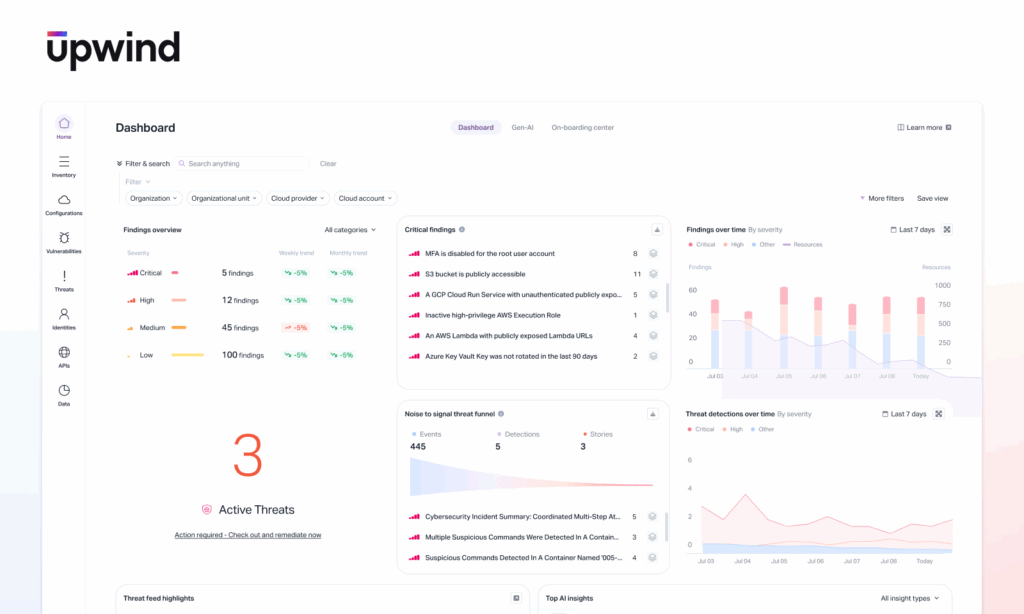
Upwind describes their offering as a “cloud security platform with runtime visibility and risk prioritization.” They focus on helping teams understand which risks actually matter in their specific environment.
The Upwind Philosophy
Upwind built their platform around the idea that context matters. Not every vulnerability poses the same risk. A critical CVE in a container that’s never exposed to the internet is different from the same CVE in a public-facing service.
Their platform combines runtime visibility with risk prioritization. The goal is helping security teams focus on what matters most, rather than drowning in alerts.
Upwind’s approach emphasizes:
- Runtime visibility that shows exactly what’s happening in your environment
- Risk prioritization based on actual exposure and exploitability
- Flexible deployment options that work across different architectures
Detection and Visibility Capabilities
Upwind’s detection engine monitors runtime behavior across cloud workloads. They collect detailed telemetry about what processes run, what network connections form, and how applications behave.
This data feeds into their risk prioritization engine. Instead of showing you every potential issue, Upwind highlights the ones that pose real danger. It considers factors like network exposure, whether a vulnerable component is actually loaded in memory, and the sensitivity of the data involved.
Users praise Upwind for the quality of their detections. The 9.5 average rating reflects satisfaction with how the platform identifies and prioritizes threats.
Versatile Deployment Options
Upwind offers what reviewers call a “versatile deployment model.” This flexibility lets teams choose how they want to run the platform based on their specific needs and constraints.
Some organizations want full agent-based visibility. Others prefer lighter-weight approaches for certain workloads. Upwind accommodates both, though there may be trade-offs in depth of visibility depending on the chosen method.
The flexibility is valuable but comes with a note. Reviews suggest Upwind may require more time to deploy effectively compared to some alternatives. The setup process is thorough, which is good for long-term results but means longer time-to-value initially.
Advanced Feature Set
Upwind positions itself as having “advanced features” that make it ideal for organizations prioritizing robust functionality. This includes deep integration with cloud provider APIs, detailed network mapping, and sophisticated behavioral analysis.
For teams with complex cloud environments and mature security programs, these advanced capabilities provide significant value. They allow for more nuanced policies and more accurate threat detection.
However, advanced features also mean more to learn and configure. Organizations need sufficient expertise to get the most from Upwind’s capabilities.
Deployment and Implementation: Sweet Security Compared to Upwind
How quickly can you get value from a security platform? Deployment matters more than many buyers realize. A tool that takes months to implement delays protection and burns team resources.
Sweet Security Deployment Experience
Sweet Security emphasizes rapid deployment. Their platform is designed to integrate quickly with existing environments. Users report getting initial visibility within hours or days, not weeks.
The deployment process typically involves:
- Connecting to your cloud environment via API
- Deploying lightweight agents to workloads you want to monitor
- Configuring integrations with existing tools (SIEM, ticketing systems, etc.)
- Tuning alerts based on your specific environment
Sweet Security’s support team actively assists during deployment. This hands-on approach helps teams avoid common pitfalls and get configured correctly the first time.
The focus on agility extends to ongoing operations. When you need to onboard new workloads or adjust configurations, the process is straightforward.
Upwind Deployment Experience
Upwind’s deployment is described as “efficient” but may “require more time” than some alternatives. This isn’t necessarily negative. Thorough setup often leads to better long-term results.
The Upwind deployment process includes:
- Cloud environment integration via API connections
- Agent deployment based on your chosen deployment model
- Configuration of risk prioritization rules
- Integration with security workflows and tools
- Custom policy creation based on your requirements
Upwind’s versatile deployment model means more decisions during setup. You’ll need to determine which deployment approach fits each workload type. This adds complexity but also provides flexibility.
Organizations with complex environments may appreciate this flexibility. Those wanting something simpler might find the process more involved than expected.
Comparing Time-to-Value
When comparing Sweet Security vs Upwind deployment experiences, a few patterns emerge:
| Factor | Sweet Security | Upwind |
|---|---|---|
| Initial setup time | Faster, emphasis on quick start | More thorough, takes longer |
| Support during deployment | Intensive, hands-on assistance | Effective but less intensive |
| Complexity | Lower, streamlined process | Higher, more options to configure |
| Flexibility | Good for standard deployments | Better for complex requirements |
Your situation determines which approach works better. Teams needing protection quickly should consider Sweet Security’s speed. Those with complex requirements and time to invest may prefer Upwind’s thoroughness.
Runtime Protection and Threat Detection: A Direct Comparison
Runtime protection is where both Sweet Security and Upwind have invested heavily. This is the core battlefield where these platforms compete. Let’s examine how each handles real-time threat detection.
Sweet Security’s Detection Approach
Sweet Security uses AI-powered detection that focuses on speed and proactive identification. Their system monitors runtime behavior and flags anomalies quickly.
Key characteristics of Sweet Security’s detection:
- Behavioral baselining that learns what normal looks like for each workload
- AI-driven analysis that identifies patterns humans might miss
- Real-time alerting with minimal delay between detection and notification
- Proactive threat hunting capabilities built into the platform
Sweet Security positions their detection as catching threats before they cause damage. The emphasis on speed means they want to alert teams while an attack is still in early stages.
Their AI stack security focus adds detection capabilities specific to machine learning workloads. This includes monitoring for model poisoning, data exfiltration from training sets, and unusual inference patterns.
Upwind’s Detection Approach
Upwind combines detection with prioritization. They don’t just tell you something happened. They tell you whether it matters and why.
Key characteristics of Upwind’s detection:
- Deep runtime telemetry that captures detailed workload behavior
- Context-aware alerting that considers exposure and exploitability
- Risk-based prioritization that ranks threats by actual danger
- Network visibility that maps communication patterns
Upwind’s approach acknowledges that most security teams deal with alert fatigue. By adding context and prioritization, they help teams focus on genuine threats rather than chasing false positives.
The depth of telemetry Upwind collects enables sophisticated analysis. But it also requires more resources to process and store that data.
Detection Quality Comparison
Both platforms perform well at detection. But they emphasize different strengths:
| Capability | Sweet Security | Upwind |
|---|---|---|
| Detection speed | Emphasis on rapid detection | Fast but with prioritization layer |
| AI/ML analysis | Core feature, heavily promoted | Present but less emphasized |
| Risk prioritization | Available | Major differentiator |
| Telemetry depth | Good | Very detailed |
| False positive rates | Low (per user feedback) | Very low (per user feedback) |
| AI workload protection | Specific capabilities | General coverage |
Real-World Detection Scenarios
Consider a scenario where an attacker gains initial access to a container through a vulnerable dependency. Here’s how each platform might respond:
Sweet Security response pattern:
- Behavioral analysis detects unusual process execution within seconds
- AI correlates the activity with known attack patterns
- Alert fires with high confidence and recommended actions
- Team can respond immediately while attack is in early stages
Upwind response pattern:
- Runtime telemetry captures the unusual process execution
- System checks context: is this container exposed? What data can it access?
- Risk score calculated based on potential impact
- Alert fires with priority level and full context for investigation
Both approaches are valid. Sweet Security’s speed gets you faster notification. Upwind’s context helps you understand severity immediately. Which matters more depends on your team’s workflow.
Feature Comparison: Sweet Security vs Upwind Security Features
Beyond detection, both platforms offer broader security capabilities. Here’s a detailed breakdown of features across key categories.
Cloud Security Posture Management
CSPM capabilities help find misconfigurations and compliance issues in your cloud environment.
Sweet Security CSPM:
- Configuration scanning across major cloud providers
- Compliance frameworks support (SOC 2, PCI-DSS, etc.)
- Integration with runtime data for context
- Remediation guidance for found issues
Upwind CSPM:
- Detailed configuration assessment
- Multiple compliance framework support
- Risk-based prioritization of findings
- Network exposure analysis for misconfigurations
Both platforms cover CSPM basics well. Upwind’s risk prioritization extends to posture findings, helping teams focus on misconfigurations that actually create exposure.
Vulnerability Management
Finding vulnerabilities in your workloads is a core CNAPP function. Both platforms scan for known vulnerabilities but approach prioritization differently.
Sweet Security vulnerability handling:
- Scanning for vulnerabilities in containers and images
- Runtime context to understand if vulnerable code is actually loaded
- Integration with development workflows
- AI-assisted analysis of vulnerability severity
Upwind vulnerability handling:
- Comprehensive vulnerability scanning
- Runtime verification of exploitability
- Detailed risk scoring based on multiple factors
- Clear remediation paths with priority rankings
Runtime context is where both platforms shine compared to traditional scanners. They can tell you not just that a vulnerability exists, but whether it’s actually reachable and exploitable in your environment.
Network Security and Visibility
Understanding network flows in cloud environments helps detect lateral movement and unexpected connections.
Sweet Security network capabilities:
- Network flow monitoring
- Detection of unusual communication patterns
- Integration with cloud provider network logs
Upwind network capabilities:
- Detailed network mapping and visualization
- Service-to-service communication tracking
- Exposure analysis for internet-facing services
- Network policy recommendations
Upwind appears to invest more heavily in network visibility. Their platform provides detailed maps of how services communicate, which helps both security and operations teams.
Integration Capabilities
Security tools need to work with your existing stack. Both platforms offer integrations, but the depth varies.
| Integration Type | Sweet Security | Upwind |
|---|---|---|
| SIEM integrations | Major platforms supported | Major platforms supported |
| Ticketing systems | Jira, ServiceNow, others | Jira, ServiceNow, others |
| CI/CD pipelines | Good coverage | Good coverage |
| Communication tools | Slack, Teams, etc. | Slack, Teams, etc. |
| Cloud provider APIs | AWS, Azure, GCP | AWS, Azure, GCP |
Sweet Security emphasizes “seamless integration” as a key benefit. Users report that connecting the platform to existing tools is straightforward and quick.
Reporting and Compliance
Both platforms provide reporting capabilities for security teams and compliance needs.
Sweet Security reporting:
- Real-time dashboards
- Compliance reports for major frameworks
- Incident summaries and timelines
- Executive-level reporting
Upwind reporting:
- Risk-based dashboards
- Detailed compliance mapping
- Trend analysis over time
- Custom report generation
Reporting is table stakes for this category. Both platforms meet typical requirements, though the specific format and customization options may differ based on your needs.
Pricing and Value: Sweet Security versus Upwind Costs
Pricing for enterprise security tools is rarely straightforward. Both vendors use models based on workload volume and features. Here’s what we know about how they approach pricing.
Sweet Security Pricing Approach
Sweet Security has earned a reputation for “competitive pricing” in comparison reviews. Users mention that the cost is reasonable relative to the capabilities provided.
Typical pricing factors include:
- Number of workloads protected
- Features and modules included
- Support tier selected
- Contract length
Sweet Security’s intensive support model is included in their pricing, which adds value compared to platforms that charge extra for hands-on assistance.
The focus on quick deployment also creates cost advantages. Less time implementing means lower labor costs on your side and faster time to protection.
Upwind Pricing Approach
Upwind’s pricing reflects their “advanced features” positioning. The platform offers robust functionality that commands appropriate pricing.
Pricing factors typically include:
- Workload count and types
- Data retention periods
- Feature tiers
- Support levels
Organizations prioritizing comprehensive functionality often find Upwind’s pricing reasonable for what they receive. The depth of features and quality of detection justify the investment for many teams.
The longer deployment time can affect total cost of ownership. Teams should factor in the internal resources needed to implement and tune Upwind properly.
Value Comparison Framework
When evaluating Sweet Security vs Upwind pricing, consider total cost of ownership rather than just license fees:
| Cost Factor | Sweet Security | Upwind |
|---|---|---|
| License cost | Competitive | Feature-based |
| Implementation effort | Lower (faster deployment) | Higher (more thorough setup) |
| Ongoing administration | Streamlined | More involved |
| Support included | Comprehensive | Effective |
| Training requirements | Lower | Higher (advanced features) |
Sweet Security may be more cost-effective for teams wanting protection quickly without heavy internal investment. Upwind may be worth higher investment for teams that will use advanced features extensively.
Support and Customer Success: Service Quality Comparison
Support quality often determines whether a security tool succeeds in your environment. Both vendors provide support, but their approaches differ meaningfully.
Sweet Security Support Experience
Sweet Security is specifically noted for providing “comprehensive support” that’s “more intensive” than competitors. This shows up in several ways:
- Hands-on deployment assistance where Sweet Security staff actively help configure the platform
- Ongoing guidance as teams learn to use capabilities effectively
- Responsive issue resolution when problems arise
- Proactive check-ins to ensure customers get value
For organizations with smaller security teams, this level of support is valuable. You’re effectively extending your team with Sweet Security’s expertise.
The support model seems designed for customers who want partnership rather than just software. If your team has gaps in cloud security expertise, Sweet Security’s support can help fill them.
Upwind Support Experience
Upwind provides “effective” service support, though reviews suggest it’s “less intensive” than Sweet Security. This isn’t necessarily negative. It depends on what you need.
Upwind support characteristics:
- Technical support for issues and questions
- Documentation for self-service learning
- Professional services available for implementation help
- Customer success resources for ongoing assistance
Teams with strong internal expertise may not need intensive support. They might prefer self-service resources and on-demand help when specific issues arise.
Organizations expecting white-glove treatment should understand Upwind’s model upfront and plan accordingly.
Making the Support Decision
Your team’s capabilities should guide this decision:
| Team Situation | Better Fit |
|---|---|
| Small security team, limited cloud expertise | Sweet Security (intensive support) |
| Mature team, strong internal skills | Either platform works well |
| Prefer self-service with on-demand help | Upwind |
| Want ongoing partnership and guidance | Sweet Security |
| Complex environment, need deep expertise | Evaluate both support offerings carefully |
Use Cases: When to Choose Sweet Security or Upwind
Different organizations have different needs. Here’s guidance on which platform fits various scenarios.
Choose Sweet Security When:
You need fast protection: Sweet Security’s quick deployment and emphasis on speed means you can get runtime protection operational rapidly. If you’re facing an audit, compliance deadline, or just want to reduce risk quickly, this matters.
Your team is lean: The comprehensive support model helps smaller teams punch above their weight. You’ll get guidance and expertise from Sweet Security’s staff, not just software.
You’re running AI/ML workloads: Sweet Security specifically focuses on protecting AI infrastructure. If you’re deploying machine learning models in production, their AI stack security capabilities are relevant.
You want simplicity: The streamlined deployment and operation model suits teams that want effective protection without complexity. Less tuning, less administration, more protection.
Budget is constrained: Competitive pricing combined with lower implementation costs makes Sweet Security attractive for cost-conscious organizations.
Choose Upwind When:
You need deep visibility: Upwind’s detailed telemetry and network mapping provide comprehensive understanding of your environment. If you need to know exactly what’s happening across every service, this depth helps.
Alert fatigue is a problem: The risk-based prioritization approach helps teams focus on what matters. If your current tools generate too many alerts, Upwind’s context-aware approach may reduce noise.
Your environment is complex: The versatile deployment model accommodates different workload types and requirements. Complex architectures benefit from this flexibility.
You have strong internal expertise: Teams with solid cloud security skills can get more from Upwind’s advanced features. The capability depth rewards investment in learning the platform.
Compliance is critical: Detailed reporting and comprehensive risk tracking support mature compliance programs. Upwind provides the documentation and evidence collection these programs need.
Both Work Well When:
Runtime protection is the priority: Both platforms excel at runtime detection. If that’s your main requirement, either can deliver.
You’re running Kubernetes: Both platforms handle Kubernetes environments effectively. Container security is a core capability for each.
You want modern architecture support: Containers, serverless, and cloud-native applications are well-covered by both platforms.
Market Position and Company Outlook
Understanding where these vendors fit in the broader market helps evaluate long-term viability.
The New Generation of Cloud Security
Both Sweet Security and Upwind are identified as part of the “new generation of cloud security providers.” They built platforms specifically for modern cloud environments rather than adapting legacy tools.
Industry analysis notes that vendors like “Upwind, Sweet, ARMO, and RAD have all focused on their runtime detection engines, aiming to go beyond where those like Aqua and Sysdig started.” This positions them differently from both older CWPP vendors and agentless CNAPP providers.
The runtime focus is a deliberate competitive strategy. While major players like Wiz have dominated with agentless approaches, these newer vendors bet that runtime protection will become more important.
Sweet Security Market Position
Sweet Security has carved a position emphasizing AI-powered detection and fast deployment. Their #4 ranking in Cloud Detection and Response reflects solid market traction.
The company appears to be growing steadily, with positive user feedback supporting their go-to-market approach. The combination of competitive pricing and comprehensive support resonates with mid-market and growing enterprise customers.
Focus areas like AI stack security may prove prescient as more organizations deploy machine learning in production.
Upwind Market Position
Upwind has built strong positioning around runtime visibility and risk prioritization. Their #7 ranking comes with the highest user rating (9.5), suggesting high customer satisfaction among those who do choose them.
The “advanced features” positioning targets organizations with sophisticated security requirements. This may be a smaller addressable market but with deeper customer relationships.
Upwind’s detailed telemetry approach provides differentiation against both agentless platforms and competitors with lighter-weight agents.
Competitive Dynamics
Both companies compete not just with each other but with larger players like CrowdStrike, Palo Alto Networks (Prisma Cloud), and Wiz. The market is consolidating, but there’s room for focused vendors.
Recent analysis suggests that even market leaders have gaps in runtime protection. “Wiz’s weakness has always been runtime protection,” according to industry observers. This creates opportunity for Sweet Security and Upwind to win deals where runtime is the priority.
The question for buyers is whether to choose focused runtime specialists or broader platforms. Both Sweet Security and Upwind argue that depth in runtime protection beats breadth without it.
Technical Architecture: How Each Platform Works
Understanding the technical approaches helps evaluate fit with your environment.
Sweet Security Architecture
Sweet Security deploys lightweight agents to collect runtime data. These agents monitor process execution, network activity, and system calls within workloads.
Key architectural elements:
- Lightweight agents designed for minimal performance impact
- Cloud-native architecture that scales with your environment
- AI processing that analyzes behavior patterns
- API integrations with cloud providers for additional context
The architecture emphasizes efficiency. Agents collect what’s needed without excessive overhead. Processing happens in Sweet Security’s cloud infrastructure, reducing compute requirements in your environment.
The AI components use machine learning models trained on threat data and behavioral patterns. These models evolve over time as Sweet Security sees new attack techniques.
Upwind Architecture
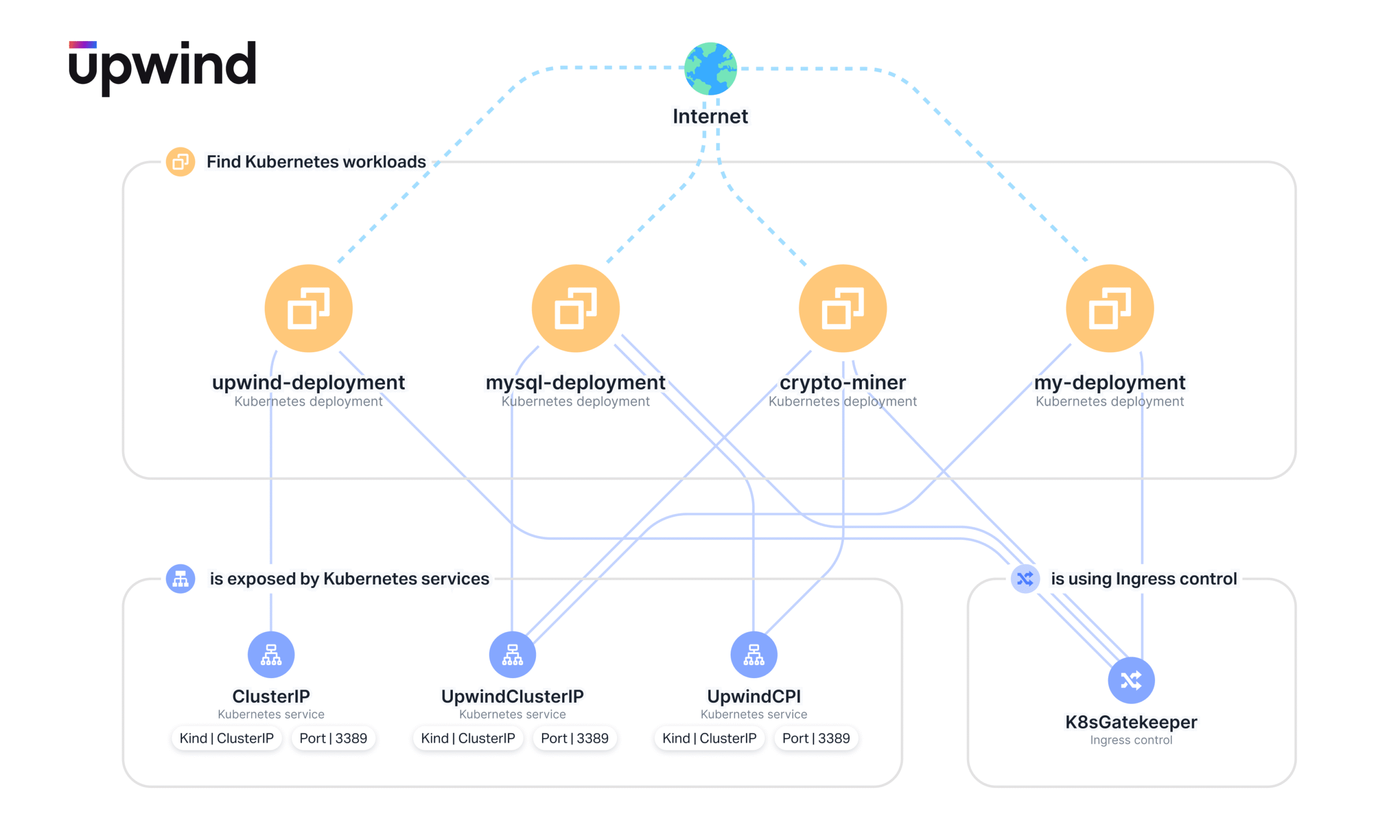
Upwind’s versatile deployment model offers options for how data collection happens. This includes agent-based approaches for deep visibility and lighter-weight methods where appropriate.
Key architectural elements:
- Flexible agents that can be tuned for depth vs. overhead
- Detailed telemetry collection capturing comprehensive runtime data
- Risk calculation engine that processes context and exposure
- Network mapping components that track service communication
Upwind collects more detailed telemetry than some competitors. This powers their risk prioritization but requires more data processing and storage.
The architecture supports complex deployments with different configurations for different workload types. This flexibility comes with configuration complexity.
Agent Overhead Considerations
Any runtime protection solution requires some resource consumption. Both vendors work to minimize impact, but there are trade-offs.
| Consideration | Sweet Security | Upwind |
|---|---|---|
| Agent footprint | Lightweight by design | Configurable based on needs |
| CPU overhead | Low | Varies by configuration |
| Memory usage | Minimal | Depends on telemetry depth |
| Network impact | Low | Higher with detailed telemetry |
Performance-sensitive workloads should evaluate agent overhead carefully. Both vendors typically offer trials or pilots to test in your actual environment.
Integration with Security Operations
A security tool is only as good as its integration with your broader security program.
SIEM and SOAR Integration
Both platforms send alerts to major SIEM and SOAR platforms. This allows correlation with other security data and automated response workflows.
Sweet Security integrations:
- Native integrations with major SIEM platforms
- Webhook support for custom integrations
- Structured alert data for easy parsing
- Context included in alerts for faster triage
Upwind integrations:
- Comprehensive SIEM integration support
- Detailed event data for correlation
- API access for custom workflows
- Risk scores included for prioritization
Teams with mature security operations centers should evaluate integration depth during trials. Test that alerts contain the information your analysts need.
DevSecOps Workflow Integration
Shifting security left means integrating with development workflows. Both platforms support this through CI/CD integrations.
Integration points include:
- Image scanning in build pipelines
- Policy gates that block vulnerable deployments
- Feedback to developers about security issues
- Correlation between runtime issues and code changes
Sweet Security’s emphasis on seamless integration suggests this is a strength. Upwind’s comprehensive feature set includes robust CI/CD capabilities as well.
Incident Response Support
When incidents occur, your security platform should help with response. Both platforms provide investigation capabilities.
Sweet Security incident support:
- Real-time visibility into active threats
- Timeline reconstruction of attack activity
- Recommended response actions
- Integration with ticketing for tracking
Upwind incident support:
- Detailed forensic data collection
- Attack path visualization
- Context about impacted resources
- Evidence collection for post-incident review
Upwind’s detailed telemetry may provide more comprehensive forensic data. Sweet Security’s speed may help contain incidents faster. Your priorities should guide this decision.
Sweet Security and Upwind: Head-to-Head Summary
After examining both platforms in depth, here’s a consolidated comparison to guide your decision.
Comprehensive Comparison Table
| Category | Sweet Security | Upwind |
|---|---|---|
| Market position | #4 in CDR, 8.6 rating | #7 in CDR, 9.5 rating |
| Recommendation rate | 100% | 100% |
| Primary strength | Speed, AI detection, support | Features, visibility, prioritization |
| Deployment speed | Faster | More thorough |
| Support intensity | High (comprehensive) | Effective (less intensive) |
| Pricing | Competitive | Feature-based |
| Best for | Fast protection, lean teams, AI workloads | Complex environments, mature teams |
| Detection approach | AI-powered, speed focused | Context-aware, prioritization focused |
| Telemetry depth | Good | Very detailed |
| Network visibility | Standard | Comprehensive |
| Learning curve | Lower | Higher |
| Flexibility | Streamlined | Versatile |
Key Differentiators
Sweet Security differentiators:
- AI-powered detection with focus on speed
- Comprehensive support included
- Competitive pricing model
- Fast deployment for quick time-to-value
- AI stack security for ML workloads
Upwind differentiators:
- Risk-based prioritization reduces alert fatigue
- Detailed telemetry for deep visibility
- Versatile deployment options
- Comprehensive network mapping
- Advanced features for mature teams
Decision Framework
Use these questions to guide your choice:
- How quickly do you need protection? If urgently, lean toward Sweet Security.
- How large is your security team? Smaller teams may benefit from Sweet Security’s support.
- How complex is your environment? Complex deployments may favor Upwind’s flexibility.
- Is alert fatigue a current problem? If yes, Upwind’s prioritization may help.
- Are you running AI/ML workloads? Sweet Security has specific capabilities here.
- What’s your budget situation? Sweet Security offers competitive pricing with lower implementation costs.
Conclusion
Sweet Security and Upwind both deliver strong runtime protection for cloud environments. Sweet Security wins on deployment speed, support quality, and competitive pricing. Upwind wins on feature depth, visibility, and risk prioritization. Your choice should match your team’s capabilities, environment complexity, and priorities. Both platforms have earned high recommendation rates from users. Either can provide effective cloud security. The best choice depends on your specific situation and what trade-offs make sense for your organization.
FAQs About Sweet Security vs Upwind
| What’s the main difference between Sweet Security and Upwind? | Sweet Security focuses on speed, AI-powered detection, and comprehensive support. Upwind emphasizes detailed visibility, risk-based prioritization, and advanced features. Sweet Security deploys faster while Upwind provides deeper telemetry. |
| Which platform is better for small security teams? | Sweet Security is typically better for smaller teams. Their intensive support model helps fill expertise gaps, and the streamlined platform requires less administration. Upwind’s advanced features benefit teams with more internal expertise. |
| How do Sweet Security and Upwind compare on pricing? | Sweet Security is described as having competitive pricing. Upwind’s pricing reflects their advanced feature set. Total cost of ownership should include implementation effort. Sweet Security typically has lower implementation costs due to faster deployment. |
| Which solution deploys faster? | Sweet Security emphasizes rapid deployment and quick time-to-value. Upwind’s deployment is described as efficient but may take longer due to more configuration options. Sweet Security can provide protection faster in most cases. |
| Do Sweet Security and Upwind both support Kubernetes? | Yes. Both platforms provide strong support for Kubernetes and containerized workloads. Container security and runtime protection in Kubernetes environments are core capabilities for both vendors. |
| Which platform has better threat detection? | Both have strong detection capabilities. Sweet Security uses AI-powered analysis focused on speed. Upwind combines detection with context-aware prioritization. User ratings are high for both (8.6 for Sweet Security, 9.5 for Upwind). |
| Can these platforms integrate with our existing SIEM? | Yes. Both Sweet Security and Upwind integrate with major SIEM platforms. They also support ticketing systems, communication tools, and CI/CD pipelines. Integration capabilities are comparable between the two. |
| Which is better for compliance requirements? | Both platforms support major compliance frameworks including SOC 2 and PCI-DSS. Upwind’s detailed telemetry and reporting may benefit organizations with intensive compliance programs. Sweet Security covers standard compliance needs effectively. |
| Should I choose Sweet Security or Upwind for AI/ML workloads? | Sweet Security has specific focus on “AI stack security” for machine learning workloads. If protecting AI infrastructure is a priority, Sweet Security’s specific capabilities in this area are worth evaluating. Upwind provides general coverage for all workload types. |
| What do users say about Sweet Security vs Upwind? | Both platforms have 100% recommendation rates from users. Sweet Security users appreciate the support and quick deployment. Upwind users praise the feature depth and detection quality. Both have positive user sentiment overall. |



 Stack Insight is intended to support informed decision-making by providing independent information about business software and services. Some product details, including pricing, features, and promotional offers, may be supplied by vendors or partners and can change without notice.