

Sweet Security vs Wiz: A Complete Comparison of Runtime CNAPP vs Agentless Cloud Security
Cloud security has changed a lot over the past few years. Organizations now run complex workloads across multiple cloud providers. They deploy containers, serverless functions, and AI models at scale. This shift created a need for Cloud-Native Application Protection Platforms, or CNAPPs.
Two names keep coming up in conversations about modern cloud security: Sweet Security and Wiz. Both offer CNAPP solutions, but they approach the problem differently. Wiz built its reputation on agentless scanning and broad visibility. Sweet Security focuses on runtime protection and real-time threat detection.
This comparison breaks down how each platform handles cloud security. We’ll look at their architectures, detection methods, deployment models, and more. By the end, you’ll understand which solution fits your specific needs better.
Understanding CNAPP: What These Platforms Actually Do
Before comparing Sweet Security and Wiz directly, let’s get clear on what CNAPPs are supposed to do in 2026.
The Evolution of Cloud-Native Application Protection
CNAPPs started as a bundle of separate tools. Companies would buy one product for posture management. Another for vulnerability scanning. A third for workload protection. This fragmented approach created gaps and alert fatigue.
Modern CNAPPs changed that. They now deliver continuous visibility and risk management across the full application lifecycle. That means covering:
- Code and infrastructure as code scanning
- Cloud security posture management
- Workload and container security
- Runtime threat detection
- Identity risk management
- Data exposure monitoring
- AI workload protection
The best CNAPPs connect all these capabilities into a single contextual risk model. Instead of five dashboards showing different problems, you get one prioritized queue of what needs attention first.
Where Sweet Security and Wiz Fit In
Wiz holds about 12.7% mindshare in the CNAPP market. They’ve grown fast by making cloud security accessible through agentless scanning. Their approach appeals to organizations that want visibility without deploying agents everywhere.
Sweet Security takes a different path. They hold about 1.5% mindshare but have a 100% recommendation rate from users. Their focus on runtime protection fills a gap that many agentless-first platforms struggle with.
Both platforms aim to solve cloud security problems. But their methods differ significantly. Understanding these differences helps you pick the right tool for your environment.
Architecture and Deployment: How Each Platform Works
The biggest difference between Sweet Security and Wiz comes down to architecture. This affects everything from deployment complexity to detection capabilities.
Wiz’s Agentless Architecture
Wiz scans cloud environments without installing agents on workloads. Their platform connects to your cloud accounts through API access. It then reads configuration data, snapshots, and metadata to build a security graph.
This approach has clear advantages:
- Fast deployment: Connect your cloud accounts and start scanning within hours
- No performance impact: No agents means no CPU or memory overhead on workloads
- Broad coverage: Scans everything visible through cloud APIs
- Easy to maintain: No agent updates or compatibility issues
Wiz supports versatile deployment across AWS, Azure, GCP, and other cloud environments. Their technical support gets praised for responsiveness when issues come up.
But agentless scanning has limitations too. It captures point-in-time snapshots rather than continuous monitoring. It can’t see inside running processes or detect attacks as they happen.
Sweet Security’s Runtime-First Architecture

Sweet Security built their platform around runtime protection. They use lightweight sensors that observe workload behavior in real time. This gives them visibility that agentless tools simply can’t match.
Sweet describes their approach as “Runtime CNAPP.” The platform unifies insights from applications, workloads, and cloud infrastructure. Teams can surface risks and resolve threats faster because they see what’s actually happening, not just what’s configured.
Key characteristics of Sweet’s architecture:
- Real-time monitoring: Detects threats as they occur, not during periodic scans
- Process-level visibility: Sees inside running containers and workloads
- Behavioral analysis: Understands normal patterns and spots anomalies
- Runtime context: Adds actual usage data to vulnerability prioritization
Sweet focuses on public and hybrid cloud deployments. Their sensors are designed to be lightweight, but they do require deployment across your workloads.
Deployment Comparison Table
| Factor | Sweet Security | Wiz |
|---|---|---|
| Primary Method | Runtime sensors/agents | Agentless API scanning |
| Time to Deploy | Days to weeks (varies by environment size) | Hours to days |
| Maintenance Overhead | Sensor updates required | Minimal ongoing maintenance |
| Cloud Support | Public and hybrid clouds | AWS, Azure, GCP, OCI, Alibaba, and more |
| Performance Impact | Low but present | None on workloads |
| Coverage Depth | Deep runtime visibility | Broad configuration visibility |
Threat Detection Capabilities: Finding Real Attacks
Detecting threats is where these platforms diverge most sharply. Each approach has strengths and blind spots.
How Wiz Finds Security Issues
Wiz excels at finding misconfigurations, vulnerabilities, and exposed data. Their security graph connects different types of risks to show attack paths. You might see that a public S3 bucket contains sensitive data and is accessible from a misconfigured EC2 instance with a known vulnerability.
This contextual view helps prioritize what to fix first. Not all vulnerabilities matter equally. A critical CVE on an internal system with no internet exposure is less urgent than a medium CVE on a public-facing application.
Wiz’s threat detection focuses on:
- Cloud Security Posture Management (CSPM): Finding misconfigurations across cloud services
- Vulnerability scanning: Identifying known CVEs in packages and dependencies
- Data security: Discovering sensitive data exposure
- Identity risks: Spotting overprivileged roles and dangerous permission combinations
- Attack path analysis: Mapping how attackers could chain issues together
Wiz also launched Wiz Defend to add runtime capabilities. This represents their move into detection and response. Early previews show it’s a step in the right direction, but runtime remains an area where Wiz has traditionally been weaker than competitors.
How Sweet Security Detects Threats
Sweet Security built their platform around catching attacks in progress. Their runtime sensors watch what applications actually do. This includes process execution, network connections, file system changes, and API calls.
Sweet combines multiple detection capabilities into what they call a unified platform:
- Cloud Detection and Response (CDR): Detecting and investigating cloud-level threats
- Application Detection and Response (ADR): Catching attacks targeting applications
- Cloud Workload Protection Platform (CWPP): Protecting containers and workloads
- Identity Threat Detection and Response (ITDR): Catching identity-based attacks
The key difference is timing. Sweet detects threats in real time. They see an attacker attempting lateral movement or data exfiltration as it happens. This enables faster response and containment.
Sweet also adds runtime context to vulnerability management. They can tell you which vulnerable packages are actually loaded in memory and being used. This cuts through the noise of theoretical vulnerabilities that exist in images but never get executed.
Detection Approaches Compared
| Detection Type | Sweet Security | Wiz |
|---|---|---|
| Misconfigurations | Yes, with runtime validation | Yes, core strength |
| Vulnerabilities | Yes, with runtime context | Yes, with attack path context |
| Active Attacks | Real-time detection | Limited (improving with Defend) |
| Lateral Movement | Detected as it happens | Detected through logs after the fact |
| Data Exfiltration | Real-time alerts | Post-incident detection |
| Zero-Day Attacks | Behavioral detection possible | Requires signature updates |
Cloud Security Posture Management Features
CSPM capabilities help organizations find and fix cloud misconfigurations. Both platforms offer this, but with different emphases.
Wiz CSPM Capabilities
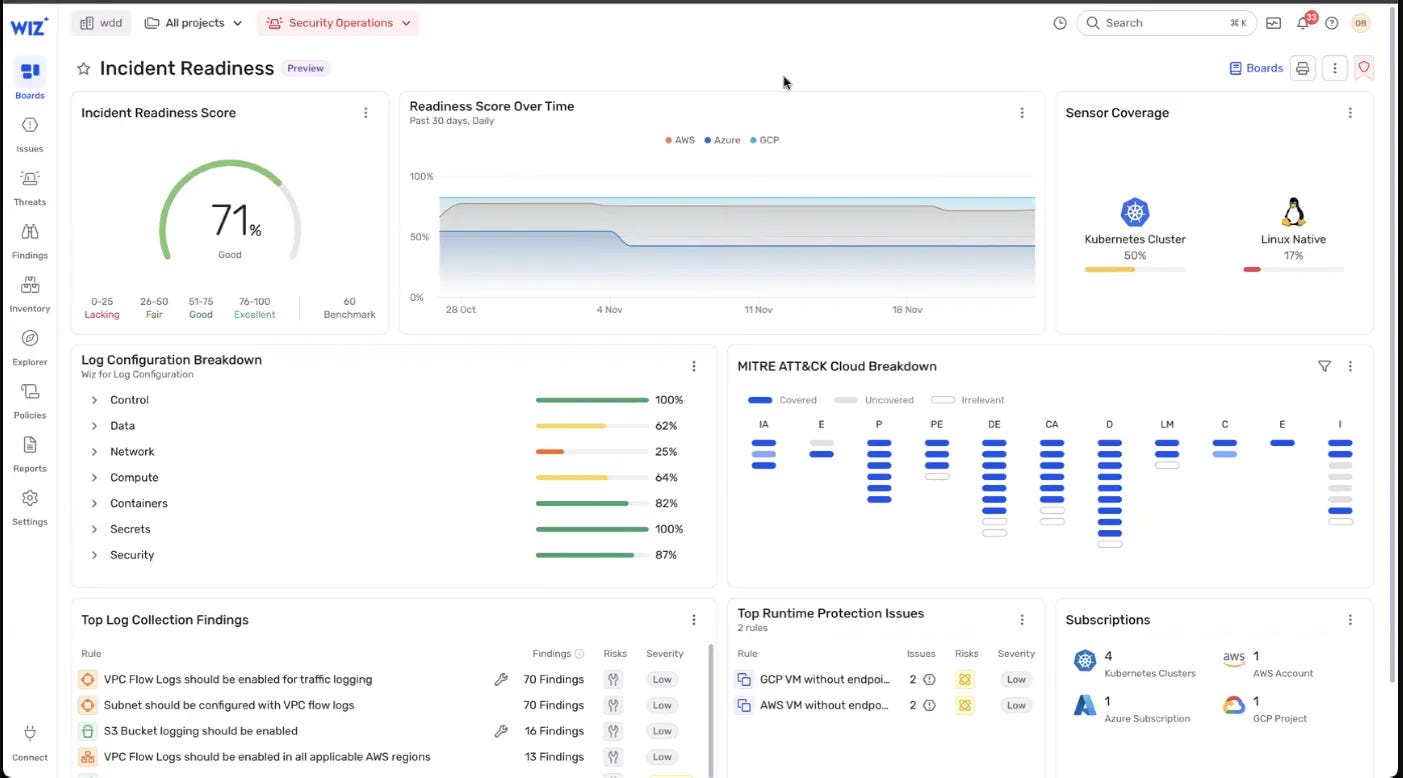
Wiz’s cloud security posture management is one of their core strengths. They scan cloud configurations against hundreds of built-in policies. These cover frameworks like CIS benchmarks, SOC 2, PCI DSS, and HIPAA.
The platform shows misconfigurations in context. You don’t just see that a security group allows SSH from anywhere. You see which resources use that group, what data they can access, and whether they’re exposed to the internet.
Wiz CSPM features include:
- Multi-cloud scanning: Consistent policies across AWS, Azure, GCP, and others
- Compliance mapping: Automatic mapping to regulatory frameworks
- Risk prioritization: Scoring based on exposure and potential impact
- Remediation guidance: Step-by-step instructions to fix issues
- Drift detection: Catching configuration changes over time
Organizations with complex multi-cloud environments often choose Wiz specifically for this comprehensive posture management.
Sweet Security CSPM Features
Sweet Security includes cloud security posture management as part of their Runtime CNAPP. Their approach adds runtime validation to configuration findings.
This means Sweet can tell you not just that a misconfiguration exists, but whether it’s actively being exploited or creating real risk. A misconfigured IAM role matters more if someone is actually using it to access sensitive resources.
Sweet’s posture management focuses on:
- Runtime-validated findings: Confirming which misconfigurations create active risk
- Continuous monitoring: Catching changes as they happen, not during periodic scans
- Workload context: Understanding how configurations affect running applications
- Integrated response: Connecting findings to detection and response workflows
The philosophy differs from traditional CSPM. Sweet treats posture management as one input to a broader risk picture, not as a standalone capability.
Which CSPM Approach Works Better?
Wiz offers deeper and more comprehensive CSPM capabilities. They’ve built extensive policy libraries and compliance mapping. Organizations that need detailed posture reporting for auditors often prefer Wiz.
Sweet’s approach works well for teams that want actionable findings. The runtime validation cuts through false positives. But you sacrifice some of the depth and compliance coverage.
If posture management is your primary concern, Wiz likely fits better. If you want CSPM as part of a broader detection and response strategy, Sweet integrates it more tightly.
Vulnerability Management and Prioritization
Every organization faces thousands of vulnerabilities. The challenge isn’t finding them. It’s figuring out which ones matter.
Wiz Vulnerability Management
Wiz scans container images, virtual machines, and serverless functions for known vulnerabilities. Their agentless approach reads disk snapshots to identify installed packages and their versions.
The platform then correlates vulnerabilities with other risk factors:
- Is the workload exposed to the internet?
- Does it have access to sensitive data?
- Are there other misconfigurations that create attack paths?
- What permissions does the workload have?
This context helps prioritize remediation. A critical vulnerability on an isolated internal system might rank lower than a high vulnerability on a public-facing application with database access.
Wiz also provides threat intelligence on known exploits. If a vulnerability has active exploitation in the wild, it gets flagged for immediate attention.
Sweet Security Vulnerability Management
Sweet takes vulnerability management “from code to cloud,” as they describe it. But their key differentiator is runtime context.
Many vulnerabilities exist in installed packages that never actually run. A container image might include a library with a critical CVE, but if that library never gets loaded, the risk is theoretical.
Sweet’s runtime sensors track which packages are actually executed. This adds a powerful filter to vulnerability prioritization:
- In use: The vulnerable code is loaded and running
- Not in use: Present but never executed
- Reachable: Can be triggered through network input
- Protected: Other controls limit exploitation
This dramatically reduces the vulnerability backlog that security teams face. Instead of thousands of findings, you focus on the dozens that represent real risk.
Prioritization Comparison
| Prioritization Factor | Sweet Security | Wiz |
|---|---|---|
| CVSS Score | Yes | Yes |
| Exploit Availability | Yes | Yes |
| Network Exposure | Yes | Yes |
| Data Access | Yes | Yes |
| Attack Paths | Yes | Yes (core strength) |
| Runtime Loading | Yes (core strength) | No |
| Active Execution | Yes | No |
| Behavioral Context | Yes | Limited |
Runtime Protection and Workload Security
Protecting running workloads is where Sweet Security has historically been stronger. But Wiz is working to close this gap.
Sweet Security Runtime Protection
Sweet positions themselves as combining ADR, CDR, and CWPP into one platform. Their runtime sensors provide deep visibility into workload behavior.
The platform watches for suspicious activities in real time:
- Process injection: Attackers trying to hide in legitimate processes
- Privilege escalation: Attempts to gain higher permissions
- Lateral movement: Moving from one workload to another
- Data access anomalies: Unusual database queries or file access
- Network anomalies: Connections to suspicious destinations
- Cryptomining: Unauthorized cryptocurrency mining
When Sweet detects an attack, teams can investigate and respond immediately. The platform provides full context about what happened, reducing mean time to resolution.
Sweet also offers API security as part of their runtime protection. They monitor API calls for anomalies and potential abuse.
Wiz Runtime Capabilities
Historically, runtime protection has been Wiz’s weakness. Industry analysts have noted this gap. The company addressed it by launching Wiz Defend in their preview program.
Wiz Defend adds detection and response capabilities to the platform. It aims to catch active threats rather than just finding misconfigurations and vulnerabilities.
Early feedback on Wiz Defend is mixed. It’s described as “a good step in a necessary direction” but “continues to be the weakest point of the platform” compared to runtime-focused competitors.
Wiz has one major advantage in the runtime space: their existing customer base and security graph. Organizations already using Wiz can add Defend without deploying a separate tool. The runtime data enriches the security graph they already rely on.
Why Runtime Matters More in 2026
Cloud attacks have gotten faster and more sophisticated. Attackers know that organizations have vulnerability scanners. They exploit zero-days or move quickly before patches get applied.
Runtime protection catches attacks that signature-based tools miss. Behavioral analysis spots anomalies even when there’s no known vulnerability being exploited.
The shift toward runtime-focused CNAPPs reflects this reality. Companies like Sweet Security, Upwind, ARMO, and RAD have all built their platforms around runtime detection engines. They’re betting that runtime visibility becomes table stakes for cloud security.
Wiz recognizes this trend. Their investment in Wiz Defend shows they’re working to compete. But catching up to runtime-native platforms takes time.
Identity Security and Access Management
Identity has become the new perimeter. Both platforms address identity risks, but in different ways.
Wiz Identity Features
Wiz analyzes IAM configurations across cloud environments. They find overprivileged roles, dangerous permission combinations, and unused credentials.
Key identity capabilities include:
- Effective permissions analysis: Understanding what roles can actually do
- Cross-account risk: Finding risky trust relationships
- Service account auditing: Identifying overprivileged service accounts
- Unused credentials: Flagging credentials that should be removed
- Policy simulation: Testing what changes would enable
Wiz’s identity analysis feeds into their security graph. They show how identity risks combine with other issues to create attack paths.
Sweet Security ITDR Features
Sweet includes Identity Threat Detection and Response (ITDR) as part of their platform. This goes beyond analyzing configurations to detect active identity-based attacks.
Sweet’s approach focuses on behavior:
- Anomalous access patterns: Detecting unusual login times or locations
- Privilege abuse: Catching misuse of legitimate credentials
- Credential theft indicators: Spotting signs of compromised credentials
- Service account anomalies: Detecting unusual service account behavior
The runtime focus means Sweet can catch identity attacks in progress. Wiz finds risky configurations. Sweet finds risky configurations and detects when those risks get exploited.
Identity Security Comparison
| Capability | Sweet Security | Wiz |
|---|---|---|
| Permission Analysis | Yes | Yes (strong) |
| Overprivilege Detection | Yes | Yes |
| Cross-Account Risks | Yes | Yes |
| Active Attack Detection | Yes (ITDR) | Limited |
| Behavioral Analysis | Yes | Limited |
| Credential Abuse Detection | Real-time | Log-based |
AI and Data Security Capabilities
AI workloads present new security challenges. Both platforms are evolving to address them.
The AI Security Challenge
Modern CNAPPs need to treat AI workloads and data as first-class parts of the attack surface. This includes:
- Protecting training data from theft or poisoning
- Securing model endpoints from abuse
- Detecting prompt injection attacks
- Monitoring inference pipelines for anomalies
- Preventing data leakage through model outputs
Organizations running large language models or machine learning pipelines need visibility into these risks.
Sweet Security AI Protection
Sweet positions themselves as a provider of “Runtime CNAPP and AI Security solutions.” They’ve expanded their platform to cover AI-specific risks.
Their runtime approach has natural advantages for AI security. They can monitor inference calls in real time. They see what data flows through models. Anomalies in AI workload behavior get flagged like any other runtime threat.
Sweet’s AI security focuses on:
- Model endpoint protection: Securing APIs that serve AI models
- Data flow monitoring: Tracking sensitive data through AI pipelines
- Anomaly detection: Catching unusual patterns in AI workload behavior
- Pipeline security: Protecting the infrastructure that runs AI workloads
Wiz Data Security
Wiz has strong data security capabilities. They scan for sensitive data exposure across cloud storage. Their platform identifies where PII, credentials, and other sensitive data lives.
For AI workloads, Wiz can find where training data is stored. They identify misconfigurations that could expose it. Their attack path analysis shows how attackers might reach AI resources.
Wiz’s AI-specific capabilities are growing but remain less developed than Sweet’s runtime approach. The agentless model works well for finding exposed data but has limits for monitoring active AI pipelines.
User Experience and Interface Design
How you interact with a security platform matters. Both tools have distinct approaches to user experience.
Wiz User Interface
Wiz built their reputation partly on user experience. The platform presents complex security data in accessible visualizations. Their security graph shows how risks connect across your environment.
Key UX features include:
- Visual attack paths: Graphical representation of how attackers could move
- Unified dashboard: Single view across all cloud environments
- Risk prioritization: Clear ranking of what needs attention
- Query interface: Powerful search across security data
- Compliance views: Easy navigation of compliance requirements
Security teams often praise Wiz for making cloud security approachable. The visualizations help explain risks to non-security stakeholders.
Sweet Security Interface
Sweet’s interface focuses on investigation and response workflows. Their platform shows real-time threat activity and provides tools to dig into incidents.
Interface highlights include:
- Real-time alerts: Immediate notification of detected threats
- Investigation timelines: Step-by-step view of attack progression
- Unified visibility: Single view across cloud, workloads, and applications
- Response actions: Built-in tools to contain and remediate threats
- Runtime context: Detailed data about what workloads are actually doing
Sweet aims to give security teams everything they need to detect, investigate, and resolve cloud attacks. The focus is on operational efficiency rather than executive dashboards.
Learning Curve and Adoption
Wiz has a gentler learning curve for teams new to cloud security. The visualizations make complex concepts accessible. Organizations can get value quickly after connecting their cloud accounts.
Sweet requires more investment to fully leverage. Understanding runtime data takes time. But teams with mature security operations often prefer the depth Sweet provides.
Integration Ecosystem and API Support
Security tools don’t work in isolation. Integration capabilities matter for operational workflows.
Wiz Integrations
Wiz offers broad integration support. They connect with:
- SIEM platforms: Splunk, Microsoft Sentinel, Sumo Logic
- Ticketing systems: Jira, ServiceNow, PagerDuty
- Communication tools: Slack, Microsoft Teams
- CI/CD pipelines: GitHub Actions, GitLab, Jenkins
- Cloud providers: Native integrations with major clouds
Wiz’s API allows custom integrations for workflows they don’t support natively. Organizations can pull data into their existing tools and processes.
Sweet Security Integrations
Sweet integrates with common security operations tools. Their focus on detection and response shapes their integration priorities:
- SIEM/SOAR platforms: For correlation with other security data
- Incident response tools: For automated response workflows
- Developer tools: For shifting security findings left
- Cloud infrastructure: Deep integration with supported cloud platforms
Sweet’s API enables real-time data streaming. This supports organizations that run their own detection logic on top of Sweet’s telemetry.
Integration Comparison
| Integration Type | Sweet Security | Wiz |
|---|---|---|
| SIEM | Yes | Yes (broad support) |
| Ticketing | Yes | Yes (broad support) |
| CI/CD | Yes | Yes |
| SOAR | Yes | Yes |
| Custom API | Yes | Yes |
| Real-time Streaming | Yes | Limited |
Pricing Models and Total Cost of Ownership
Cost matters. Let’s look at how each platform approaches pricing.
Wiz Pricing Structure
Wiz uses a consumption-based pricing model. Costs scale with the size of your cloud environment. Factors that affect pricing include:
- Number of cloud accounts
- Total workloads scanned
- Data volume processed
- Features enabled
Wiz is often perceived as premium-priced. Reddit discussions about Wiz frequently ask “why are you paying more?” But customers point to time savings and reduced risk as justification.
The agentless model keeps operational costs low. No agents means no maintenance overhead. The total cost of ownership goes beyond license fees.
Sweet Security Pricing
Sweet Security’s pricing also scales with environment size. Runtime protection requires sensors on workloads, which affects how they meter usage.
Factors in Sweet’s pricing:
- Number of protected workloads
- Telemetry volume
- Feature tiers selected
- Support level required
Sweet may have lower license costs than Wiz. But runtime sensors require deployment and maintenance. Factor in operational overhead when comparing total cost.
Cost Considerations Beyond Licensing
License fees tell only part of the story. Consider these factors:
- Deployment time: Wiz deploys faster, reducing project costs
- Maintenance effort: Agentless requires less ongoing work
- Alert fatigue reduction: Better prioritization saves analyst time
- Response speed: Faster detection limits breach costs
- Tool consolidation: One platform vs. multiple tools
Organizations should model total cost of ownership, not just compare list prices.
Customer Support and Professional Services
Support quality affects how quickly you realize value from any platform.
Wiz Customer Support
Wiz gets praised for technical support responsiveness. Users report collaborative engagement when issues arise. Support teams help with deployment challenges and ongoing optimization.
Support highlights mentioned by users:
- Quick response times
- Technical depth of support staff
- Willingness to collaborate on complex issues
- Regular account engagement
Wiz also offers professional services for organizations that need help with deployment or security program development.
Sweet Security Support
Sweet Security has less extensive feedback available about their support experience. As a smaller company, they likely provide more personalized attention. But the support team has fewer resources than Wiz’s larger organization.
Users report that Sweet’s ease of deployment for public and hybrid clouds reduces support needs. The platform works as expected without heavy hand-holding.
Community and Resources
Wiz has built a larger community around their platform. They offer extensive documentation, training materials, and educational content. The Wiz Academy provides learning resources for cloud security concepts.
Sweet Security provides documentation and onboarding support. Their community is smaller but growing as they gain market share.
Market Position and Company Trajectory
Understanding where each company is headed helps predict future capabilities.
Wiz Market Position
Wiz holds 12.7% mindshare in the CNAPP market. They’ve become one of the fastest-growing security companies in history. Their valuation and funding give them resources to expand capabilities.
Wiz’s trajectory shows expansion into adjacent areas:
- Wiz Code: Application security posture management
- Wiz Defend: Runtime detection and response
- Container security: Deeper Kubernetes capabilities
- Data security: Expanded sensitive data discovery
Wiz aims to be the comprehensive cloud security platform. They’re filling gaps through internal development and selective acquisitions.
Sweet Security Market Position
Sweet Security holds 1.5% mindshare but punches above their weight. Their 100% user recommendation rate suggests strong product-market fit. Users who try Sweet tend to become advocates.
Sweet is part of a new generation of cloud security providers. Companies like Upwind, ARMO, and RAD share their focus on runtime detection. This generation challenges established players by solving problems the older platforms don’t address well.
Sweet’s trajectory focuses on deepening runtime capabilities:
- More comprehensive ADR features
- Expanded AI security coverage
- Improved API security
- Broader cloud platform support
Market Dynamics in 2026
The CNAPP market continues to consolidate. Larger platforms acquire smaller specialists. But runtime-focused vendors maintain independence because they solve problems differently.
Organizations increasingly want both posture management and runtime protection. The question is whether to get them from one vendor or combine best-of-breed tools.
Choosing Between Sweet Security and Wiz
After examining these platforms in detail, how do you decide?
Choose Wiz If:
- You need comprehensive multi-cloud visibility quickly
- Compliance reporting is a primary driver
- You want agentless deployment with minimal overhead
- Attack path analysis and risk prioritization are priorities
- You prefer a mature, well-funded vendor
- Your team is newer to cloud security
- You have complex IAM configurations to analyze
Choose Sweet Security If:
- Runtime threat detection is your main concern
- You need to catch attacks as they happen
- Reducing vulnerability noise through runtime context matters
- You’re protecting AI workloads and pipelines
- You have a mature security operations team
- Real-time investigation and response are priorities
- You’re willing to deploy sensors for deeper visibility
Consider Using Both If:
- You have complex environments requiring both approaches
- Budget allows for complementary tools
- You want defense in depth across posture and runtime
- Different teams own different aspects of cloud security
Decision Framework
| Your Priority | Better Choice | Why |
|---|---|---|
| Fast deployment | Wiz | Agentless scanning starts in hours |
| Real-time detection | Sweet Security | Built for runtime from the start |
| Compliance reporting | Wiz | Deeper framework coverage |
| Vulnerability prioritization | Sweet Security | Runtime context cuts noise |
| Attack path analysis | Wiz | Core strength of platform |
| AI workload security | Sweet Security | Runtime monitoring fits AI needs |
| Multi-cloud breadth | Wiz | More cloud platforms supported |
| Incident response | Sweet Security | Detection and response focus |
Conclusion: Sweet Security vs Wiz Final Thoughts
Sweet Security and Wiz both deliver strong cloud security capabilities. But they solve different problems best. Wiz excels at comprehensive visibility and risk prioritization through agentless scanning. Sweet Security leads in runtime detection and real-time threat response.
Your choice should depend on your specific needs, team maturity, and security priorities. Neither platform is universally better. The right answer depends on what problems you’re trying to solve and how your security operations work.
Frequently Asked Questions About Sweet Security vs Wiz
| What is the main difference between Sweet Security and Wiz? The main difference is architecture. Wiz uses agentless scanning through cloud APIs to find misconfigurations and vulnerabilities. Sweet Security deploys runtime sensors to detect active threats in real time. Wiz finds problems waiting to be exploited. Sweet catches attacks as they happen. |
| Which platform deploys faster, Sweet Security or Wiz? Wiz deploys faster because it’s agentless. You connect your cloud accounts and start getting visibility within hours. Sweet Security requires deploying sensors to workloads, which takes longer depending on environment size. But Sweet provides deeper visibility once deployed. |
| Is Sweet Security or Wiz better for compliance? Wiz is generally better for compliance use cases. They have more extensive framework mapping and policy coverage. Their reports are designed for auditor consumption. Sweet includes compliance capabilities but focuses more on operational security than regulatory reporting. |
| Can I use Sweet Security and Wiz together? Yes, some organizations use both platforms. Wiz provides comprehensive posture management and attack path analysis. Sweet adds runtime detection and response. This gives defense in depth but increases costs and complexity. |
| Which platform is better for detecting active attacks? Sweet Security is better for detecting active attacks. Their runtime sensors watch workload behavior in real time. They catch lateral movement, data exfiltration, and privilege escalation as it happens. Wiz is adding runtime capabilities through Wiz Defend but started from a posture-first approach. |
| How do Sweet Security and Wiz handle vulnerability prioritization? Both platforms prioritize vulnerabilities based on context like network exposure and data access. But Sweet adds runtime context showing which vulnerable packages are actually loaded and running. This additional signal helps cut through false positives that affect posture-only tools. |
| What is the market share difference between Sweet Security and Wiz? Wiz holds about 12.7% mindshare in the CNAPP market. Sweet Security holds about 1.5%. However, Sweet has a 100% user recommendation rate compared to Wiz’s 97%. Smaller market share but very satisfied customers. |
| Which platform is better for securing AI workloads? Sweet Security has advantages for AI workload security. Their runtime approach lets them monitor inference calls, data flows through models, and AI pipeline behavior in real time. Wiz can find exposed AI data and misconfigurations but has less visibility into active AI operations. |
| What support options do Sweet Security and Wiz offer? Wiz offers technical support praised for responsiveness and collaboration. They have extensive documentation and training resources. Sweet Security provides personalized support with their smaller team. Both offer professional services for complex deployments. |
| Which platform requires more ongoing maintenance? Sweet Security requires more maintenance because runtime sensors need updates and monitoring. Wiz’s agentless approach minimizes ongoing operational work. Consider this maintenance overhead when comparing total cost of ownership between the platforms. |




 Stack Insight is intended to support informed decision-making by providing independent information about business software and services. Some product details, including pricing, features, and promotional offers, may be supplied by vendors or partners and can change without notice.