Snyk vs Aikido Security: The Complete Comparison Guide for 2026
Choosing the right application security platform can feel overwhelming. You’ve got code to protect, deadlines to meet, and budgets to justify. Two names keep popping up in conversations: Snyk and Aikido Security. Both promise to secure your software. Both have their fans. But they take very different approaches to solving the same problem.
This comparison breaks down everything you need to know. We’ll look at how each tool handles vulnerability detection, pricing models, integrations, ease of use, and more. By the end, you’ll have a clear picture of which platform fits your team’s needs. No fluff. No marketing speak. Just the facts you need to make a smart decision for your organization’s security posture.
Understanding the Core Philosophy Behind Each Platform
Before diving into features, let’s talk about what makes these two tools different at their core. It’s like comparing a Swiss Army knife to a specialized blade. Both cut, but they’re built for different situations.
Snyk’s Developer-First Approach
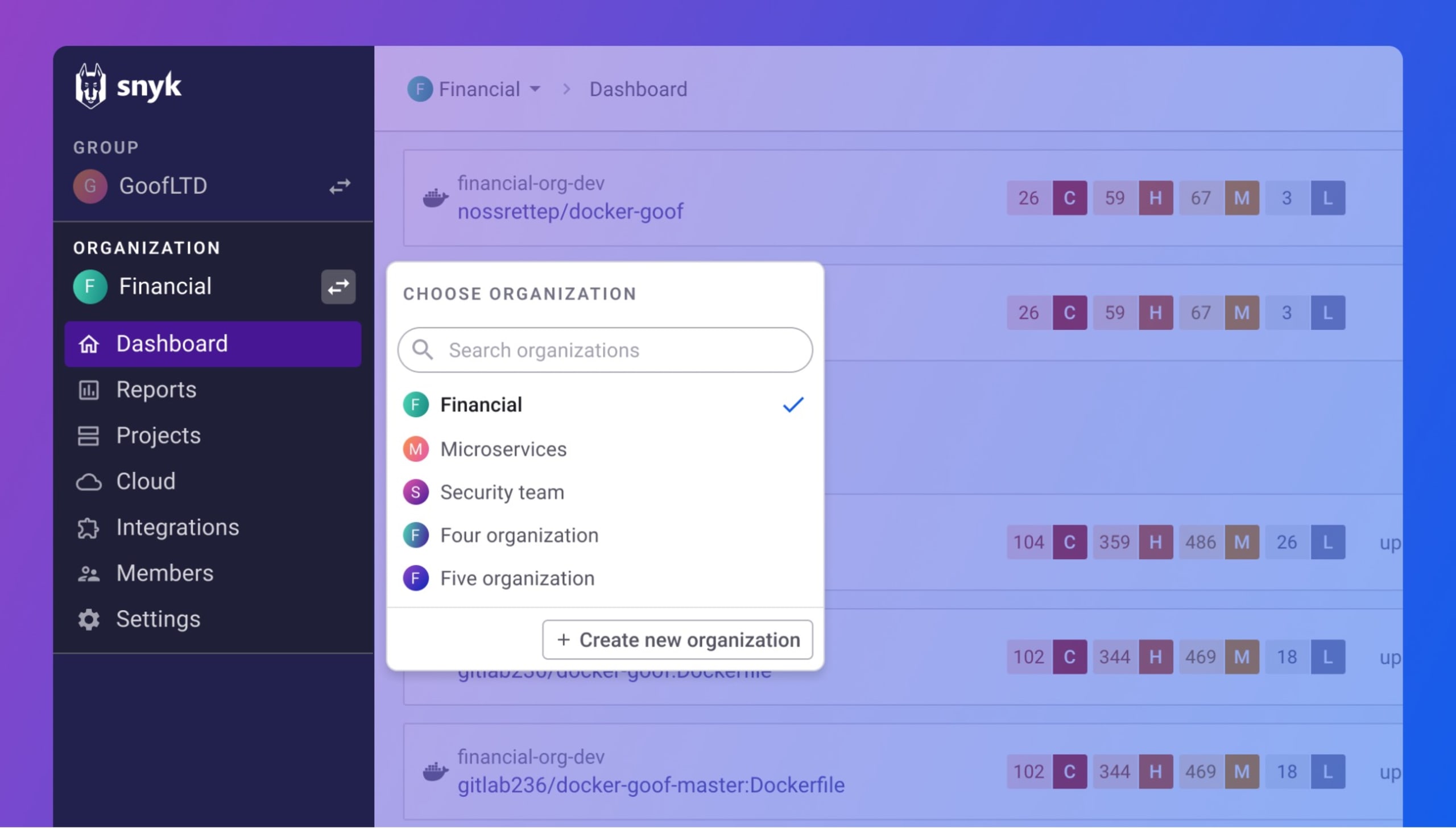
Snyk built its reputation on one idea: security should live where developers work. The company started in 2015 with a focus on open-source dependency scanning. It grew from there.
The platform now covers multiple security areas. You can scan code, containers, infrastructure as code, and open-source libraries. Each capability comes as a separate module. Think of it like building blocks.
Snyk’s biggest selling point is its proprietary vulnerability database. This database is three times larger than the next biggest public database. They claim to disclose vulnerabilities 47 days faster than public sources like the National Vulnerability Database.
For teams that want deep expertise in specific areas, Snyk delivers. You pick the modules you need. You pay for what you use. The trade-off? Complexity grows as you add more pieces.
Aikido Security’s All-in-One Strategy
Aikido Security took a different path. Founded more recently, the company saw how fragmented security tools had become. Their answer? Bundle everything into one product.
The platform includes seven scanner types out of the box:
- Static Application Security Testing (SAST)
- Dynamic Application Security Testing (DAST)
- Software Composition Analysis (SCA)
- Container scanning
- Secrets detection
- Cloud Security Posture Management (CSPM)
- Infrastructure as Code (IaC) scanning
Plus, they’ve added runtime protection to the mix. All of this comes in one package with flat-rate pricing. No per-seat charges. No module add-ons.
Aikido’s philosophy centers on correlation. They connect findings across your entire stack. A vulnerability in your code might not matter if it’s not reachable. Context helps teams focus on what actually creates risk.
What This Means for Your Choice
The philosophical difference shapes everything else. Snyk gives you flexibility to build your stack. Aikido gives you simplicity with everything included. Neither approach is wrong. The right choice depends on your team’s size, budget, and security maturity.
Vulnerability Detection Capabilities Compared
Detection is the heart of any security tool. If it can’t find vulnerabilities, nothing else matters. Let’s see how Snyk and Aikido Security stack up in this area.
Snyk’s Detection Strengths
Snyk’s vulnerability intelligence stands out immediately. Their research team adds vulnerabilities to their database before they hit public sources. That 47-day head start can make a real difference when a new threat emerges.
The Snyk Code product uses semantic analysis for SAST. It understands code context, not just pattern matching. This reduces false positives compared to older static analysis tools.
For open-source scanning, Snyk Open Source tracks over 11 million open-source packages. It maps dependencies recursively, showing you the full tree. A vulnerability buried three levels deep? Snyk will find it.
Container scanning with Snyk Container goes beyond just the image. It looks at base images, application dependencies, and operating system packages. You see exactly where vulnerabilities live.
Snyk IaC scans Terraform, CloudFormation, Kubernetes manifests, and more. It catches misconfigurations before they reach production. The rules library covers major compliance frameworks.
Aikido Security’s Detection Approach
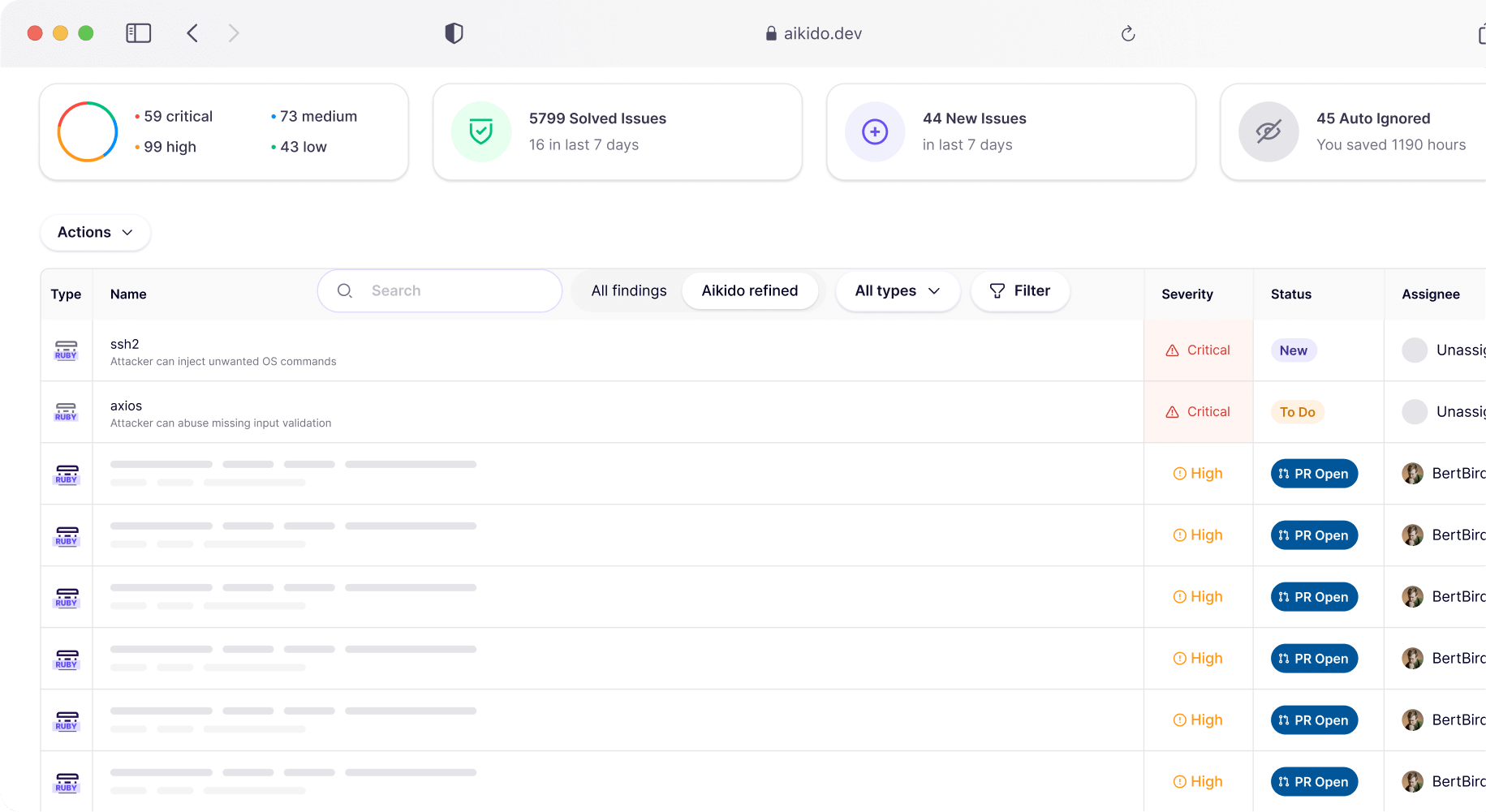
Aikido takes a different angle on detection. Rather than building the biggest database, they focus on signal over noise. Their platform pulls from standard sources like NVD and GitHub Security Advisories.
What sets Aikido apart is correlation. The platform connects findings across scanners. A SAST finding might link to an SCA vulnerability that connects to a cloud misconfiguration. You see the full attack path.
Their SAST engine now includes AI-powered autofix. When it finds a vulnerability, it suggests code changes. Developers can apply fixes with minimal context switching.
The DAST capabilities let you test running applications. Many competitors skip this. Aikido includes it by default. You catch vulnerabilities that only appear at runtime.
Secrets detection scans your codebase for exposed credentials. API keys, passwords, tokens. These often slip through code review. Aikido catches them automatically.
CSPM features monitor your cloud environment continuously. AWS, GCP, Azure. Misconfigurations get flagged as they happen. You don’t wait for the next scheduled scan.
Detection Comparison Table
| Detection Area | Snyk | Aikido Security |
|---|---|---|
| SAST | Snyk Code (separate module) | Included with AI autofix |
| SCA | Industry-leading database | Standard sources (NVD, GHSA) |
| DAST | Not native (requires integration) | Built-in |
| Container Scanning | Snyk Container (separate module) | Included |
| IaC Scanning | Snyk IaC (separate module) | Included |
| Secrets Detection | Limited | Full scanning included |
| CSPM | Not native | Included |
| Runtime Protection | Not native | Included |
Which Detection Approach Wins?
For pure SCA depth, Snyk leads. Their database and research team are hard to beat. If open-source vulnerability scanning is your top priority, Snyk delivers excellence.
For breadth of coverage in one tool, Aikido wins. You get seven scanner types without adding modules. The correlation engine ties findings together. Smaller teams especially benefit from this consolidated approach.
Pricing Models: Per-Seat vs Flat-Rate
Pricing often decides which tool you can actually buy. Let’s break down how each company charges and what that means for your budget.
How Snyk Charges Customers
Snyk uses per-developer seat pricing. The exact cost depends on which modules you need. Here’s the basic structure:
- Free tier: Limited scanning for small projects
- Team tier: Starts at $25 per developer per month
- Enterprise tier: Custom pricing with full features
Each module gets priced separately. Want Code, OSS, Container, and IaC? You’re paying for four products. Costs add up quickly as your team grows.
A 20-person development team could easily spend $6,000+ per year on just the basic modules. Enterprise features push that higher. Large organizations report six-figure annual contracts.
The per-seat model creates friction. When you hire new developers, your security costs increase. Some teams limit who gets access to keep costs down. That’s not great for security culture.
How Aikido Security Charges Customers
Aikido uses flat-rate pricing with unlimited users. Everyone on your team can access the platform without increasing your bill. The cost ties to your codebase size, not headcount.
This model brings predictability. You know what you’ll pay next month. Hiring five new developers doesn’t blow your security budget.
Startups especially like this approach. Cash is tight. Developer teams fluctuate. A fixed cost for security makes planning easier.
The “all features included” model also matters. No surprise add-ons. No upsells for DAST or secrets detection. Everything works from day one.
Total Cost of Ownership Comparison
Let’s model some real scenarios:
| Team Size | Snyk (Estimated Annual) | Aikido (Estimated Annual) |
|---|---|---|
| 5 developers | $1,500 – $3,000+ | Flat rate based on code |
| 20 developers | $6,000 – $15,000+ | Same flat rate |
| 50 developers | $15,000 – $40,000+ | Same flat rate |
| 100+ developers | $50,000 – $200,000+ | Enterprise tier flat rate |
Note: Snyk costs vary widely based on modules selected and negotiated enterprise pricing.
Hidden Costs to Consider
Beyond licensing, think about these costs:
With Snyk:
- Integration time for multiple modules
- Training across different interfaces
- Potential third-party tools for DAST, CSPM
- Professional services for complex setups
With Aikido:
- Possible migration from existing tools
- Learning curve for new platform
- Less specialized depth in some areas
The true cost includes more than the license fee. Factor in the time your team spends managing multiple tools versus one consolidated platform.
User Experience and Developer Adoption
Security tools only work if people use them. A clunky interface means developers find workarounds. Let’s compare how each platform handles user experience.
Snyk’s Interface and Workflow
Snyk positions itself as developer-friendly. The company has invested heavily in IDE plugins. Developers can scan code without leaving VS Code, IntelliJ, or their preferred editor.
The CLI tools work well for automation. CI/CD integration happens through plugins and direct CLI calls. Most major platforms have documented support.
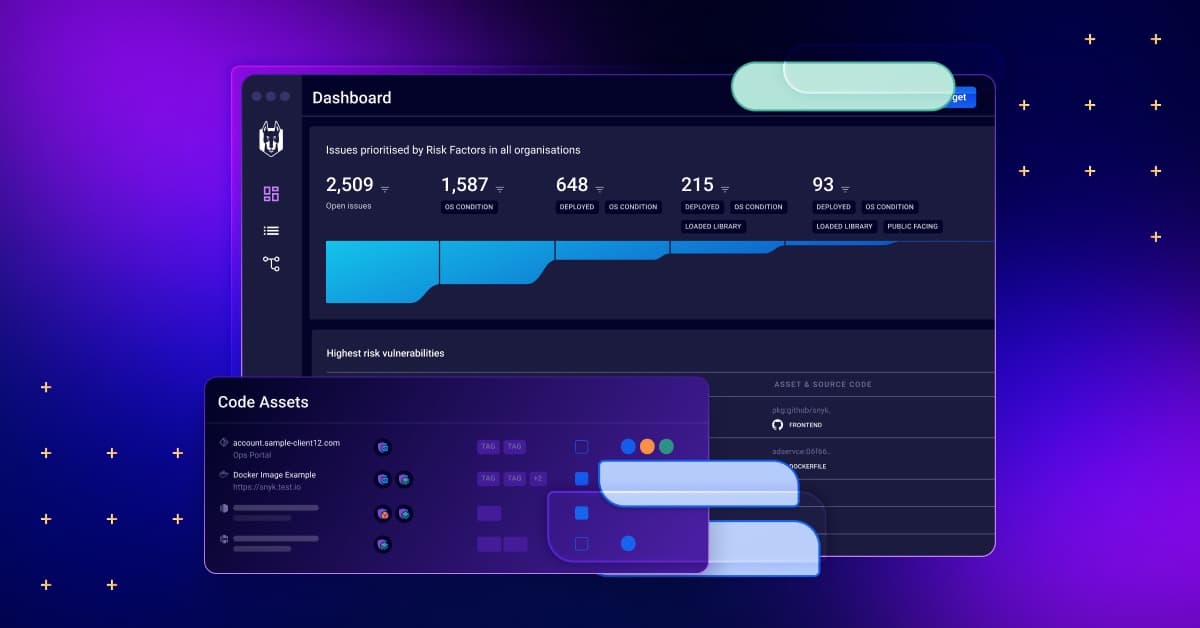
The web dashboard provides visibility across projects. You see vulnerability counts, fix status, and trends over time. Filtering helps focus on what matters.
Users on G2 rate Snyk at 4.4 stars based on 236 reviews. That’s solid but reveals some friction points.
Common complaints include:
- UI complexity as you add modules
- Onboarding challenges for new team members
- Add-ons that feel like they should be included
- Integration setup taking longer than expected
Power users love the depth. Casual users sometimes feel overwhelmed. The learning curve steepens as you adopt more modules.
Aikido Security’s Interface and Workflow
Aikido built its interface for simplicity. One dashboard shows all findings across all scanner types. No switching between modules or products.
The onboarding experience gets particular praise. Teams report going from signup to first scan in under an hour. Quick time-to-value matters when evaluating tools.
G2 shows Aikido at 4.8 stars based on 44 reviews. Fewer reviews, but higher satisfaction. Users highlight ease of use consistently.
The correlation engine surfaces related findings together. A vulnerability in your code links to the dependency it affects. You see the full picture without clicking through multiple screens.
IDE plugins exist but aren’t as mature as Snyk’s ecosystem. The platform is newer. The tooling continues to develop.
CI/CD integration works through standard approaches. GitHub Actions, GitLab CI, Jenkins. Setup is straightforward for common pipelines.
Comparing G2 Review Sentiments
Real user feedback tells a story:
What Snyk users love:
- Depth of vulnerability intelligence
- Automated fix PRs for dependencies
- Strong open-source community
- Enterprise-grade features
What Snyk users wish was better:
- Simpler pricing structure
- Less fragmented product experience
- Easier initial setup
- More features in base tier
What Aikido users love:
- All-in-one approach
- Fast onboarding
- Transparent pricing
- Prioritization across findings
What Aikido users wish was better:
- More mature ecosystem
- Deeper customization options
- Broader IDE support
- More integrations
Developer Adoption Rates
Adoption matters more than feature lists. The best security tool is the one developers actually use.
Snyk’s brand recognition helps initial adoption. Many developers have heard of it. That familiarity reduces resistance to new tools.
Aikido’s simplicity drives sustained usage. When a tool is easy, people keep using it. The flat-rate pricing removes barriers to adding users.
Consider your team’s culture. Do developers prefer specialized tools? Snyk’s modular approach might resonate. Do they want one solution? Aikido’s consolidated platform could win.
Integration Ecosystem and DevOps Compatibility
Modern development involves dozens of tools. Your security platform needs to fit into that ecosystem. Let’s examine how each product integrates.
Snyk’s Integration Landscape
Snyk has years of integration development behind it. The ecosystem runs deep.
Source control integrations:
- GitHub (cloud and enterprise)
- GitLab (all tiers)
- Bitbucket (cloud and server)
- Azure Repos
CI/CD platform support:
- Jenkins (native plugin)
- GitHub Actions
- GitLab CI
- CircleCI
- Azure Pipelines
- Bamboo
- TeamCity
Container registries:
- Docker Hub
- Amazon ECR
- Google Container Registry
- Azure Container Registry
- JFrog Artifactory
IDE plugins:
- VS Code
- IntelliJ IDEA
- Eclipse
- Visual Studio
Issue tracking:
- Jira
- GitHub Issues
- ServiceNow
The API allows custom integrations. Enterprise customers often build connections to internal systems. Documentation exists for common scenarios.
Aikido Security’s Integration Approach
Aikido’s integration list is shorter but covers the essentials. The platform is newer, so the ecosystem continues growing.
Source control support:
- GitHub
- GitLab
- Bitbucket
- Azure DevOps
CI/CD integration:
- GitHub Actions
- GitLab CI
- Standard CLI for other platforms
Cloud provider connections:
- AWS
- Google Cloud Platform
- Microsoft Azure
Communication tools:
- Slack
- Microsoft Teams
The built-in CSPM means cloud connections come ready. No third-party tool needed to monitor your cloud posture.
Integration Depth vs Breadth
| Integration Area | Snyk | Aikido Security |
|---|---|---|
| Source Control | Extensive with deep features | Major platforms covered |
| CI/CD | Native plugins for most platforms | CLI-based, major platforms native |
| Container Registries | Broad support | Growing support |
| IDE Plugins | Mature ecosystem | Basic support, improving |
| Issue Trackers | Multiple options | Standard options |
| Cloud Providers | Through partnerships | Native CSPM connection |
What This Means for Your Pipeline
If you use niche or legacy tools, check Snyk’s integration list first. They likely support it. Years of development created a broad ecosystem.
If you use standard modern tooling, Aikido covers your needs. GitHub, GitLab, AWS. The major players work. Less common tools might require workarounds.
Consider future growth too. Will you adopt new tools? How quickly do you need security integrations for them? Snyk’s larger team means faster integration development typically.
Vulnerability Prioritization and Risk Scoring
Finding vulnerabilities is step one. Knowing which to fix first is step two. This section compares how each platform helps you prioritize.
Snyk’s Prioritization Methods
Snyk uses Priority Score to rank vulnerabilities. This score combines multiple factors:
- CVSS score (base severity)
- Exploit maturity (is there working exploit code?)
- Social trends (what’s being discussed?)
- Reachability (can the vulnerable code actually run?)
- Fixability (is there a patch available?)
The score runs from 0 to 1000. Higher means more urgent. This helps cut through the noise of hundreds of findings.
Reachability analysis deserves special mention. Snyk traces code paths to see if vulnerable code can actually execute. A library with a critical vulnerability might score lower if your code never calls the affected function.
For open-source dependencies, Snyk shows the dependency path. You see how a vulnerable package entered your project. Direct dependency? Transitive? This context helps understand fix complexity.
Aikido Security’s Prioritization Approach
Aikido takes a cross-platform correlation approach. Rather than scoring individual findings, they connect findings across your stack.
A vulnerability matters more when:
- It’s exposed to the internet
- It affects production environments
- Multiple attack paths lead to it
- Sensitive data is at risk
The platform builds attack trees. A code vulnerability connected to a cloud misconfiguration connected to exposed credentials creates a path. That path gets priority over isolated findings.
Runtime data factors in too. Aikido’s runtime protection sees what actually runs. A vulnerability in unused code matters less than one in hot paths.
The dashboard groups related findings. Instead of 500 individual issues, you might see 50 clusters. Each cluster represents a cohesive risk area. Fix the cluster, not just one finding.
Comparing Prioritization Effectiveness
Both platforms aim to reduce noise. They take different routes.
Snyk excels when:
- You need detailed scoring methodology
- Open-source dependencies are your main concern
- You want to customize scoring weights
- Compliance requires documented risk calculations
Aikido excels when:
- You want to see full attack paths
- Your risk spans code, cloud, and runtime
- You prefer grouped findings over individual items
- Context across the SDLC matters most
Real-World Prioritization Example
Consider this scenario: Your application has 300 vulnerabilities across code, dependencies, and cloud config.
With Snyk: You’d see each finding scored. Sort by Priority Score. Work through high scores first. Each module might have its own prioritization. You combine them mentally.
With Aikido: You’d see findings grouped into maybe 40 risk areas. Five clusters might be critical. These clusters show connected findings. Fix all parts of a cluster together.
Neither approach is universally better. Your team’s workflow determines which fits. Do you want granular control? Snyk. Do you want curated groupings? Aikido.
Remediation Features and Fix Automation
Finding problems is helpful. Fixing them is what matters. Let’s compare the remediation capabilities of each platform.
Snyk’s Automated Fix Features
Snyk pioneered automated fix pull requests. For dependency vulnerabilities, the platform can:
- Create a PR that bumps the vulnerable package
- Choose the minimal version change needed
- Include release notes and vulnerability details
- Run automatically when new vulnerabilities appear
This feature alone drives adoption for many teams. Developers see a PR ready to merge. Testing passes. They merge. Done. No manual version hunting.
For code vulnerabilities, Snyk Code suggests fixes. The suggestions appear inline with findings. Apply them or adapt them to your codebase.
Snyk’s fix recommendations consider compatibility. They won’t suggest a major version bump that breaks your build (usually). The logic accounts for semantic versioning.
Batch fixing helps too. Have 20 repositories with the same vulnerable dependency? Fix them all at once. Enterprise teams save hours.
Aikido Security’s Remediation Capabilities
Aikido includes AI-powered autofix for SAST findings. The system analyzes the vulnerability context and generates a fix suggestion.
For code issues, the AI considers:
- Surrounding code patterns
- Language idioms
- Security best practices
- Your existing style
Developers review the suggestion and apply with a click. The fix integrates into their normal workflow.
Dependency fixes work similarly to Snyk. Aikido identifies safe upgrade paths. It creates fix suggestions you can apply.
The correlation engine helps here too. When you fix a root cause, related findings resolve. Fix one cluster, close multiple issues.
For cloud misconfigurations, Aikido provides remediation steps. Some can be automated. Others require manual intervention. The platform guides you either way.
Remediation Feature Comparison
| Remediation Feature | Snyk | Aikido Security |
|---|---|---|
| Auto-generated PRs | Yes, mature feature | Yes |
| SAST fix suggestions | Manual suggestions | AI-powered autofix |
| Batch fixing | Strong enterprise feature | Available |
| Dependency upgrade paths | Detailed with compatibility | Standard suggestions |
| IaC fix recommendations | Code samples provided | Guided steps |
| Cloud remediation | Through integrations | Built-in guidance |
Time to Resolution Comparison
How fast can you go from finding to fix?
Snyk strengths:
- Automated PRs ship fixes fast
- Minimal developer involvement for simple cases
- Years of refinement on the fix logic
Aikido strengths:
- AI fixes reduce manual coding time
- Cluster-based fixes close multiple issues
- Context helps developers understand what to fix
Both platforms reduce time to resolution compared to manual approaches. Your mileage varies based on your codebase and vulnerability types.
Cloud Security and Infrastructure Scanning
Modern applications live in the cloud. Your security tools need to understand that environment. Here’s how each platform handles cloud security.
Snyk’s Cloud Security Capabilities
Snyk approaches cloud security through Infrastructure as Code scanning. The Snyk IaC product catches misconfigurations before deployment.
Supported IaC formats include:
- Terraform (HCL)
- CloudFormation
- Kubernetes YAML
- Helm charts
- Azure Resource Manager templates
The rule library covers major compliance frameworks. CIS Benchmarks. SOC 2. HIPAA. PCI DSS. You see which rules apply to your requirements.
For runtime cloud monitoring, Snyk relies on partnerships. They integrate with cloud security partners rather than building native CSPM. This means additional tools and costs for full coverage.
Container scanning with Snyk Container adds another layer. You scan images before and after deployment. The integration with Kubernetes helps track what’s running.
Aikido Security’s Cloud Security Features
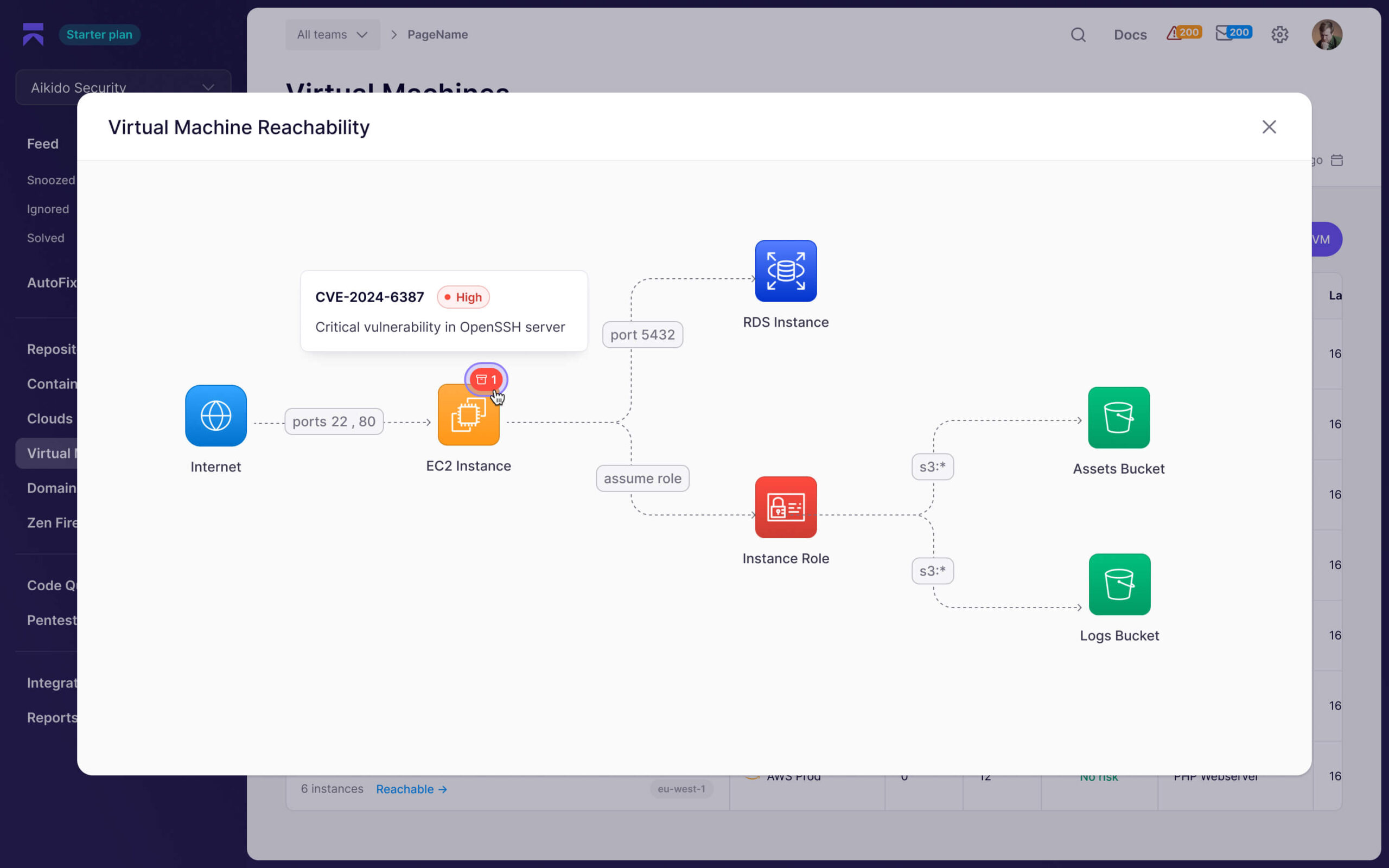
Aikido builds CSPM directly into the platform. No partnerships or add-ons needed. Cloud monitoring works out of the box.
Connect your AWS, GCP, or Azure accounts. Aikido starts monitoring immediately. You see misconfigurations across:
- IAM policies
- Storage bucket permissions
- Network security groups
- Encryption settings
- Logging configurations
- Compute instance settings
The platform correlates cloud findings with application vulnerabilities. A misconfigured S3 bucket connected to application code that accesses it creates a combined risk. You see that relationship.
IaC scanning works too. Catch problems in Terraform before they deploy. Then monitor the deployed infrastructure continuously. Coverage spans the full lifecycle.
Runtime protection adds active monitoring. Aikido watches your running applications. Anomalies trigger alerts. You catch attacks in progress, not just vulnerabilities waiting to be exploited.
Cloud Security Comparison Table
| Cloud Security Feature | Snyk | Aikido Security |
|---|---|---|
| IaC Scanning | Strong, multiple formats | Supported |
| Native CSPM | No (partnerships) | Yes, built-in |
| Cloud Provider Support | Through integrations | AWS, GCP, Azure native |
| Runtime Monitoring | Limited | Included |
| Compliance Mapping | Major frameworks | Major frameworks |
| Container Runtime | Snyk Container | Included |
Choosing Based on Cloud Maturity
Your cloud security maturity affects the choice.
Choose Snyk if:
- You already have a CSPM tool you like
- IaC scanning is your primary need
- You want best-of-breed for each area
Choose Aikido if:
- You want CSPM included without extra cost
- Correlating cloud and code findings matters
- You prefer one vendor for security
Enterprise Features and Scalability
Large organizations have different needs than startups. Let’s examine how each platform handles enterprise requirements.
Snyk’s Enterprise Offerings
Snyk has served enterprises for years. The platform handles large-scale deployments.
Role-based access control (RBAC): Define who sees what. Security teams see everything. Developers see their projects. Auditors get read-only access.
Single sign-on (SSO): SAML support for enterprise identity providers. Okta, Azure AD, OneLogin. Your IT team controls access centrally.
Audit logging: Track who did what when. Export logs to your SIEM. Meet compliance requirements for activity monitoring.
Custom policies: Write your own security rules. Enforce organization-specific standards. Block builds that violate policies.
Reporting: Executive dashboards show trends. Export data for board presentations. Custom reports for different stakeholders.
Support tiers: Enterprise customers get dedicated support. Named contacts. SLAs for response times. Professional services for complex deployments.
Snyk scales to thousands of repositories. Large financial institutions use it. Healthcare companies. Government contractors. The enterprise track record exists.
Aikido Security’s Enterprise Capabilities
Aikido has grown its enterprise features rapidly. The platform now serves larger customers.
Team management: Create teams and assign projects. Permissions flow from team membership. Adding people is straightforward.
SSO support: Enterprise identity providers work. Standard SAML configuration. Your IT team can manage it.
Compliance features: Mapping to SOC 2, ISO 27001, and others. See which findings affect compliance. Generate evidence for audits.
API access: Programmatic access for custom workflows. Export data to other systems. Build integrations your way.
Unlimited users: The flat-rate model means no seat limits. Everyone can have access. Security knowledge spreads across the organization.
Aikido wins pilots consistently according to their data. Fast onboarding appeals to enterprise buyers tired of long implementations. Transparent pricing helps budget discussions.
Enterprise Feature Comparison
| Enterprise Feature | Snyk | Aikido Security |
|---|---|---|
| RBAC | Granular controls | Team-based |
| SSO | Full SAML support | Full SAML support |
| Audit Logs | Comprehensive | Available |
| Custom Policies | Extensive customization | Growing capabilities |
| Reporting | Mature dashboards | Clear dashboards |
| Support Tiers | Multiple levels | Responsive support |
| Scale Tested | Fortune 500 companies | Growing enterprise base |
Which Platform for Enterprise?
For established enterprises with complex requirements, Snyk offers proven scale. The feature depth handles intricate access control. The track record provides confidence.
For growing companies entering enterprise territory, Aikido offers faster deployment. The all-in-one approach reduces vendor management. Pricing stays predictable as you scale.
Enterprises running pilots should test both. Your specific requirements determine the winner. Evaluate against your actual use cases, not marketing features.
Support, Documentation, and Community
When things break, you need help. Let’s compare the support ecosystems around each platform.
Snyk’s Support Infrastructure
Snyk has built extensive support resources over the years.
Documentation: Comprehensive docs cover every feature. Search works well. Getting started guides help new users. API documentation enables developers.
Snyk Learn: Free security education platform. Courses cover vulnerabilities, secure coding, and platform usage. Certifications available.
Community: Active community forums. User groups in major cities. Conferences and events. Twitter engagement from the team.
Blog: Regular security research publications. Vulnerability disclosures. Product updates. Technical deep dives.
Support channels:
- Free tier: Community support
- Team tier: Email support
- Enterprise tier: Dedicated support with SLAs
The ecosystem benefits from age. Years of content accumulation mean most questions have answers somewhere.
Aikido Security’s Support Model
Aikido focuses on responsive, direct support.
Documentation: Clear guides for core features. Growing coverage. Less depth than Snyk currently, but improving.
Onboarding: Hands-on help for new customers. Teams report fast time-to-value. Support helps with initial setup.
Communication: Direct access to the team. Slack channels for customers. Quick responses to questions.
Blog: Technical content about security topics. Product updates. Comparison guides. Growing content library.
Support approach: All customers get responsive support. No tiered delays based on pricing level. The team is accessible.
Aikido’s smaller size means closer relationships. You might chat with the founders. Feedback reaches product teams quickly.
Getting Help: What to Expect
With Snyk: Search documentation first. Most answers exist. Community might have edge cases. Enterprise support responds within SLA times.
With Aikido: Reach out directly. Expect quick responses. Less self-service content but more personal attention. Good for teams wanting relationship-based support.
Your support preferences matter. Do you want extensive self-service? Snyk’s maturity helps. Do you want direct access? Aikido’s team is reachable.
Migration Considerations and Implementation Time
Switching tools takes effort. Let’s think through what migration looks like for each option.
Migrating to Snyk
If you’re adopting Snyk, expect these steps:
1. Decide which modules you need. Code? OSS? Container? IaC? Each adds configuration time.
2. Connect repositories. GitHub, GitLab, or Bitbucket integration. Import your projects. Large organizations have hundreds.
3. Configure scanning. Set up which branches to scan. Configure PR checks. Tune severity thresholds.
4. Roll out to teams. Invite developers. Assign projects. Train users on the interface.
5. Integrate pipelines. Add Snyk to CI/CD. Configure fail conditions. Test the workflow.
Typical implementation takes weeks to months depending on organization size. Enterprise deployments need planning.
Professional services can accelerate this. Snyk offers implementation help for enterprise customers. Budget accordingly.
Migrating to Aikido Security
Aikido emphasizes fast onboarding. The process looks like:
1. Sign up and connect repos. One step brings in all your code. No module decisions needed.
2. Connect cloud accounts. AWS, GCP, or Azure. CSPM starts immediately.
3. Initial scan. All scanner types run. Results appear in one dashboard.
4. Invite the team. Unlimited users mean everyone can join. No seat counting.
5. Configure integrations. Slack, Jira, CI/CD. Standard setup process.
Teams report going from signup to scanning in under an hour. The consolidated platform simplifies initial setup.
Less configuration also means less customization initially. You might tune things later. But you get value fast.
Migration from Existing Tools
What if you’re switching from another security tool?
Consider:
- Historical data: Can you export/import findings?
- Suppression rules: Do you lose false positive markups?
- Custom policies: Do they translate?
- Training: How much relearning is needed?
Both Snyk and Aikido can coexist with existing tools during transition. Run them in parallel. Compare findings. Build confidence before cutting over.
Security Posture Management and Compliance
Beyond finding vulnerabilities, organizations need visibility into their overall security posture. Compliance requirements add another layer. Here’s how each platform addresses these needs.
Snyk’s Compliance and Posture Features
Snyk provides compliance mapping through its various modules.
IaC compliance: Rules map to CIS Benchmarks, SOC 2 controls, PCI DSS requirements. You see which findings affect which frameworks.
License compliance: For open-source dependencies, Snyk tracks licenses. GPL, MIT, Apache. Create policies about which licenses your organization allows.
Reporting for audits: Export vulnerability data. Show remediation timelines. Demonstrate due diligence to auditors.
Trends over time: Track how your security posture changes. Are you fixing faster than you’re accumulating? Dashboards show the trajectory.
Enterprise customers often need these features for regulated industries. Financial services, healthcare, government. Snyk’s reporting helps satisfy auditors.
Aikido Security’s Posture Management
Aikido approaches posture management holistically. The platform shows your security state across all dimensions.
Unified dashboard: One view of code, cloud, and runtime security. No switching between tools to understand your posture.
Compliance mapping: Findings map to frameworks like SOC 2 and ISO 27001. See gaps in your compliance coverage.
Risk trending: Watch risk scores change over time. See if you’re improving or declining. Spot regressions early.
Evidence collection: Generate reports for auditors. Show what you’ve found and fixed. Demonstrate continuous monitoring.
The CSPM integration helps here. Cloud compliance and application compliance in one platform. Auditors see the complete picture.
Compliance Framework Support
| Compliance Framework | Snyk | Aikido Security |
|---|---|---|
| SOC 2 | Mapping available | Mapping available |
| ISO 27001 | Mapping available | Mapping available |
| PCI DSS | Strong mapping | Mapping available |
| HIPAA | Mapping available | Mapping available |
| CIS Benchmarks | Extensive coverage | Cloud benchmarks |
| GDPR | Some controls | Some controls |
Performance and False Positive Rates
Speed and accuracy affect daily usability. Nobody wants slow scans or alert fatigue. Let’s compare how each platform performs.
Scan Speed Comparison
Snyk optimizes for speed in developer workflows. IDE scanning happens in seconds. PR checks complete quickly. Developers don’t wait long.
Full repository scans take longer. Large codebases might need minutes. Container image scans depend on image size. Performance is generally acceptable.
Aikido runs multiple scanner types in parallel. Initial scans cover more ground. The tradeoff is slightly longer initial setup time. Once configured, incremental scans are fast.
DAST scans inherently take longer. They test running applications. Aikido’s DAST adds time but catches issues static analysis misses.
False Positive Management
False positives waste developer time. Both platforms work to reduce them.
Snyk’s approach:
- Reachability analysis filters unreachable code
- Proprietary database has curated entries
- Users can mark false positives
- Machine learning improves over time
Aikido’s approach:
- Correlation reduces noise
- Runtime data validates findings
- Context-aware prioritization
- Users can suppress findings
Neither platform claims zero false positives. That’s impossible. But both actively work to reduce them. Users report reasonable accuracy from both.
Performance Tips
To get the best performance:
With Snyk:
- Configure ignore files for irrelevant code
- Tune severity thresholds
- Use targeted scans during development
- Full scans on schedule, not every commit
With Aikido:
- Start with default configurations
- Review correlation groupings
- Use suppression for known issues
- Let the platform learn your codebase
Future Development and Company Direction
Where are these companies heading? Product roadmaps matter for long-term decisions.
Snyk’s Direction
Snyk continues expanding its platform. Recent focus areas include:
- AI-powered features for code analysis
- Improved developer experience
- Deeper enterprise capabilities
- Broader language and framework support
The company has raised significant funding. Resources exist for continued development. Expect steady feature additions.
Snyk’s challenge is integration. As modules multiply, keeping the experience cohesive gets harder. Watch how they address this.
Aikido Security’s Direction
Aikido is younger and moving fast. Their trajectory includes:
- Expanding integration ecosystem
- Deepening AI capabilities
- Growing enterprise features
- Improving scanner accuracy
Being smaller means faster pivots. User feedback reaches product teams quickly. Expect rapid iteration.
Aikido’s challenge is competing with established players. They need to keep innovating to maintain differentiation.
Industry Trends Affecting Both
Broader trends will shape both platforms:
- AI integration: Expect more AI-powered features from both
- Supply chain security: SBOM requirements are increasing
- Shift left: Earlier scanning continues to matter
- Consolidation: Buyers want fewer tools, not more
These trends favor Aikido’s consolidated approach but don’t rule out Snyk’s modular strategy. The market has room for both approaches.
Making Your Decision: Snyk vs Aikido Security
After all this analysis, how do you choose? Let’s summarize key decision factors.
Choose Snyk When
- Open-source security is your top priority. Snyk’s database and fix PRs lead the industry.
- You want modular flexibility. Buy only what you need. Add capabilities over time.
- Enterprise maturity matters. Proven at scale with Fortune 500 companies.
- Deep IDE integration helps your workflow. Snyk’s plugins are mature.
- You have budget for best-of-breed tools. Per-seat pricing works if cost isn’t primary concern.
Choose Aikido Security When
- You want everything in one tool. Seven scanner types without module decisions.
- Budget predictability matters. Flat-rate pricing with unlimited users.
- Fast onboarding is a priority. Get scanning in under an hour.
- Cloud security should be included. Native CSPM without add-ons.
- Correlation across findings helps your team. See connected risks, not isolated alerts.
Quick Comparison Summary
| Criteria | Snyk | Aikido Security |
|---|---|---|
| Best For | Teams wanting depth in specific areas | Teams wanting breadth in one platform |
| Pricing Model | Per-developer seat, per-module | Flat-rate, unlimited users |
| Scanner Types | Modular (add as needed) | 7 types included |
| CSPM | Through partnerships | Built-in |
| G2 Rating | 4.4 stars (236 reviews) | 4.8 stars (44 reviews) |
| Onboarding Speed | Weeks to months | Hours to days |
| Best Differentiator | Vulnerability database | All-in-one simplicity |
Trial Both Before Deciding
Free trials exist for both platforms. Use them.
Connect your actual repositories. Scan your real code. See what findings appear. Evaluate the experience with your team.
No comparison article can replace hands-on testing. Your codebase, team, and workflow are unique. Let your specific context guide the final decision.
Conclusion
Snyk and Aikido Security both protect your applications, but they do it differently. Snyk offers modular depth with industry-leading vulnerability intelligence. Aikido provides consolidated breadth with simpler pricing. Your choice depends on whether you prefer specialized tools or all-in-one simplicity. Consider your team size, budget model, cloud security needs, and how quickly you need to deploy. Test both platforms with your actual code before committing. The right tool is the one your team will actually use every day.
Frequently Asked Questions About Snyk vs Aikido Security
| Which tool is better for small startups? | Aikido Security typically fits startups better due to flat-rate pricing with unlimited users. You won’t pay more as your team grows. The all-in-one approach also means fewer tools to manage when resources are limited. Snyk’s per-seat model can get expensive quickly as you hire. |
| Can Snyk and Aikido Security be used together? | Yes, some organizations run both. They might use Snyk for its open-source database depth while using Aikido for CSPM and correlation. This adds complexity and cost, but it’s possible if you want specific strengths from each platform. |
| Which platform has better false positive rates? | Both platforms work to minimize false positives. Snyk uses reachability analysis and curated databases. Aikido uses correlation and runtime data. User reviews suggest reasonable accuracy from both. Your results will depend on your specific codebase and languages. |
| How long does it take to set up each platform? | Aikido claims setup in under an hour for basic scanning. Snyk implementations typically take weeks to months for full enterprise deployment. The difference comes from Aikido’s consolidated approach versus Snyk’s modular configuration requirements. |
| Which platform offers better support for compliance requirements? | Both platforms map findings to major compliance frameworks like SOC 2, ISO 27001, and PCI DSS. Snyk has more mature reporting for enterprise audits. Aikido’s built-in CSPM provides unified compliance visibility across code and cloud. |
| Does Aikido Security have the same vulnerability database quality as Snyk? | No, Snyk’s proprietary database is larger and discloses vulnerabilities faster. Aikido relies on standard public sources like NVD and GHSA. For organizations where early vulnerability disclosure is critical, Snyk has an advantage. |
| Which platform is better for container security? | Snyk Container is a dedicated product with deep container scanning capabilities. Aikido includes container scanning as part of its unified platform. For pure container focus, Snyk offers more features. For combined container and cloud security, Aikido’s integration is compelling. |
| What happens when I need to scale my security program? | With Snyk, scaling means higher costs as you add developers and modules. With Aikido, your flat rate stays consistent regardless of team size. Consider your growth plans when evaluating total cost of ownership over multiple years. |
| Which tool has better developer experience? | Snyk pioneered developer-friendly security with mature IDE plugins and automated fix PRs. Aikido emphasizes simplicity with one dashboard for all findings. Developer preference varies. Test both with your team to see what resonates. |
| Should I migrate from Snyk to Aikido Security or vice versa? | Migration makes sense if your current tool doesn’t fit your needs. Moving from Snyk to Aikido makes sense if you want consolidation and simpler pricing. Moving from Aikido to Snyk makes sense if you need deeper specialization in specific areas. Evaluate your specific pain points before switching. |

 Stack Insight is intended to support informed decision-making by providing independent information about business software and services. Some product details, including pricing, features, and promotional offers, may be supplied by vendors or partners and can change without notice.