
Cycode Review


Cycode Review 2026: Complete Analysis of the AI-Native Application Security Platform
Application security has become a top priority for development teams everywhere. With code vulnerabilities making headlines and supply chain attacks on the rise, companies need tools that actually work. Cycode positions itself as an AI-native application security posture management (ASPM) platform that brings everything together in one place. But does it deliver on that promise?
In this Cycode review, we’ll break down every aspect of the platform. We’ll look at its features, pricing approach, real customer feedback, and how it stacks up against competitors. Whether you’re a security engineer evaluating options or a development lead looking to simplify your security stack, this guide covers what you need to know. Let’s dig in.
What Is Cycode and What Does It Actually Do?
Cycode is an application security posture management platform built to secure the entire software development lifecycle. The company focuses on giving teams visibility from code to cloud. That means tracking security across your repositories, CI/CD pipelines, infrastructure as code, and runtime environments.
The platform ranks as the #9 solution in top ASPM tools according to industry analysts. It also holds the #10 spot in software supply chain security solutions. These rankings put Cycode in solid company alongside established players in the space.
The Core Problem Cycode Solves
Most organizations run multiple security tools that don’t talk to each other. You might have one tool for SAST, another for SCA, something else for secrets detection. The result? Alert fatigue, duplicate findings, and no clear picture of actual risk.
Cycode tackles this by consolidating everything into a single platform. As one customer put it: “Cycode is one of the best platforms in the market that allows us to centralize everything in one place replacing multiple tools.”
The platform doesn’t just aggregate alerts though. It uses what Cycode calls a Knowledge Graph to connect findings with context about your development environment. This helps teams understand which vulnerabilities actually matter and who should fix them.
Who Built Cycode?
Cycode was founded by security experts with backgrounds in intelligence and enterprise software. The company has raised funding from well-known investors and built a growing customer base across industries. Their focus from day one has been on making application security practical for development teams, not just security specialists.
Key Features and Capabilities: A Close Look at the Cycode Platform
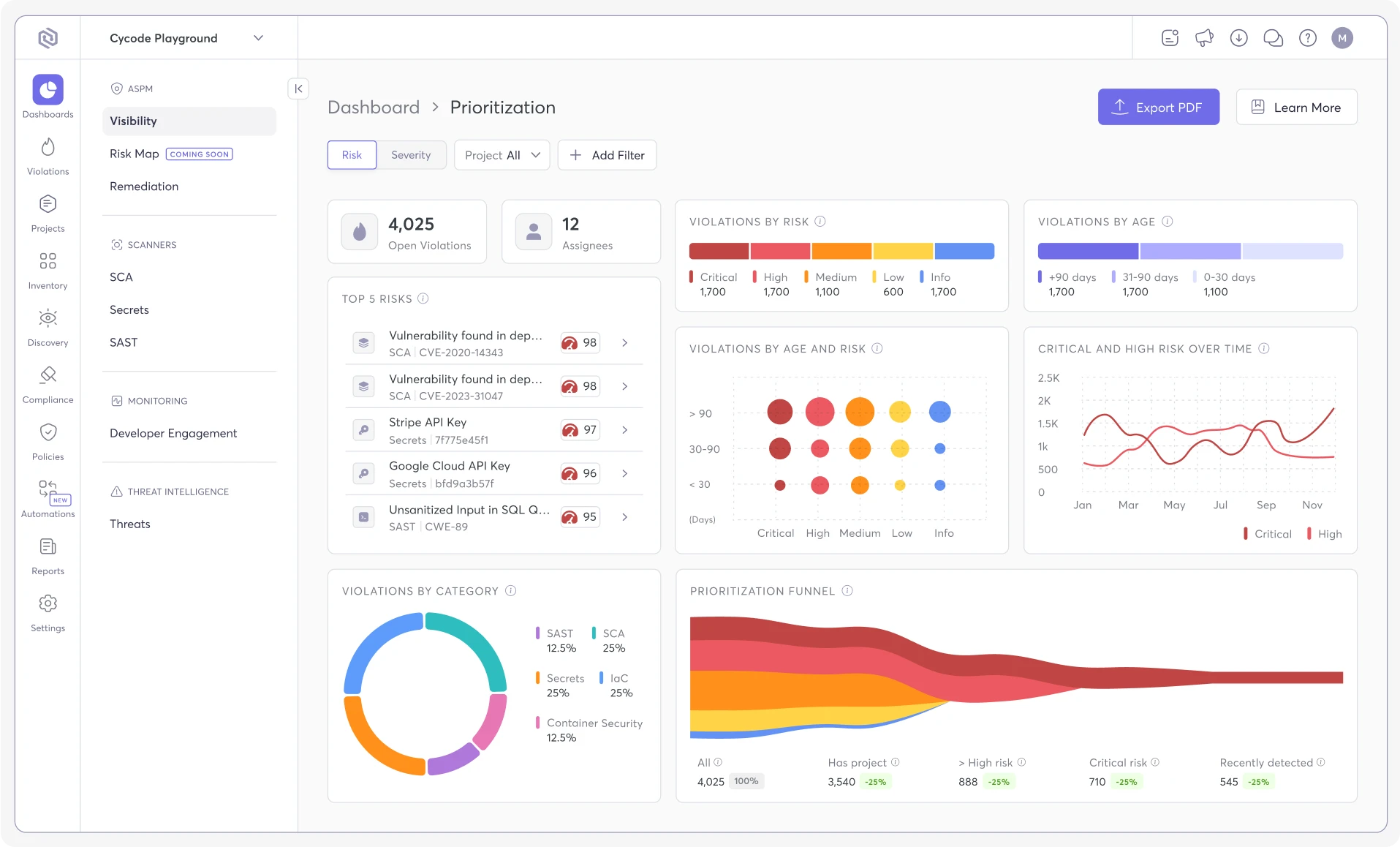
Understanding what Cycode offers requires looking at each major capability. The platform bundles several security functions that would otherwise require separate tools. Here’s what you get.
Application Security Posture Management (ASPM)
ASPM sits at the heart of what Cycode does. This isn’t just another dashboard. The ASPM layer connects findings from all your security tools and maps them to your actual codebase, repositories, and pipelines.
- Unified visibility across all application security tools
- Risk prioritization based on business context and exploitability
- Ownership mapping that connects vulnerabilities to responsible teams
- Compliance tracking for frameworks like SOC 2 and ISO 27001
One verified user on Gartner Peer Insights noted: “The product offers a platform with comprehensive application security capabilities with streamlined workflows, covering and giving us visibility for our posture across key systems.”
Source Code Security and Secret Detection
Leaked secrets remain one of the biggest causes of breaches. API keys, passwords, and tokens accidentally committed to repositories create easy entry points for attackers. Cycode scans for these continuously.
The secret detection engine works across:
- Git repositories (GitHub, GitLab, Bitbucket, Azure DevOps)
- CI/CD pipeline configurations
- Infrastructure as code files
- Container images and registries
When Cycode finds a hardcoded credential, it flags the issue before code reaches production. This pre-production blocking prevents secrets from ever making it into deployed applications.
Software Composition Analysis (SCA)
Open source components power most modern applications. But those dependencies bring risk. Cycode’s SCA capabilities identify vulnerable packages in your software supply chain.
The SCA module checks for:
- Known CVEs in direct and transitive dependencies
- License compliance issues
- Outdated packages that need updates
- Malicious packages in registries
Unlike standalone SCA tools, Cycode connects these findings to runtime context. A vulnerable library that’s never actually loaded poses less risk than one actively called in production code. The platform helps you tell the difference.
Static Application Security Testing (SAST)
SAST scans your source code for security flaws without running the application. Cycode includes SAST capabilities that analyze code as developers write it. Common findings include SQL injection patterns, cross-site scripting vulnerabilities, and insecure cryptographic practices.
The SAST engine supports major programming languages:
| Language | Coverage Level |
|---|---|
| JavaScript/TypeScript | Full |
| Python | Full |
| Java | Full |
| Go | Full |
| C#/.NET | Full |
| Ruby | Partial |
| PHP | Partial |
Infrastructure as Code (IaC) Security
Modern applications deploy through code. Terraform files, Kubernetes manifests, CloudFormation templates. These configuration files can contain security misconfigurations that create vulnerabilities in your cloud environment.
Cycode scans IaC files for issues like:
- Overly permissive IAM policies
- Unencrypted storage buckets
- Open security groups
- Missing network segmentation
- Insecure default configurations
Catching these problems in code is far cheaper than fixing them after deployment. Cycode shifts this security left into the development workflow where changes are easy to make.
CI/CD Pipeline Security
Your build pipeline is a prime target for attackers. A compromised pipeline can inject malicious code into every release. Cycode monitors CI/CD configurations for security weaknesses.
Pipeline security checks include:
- Exposed credentials in workflow files
- Unsigned or unverified build artifacts
- Missing branch protection rules
- Insecure runner configurations
- Third-party action vulnerabilities
This supply chain focus addresses the kind of attacks that hit SolarWinds and Codecov. Protecting the pipeline protects everything downstream.
The Knowledge Graph: Cycode’s Secret Weapon
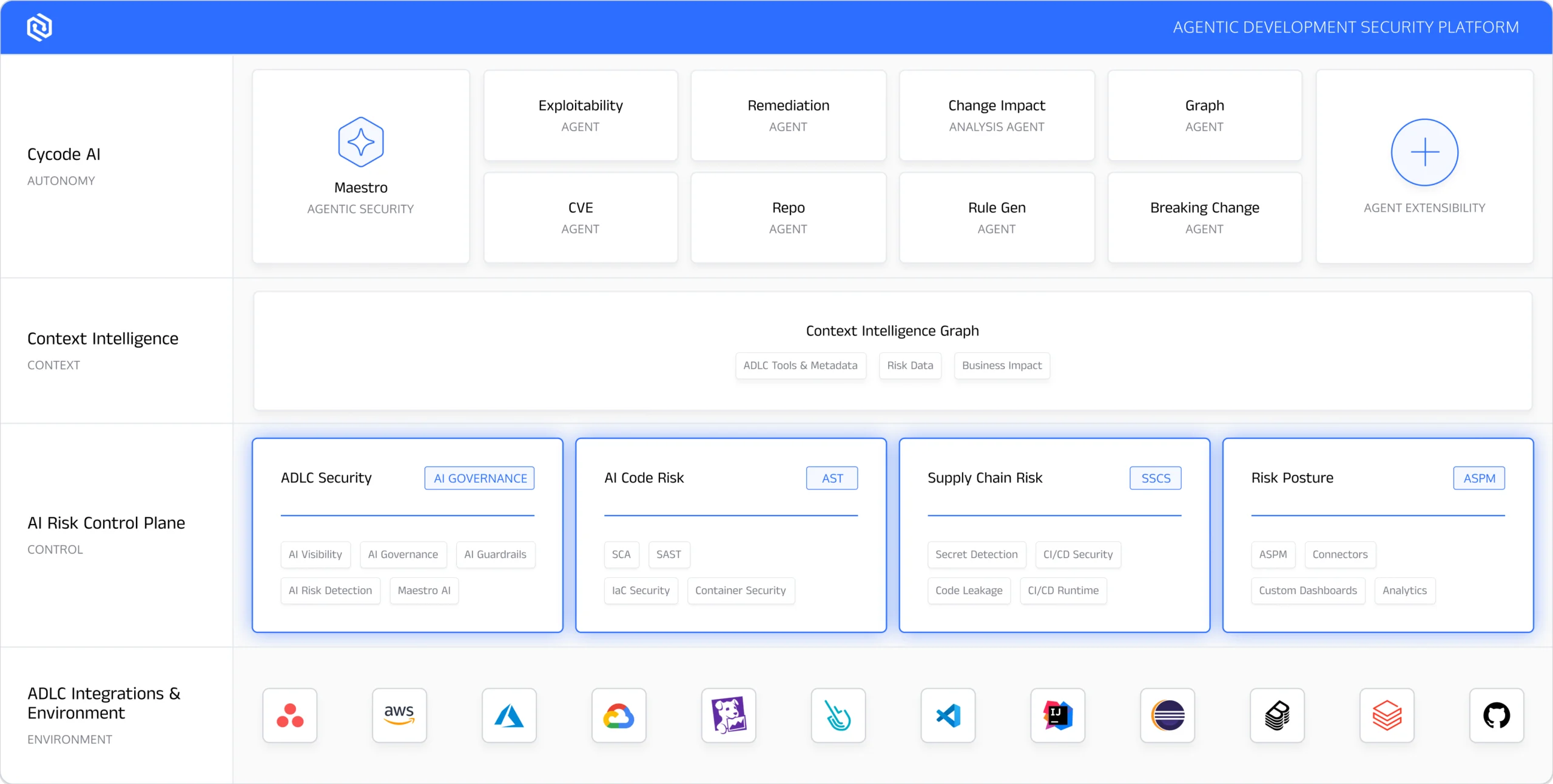
The Knowledge Graph deserves special attention because it’s what makes Cycode different from tools that just aggregate alerts. This graph database maps relationships between code, people, systems, and risks across your entire development environment.
According to Cycode’s documentation: “The Cycode platform makes AppSec tools better through its Knowledge Graph, which provides complete context of the SDLC to improve accuracy.”
What does this mean in practice? When the platform finds a vulnerability, it can tell you:
- Which developer introduced the code
- What applications use the affected component
- Whether the vulnerable code path is reachable
- How business-critical the affected systems are
- What compliance frameworks apply
This context transforms raw findings into actionable intelligence. Security teams stop chasing false positives and focus on real risks.
AI-Powered Features: How Cycode Uses Artificial Intelligence
AI has become a buzzword in security tools. Cycode’s approach focuses on practical applications that save time. Let’s look at what the AI actually does.
Auto Fix and Remediation
Finding vulnerabilities is only half the battle. Fixing them takes developer time. Cycode’s AI-powered auto-fix feature generates remediation code for common vulnerability types.
One customer highlighted this capability: “With Cycode AI’s Auto Fix and Remediation, our developers resolve vulnerabilities in record time, boosting productivity and code quality.”
The auto-fix engine handles patterns like:
- Upgrading vulnerable dependencies to patched versions
- Replacing insecure function calls with safe alternatives
- Adding input validation to prevent injection attacks
- Configuring secure defaults in IaC templates
Developers review and approve suggested fixes before merging. The AI handles the tedious work while humans maintain control over the final code.
Smart Prioritization
Not every vulnerability needs immediate attention. The AI scoring model weighs factors like:
- CVSS score of the underlying flaw
- Whether an exploit exists in the wild
- If the vulnerable code is reachable in runtime
- Business importance of affected applications
- Compliance requirements that apply
This ranking helps teams focus limited resources on issues that actually matter. A critical CVE in code that never runs is less urgent than a medium-severity bug in your payment processing system.
Natural Language Queries
Some ASPM platforms require complex query languages to search findings. Cycode lets users ask questions in plain English. Examples include:
- “Show me all critical vulnerabilities in the checkout service”
- “Which repos have exposed AWS credentials?”
- “List findings owned by the mobile team”
This accessibility makes the platform usable by team members who aren’t security specialists. Product managers and engineering leads can get answers without learning new syntax.
Real Customer Feedback: What Users Say About Cycode
Marketing materials only tell part of the story. Real user reviews reveal how Cycode performs in production environments. We gathered feedback from PeerSpot, Gartner Peer Insights, and published case studies.
Positive Feedback Themes
Consolidation of tools: Multiple reviewers praise Cycode for replacing fragmented security stacks. One user wrote: “Cycode is a fully featured ASPM tool with every application security need centralized in a single solution.”
Visibility improvements: Security teams consistently mention better visibility as a top benefit. A customer testimonial states: “Cycode has helped us with visibility and surfacing the security risk that exists in our software development process.”
End-to-end coverage: The code-to-cloud approach resonates with users. As one reviewer noted: “Cycode is one of the best ASPM platforms in the market that allows us to cover our security posture end to end.”
Developer experience: Several reviews highlight that developers actually use the platform, unlike some security tools that get ignored. The IDE integrations and auto-fix features receive specific praise.
Constructive Criticism
No platform is perfect. Here’s what some users wish was better:
- Learning curve: The Knowledge Graph and query capabilities take time to master fully
- Documentation: Some users requested more detailed technical docs for advanced configurations
- Custom rule creation: A few reviewers wanted more flexibility in writing custom detection rules
- Reporting customization: Enterprise users sometimes need more report formatting options
These critiques appear in a minority of reviews. Most users rate their experience positively overall.
Case Study: theScore
theScore, a sports media and betting company, deployed Cycode to improve their application security posture. According to published materials, “theScore Gains Full Code-to-Cloud Visibility with Cycode’s AI-Native Application Security Platform.”
Key outcomes from their implementation:
- Consolidated multiple point security tools into one platform
- Gained visibility into previously unknown risks
- Reduced mean time to remediation for vulnerabilities
- Improved collaboration between security and development teams
This case demonstrates Cycode’s value for organizations with complex development environments and strict security requirements.
Cycode Pricing and Plans: What Does It Cost?
Cycode doesn’t publish specific pricing on their website. Like most enterprise security platforms, they offer custom quotes based on your organization’s size and needs. Here’s what we know about their pricing approach.
Pricing Factors
Based on information from users and industry knowledge, Cycode pricing typically depends on:
| Factor | How It Affects Price |
|---|---|
| Number of developers | More developers = higher cost |
| Repository count | Large codebases may incur additional fees |
| Features selected | Full platform costs more than individual modules |
| Support level | Premium support adds to base price |
| Contract length | Multi-year deals often include discounts |
Getting a Quote
To get accurate pricing, you’ll need to contact Cycode directly. Their sales team typically asks about:
- Current security tool spending
- Number of active developers
- Languages and frameworks in use
- Cloud providers and deployment targets
- Compliance requirements
Expect the process to include a demo and possibly a proof-of-concept trial. Enterprise security purchases usually involve technical validation before finalizing contracts.
ROI Considerations
When evaluating cost, consider what Cycode might replace:
- Separate SAST tool subscription
- Standalone SCA platform
- Secret detection service
- IaC scanning solution
- Pipeline security tools
- Manual triage and prioritization effort
Organizations running five or more point solutions often find that consolidating into Cycode reduces total spend while improving coverage. The time savings from automated prioritization and remediation add additional value.
Cycode vs. Competitors: How Does It Compare?
The application security market includes several strong players. Understanding how Cycode stacks up helps you make an informed choice. Let’s compare against major alternatives.
Cycode vs. Snyk
Snyk is one of the most recognized names in developer security tools. Here’s how they compare:
| Capability | Cycode | Snyk |
|---|---|---|
| ASPM/Posture Management | Core focus | Added later |
| SAST | Included | Included (Snyk Code) |
| SCA | Included | Core strength |
| Secrets Detection | Included | Limited |
| Pipeline Security | Strong focus | Basic coverage |
| AI Auto-Fix | Included | Available |
| Knowledge Graph | Yes | No equivalent |
| Pricing Model | Enterprise custom | Developer-based tiers |
Bottom line: Snyk has broader brand recognition and a mature SCA product. Cycode offers stronger ASPM capabilities and better supply chain security coverage. Organizations that want full lifecycle visibility often prefer Cycode.
Cycode vs. Checkmarx
Checkmarx is an established enterprise security vendor with decades in the market.
| Capability | Cycode | Checkmarx |
|---|---|---|
| SAST Depth | Good | Excellent |
| SCA Coverage | Strong | Strong |
| ASPM Platform | Native | Acquired/Added |
| Deployment Options | Cloud-native | Cloud and on-prem |
| Modern CI/CD Integration | Excellent | Good |
| Enterprise Features | Growing | Mature |
| Cost | Mid-range | Premium |
Bottom line: Checkmarx suits organizations that need on-premise deployment or have existing relationships with the vendor. Cycode appeals to teams that want a cloud-native, unified platform built from the ground up.
Cycode vs. Semgrep
Semgrep focuses on lightweight, customizable code scanning.
| Capability | Cycode | Semgrep |
|---|---|---|
| Primary Focus | Full ASPM | SAST/Code scanning |
| Custom Rules | Supported | Core strength |
| SCA | Included | Added feature |
| Secrets Detection | Strong | Available |
| Pipeline Security | Comprehensive | Limited |
| Knowledge Graph | Yes | No |
| Free Tier | No | Yes (open source) |
Bottom line: Semgrep works well for teams that want maximum rule customization and can live without ASPM features. Cycode provides a more complete platform for organizations that want everything in one place.
Cycode vs. GitLab Security
GitLab includes security scanning in its DevOps platform.
| Capability | Cycode | GitLab Security |
|---|---|---|
| Multi-SCM Support | Yes (GitHub, GitLab, Bitbucket, etc.) | GitLab only |
| Scanner Quality | Purpose-built | Integrated but basic |
| ASPM Features | Comprehensive | Limited |
| Cross-tool Correlation | Yes | Within GitLab only |
| Pricing | Separate purchase | Included in Ultimate tier |
Bottom line: GitLab’s built-in security works for teams fully committed to GitLab’s ecosystem. Organizations using multiple SCM platforms or wanting deeper security capabilities need a dedicated tool like Cycode.
Deployment and Integration: Getting Started with Cycode
How hard is it to set up Cycode? What integrations does it support? Let’s cover the practical aspects of deployment.
Supported Integrations
Cycode connects with the tools development teams already use. Major integrations include:
Source Control Management:
- GitHub (Cloud and Enterprise)
- GitLab (SaaS and Self-Managed)
- Bitbucket (Cloud and Server)
- Azure DevOps
CI/CD Platforms:
- Jenkins
- GitHub Actions
- GitLab CI
- CircleCI
- Azure Pipelines
- Buildkite
Cloud Providers:
- AWS
- Google Cloud Platform
- Microsoft Azure
Issue Tracking:
- Jira
- ServiceNow
- Linear
- Slack (for notifications)
Developer Tools:
- VS Code extension
- IntelliJ IDEA plugin
- CLI for local scanning
Typical Deployment Timeline
Based on customer feedback, here’s what a typical Cycode rollout looks like:
| Phase | Duration | Activities |
|---|---|---|
| Initial Setup | 1-2 days | Connect SCM, configure basic scanning |
| Baseline Scan | 2-5 days | Full scan of existing codebase |
| Triage and Tuning | 1-2 weeks | Review findings, adjust policies |
| Pipeline Integration | 1 week | Add scans to CI/CD workflows |
| Team Training | Ongoing | Developer onboarding, workflow refinement |
Most organizations see initial value within the first month. Full maturity, including custom policies and automated remediation, typically takes 3-6 months.
Implementation Best Practices
Teams that get the most from Cycode follow these patterns:
- Start with visibility mode: Run scans without blocking builds initially to understand your baseline
- Prioritize crown jewels: Focus first on your most sensitive repositories and applications
- Involve developers early: Get engineering input on policies before enforcement
- Use the Knowledge Graph: Invest time learning how to query and explore relationships
- Set realistic SLAs: Define response times for different severity levels that teams can actually meet
Security and Compliance Capabilities
For organizations with regulatory requirements, security tools need to support compliance efforts. Here’s how Cycode helps.
Compliance Framework Support
Cycode includes built-in policies aligned with major frameworks:
- SOC 2: Controls for secure development practices
- ISO 27001: Information security management requirements
- PCI DSS: Payment card industry standards for secure coding
- HIPAA: Healthcare data protection requirements
- GDPR: Data privacy and protection rules
- NIST: Cybersecurity framework alignment
The platform generates compliance reports showing which controls are met and where gaps exist. This documentation helps during audits and assessments.
Supply Chain Security Standards
New regulations increasingly focus on software supply chain security. Cycode supports:
- SLSA Framework: Supply-chain Levels for Software Artifacts
- SBOM Generation: Software Bill of Materials in SPDX and CycloneDX formats
- Provenance Tracking: Verification of artifact origins and build processes
These capabilities address requirements from executive orders and industry guidelines around software supply chain integrity.
Data Security
Cycode handles sensitive code and security data. Their security practices include:
- SOC 2 Type II certification for the platform
- Encryption in transit and at rest
- Role-based access controls
- Audit logging for all platform activities
- Data retention controls
For organizations with strict data residency requirements, Cycode offers deployment options in multiple regions.
Developer Experience: How Cycode Fits into Daily Workflows
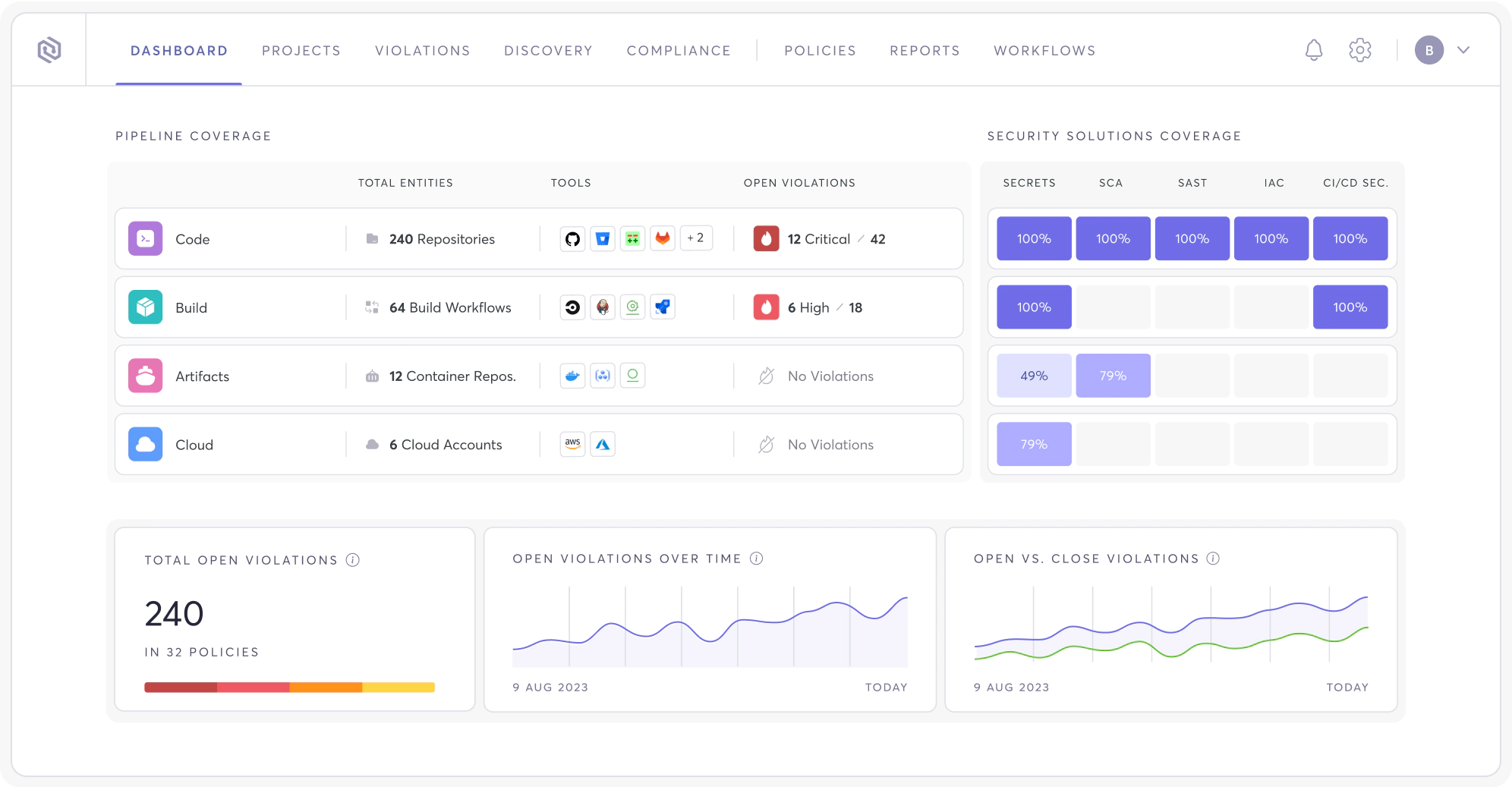
A security tool is only useful if developers actually use it. Cycode has invested heavily in developer experience. Let’s see what that looks like in practice.
IDE Integration
The VS Code and IntelliJ extensions bring scanning into the editor. Developers see issues as they write code, before even committing. This immediate feedback loop catches problems when they’re easiest to fix.
Features in the IDE plugins include:
- Real-time vulnerability highlighting
- One-click view of finding details
- Suggested fixes within the editor
- Links to relevant documentation
Pull Request Scanning
When developers open PRs, Cycode scans the changes and posts results as comments. The scan focuses on new or modified code, not the entire codebase. This keeps feedback relevant and reduces noise.
PR checks can be configured to:
- Block merges for critical findings
- Warn without blocking for lower severity issues
- Auto-approve if no new vulnerabilities are introduced
This flexibility lets teams balance security with development velocity.
Fix Suggestions
When Cycode finds an issue, it doesn’t just flag it. The platform often provides specific remediation guidance:
- Exact code changes needed
- Package versions to upgrade to
- Configuration values to update
- Links to documentation explaining the vulnerability
The AI-powered auto-fix takes this further by generating complete patches for common vulnerability patterns. Developers can review and apply fixes with minimal effort.
Reducing Alert Fatigue
One of the biggest complaints about security tools is too many alerts. Cycode addresses this through:
- Deduplication: Same finding across multiple scanners appears once
- Reachability analysis: Filters out vulnerabilities in unused code paths
- Business context: Prioritizes based on application importance
- Noise suppression: Learns from dismissed findings to reduce false positives
Teams report spending less time triaging and more time fixing actual risks.
Performance and Scalability
Enterprise deployments need platforms that can handle scale. Here’s what to expect from Cycode’s performance.
Scan Speed
Cycode uses incremental scanning to analyze only changed files when possible. Full repository scans depend on codebase size:
| Repository Size | Typical Scan Time |
|---|---|
| Small (under 10K lines) | Under 1 minute |
| Medium (10K-100K lines) | 2-5 minutes |
| Large (100K-1M lines) | 10-20 minutes |
| Very large (1M+ lines) | 30+ minutes |
PR scans on changed files typically complete in under a minute, keeping developer workflows fast.
Scaling to Large Organizations
Cycode supports organizations with:
- Thousands of repositories
- Multiple SCM providers simultaneously
- Hundreds of active developers
- High-volume CI/CD pipelines
The cloud-native architecture scales automatically without customer intervention. No need to provision additional infrastructure as your codebase grows.
API and Automation
For advanced use cases, Cycode provides APIs to:
- Query findings programmatically
- Trigger scans on demand
- Export data to other systems
- Manage policies as code
- Integrate with custom workflows
This programmability allows security teams to build automation tailored to their processes.
Support and Customer Success
The quality of vendor support matters, especially during complex deployments. Here’s what Cycode offers.
Support Tiers
Cycode provides different support levels:
- Standard support: Email and ticket-based, business hours response
- Premium support: Faster SLAs, dedicated contacts, extended hours
- Enterprise support: Named account managers, 24/7 coverage, custom integrations
Specific terms vary by contract. Discuss support requirements during the sales process.
Documentation and Training
Self-service resources include:
- Product documentation and guides
- Video tutorials for common tasks
- API reference documentation
- Community forums for peer discussion
- Regular webinars on new features
Enterprise customers may also receive:
- Custom onboarding sessions
- Technical training for security teams
- Developer workshops on secure coding
- Architecture reviews for complex deployments
Customer Success Programs
Larger accounts often get assigned customer success managers who help with:
- Adoption tracking and recommendations
- Quarterly business reviews
- Feature request prioritization
- Best practice sharing
- Executive briefings on security trends
This ongoing partnership helps organizations get maximum value from their investment.
Strengths and Weaknesses: Honest Assessment
Every platform has trade-offs. Here’s a balanced view of where Cycode excels and where it could improve.
Key Strengths
1. True ASPM Platform
Cycode was built as an ASPM tool from the start, not pieced together through acquisitions. This shows in the integrated experience and the Knowledge Graph that connects everything.
2. Supply Chain Security Focus
Strong coverage of pipeline security, secrets detection, and dependency analysis addresses modern attack vectors that some competitors miss.
3. AI-Powered Remediation
The auto-fix capabilities genuinely save developer time. Other tools find problems; Cycode also helps solve them.
4. Code-to-Cloud Visibility
Connecting findings from source code through deployment to runtime provides context that point solutions lack.
5. Developer-Friendly Design
IDE integrations, PR comments, and fix suggestions make security actionable for developers, not just security teams.
Areas for Improvement
1. Brand Recognition
Cycode is newer than some competitors. Larger enterprises may require more validation before committing.
2. Custom Rule Flexibility
While improving, custom rule creation isn’t as mature as specialized tools like Semgrep.
3. On-Premise Options
Organizations that can’t use cloud services may find deployment options limited compared to traditional vendors.
4. Pricing Transparency
Like most enterprise tools, you can’t easily compare pricing without talking to sales. This slows evaluation.
Who Should Use Cycode?
Cycode works well for certain use cases and may be overkill for others. Let’s break down who benefits most.
Ideal Users
Mid-size to large development teams: Organizations with 50+ developers, multiple repositories, and complex CI/CD pipelines get the most value from ASPM consolidation.
Security-conscious industries: Financial services, healthcare, and technology companies with strict compliance requirements benefit from the compliance mapping features.
Teams drowning in alerts: If your current tools generate more noise than signal, Cycode’s prioritization and deduplication provide relief.
DevOps-mature organizations: Teams that already have CI/CD pipelines and infrastructure as code can immediately use Cycode’s full capabilities.
Companies consolidating tools: If you’re paying for multiple point solutions, Cycode can reduce costs while improving coverage.
Less Ideal Fits
Very small teams: A startup with five developers and one repository may not need a full ASPM platform. Simpler tools might suffice.
Air-gapped environments: Organizations that can’t connect to cloud services need to explore on-premise options that Cycode may not offer.
Single-tool needs: If you only need SAST and nothing else, a specialized tool might be more cost-effective.
Extremely custom requirements: Teams that need to write hundreds of custom detection rules may want tools with more flexible rule engines.
Industry Recognition and Awards
Cycode has earned recognition from analysts and publications. Notable mentions include:
- Ranked #9 in top Application Security Posture Management solutions
- Ranked #10 in Software Supply Chain Security solutions
- Featured in Cyber Defense Magazine as a publisher’s spotlight for ASPM
- Positive reviews on Gartner Peer Insights
- High ratings on PeerSpot and other review platforms
Gartner describes the solution in the context of ASPM tools that help organizations manage their application security posture at scale. This analyst recognition helps validate the platform for enterprise buyers.
The Future of Cycode
Where is Cycode headed? Based on product announcements and market trends, we can expect continued evolution in several areas.
Likely Developments
- Expanded AI capabilities: More intelligent auto-remediation and predictive risk scoring
- Deeper runtime integration: Tighter connections between code findings and runtime behavior
- Enhanced compliance automation: More frameworks and automated evidence collection
- Broader language support: Coverage for additional programming languages and frameworks
- Partner ecosystem growth: More integrations with security and development tools
Market Positioning
The ASPM market continues growing as organizations realize point solutions create fragmentation. Cycode is well-positioned to capture this shift. Their early focus on the ASPM category gives them an advantage over vendors retrofitting existing products.
Competition will intensify as larger players invest in similar capabilities. Cycode’s success depends on continued innovation and maintaining their developer experience advantage.
Conclusion
Cycode delivers a solid ASPM platform that genuinely helps teams secure their software development lifecycle. The Knowledge Graph, AI-powered remediation, and code-to-cloud visibility set it apart from basic scanners. Real customers praise the consolidation benefits and improved risk visibility. For organizations ready to move beyond fragmented security tools, Cycode deserves serious consideration.
Frequently Asked Questions About Cycode Review
| What is Cycode used for? | Cycode is an application security posture management (ASPM) platform. It secures the software development lifecycle from code to cloud by combining SAST, SCA, secrets detection, IaC scanning, and pipeline security in one unified solution. |
| Who should use Cycode? | Cycode works best for mid-size to large development teams with multiple repositories, complex CI/CD pipelines, and compliance requirements. Security teams and DevOps engineers typically drive adoption, while developers use the day-to-day features. |
| How does Cycode compare to Snyk? | Snyk has stronger brand recognition and mature SCA capabilities. Cycode offers more comprehensive ASPM features and supply chain security. Organizations wanting full lifecycle visibility often prefer Cycode, while those focused mainly on dependency scanning may prefer Snyk. |
| What does Cycode cost? | Cycode uses custom pricing based on factors like developer count, repository volume, and features selected. You’ll need to contact their sales team for a quote. Most enterprise security tools in this category range from tens to hundreds of thousands annually. |
| How long does it take to deploy Cycode? | Initial setup takes 1-2 days. A baseline scan completes within a week. Full deployment with pipeline integration and team training typically takes 1-3 months depending on organization size and complexity. |
| Does Cycode support on-premise deployment? | Cycode is primarily a cloud-native platform. Organizations with strict on-premise requirements should discuss specific deployment options directly with Cycode’s team. |
| What integrations does Cycode support? | Cycode integrates with major SCM platforms (GitHub, GitLab, Bitbucket, Azure DevOps), CI/CD tools (Jenkins, GitHub Actions, CircleCI), issue trackers (Jira, ServiceNow), and cloud providers (AWS, GCP, Azure). IDE plugins are available for VS Code and IntelliJ. |
| Is Cycode good for small teams? | Small teams with limited repositories may find Cycode more than they need. The platform is designed for organizations with meaningful scale and complexity. Very small teams might start with simpler tools and grow into Cycode later. |
| What makes Cycode different from other security tools? | Cycode’s Knowledge Graph connects findings across the entire development lifecycle with context about code ownership, business criticality, and reachability. This unified view and AI-powered remediation differentiate it from tools that just generate alerts. |
| Does Cycode help with compliance? | Yes. Cycode includes built-in policies for SOC 2, ISO 27001, PCI DSS, HIPAA, and other frameworks. The platform generates compliance reports and tracks control implementation across your codebase. |



 Stack Insight is intended to support informed decision-making by providing independent information about business software and services. Some product details, including pricing, features, and promotional offers, may be supplied by vendors or partners and can change without notice.