
Ox Security Review


OX Security Review: A Complete Analysis of the AppSec Platform That Focuses on What Matters
Application security has become a real headache for development teams. Every day brings more alerts, more vulnerabilities, and more pressure to ship code faster. Traditional security tools weren’t built for this pace. They flood teams with thousands of findings, most of which don’t actually pose a real threat.
OX Security takes a different approach. Founded in 2021 by Check Point veterans Neatsun Ziv and Lior Arzi, this platform focuses on what they call the “5%” of vulnerabilities that actually matter. These are the ones that are exploitable, reachable, and can cause real damage to your organization.
In this OX Security review, we’ll break down every aspect of the platform. You’ll learn how it handles AI-generated code, software supply chain security, and vulnerability prioritization. We’ll look at real user feedback, compare it to competitors, and help you decide if it’s the right fit for your team.
What Is OX Security and Why Does It Exist?
OX Security emerged from a specific moment in cybersecurity history. The SolarWinds attack in 2020 changed how security leaders think about software supply chains. It showed that attackers could compromise trusted software and reach thousands of organizations at once.
The Founding Story Behind OX Security
Neatsun Ziv and Lior Arzi spent years at Check Point, one of the biggest names in network security. They watched the SolarWinds attack unfold and recognized a gap in the market. Traditional application security tools weren’t designed to protect the entire software development lifecycle.
In 2021, they launched OX Security with a clear mission. Help organizations stop chasing every vulnerability and start focusing on the ones that actually put them at risk. The company has since grown and earned recognition as a leader in the space.
OX Security’s Core Philosophy
The platform operates on a simple but powerful idea. Not all vulnerabilities are created equal. A vulnerability in a library that your code never actually calls isn’t the same as one sitting in a publicly exposed API endpoint.
OX Security claims that only about 5% of security findings represent real, exploitable risk. Their platform is built to identify that 5% and let teams ignore the noise. This approach addresses one of the biggest complaints about security tools: alert fatigue.
Recognition and Industry Standing
The company has earned notable recognition in the industry. OX Security was named a Leader in the first-ever 2026 Gartner Magic Quadrant for Software Supply Chain Security. They’ve also been listed in the Top 50 cyber winners, which signals that analysts and industry watchers see real value in their approach.
This recognition matters because the ASPM (Application Security Posture Management) market is getting crowded. Having independent validation helps potential buyers separate hype from substance.
Understanding the OX Security Platform Architecture
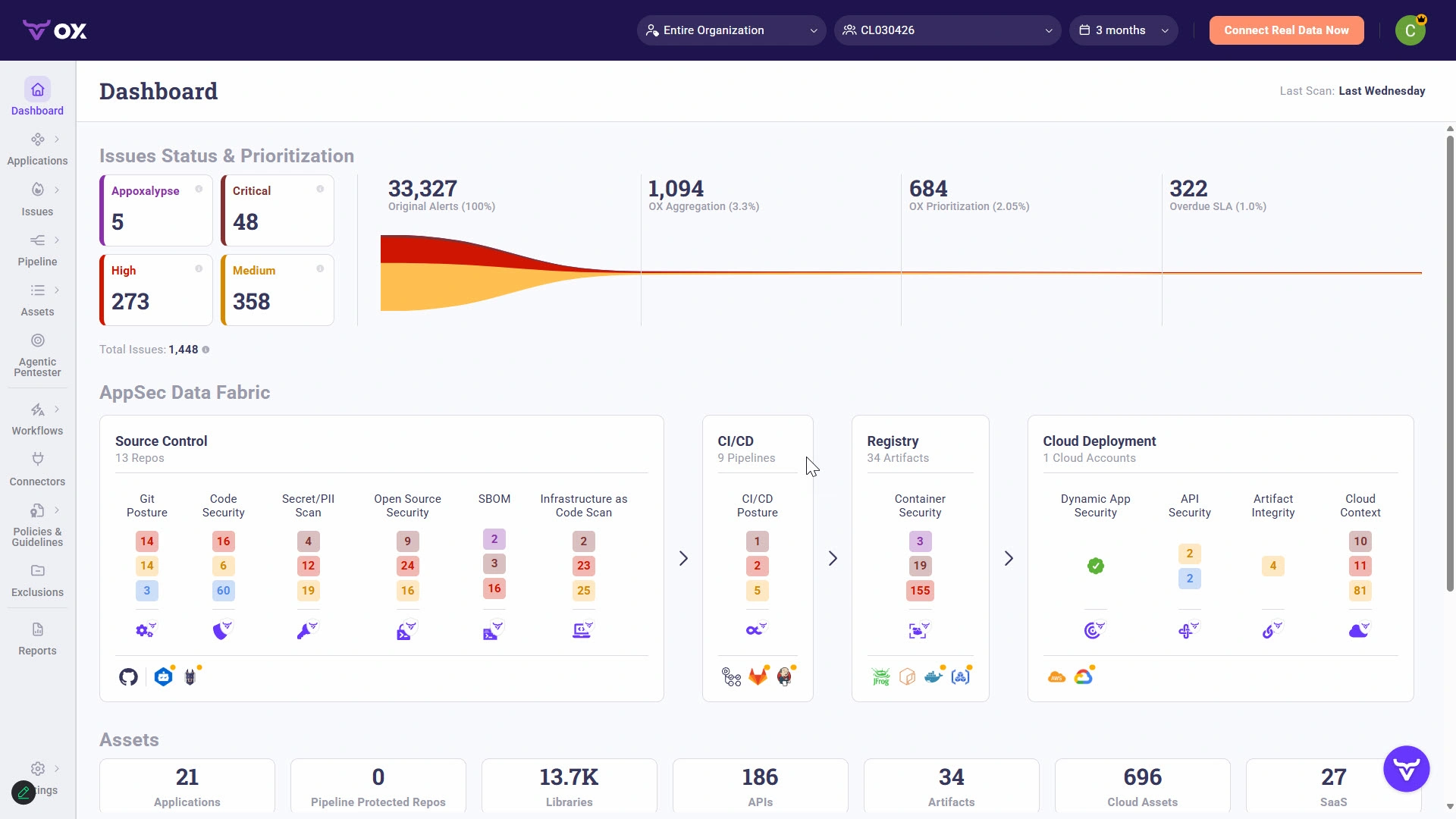
OX Security positions itself as a “Prompt to Runtime” security platform. This phrase captures their ambition to secure applications from the moment code is written until it’s running in production.
The SDLC Coverage Model
Traditional security tools often focus on just one phase of development. A SAST tool scans code. An SCA tool checks dependencies. A runtime tool monitors production. OX Security tries to connect all these phases into a single view.
The platform provides:
- Development phase monitoring: Watching code as it’s written, including AI-generated code
- CI/CD pipeline integration: Catching issues before they reach production
- Dependency analysis: Understanding the full software supply chain
- Runtime correlation: Connecting vulnerabilities to actual production exposure
This full-lifecycle approach means security teams don’t need to piece together information from multiple disconnected tools. Everything lives in one platform with shared context.
Integration With Existing Security Tools
OX Security doesn’t ask you to throw away your current security stack. Instead, it aggregates findings from third-party tools into a unified view. This is a smart approach because most organizations have already invested heavily in various security products.
The platform can pull data from:
- Static Application Security Testing (SAST) tools
- Software Composition Analysis (SCA) tools
- Container security scanners
- Infrastructure as Code (IaC) scanners
- Secret detection tools
- Cloud security posture management systems
By unifying these data sources, OX Security creates what they call “a unified view across the software supply chain.” This aggregation is where much of the platform’s value comes from.
The Technical Foundation
OX Security uses what they describe as reachability analysis to determine which vulnerabilities actually matter. This goes beyond just finding a vulnerability. The platform traces code paths to see if a vulnerable function is actually called in your application.
Consider this example: Your application uses a library with a known vulnerability in its XML parsing function. Traditional tools would flag this as a high-severity finding. But if your code never actually uses that XML parsing function, the vulnerability can’t be exploited through your application.
OX Security’s reachability analysis would identify this and deprioritize the finding. This is how they filter down to that 5% of vulnerabilities that truly represent risk.
AI Code Security: OX Security’s Response to Modern Development
AI-assisted coding has changed how software gets built. Tools like GitHub Copilot, ChatGPT, and various AI coding assistants now generate significant portions of application code. This creates new security challenges that traditional tools weren’t designed to handle.
Why AI-Generated Code Needs Different Security Approaches
Traditional security tools were built around human development speeds. A developer might write a few hundred lines of code per day. Security teams could review changes, run scans, and address findings in a reasonable timeframe.
AI coding assistants have exploded this model. A developer using Copilot might accept dozens of code suggestions in a single session. The volume of code entering repositories has grown dramatically. And each AI-generated commit expands the attack surface.
OX Security’s blog states it directly: “Traditional tools are no longer keeping up.” They argue that “AI security for AppSec demands a fundamentally different approach.”
How OX Security Handles AI-Generated Code
The platform includes specific capabilities for AI code security:
- Automatic prevention: OX Security can “automatically prevent vulnerabilities in AI-generated code, ensuring security from the first line”
- Point-of-creation detection: Rather than waiting for code to hit the repository, the platform can “pinpoint risk at its exact point of creation”
- Source elimination: The goal is to “eliminate it at the source” rather than tracking issues downstream
This approach recognizes that catching problems early costs far less than fixing them in production. When AI generates insecure code, you want to know immediately, not weeks later during a security review.
The Broader AI Application Security Challenge
OX Security’s AI security capabilities extend beyond just code generation. According to their documentation, they address “the broader AI application security challenge that extends beyond code generation to model behavior, agent workflows, and runtime exposure.”
This matters because AI is being embedded throughout applications, not just in code generation. Organizations are building AI agents, deploying models, and creating new types of attack surfaces that didn’t exist a few years ago.
The platform’s “Prompt to Runtime” positioning directly addresses this expanded threat landscape. Security teams need visibility into AI-related risks at every stage.
Software Supply Chain Security Capabilities
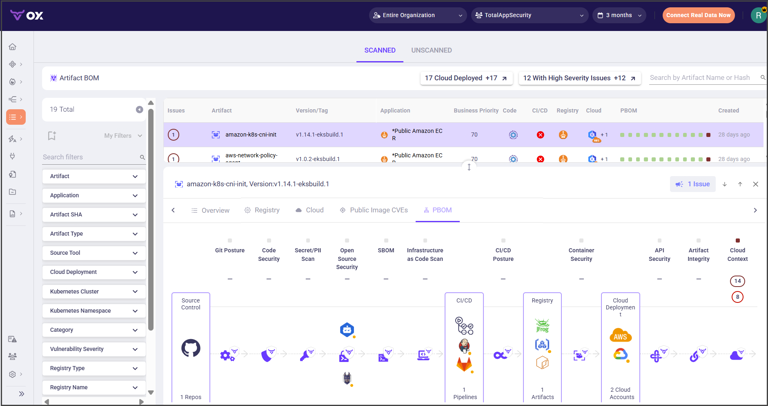
OX Security was born from the SolarWinds incident, so software supply chain security is central to their platform. This isn’t an afterthought or a feature added later. It’s baked into the company’s DNA.
Understanding Software Supply Chain Risks
Modern applications don’t exist in isolation. A typical enterprise application might include:
- Hundreds of open-source packages
- Dozens of third-party commercial components
- Multiple CI/CD tools and plugins
- Various cloud services and APIs
- Container images and base layers
Each of these represents a potential attack vector. A compromised dependency can give attackers a foothold in your application. A vulnerable CI/CD plugin can let them modify your build process. Supply chain attacks are attractive because they let adversaries reach many targets through a single compromise.
OX Security’s Supply Chain Visibility
The platform provides what they call “a unified view across the software supply chain, including third-party tools.” This visibility is the foundation for supply chain security. You can’t protect what you can’t see.
Specific capabilities include:
| Capability | Description | Business Value |
|---|---|---|
| Dependency mapping | Complete inventory of all direct and transitive dependencies | Know exactly what code you’re shipping |
| SBOM generation | Software Bill of Materials creation and management | Meet compliance requirements and customer requests |
| Pipeline integrity | Monitoring of CI/CD configurations and access | Prevent build process tampering |
| Third-party risk scoring | Assessment of vendor and component risk levels | Make informed decisions about what to include |
The Gartner Recognition for Supply Chain Security
Being named a Leader in the 2026 Gartner Magic Quadrant for Software Supply Chain Security validates OX Security’s capabilities in this area. Gartner’s Magic Quadrant evaluations consider multiple factors:
- Completeness of vision
- Ability to execute
- Market understanding
- Product capabilities
- Customer experience
Landing in the Leaders quadrant means Gartner sees OX Security as both visionary and capable of delivering. This is particularly notable because this was the first-ever Magic Quadrant specifically for Software Supply Chain Security. OX Security didn’t just participate in a new market category. They led it from day one.
Vulnerability Prioritization and Risk-Based Analysis
Alert fatigue kills security programs. When developers receive hundreds of findings, they stop taking any of them seriously. OX Security’s prioritization engine attempts to solve this by surfacing only what truly matters.
The 5% Philosophy in Practice
OX Security claims that only about 5% of vulnerabilities are “exploitable, reachable, and impactful.” This isn’t just marketing language. It reflects a real observation about vulnerability data.
Consider a typical enterprise application with 500 open-source dependencies. A standard SCA scan might find hundreds of vulnerabilities across those dependencies. But how many of them can actually be exploited?
- Some vulnerabilities require specific conditions that don’t exist in your environment
- Some are in code paths your application never calls
- Some require attacker access that your architecture prevents
- Some have theoretical impact but no practical exploit
OX Security’s analysis filters out these non-issues. What remains is the subset of vulnerabilities that actually put your organization at risk.
How the Prioritization Engine Works
The platform uses multiple factors to determine risk:
Reachability analysis: Does your code actually call the vulnerable function? If not, the vulnerability can’t be exploited through your application.
Exploitability assessment: Is there a known exploit? Is it being used in the wild? Theoretical vulnerabilities with no real-world exploits get deprioritized.
Business context: Where does this code run? A vulnerability in an internal tool is different from one in a customer-facing API.
Fix availability: Is there a patch? If a fix exists, remediation is straightforward. If not, you need to evaluate workarounds.
By combining these factors, OX Security creates a prioritized list that developers can actually work through. The most dangerous, most fixable issues rise to the top.
Real User Feedback on Prioritization
G2 reviews highlight the prioritization capabilities. Users appreciate that OX Security “streamlines issue management and enhances team focus.” One review mentioned getting “valuable insights” that helped them understand which issues deserved attention.
This feedback matters because prioritization claims are easy to make but hard to deliver. The fact that real users call out this capability as a strength suggests it’s working in practice.
CI/CD Integration and Pipeline Security
Security that slows down development doesn’t get used. OX Security’s approach to CI/CD integration aims to provide protection without becoming a bottleneck.
Early Detection in the Development Workflow
An OX Security customer testimonial states: “OX is essential to our AppSec strategy, streamlining security with early issue detection in the CI pipeline.”
This early detection model has significant advantages:
- Lower fix costs: Finding issues during development is far cheaper than finding them in production
- Faster feedback: Developers learn about problems while the code is fresh in their minds
- Prevention over remediation: Issues get fixed before they reach customers
- Reduced rework: No need to revisit and refactor code weeks later
Pipeline Configuration Monitoring
CI/CD pipelines themselves can be attack vectors. If an attacker can modify your build configuration, they can inject malicious code into your artifacts. OX Security monitors pipeline configurations to detect:
- Unauthorized changes to build scripts
- Addition of unknown plugins or actions
- Modification of deployment targets
- Changes to access controls and permissions
This pipeline security layer adds protection that most traditional AppSec tools don’t provide. It’s part of the broader supply chain security approach.
Balancing Security and Speed
Development teams live under constant pressure to ship features. Security tools that block deployments or add hours to build times become enemies, not allies.
OX Security’s approach tries to balance these tensions:
| Challenge | OX Security’s Approach |
|---|---|
| Too many alerts | Prioritization reduces findings to actionable subset |
| Slow scans | Incremental analysis focuses on changed code |
| Context switching | Findings appear where developers already work |
| Unclear remediation | Guidance explains how to fix issues, not just what’s wrong |
The goal is to make security feel like a natural part of development rather than an obstacle.
Static Application Security Testing (SAST) Features
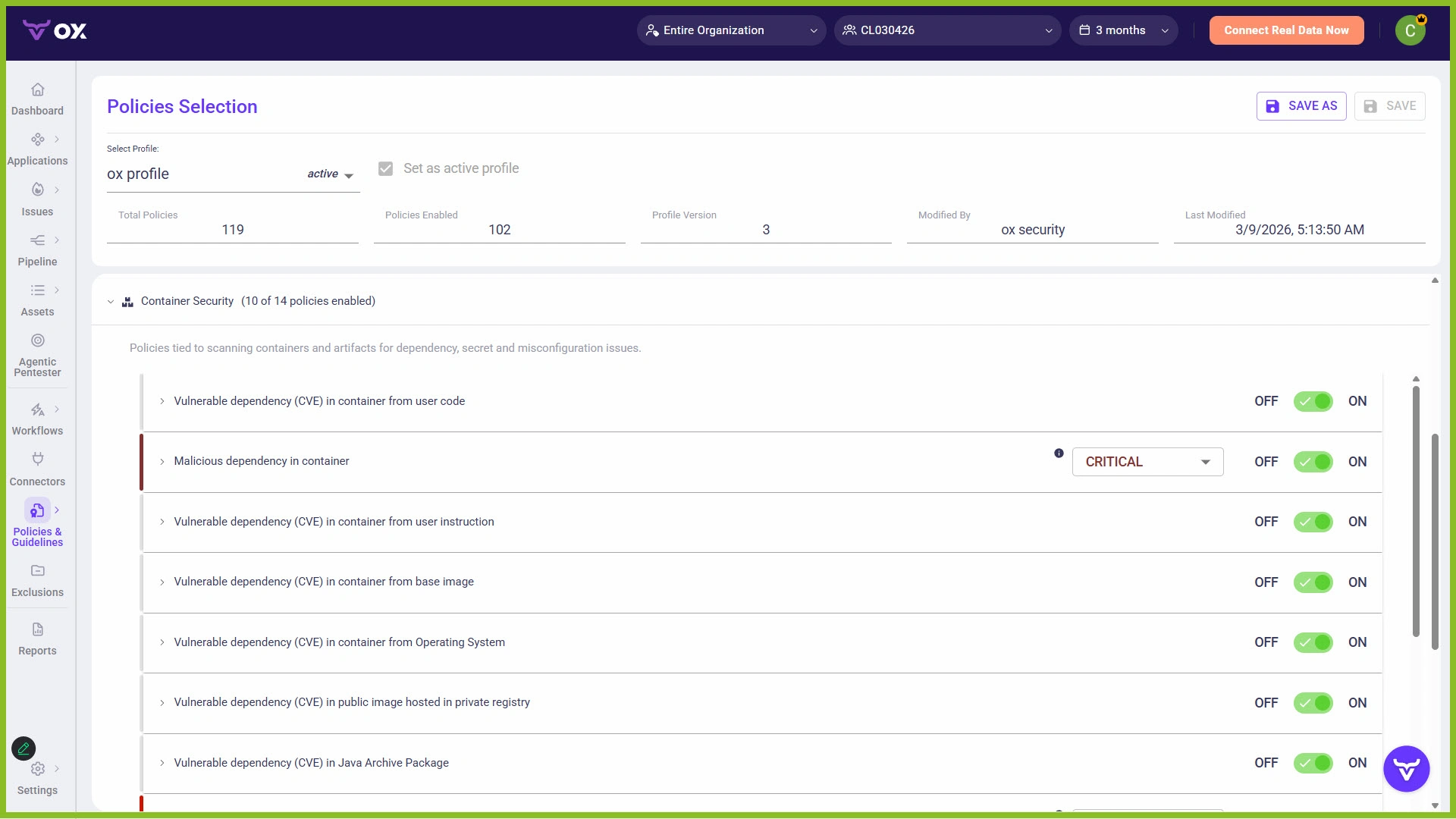
OX Security includes SAST capabilities as part of its broader platform. This code analysis helps find security issues in first-party code before it ships.
What SAST Does in the OX Security Platform
SAST analyzes source code without running it. The technology looks for patterns that indicate potential vulnerabilities:
- Injection flaws: SQL injection, command injection, XSS vulnerabilities
- Authentication issues: Weak password handling, session management problems
- Cryptography mistakes: Weak algorithms, improper key management
- Data exposure: Sensitive information in logs, error messages, or responses
- Access control gaps: Missing authorization checks, privilege escalation paths
Language and Framework Support
Effective SAST requires deep understanding of programming languages and frameworks. A generic scanner misses framework-specific vulnerabilities and generates false positives from legitimate patterns.
OX Security’s SAST capabilities cover major languages used in enterprise development. The platform understands framework conventions, which helps reduce false positives. When the scanner knows how Spring Security or Django’s authentication works, it can better identify when something’s actually wrong.
Integration With the Broader Platform
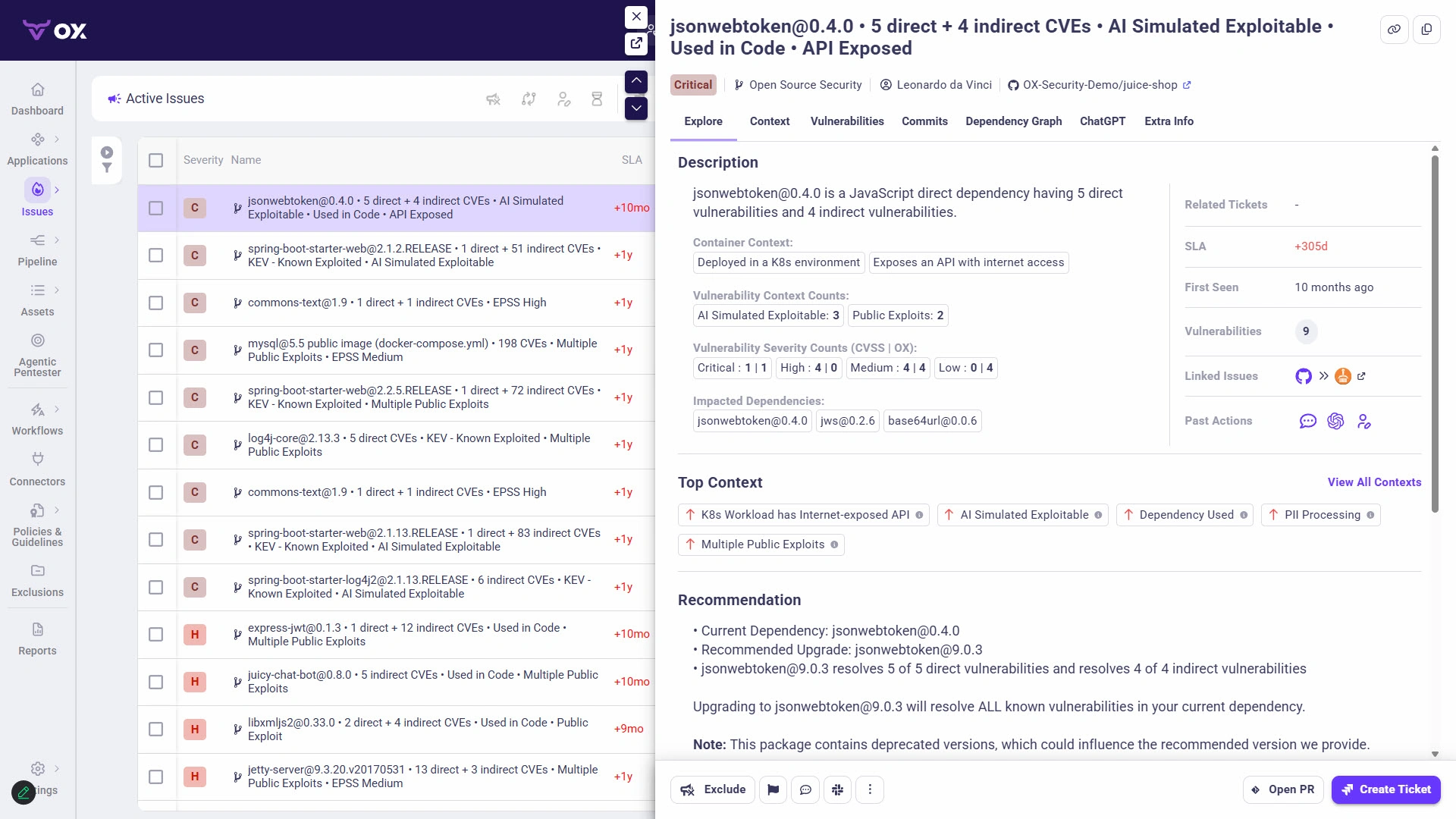
Unlike standalone SAST tools, OX Security’s code analysis connects to the rest of the platform. A SAST finding gets enriched with:
- Reachability information from runtime analysis
- Dependency context from SCA
- Business criticality from asset classification
- Historical data about similar issues
This enrichment helps with prioritization. A code vulnerability in a critical, externally-facing service ranks higher than the same issue in an internal tool.
Software Composition Analysis (SCA) Deep Dive
Modern applications are mostly built from other people’s code. SCA helps you understand and secure those dependencies.
The Dependency Challenge
A typical application might include a few dozen direct dependencies. But each of those has its own dependencies. And those have dependencies. This “transitive dependency” problem creates massive complexity.
An application with 30 direct dependencies might have 500 total packages when you count everything. Understanding this full graph is essential for security.
OX Security’s SCA Capabilities
The platform’s SCA features include:
Complete dependency graphing: Not just direct dependencies, but the full tree of transitive packages
Vulnerability correlation: Matching your dependencies against known vulnerability databases
License analysis: Identifying license obligations and conflicts (important for compliance)
Outdated component detection: Finding dependencies that haven’t been updated in a long time
Maintainer activity: Flagging dependencies with inactive or suspicious maintainers
Going Beyond Basic Vulnerability Matching
Simple SCA tools just check if your dependencies appear in vulnerability databases. OX Security goes further with reachability analysis.
Here’s why this matters. Suppose your application uses a library called “data-utils” version 2.3.1. A vulnerability database shows this version has a critical XML External Entity (XXE) vulnerability in its XML parsing module.
A basic SCA tool flags this as critical. Drop everything and upgrade immediately.
OX Security’s reachability analysis checks whether your code actually uses the XML parsing module. If you only use data-utils for its JSON functions, and never touch the vulnerable XML code, the practical risk drops significantly.
This doesn’t mean you should ignore the vulnerability. But it does mean you can prioritize it appropriately instead of treating it as an emergency.
Real User Reviews and Feedback Analysis
Marketing materials tell one story. User reviews tell another. Let’s look at what actual OX Security customers say about the platform.
Positive Feedback Themes
G2 reviews highlight several strengths:
Comprehensive testing: “Users appreciate the comprehensive security testing OX Security offers.” This suggests the platform’s breadth covers real customer needs.
Issue management: The platform succeeds at “streamlining issue management and enhancing team focus.” This addresses the alert fatigue problem many teams face.
Valuable insights: Customers find the analysis provides “valuable insights” beyond simple vulnerability lists.
Customer Testimonials
One testimonial comes from a customer at Upstream Security: “As one of OX Security’s first customers, I was searching for an effective solution to upscale Upstream Security’s application security stack.”
This quote reveals something important. Early customers were looking to grow their AppSec capabilities, not just add another tool. OX Security positioned itself as a platform for scaling security programs.
Another customer states: “OX is essential to our AppSec strategy, streamlining security with early issue detection in the CI pipeline and valuable insights.”
The word “essential” is strong. This customer sees OX Security as central to their security approach, not just a nice-to-have addition.
Areas for Consideration
No product is perfect for everyone. Based on available information, potential buyers should consider:
- Enterprise focus: OX Security appears designed for larger organizations with complex environments
- Integration requirements: Getting full value requires connecting multiple data sources
- Learning curve: Comprehensive platforms take time to configure and learn
- Pricing: Enterprise-grade platforms typically come with enterprise-grade pricing
Organizations should evaluate whether their needs match OX Security’s strengths.
OX Security vs. Competitors: How It Compares
The ASPM market includes several players. Understanding how OX Security compares helps with vendor selection.
OX Security vs. Legit Security
Legit Security is a direct competitor in the ASPM space. According to Legit’s own comparison page, both platforms “help security teams optimize their application security programs by adding clarity and prioritization to AppSec findings.”
Key differences according to Legit’s comparison:
| Aspect | OX Security | Legit Security |
|---|---|---|
| Target market | Enterprises across industries | Large enterprises in regulated industries |
| Framework mapping | Standard capabilities | Claims stronger framework mapping |
| Root cause remediation | Included | Claims this as a differentiator |
| AI positioning | “Prompt to Runtime” security | “AI-native ASPM platform” |
| Supply chain focus | Central to platform identity | Strong capabilities |
Note that this comparison comes from Legit’s marketing materials, which naturally favor their product. Independent evaluation is recommended.
Differentiating Factors for OX Security
OX Security’s competitive positioning emphasizes:
- The 5% focus: Strong prioritization to reduce alert noise
- Prompt to Runtime: Full lifecycle coverage including AI code security
- Supply chain heritage: Born from SolarWinds response, not bolted on later
- Gartner recognition: Leader status in the new Magic Quadrant category
Questions to Ask When Comparing
If you’re evaluating OX Security against competitors, consider asking:
- How does prioritization work in practice? Ask for specific examples with your tech stack.
- What integrations are available out of the box? Check coverage for your existing tools.
- How is AI-generated code handled? This becomes more important as AI coding adoption grows.
- What’s the implementation timeline? Understand the effort required to see value.
- How does pricing scale? Clarify per-developer, per-repository, or other models.
Implementation Considerations and Best Practices
Buying a platform is just the start. Getting value from it requires thoughtful implementation.
Getting Started With OX Security
Based on the platform’s architecture, a typical implementation path would include:
Phase 1: Discovery and Integration
- Connect source code repositories
- Integrate CI/CD pipelines
- Link existing security tools
- Import asset and application metadata
Phase 2: Configuration and Tuning
- Define business criticality for applications
- Set risk tolerance thresholds
- Configure notification and alerting rules
- Establish baseline metrics
Phase 3: Operationalization
- Train teams on using the platform
- Build remediation workflows
- Create dashboards and reports
- Define SLAs for vulnerability resolution
Success Factors
Organizations that get the most from ASPM platforms typically:
- Start with high-priority applications: Don’t try to onboard everything at once. Pick critical applications and prove value there first.
- Involve developers early: Security tools that developers hate don’t get used. Get their input on workflow integration.
- Define clear ownership: Someone needs to own the platform. Orphaned tools become shelfware.
- Measure outcomes: Track metrics like mean time to remediation, vulnerability counts over time, and developer satisfaction.
Common Implementation Challenges
Be prepared for these common obstacles:
| Challenge | Mitigation Strategy |
|---|---|
| Data quality issues | Clean up asset inventory before importing |
| Integration gaps | Verify specific tool versions and APIs are supported |
| Organizational resistance | Show value quickly with pilot projects |
| Alert fatigue (ironically) | Trust the prioritization and resist looking at everything |
| Scope creep | Phase the rollout rather than doing everything at once |
Pricing and Licensing Considerations
OX Security doesn’t publish pricing on their website. This is typical for enterprise security platforms where pricing depends on organization size, features needed, and negotiation.
What Affects ASPM Pricing
Enterprise security platforms typically price based on:
- Number of developers: More users means higher costs
- Repository count: Some platforms charge per connected repository
- Application volume: Number of applications under management
- Feature tiers: Advanced capabilities may require premium licensing
- Support levels: Enterprise support costs more than standard
Getting Pricing Information
To understand OX Security pricing for your organization:
- Prepare an inventory of repositories, applications, and developers
- List the integrations you’ll need
- Identify must-have vs. nice-to-have features
- Request a custom quote from OX Security sales
- Ask about pilot programs or proof-of-concept pricing
Total Cost of Ownership
Platform licensing is just part of the cost. Consider also:
- Implementation effort: Internal time and possibly professional services
- Training: Getting teams up to speed
- Ongoing administration: Someone needs to maintain the platform
- Process changes: Updating workflows to use the new tool
Balance these costs against the value: reduced vulnerability remediation time, fewer security incidents, faster and safer software delivery.
Use Cases and Ideal Customer Profile
OX Security isn’t right for every organization. Understanding who benefits most helps with evaluation.
Organizations That Benefit Most
Large enterprises with complex environments: Organizations running hundreds of applications across multiple teams get the most value from centralized visibility and prioritization.
Companies using AI coding assistants: The “Prompt to Runtime” capabilities specifically address risks from AI-generated code.
Organizations in regulated industries: SBOM requirements, compliance frameworks, and audit needs benefit from comprehensive tracking.
Teams drowning in security alerts: If your current tools generate more findings than you can handle, prioritization helps.
Companies concerned about supply chain attacks: Given OX Security’s origins and focus, supply chain security is a strength.
Organizations That Might Look Elsewhere
Small startups: The platform’s enterprise focus may be overkill for small teams with simple tech stacks.
Organizations wanting point solutions: If you just need SAST or just need SCA, a specialized tool might be better.
Teams without dedicated security staff: Getting value from a comprehensive platform requires someone to run it.
Industry Vertical Considerations
| Industry | Relevant OX Security Capabilities |
|---|---|
| Financial services | Supply chain security, compliance tracking, audit support |
| Healthcare | Vulnerability prioritization, SBOM generation, third-party risk |
| Technology | AI code security, CI/CD integration, developer experience |
| Manufacturing | Supply chain visibility, OT/IT convergence security |
| Retail | PCI compliance support, third-party component tracking |
The Future of Application Security and OX Security’s Position
The application security market is changing rapidly. Understanding where it’s heading helps evaluate long-term platform investments.
Trends Shaping AppSec
AI code generation expansion: AI coding assistants are becoming standard developer tools. Security platforms must adapt to this reality.
Supply chain focus: Regulatory requirements and attack trends are pushing more attention to software supply chains.
Platform consolidation: Organizations want fewer tools, not more. Comprehensive platforms are gaining over point solutions.
Developer-centric security: Shifting left continues. Security must work where developers work.
Runtime correlation: Static analysis alone isn’t enough. Connecting to runtime data provides better risk understanding.
How OX Security Aligns With These Trends
OX Security appears well-positioned for several of these trends:
- Their AI code security capabilities directly address the AI coding assistant trend
- Supply chain security is core to their identity, not an afterthought
- The comprehensive platform approach fits consolidation preferences
- CI/CD integration supports developer-centric workflows
- The “Prompt to Runtime” vision includes runtime correlation
Areas to Watch
As you evaluate OX Security for the long term, monitor:
- Product roadmap: Is the platform evolving to address emerging threats?
- Market position: How does Gartner and other analyst coverage trend over time?
- Customer growth: Are they winning in the market?
- Integration ecosystem: Are they keeping up with new tools and platforms?
Conclusion: Is OX Security Right for Your Organization?
OX Security offers a comprehensive approach to application security with strong prioritization, supply chain security, and AI code protection capabilities. The platform earned Gartner Leader status in its category and receives positive user feedback for reducing alert fatigue and providing actionable insights.
Organizations struggling with too many vulnerabilities and not enough context should evaluate OX Security seriously. The “5% that matters” philosophy addresses a real problem in enterprise security programs.
Request a demo with your actual environment to see how prioritization works with your technology stack. That hands-on evaluation will tell you more than any review can.
FAQs About OX Security Review
| What is OX Security and what does it do? | OX Security is an Application Security Posture Management (ASPM) platform that helps organizations identify and prioritize the most critical vulnerabilities in their applications. The platform covers the full software development lifecycle from code creation to runtime, with particular focus on supply chain security and AI-generated code protection. |
| Who should use OX Security? | OX Security is best suited for mid-size to large enterprises with complex development environments, multiple applications, and dedicated security teams. Organizations dealing with alert fatigue from existing security tools, those using AI coding assistants, and companies concerned about supply chain attacks will find the most value. |
| How does OX Security handle AI-generated code? | The platform includes specific capabilities for AI code security, automatically detecting vulnerabilities in AI-generated code at the point of creation. This addresses the unique challenges posed by tools like GitHub Copilot that generate code faster than traditional security processes can review. |
| What makes OX Security different from other ASPM tools? | OX Security differentiates through its focus on the “5% of vulnerabilities that matter” using reachability analysis, its strong supply chain security heritage (the company was founded in response to the SolarWinds attack), and its Gartner Leader status in the Software Supply Chain Security Magic Quadrant. |
| Does OX Security replace existing security tools? | No. OX Security is designed to aggregate and correlate findings from existing security tools like SAST, SCA, and container scanners. It adds a unified view and prioritization layer on top of your current investments rather than requiring you to replace them. |
| How much does OX Security cost? | OX Security doesn’t publish pricing publicly. Like most enterprise security platforms, pricing varies based on organization size, number of applications, required features, and other factors. Contact OX Security directly for a custom quote. |
| How long does OX Security take to implement? | Implementation time depends on organization size and complexity. Expect to spend time on integration setup, configuration tuning, and team training. Many organizations start with a pilot on critical applications before expanding across the enterprise. |
| What integrations does OX Security support? | The platform integrates with source code repositories, CI/CD pipelines, and various third-party security tools including SAST, SCA, container scanners, and cloud security platforms. Check with OX Security for specific integration compatibility with your technology stack. |
| Is OX Security good for small teams or startups? | OX Security appears designed for larger organizations with complex environments. Small teams with simple tech stacks might find the platform’s capabilities exceed their needs. Startups should evaluate whether a more focused point solution might be more appropriate. |
| What do real users say about OX Security? | G2 reviews highlight the platform’s comprehensive security testing, effective issue management, and valuable insights. Customers describe it as “essential” to their AppSec strategy and appreciate the early detection capabilities in CI pipelines. |



 Stack Insight is intended to support informed decision-making by providing independent information about business software and services. Some product details, including pricing, features, and promotional offers, may be supplied by vendors or partners and can change without notice.