
OX Security vs Apiiro: A Complete Comparison for 2026
Choosing the right Application Security Posture Management (ASPM) tool can feel overwhelming. The market is packed with options, and every vendor claims to offer the best solution. Two names that keep popping up in conversations among AppSec teams are OX Security and Apiiro.
Both platforms promise to help you manage application security at scale. They both aim to cut through the noise of thousands of security findings. And they both want to help developers fix what actually matters.
But they approach these goals differently. OX Security focuses on exploitability-first prioritization and native scanning capabilities. Apiiro leans heavily into code-to-cloud context and what they call “material change detection.”
This comparison breaks down everything you need to know. We’ll cover architecture, features, pricing approaches, integrations, and real-world use cases. By the end, you’ll have a clear picture of which platform fits your team’s needs.
Understanding ASPM: Why These Tools Exist
Before jumping into the OX Security and Apiiro comparison, let’s talk about why ASPM platforms matter in 2026.
The Problem ASPM Tools Solve
Modern development teams use dozens of security tools. SAST scanners check your source code. DAST tools test running applications. SCA tools look at open-source dependencies. Container scanners examine your Docker images.
Each tool generates findings. Lots of them. A mid-sized company might see tens of thousands of security alerts every month. Most of these findings aren’t actually exploitable. Many are duplicates. Some are false positives.
Security teams drown in this noise. Developers ignore alerts because there are too many. Real vulnerabilities hide among thousands of low-priority items.
ASPM platforms fix this by:
- Aggregating findings from all your security tools into one view
- Correlating alerts to remove duplicates
- Adding context to help prioritize what matters
- Tracking remediation progress across teams
- Providing visibility into your overall security posture
Where OX Security and Apiiro Fit
Both OX Security and Apiiro sit in the ASPM category. But they’ve evolved beyond basic aggregation. They now offer native scanning, risk scoring, and developer-focused workflows.
OX Security positions itself as an “exploitability-first” platform. Their main pitch is that they cut findings down to what’s genuinely exploitable. They do more native scanning and bundle it into a unified experience.
Apiiro focuses on “code-to-cloud” context. They’ve built something called “material change detection” that tracks how code changes affect risk. They map attack paths from code through runtime environments.
Both approaches have merit. The right choice depends on your team’s priorities, existing tooling, and how you want to work with developers.
Company Background and Market Position
OX Security: Company Overview
OX Security launched with a focus on software supply chain security. The company recognized that application security extends beyond just source code. CI/CD pipelines, build processes, and deployment configurations all create attack surfaces.
The platform has grown into what OX calls a “unified, code-first security platform.” It covers the full application lifecycle from AI-generated code written in tools like Cursor or Copilot, through pipelines and dependencies, all the way to cloud runtime.
Key company facts:
- Founded with a supply chain security focus
- Expanded into full ASPM capabilities
- Strong emphasis on native scanning tools
- Known for evidence-based exploitability scoring
- Targets AppSec, Security Architects, and DevSecOps teams
OX Security has built a reputation for being “good enough” at native scanning. This matters because teams can consolidate tools rather than managing multiple vendors. The tradeoff is that specialized tools might catch more edge cases.
Apiiro: Company Overview
Apiiro entered the market with a different angle. They focused on understanding code context and risk at a deeper level. Their AI-powered SAST (Static Application Security Testing) was an early differentiator.
The company pioneered “material code insights.” This feature analyzes code changes to determine which modifications actually affect security risk. A cosmetic change to a logging message doesn’t get the same treatment as a change to authentication logic.
Key company facts:
- Strong AI and machine learning foundation
- Created the “material change detection” concept
- Deep code-to-runtime risk mapping
- Attack path visualization capabilities
- Focus on reducing noise through contextual analysis
Apiiro’s approach appeals to teams who want to understand not just what vulnerabilities exist, but how they connect to real attack scenarios. Their Risk Intelligence Graph maps relationships between code, infrastructure, and runtime environments.
Market Position Comparison
| Aspect | OX Security | Apiiro |
|---|---|---|
| Primary Focus | Exploitability-first prioritization | Code-to-cloud context |
| Native Scanning | Extensive built-in scanners | AI SAST plus integrations |
| Unique Feature | Evidence-based scoring | Material change detection |
| Target Buyer | Teams wanting tool consolidation | Teams wanting deep context |
| Deployment | SaaS | SaaS |
Architecture and Technical Approach
OX Security Architecture
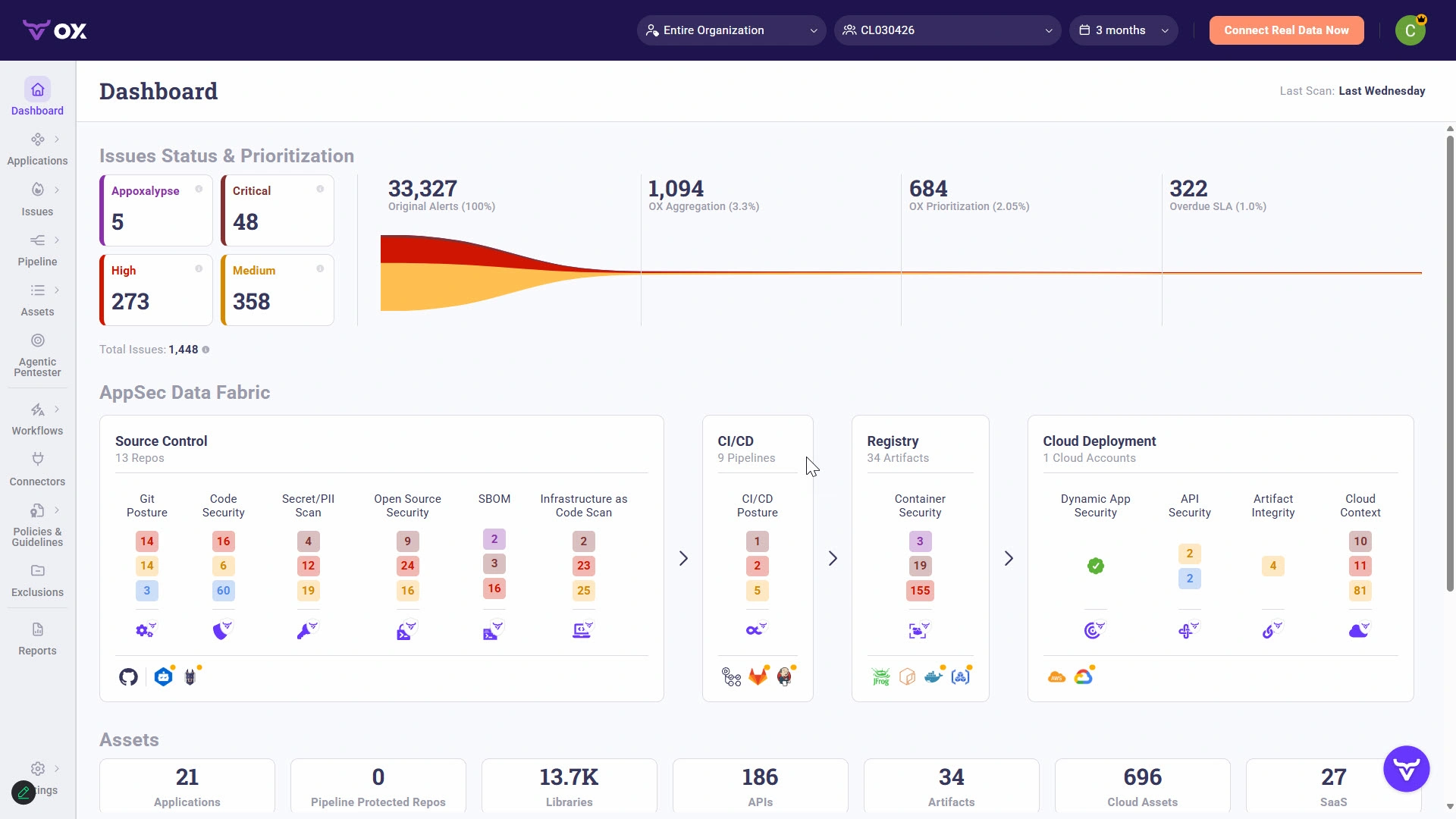
OX Security built their platform around the concept of a unified security view. The architecture connects to your development environment at multiple points. It monitors code repositories, CI/CD pipelines, container registries, and cloud deployments.
Data Collection Layer:
OX uses agents and API integrations to gather security data. The platform connects to GitHub, GitLab, Bitbucket, Jenkins, Azure DevOps, and other common tools. It also pulls findings from existing security scanners you might already use.
Native Scanning Engine:
What sets OX apart is their investment in native scanning. Rather than just aggregating third-party tool results, OX runs its own scans. This covers:
- Static code analysis (SAST)
- Software composition analysis (SCA)
- Infrastructure as Code (IaC) scanning
- Secrets detection
- CI/CD pipeline security checks
- Container image scanning
Correlation Engine:
The platform correlates findings across sources. If your SAST tool and SCA tool both flag the same issue, OX recognizes this. It creates a single finding rather than two separate alerts.
Exploitability Analysis:
This is OX Security’s core differentiator. The platform analyzes each finding to determine if it’s actually exploitable in your specific environment. A vulnerable library that’s never called in your code gets deprioritized. A SQL injection vulnerability in a public-facing endpoint gets flagged as critical.
The evidence-based scoring system looks at:
- Is the vulnerable code path reachable?
- Are there existing security controls that block exploitation?
- Is the affected component exposed to the internet?
- Does the vulnerability have a known exploit in the wild?
Apiiro Architecture
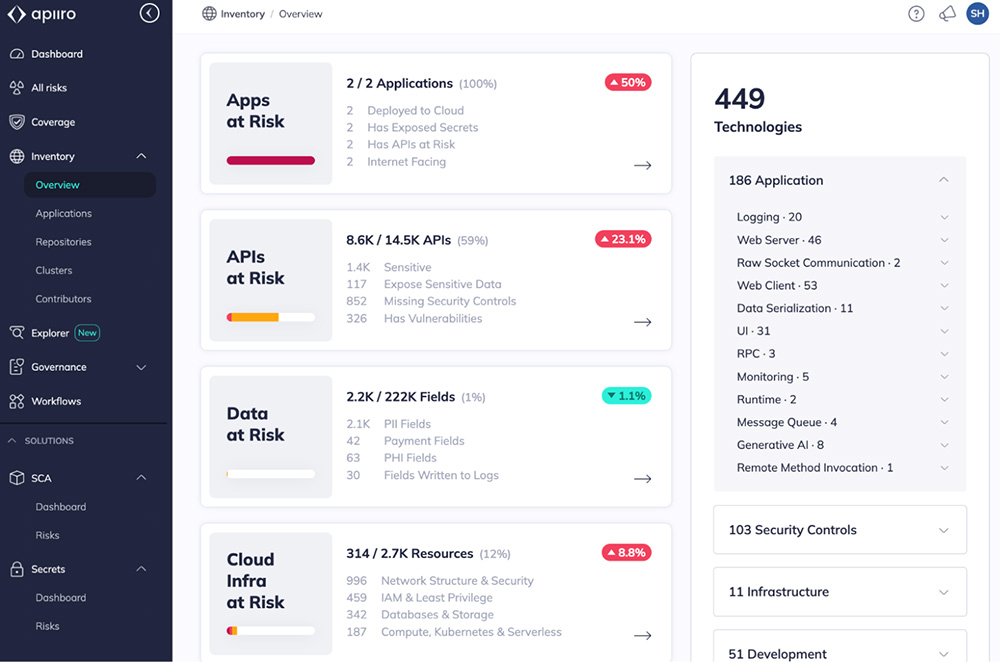
Apiiro’s architecture centers on what they call the Risk Intelligence Graph. This is a knowledge graph that maps relationships between code, developers, infrastructure, and security findings.
Code Analysis Layer:
Apiiro performs deep code analysis that goes beyond traditional SAST. Their AI models understand code semantics, not just syntax. They track data flows, identify business logic, and recognize security-relevant patterns.
Material Change Detection:
This is Apiiro’s standout feature. The platform monitors code changes and classifies them by risk impact. A change to user input handling triggers different analysis than a change to internal utility functions.
The system asks questions like:
- Does this change touch authentication or authorization code?
- Does it modify how data flows from external sources?
- Does it change security controls or configurations?
- Does it introduce new dependencies or API endpoints?
Attack Path Mapping:
Apiiro builds visual maps of how an attacker could move through your application. Starting from an entry point like a vulnerable API, the platform traces paths through your code and infrastructure to sensitive assets.
Developer Risk Profiles:
The platform tracks individual developers and their code contributions. This isn’t about blame. It helps identify where additional code review or training might help. A developer new to a codebase might need more scrutiny on their changes.
Architectural Comparison
| Component | OX Security Approach | Apiiro Approach |
|---|---|---|
| Data Model | Unified finding database | Knowledge graph (Risk Intelligence Graph) |
| Code Analysis | Native scanners plus integrations | AI-powered semantic analysis |
| Prioritization Method | Exploitability evidence | Material change context |
| Risk Visualization | Dashboard-centric | Graph-based attack paths |
| Integration Philosophy | Replace tools where possible | Augment existing tools |
Native Scanning Capabilities
OX Security’s Native Scanners
OX Security has invested heavily in building native scanning capabilities. Their philosophy is that teams shouldn’t need separate tools for each security concern. One platform should handle it all.
SAST (Static Application Security Testing):
OX provides built-in static analysis for common programming languages. The scanner looks for security issues like SQL injection, cross-site scripting, insecure deserialization, and authentication flaws. Coverage includes Java, JavaScript, TypeScript, Python, Go, C#, and Ruby.
The SAST engine runs automatically on code commits. Developers see results directly in pull requests. This shifts security left without requiring developers to switch contexts.
SCA (Software Composition Analysis):
Open-source dependencies create major risk. OX scans package manifests like package.json, pom.xml, requirements.txt, and go.mod. The scanner identifies known vulnerabilities in dependencies and transitive dependencies.
The tool goes beyond just flagging CVEs. It checks if the vulnerable code path is actually used in your application. A vulnerability in a function you never call gets lower priority.
Secrets Detection:
API keys, passwords, and tokens accidentally committed to code cause breaches. OX scans repositories for secrets using pattern matching and entropy analysis. It catches common patterns like AWS keys, database passwords, and OAuth tokens.
The scanner also monitors CI/CD configurations where secrets often leak. Environment variables and build scripts get scrutinized.
IaC Scanning:
Infrastructure as Code files define cloud resources. Misconfigurations here lead to exposed databases, overly permissive access, and compliance violations. OX scans Terraform, CloudFormation, Kubernetes manifests, and Helm charts.
Container Security:
Docker images often contain vulnerable base images or packages. OX scans container images for known vulnerabilities and configuration issues. It checks registries and running containers.
CI/CD Pipeline Security:
Build pipelines themselves can be attack vectors. OX analyzes GitHub Actions workflows, Jenkins pipelines, and Azure DevOps configurations. It flags risky patterns like untrusted inputs, missing approvals, and excessive permissions.
Apiiro’s AI SAST and Scanning
Apiiro takes a different approach. Rather than trying to replace all scanning tools, they focus on adding intelligence to the scanning process. Their AI SAST is a standout capability.
AI-Powered Static Analysis:
Apiiro’s SAST uses machine learning models trained on millions of code samples. The AI understands code patterns at a semantic level. It recognizes what code is trying to do, not just what syntax it uses.
This leads to fewer false positives. Traditional SAST tools often flag code patterns that look risky but aren’t actually exploitable. Apiiro’s AI better understands context.
Code Change Analysis:
Every code change gets analyzed for security impact. The platform classifies changes into categories:
- Material changes: Modifications that affect security-relevant logic
- Structural changes: Refactoring that doesn’t change behavior
- Cosmetic changes: Comments, formatting, and documentation
Security teams can focus review efforts on material changes. A pull request with only cosmetic changes might not need security review.
Third-Party Scanner Integration:
Apiiro integrates with existing security tools rather than replacing them entirely. If you’ve invested in Snyk for SCA or Checkmarx for SAST, Apiiro pulls those results into its platform. It adds context and correlation but doesn’t require you to abandon existing tools.
Runtime Context:
Apiiro connects code findings to runtime environments. A vulnerability in code that runs in a sandboxed environment gets different treatment than one exposed to the internet. This code-to-cloud mapping adds critical prioritization context.
Scanning Comparison Table
| Scanning Type | OX Security | Apiiro |
|---|---|---|
| SAST | Native scanner, multi-language support | AI-powered semantic analysis |
| SCA | Native scanner with reachability analysis | Integrations plus context layer |
| Secrets | Native detection in code and CI/CD | Integration-based |
| IaC | Native Terraform, CloudFormation, K8s | Integration-based with context |
| Container | Native image scanning | Integration-based |
| CI/CD | Native pipeline security checks | Pipeline risk analysis |
| Philosophy | All-in-one native scanning | AI-enhanced analysis with integrations |
Risk Prioritization and Vulnerability Management
How OX Security Prioritizes Risk
OX Security’s prioritization approach centers on exploitability. The platform doesn’t just tell you a vulnerability exists. It tells you if that vulnerability can actually be exploited in your specific environment.
Evidence-Based Scoring:
Every finding gets analyzed for real-world exploitability. OX collects evidence that supports or contradicts the severity of a finding. This evidence includes:
- Reachability: Can an attacker reach the vulnerable code path?
- Exposure: Is the component internet-facing or internal-only?
- Existing controls: Do firewalls, WAFs, or other controls block the attack?
- Exploit availability: Are there known exploits being used in the wild?
- Data sensitivity: What data could be compromised if exploited?
The result is a prioritized list where truly dangerous vulnerabilities bubble to the top. Teams stop chasing theoretical risks and focus on real threats.
Example Scenario:
Imagine your SCA tool finds a critical CVE in a logging library. Traditional tools would flag this as urgent. OX Security analyzes further and discovers:
- The vulnerable function in the library is never called by your code
- The library runs in an internal service with no internet exposure
- There’s no known exploit for this CVE
OX would deprioritize this finding. Your team focuses on issues that actually matter.
Automated Triage:
OX automatically closes or deprioritizes findings that meet certain criteria. Duplicates get merged. Non-reachable vulnerabilities get flagged but not escalated. This automation reduces the manual effort security teams spend triaging alerts.
How Apiiro Prioritizes Risk
Apiiro’s approach focuses on understanding the full context of code and how it connects to business risk. Their Risk Intelligence Graph powers a different kind of prioritization.
Material Change Detection:
Apiiro tracks code changes and classifies them by security relevance. When a developer modifies authentication logic, that change gets flagged for extra scrutiny. A change to CSS styling doesn’t trigger the same response.
This allows security teams to focus review efforts where they matter most. Not every pull request needs deep security review. Material changes do.
Attack Path Analysis:
Apiiro maps how vulnerabilities connect to create attack paths. A single vulnerability might seem low-risk in isolation. But if it sits along a path to sensitive data, its priority increases.
The platform visualizes these paths. Security teams can see how an attacker might chain vulnerabilities to reach a target. This helps prioritize vulnerabilities that enable larger attacks.
Business Context:
Apiiro factors in business criticality. A vulnerability in your payment processing code matters more than one in an internal tool. The platform lets you tag applications and components with business context that affects prioritization.
Developer Risk Context:
Changes from developers new to a codebase or working outside their usual domain get additional scrutiny. This isn’t about distrust. It’s about recognizing that unfamiliar code areas carry higher risk of mistakes.
Prioritization Comparison
| Factor | OX Security | Apiiro |
|---|---|---|
| Primary Method | Exploitability evidence | Contextual risk mapping |
| Reachability Analysis | Yes, native capability | Yes, via code analysis |
| Attack Path Mapping | Basic support | Advanced visualization |
| Business Context | Application tagging | Deep business risk integration |
| Change-Based Priority | Some support | Core feature (material changes) |
| Automation Level | High auto-triage | High with AI assistance |
Software Supply Chain Security
OX Security’s Supply Chain Approach
Software supply chain security was OX Security’s original focus. The platform provides deep visibility into how code moves from development to production. Every step in that journey can introduce risk.
CI/CD Pipeline Visibility:
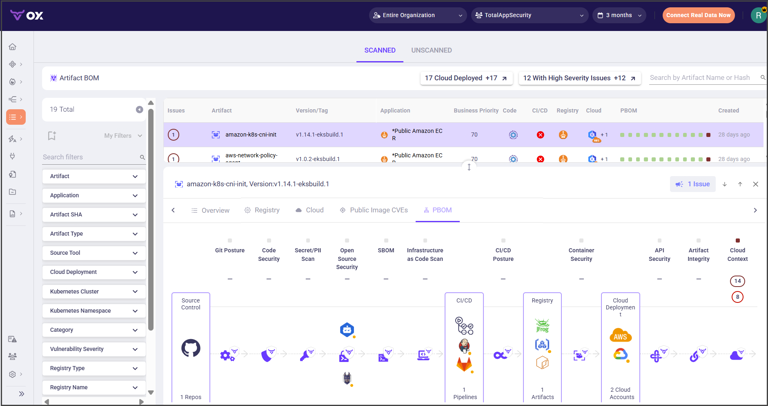
OX maps your entire CI/CD infrastructure. It identifies every build step, every dependency, every configuration. The platform shows how code flows from commit to deployment.
This visibility reveals hidden risks. A build script that downloads code from an external source creates supply chain risk. An automated deployment without approval gates creates risk. OX surfaces these issues.
Dependency Chain Analysis:
Modern applications depend on hundreds of open-source packages. Each package has its own dependencies. OX traces these chains completely. A vulnerability six levels deep in your dependency tree still gets flagged.
The platform also tracks dependency provenance. Where does each package come from? Is it from official registries or potentially compromised sources? Has the package maintainer changed recently?
Build Integrity:
OX monitors build processes for tampering indicators. The platform can detect if build artifacts don’t match expected hashes. It identifies builds that deviate from approved patterns.
Secrets in Pipelines:
CI/CD pipelines often handle sensitive credentials. OX scans pipeline configurations for exposed secrets. It monitors for credentials logged in build outputs or passed insecurely between stages.
SBOM Generation:
Software Bill of Materials (SBOM) documents list all components in your software. OX generates SBOMs automatically. These documents support compliance requirements and incident response by documenting exactly what’s in each release.
Apiiro’s Supply Chain Approach
Apiiro addresses supply chain security through their code-to-cloud context model. They focus on understanding how supply chain risks connect to actual exploitation scenarios.
Code Origin Tracking:
Apiiro tracks where code comes from and how it changes. The platform identifies when code patterns match known vulnerable code or potentially malicious patterns. It flags unusual code additions that don’t match typical development patterns.
Third-Party Risk Context:
When Apiiro identifies a vulnerable dependency, it doesn’t stop at flagging the CVE. The platform analyzes how that dependency is used. What functions does your code call? What data passes through the vulnerable component?
This context helps teams understand actual impact. A vulnerable library used only for logging has different risk than one processing user credentials.
Change Impact Analysis:
Apiiro’s material change detection applies to supply chain components too. When a dependency updates, the platform analyzes what changed. Security-relevant changes in dependencies get flagged for review.
Risk Intelligence Integration:
Apiiro’s Risk Intelligence Graph includes supply chain relationships. The graph shows how vulnerabilities in dependencies connect to attack paths in your application. This unified view helps prioritize supply chain risks alongside code vulnerabilities.
Supply Chain Security Comparison
| Capability | OX Security | Apiiro |
|---|---|---|
| CI/CD Visibility | Deep pipeline mapping | Pipeline risk analysis |
| Dependency Analysis | Full chain with reachability | Contextual usage analysis |
| Build Security | Integrity monitoring | Change tracking |
| SBOM Support | Native generation | Integration-based |
| Secrets Detection | Native scanning | Integration-based |
| Overall Focus | Complete pipeline security | Risk context for supply chain |
Developer Experience and Workflow Integration
OX Security Developer Tools
For security to work, developers need to adopt it. OX Security has invested in making security findings actionable for developers without requiring them to change how they work.
Pull Request Integration:
OX comments directly on pull requests with security findings. Developers see issues in the context of their code changes. They don’t need to switch to a separate security tool to understand what needs fixing.
The integration is smart about what it shows. Low-priority findings don’t clutter the PR. Critical issues get prominent placement with clear remediation guidance.
IDE Extensions:
OX offers IDE plugins that surface security issues while developers write code. Real-time feedback catches problems before code even reaches the repository. This is the ultimate “shift left” experience.
Remediation Guidance:
Findings come with actionable fix recommendations. OX doesn’t just say “SQL injection vulnerability.” It shows the specific code pattern and suggests how to fix it. For dependency vulnerabilities, it recommends specific version upgrades.
Ticket Integration:
OX integrates with Jira, Azure DevOps, and other issue trackers. Security findings can automatically create tickets assigned to the right developers. This fits into existing workflows rather than requiring new processes.
Developer Dashboard:
Developers get their own view of security status. They see issues in code they own, progress on fixes, and how their applications compare to others. This visibility helps developers take ownership of security.
Apiiro Developer Tools
Apiiro focuses on making security contextual for developers. Their tools help developers understand why something matters, not just what the problem is.
Pull Request Analysis:
Apiiro’s pull request integration focuses on material changes. When a PR touches security-relevant code, developers get detailed analysis. The platform explains what makes the change risky and what to watch for.
This targeted approach means developers aren’t overwhelmed with feedback. Only relevant changes get security commentary.
Code Context Visualization:
Apiiro shows developers how their code connects to the broader application. A developer fixing a vulnerability can see how that code path connects to user inputs and sensitive data. This context helps them understand the full impact of their changes.
Risk Explanations:
Rather than just flagging issues, Apiiro explains the risk in business terms. A finding might explain that “this authentication change could allow unauthorized access to customer payment data.” This helps developers understand priority.
Review Workflow Integration:
Apiiro can flag PRs that need security review based on material changes. The platform integrates with code review tools to add security reviewers automatically when needed. This adds security oversight without creating bottlenecks on every PR.
Learning Resources:
Apiiro provides educational content linked to specific findings. Developers can learn about vulnerability types and secure coding practices while fixing issues. This builds security knowledge over time.
Developer Experience Comparison
| Feature | OX Security | Apiiro |
|---|---|---|
| PR Comments | Findings with fix guidance | Material change analysis |
| IDE Support | Plugins available | Limited |
| Fix Recommendations | Specific code suggestions | Contextual guidance |
| Issue Tracking | Jira, Azure DevOps, others | Jira, Azure DevOps, others |
| Developer Dashboard | Yes | Yes |
| Security Training | Basic guidance | Integrated learning |
Integration Ecosystem and Tool Compatibility
OX Security Integrations
OX Security’s integration strategy reflects their all-in-one philosophy. The platform integrates with development tools while also providing native capabilities that can replace specialized security tools.
Source Code Management:
- GitHub (Cloud and Enterprise)
- GitLab (Cloud and Self-Managed)
- Bitbucket (Cloud and Server)
- Azure Repos
CI/CD Platforms:
- GitHub Actions
- GitLab CI
- Jenkins
- Azure Pipelines
- CircleCI
- Bamboo
Cloud Providers:
- AWS
- Azure
- Google Cloud Platform
Container and Kubernetes:
- Docker
- Kubernetes
- Amazon ECR
- Azure Container Registry
- Google Container Registry
Security Tool Aggregation:
OX can ingest findings from existing security tools:
- Snyk
- Checkmarx
- Veracode
- SonarQube
- Fortify
- WhiteSource (Mend)
This means teams can start using OX without abandoning existing tools. Over time, they might replace some tools with OX native capabilities.
Apiiro Integrations
Apiiro’s integration approach emphasizes augmentation. The platform works alongside existing security tools, adding context and correlation rather than replacement.
Source Code Management:
- GitHub (Cloud and Enterprise)
- GitLab (Cloud and Self-Managed)
- Bitbucket (Cloud and Server)
- Azure Repos
CI/CD Platforms:
- GitHub Actions
- GitLab CI
- Jenkins
- Azure Pipelines
- CircleCI
Cloud and Runtime:
- AWS
- Azure
- Google Cloud Platform
- Kubernetes environments
Security Tool Integration:
Apiiro integrates deeply with security scanners:
- Snyk
- Checkmarx
- Veracode
- SonarQube
- Fortify
- Semgrep
- WhiteSource (Mend)
- Various DAST tools
The integration goes beyond just importing findings. Apiiro correlates results from multiple tools, adds context from code analysis, and creates unified attack path views.
Integration Philosophy Comparison
| Integration Type | OX Security | Apiiro |
|---|---|---|
| SCM Coverage | All major platforms | All major platforms |
| CI/CD Coverage | Extensive | Extensive |
| Cloud Coverage | AWS, Azure, GCP | AWS, Azure, GCP |
| Security Tool Import | Yes, with native alternatives | Yes, as primary strategy |
| Integration Depth | Replace or augment | Augment and correlate |
| API Access | Full API available | Full API available |
Reporting, Compliance, and Governance
OX Security Reporting Capabilities
Enterprise security programs need strong reporting. OX Security provides dashboards and reports that satisfy both technical teams and executive stakeholders.
Executive Dashboards:
High-level views show overall security posture. Metrics include vulnerability trends, mean time to remediate, risk scores by application, and compliance status. These dashboards work for CISOs and board presentations.
Technical Reports:
Detailed technical reports support security engineers and developers. These include finding details, affected code paths, remediation steps, and historical trends. Export options include PDF, CSV, and JSON formats.
Compliance Mapping:
OX maps security findings to compliance frameworks:
- SOC 2
- ISO 27001
- HIPAA
- PCI DSS
- NIST
- FedRAMP
Reports show compliance status against framework requirements. Gaps are clearly identified with remediation priorities.
SBOM Reports:
Software Bill of Materials reports document all components in your applications. These reports support customer requirements and regulatory compliance. OX generates SBOMs in standard formats like SPDX and CycloneDX.
Trend Analysis:
Historical data shows how security posture changes over time. You can track improvement (or regression) across teams, applications, or vulnerability types. This data supports security program justification.
Apiiro Reporting Capabilities
Apiiro’s reporting emphasizes risk context and business impact. Their reports help stakeholders understand not just what vulnerabilities exist, but what they mean for the business.
Risk Dashboards:
Apiiro’s dashboards focus on risk rather than raw vulnerability counts. A dashboard might show applications ranked by actual business risk rather than number of findings. This helps executives focus on what matters.
Attack Path Reports:
Visual reports show attack paths through your application landscape. Stakeholders can see how vulnerabilities chain together to create real threats. This is powerful for communicating risk to non-technical audiences.
Developer Metrics:
Reports track security metrics at the team and developer level. This includes code change risk, fix rates, and security training progress. These metrics support security culture programs.
Compliance Support:
Apiiro maps to common compliance frameworks:
- SOC 2
- ISO 27001
- HIPAA
- PCI DSS
- NIST frameworks
The platform can generate evidence for audits and track control implementation across applications.
Custom Reporting:
Apiiro provides tools to build custom reports and dashboards. Organizations with specific reporting requirements can create views that match their needs.
Reporting Comparison
| Reporting Feature | OX Security | Apiiro |
|---|---|---|
| Executive Dashboards | Yes, posture-focused | Yes, risk-focused |
| Technical Detail | Comprehensive | Comprehensive |
| Compliance Mapping | Major frameworks | Major frameworks |
| SBOM Generation | Native, SPDX/CycloneDX | Available |
| Attack Path Visualization | Basic | Advanced |
| Custom Reports | Available | Flexible builder |
Pricing Models and Total Cost of Ownership
Understanding ASPM Pricing
ASPM platforms typically price based on factors like number of applications, developers, or code repositories. Both OX Security and Apiiro use custom pricing that requires talking to sales. Neither publishes specific pricing on their websites.
This is common in enterprise security software. Pricing varies based on deployment size, features needed, and contract length. Getting accurate quotes requires going through sales processes.
OX Security Pricing Considerations
Pricing Model:
OX Security’s pricing reportedly considers factors like:
- Number of applications monitored
- Number of developers or contributors
- Feature tiers selected
- Support level requirements
Total Cost Factors:
OX’s native scanning capabilities affect total cost of ownership. If you can replace separate SAST, SCA, and secrets detection tools with OX, you save on those licenses. This consolidation value can offset higher ASPM costs.
However, you might need to maintain some specialized tools for specific use cases. OX’s native scanners are “good enough” for many scenarios but may not match specialized tools for edge cases.
Hidden Costs to Consider:
- Integration effort for complex environments
- Training time for security teams
- Developer time adapting to new workflows
- Potential overlap with existing tools during transition
Apiiro Pricing Considerations
Pricing Model:
Apiiro’s pricing reportedly considers:
- Number of repositories
- Number of developers
- Feature tiers
- Contract terms
Total Cost Factors:
Apiiro integrates with existing tools rather than replacing them. This means you’ll likely maintain your current security tool licenses. Apiiro adds value through correlation and context, but it’s an additional layer rather than a replacement.
For teams with significant existing tool investments, this integration approach makes sense. You don’t lose the specialized capabilities of dedicated tools.
Hidden Costs to Consider:
- Maintaining multiple tool licenses
- Integration maintenance as tools update
- Training on both Apiiro and underlying tools
- Potential data synchronization overhead
Cost Comparison Framework
| Cost Factor | OX Security Impact | Apiiro Impact |
|---|---|---|
| Platform License | Enterprise pricing | Enterprise pricing |
| Tool Consolidation | High potential savings | Limited, keep existing tools |
| Integration Effort | Moderate | Moderate to High |
| Ongoing Maintenance | Lower (fewer tools) | Higher (multiple tools) |
| Training Needs | One platform focus | Multiple tool knowledge |
Use Cases and Ideal Customer Profiles
When to Choose OX Security
OX Security fits certain organizational profiles and use cases particularly well. Consider OX if your situation matches these patterns.
Tool Consolidation Priority:
If you’re tired of managing multiple security tools, OX offers a path to consolidation. The native scanning capabilities can replace separate SAST, SCA, secrets detection, and IaC scanning tools. This simplifies vendor management and reduces integration complexity.
Supply Chain Focus:
Organizations with strong supply chain security requirements benefit from OX’s deep CI/CD visibility. If you’ve experienced or worry about supply chain attacks, OX provides the monitoring and controls you need.
Alert Fatigue:
Teams drowning in security alerts appreciate OX’s exploitability-based prioritization. If your developers ignore security findings because there are too many, OX can cut the noise dramatically by focusing on genuinely exploitable issues.
Growing AppSec Programs:
A Reddit user noted that OX “does more native scanning and is good enough” for growing AppSec programs. If you’re building a security program from scratch, OX provides a comprehensive starting point without requiring multiple tool purchases.
DevSecOps Integration:
Teams committed to DevSecOps benefit from OX’s developer-focused tools. PR comments, IDE extensions, and automated ticket creation help integrate security into development workflows.
When to Choose Apiiro
Apiiro fits different organizational needs. Consider Apiiro if your situation matches these patterns.
Existing Tool Investment:
If you’ve invested heavily in security tools you want to keep, Apiiro adds value without replacement. Organizations with mature security tool stacks benefit from Apiiro’s correlation and context capabilities.
Context and Risk Understanding:
Teams that need to understand not just what vulnerabilities exist, but how they connect to business risk, benefit from Apiiro’s approach. The material change detection and attack path mapping provide deep context.
Large Enterprise Complexity:
Organizations with complex, diverse development environments benefit from Apiiro’s flexible approach. If you have teams using different languages, frameworks, and tools, Apiiro’s integration model accommodates variety.
Change-Based Security:
If you want to focus security effort on code changes rather than bulk scanning, Apiiro’s material change detection is unique. This approach targets security review where risk actually changes.
Attack Path Visibility:
Security teams that need to communicate risk to stakeholders in business terms benefit from Apiiro’s visualization. The attack path diagrams make abstract risks concrete and understandable.
Comparison by Organization Type
| Organization Type | OX Security Fit | Apiiro Fit |
|---|---|---|
| Startup building AppSec | Strong | Moderate |
| Mid-size with some tools | Strong | Strong |
| Enterprise with mature stack | Moderate | Strong |
| Regulated industry | Strong | Strong |
| Supply chain focused | Very Strong | Strong |
| Risk communication priority | Moderate | Very Strong |
Strengths and Weaknesses Summary
OX Security Strengths
- Native scanning capabilities: Comprehensive built-in scanners reduce tool sprawl
- Exploitability focus: Evidence-based scoring cuts noise dramatically
- Supply chain depth: Strong CI/CD security and pipeline visibility
- Developer integration: PR comments, IDE support, ticket automation
- SBOM generation: Native support for compliance requirements
- Unified platform: Single view across code, pipelines, and cloud
OX Security Weaknesses
- Native scanner limits: May not match specialized tools for all use cases
- Attack path visualization: Less advanced than Apiiro’s offerings
- Context depth: Material change detection not as developed
- Replacement pressure: Value proposition assumes replacing other tools
Apiiro Strengths
- Material change detection: Unique capability for change-based security
- AI-powered analysis: Deep semantic code understanding
- Attack path mapping: Advanced visualization of connected risks
- Tool augmentation: Works with existing security investments
- Business context: Strong risk communication capabilities
- Code-to-cloud mapping: Connects code findings to runtime context
Apiiro Weaknesses
- Integration dependency: Relies on other tools for some scanning
- Complexity: More moving parts to manage and maintain
- Native scanning limits: Less comprehensive than OX’s built-in options
- Cost layering: Adds to existing tool costs rather than replacing
Making Your Decision: OX Security vs Apiiro
Key Questions to Ask
Before choosing between OX Security and Apiiro, ask yourself these questions:
1. What’s your current tool situation?
If you have many security tools you want to keep, Apiiro fits better. If you want to consolidate or start fresh, OX makes more sense.
2. What’s your biggest pain point?
Too many alerts? OX’s exploitability focus helps. Need better risk context? Apiiro’s material changes and attack paths deliver.
3. How mature is your AppSec program?
Building from scratch? OX provides a complete foundation. Mature program needing better correlation? Apiiro adds a valuable layer.
4. What’s your supply chain concern level?
High supply chain risk? OX’s deep pipeline security is a strength. General application security? Both platforms cover basics.
5. How do you want to work with developers?
Both platforms offer developer tools. OX focuses on actionable findings. Apiiro focuses on contextual understanding.
Decision Matrix
| If You Need… | Choose | Why |
|---|---|---|
| Tool consolidation | OX Security | Native scanners can replace multiple tools |
| Deep risk context | Apiiro | Material changes and attack paths excel |
| Supply chain security | OX Security | Original focus area with deep capabilities |
| Exploit existing tools | Apiiro | Designed to augment, not replace |
| Alert reduction | OX Security | Exploitability scoring cuts noise |
| Risk visualization | Apiiro | Advanced attack path mapping |
| Starting fresh | OX Security | Complete platform for new programs |
| Enhancing mature program | Apiiro | Adds context to existing capabilities |
Hybrid Approaches
Some organizations evaluate both platforms. Each has different strengths. In some cases, using both isn’t crazy. OX handles supply chain and native scanning. Apiiro adds context and attack path analysis.
However, this approach increases cost and complexity. Most organizations should choose one platform as their primary ASPM solution. The right choice depends on your specific needs and priorities.
Trial and Evaluation Tips
Both vendors offer proofs of concept. When evaluating, consider these tips:
- Use real data: Test with your actual repositories, not sample projects
- Measure noise reduction: How many findings does each platform deprioritize?
- Test developer workflow: Have developers actually use the PR integration
- Check integration depth: Ensure your tools connect properly
- Evaluate support: How responsive is each vendor during trial?
- Calculate total cost: Include tool replacement or maintenance in ROI
Conclusion
Both OX Security and Apiiro are strong ASPM platforms for 2026. OX Security excels at tool consolidation, exploitability-based prioritization, and supply chain security. It’s ideal for teams wanting a unified platform with native scanning capabilities.
Apiiro shines in risk context, material change detection, and attack path visualization. It works best for organizations with existing security tools who need better correlation and business-focused risk communication.
Your choice depends on your current tools, biggest pain points, and security program maturity. Both platforms can dramatically improve how you manage application security. The right fit is the one that matches your specific situation.
FAQs About OX Security vs Apiiro Comparison
| What is the main difference between OX Security and Apiiro? |
| OX Security focuses on exploitability-first prioritization with extensive native scanning capabilities. It aims to replace multiple security tools with one unified platform. Apiiro focuses on code-to-cloud context and material change detection. It typically augments existing security tools rather than replacing them. OX is better for tool consolidation, while Apiiro excels at risk context and attack path visualization. |
| Which platform is better for supply chain security? |
| OX Security has the edge in supply chain security. This was their original focus area. OX provides deep CI/CD pipeline visibility, build integrity monitoring, dependency chain analysis, and native secrets detection across build processes. Apiiro covers supply chain basics but doesn’t match OX’s depth in this specific area. |
| Can OX Security or Apiiro replace my existing security tools? |
| OX Security’s native scanners can potentially replace separate SAST, SCA, secrets detection, and IaC scanning tools. The scanners are described as “good enough” for most use cases. Apiiro takes a different approach and works alongside existing tools rather than replacing them. If tool consolidation is a priority, OX is the better choice. |
| What is Apiiro’s material change detection feature? |
| Material change detection is Apiiro’s unique capability that analyzes code changes for security impact. The system classifies changes as material (affecting security logic), structural (refactoring), or cosmetic (formatting). Security teams can focus review on material changes rather than treating all code changes equally. This reduces review burden while maintaining security coverage. |
| How do OX Security and Apiiro handle alert prioritization? |
| OX Security uses evidence-based exploitability scoring. It analyzes whether vulnerabilities are actually exploitable in your specific environment by checking reachability, exposure, and existing controls. Apiiro uses contextual risk mapping with material change detection and attack path analysis. Both approaches reduce alert noise, but through different methods. |
| Which platform has better developer experience? |
| Both platforms offer strong developer tools including PR integration and ticket automation. OX Security provides IDE extensions and focuses on actionable fix recommendations. Apiiro emphasizes contextual understanding and risk explanations. The “better” choice depends on whether your developers prefer specific fix guidance (OX) or understanding risk context (Apiiro). |
| What types of organizations should choose OX Security? |
| OX Security fits organizations that want to consolidate security tools, have strong supply chain security concerns, suffer from alert fatigue, are building AppSec programs from scratch, or want a unified code-to-cloud platform. It’s particularly strong for teams prioritizing exploitability-based prioritization and CI/CD pipeline security. |
| What types of organizations should choose Apiiro? |
| Apiiro fits organizations with significant existing security tool investments, complex and diverse development environments, needs for deep risk context and business communication, focus on change-based security review, or requirements for advanced attack path visualization. It’s particularly strong for mature security programs needing better correlation. |
| How do pricing models compare between OX Security and Apiiro? |
| Both platforms use enterprise pricing that requires contacting sales. Key cost considerations differ: OX Security can reduce total cost through tool consolidation, while Apiiro adds a layer on top of existing tool costs. Organizations should calculate total cost of ownership including tool replacement, integration effort, and ongoing maintenance. |
| Can I use both OX Security and Apiiro together? |
| Technically yes, but most organizations choose one as their primary ASPM platform. Using both increases cost and complexity. However, some organizations use OX for supply chain security and native scanning while adding Apiiro for risk context and attack path analysis. This approach is uncommon but possible for organizations with specific requirements. |

 Stack Insight is intended to support informed decision-making by providing independent information about business software and services. Some product details, including pricing, features, and promotional offers, may be supplied by vendors or partners and can change without notice.